

The DOI matches its Crossref record; 230 of the 231 references it cites were found in a registry or an index.
Machine Learning and Integrative Analysis of Biomedical Big Data
Open accessAbstract
Recent developments in high-throughput technologies have accelerated the accumulation of massive amounts of omics data from multiple sources: genome, epigenome, transcriptome, proteome, metabolome, etc. Traditionally, data from each source (e.g., genome) is analyzed in isolation using statistical and machine learning (ML) methods. Integrative analysis of multi-omics and clinical data is key to new biomedical discoveries and advancements in precision medicine. However, data integration poses new computational challenges as well as exacerbates the ones associated with single-omics studies. Specialized computational approaches are required to effectively and efficiently perform integrative analysis of biomedical data acquired from diverse modalities. In this review, we discuss state-of-the-art ML-based approaches for tackling five specific computational challenges associated with integrative analysis: curse of dimensionality, data heterogeneity, missing data, class imbalance and scalability issues.
Overview
The claims and statistics of this paper haven’t been checked yet.
Run the check — free, no account needed. It reads the open-access text and checks the sources it cites.
Integrity signals
Registry
Cites
Statistics
Figures
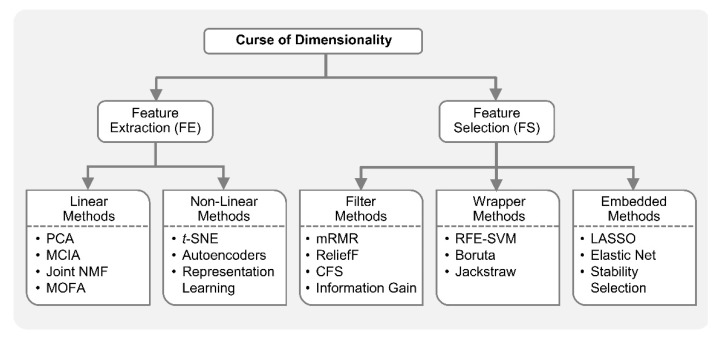
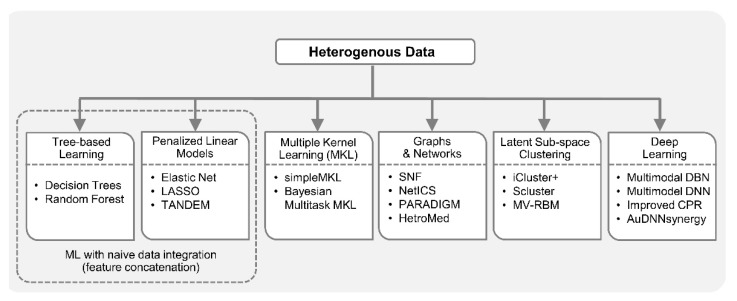
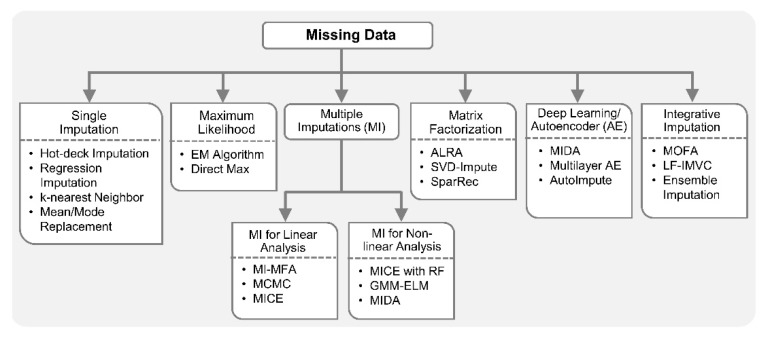
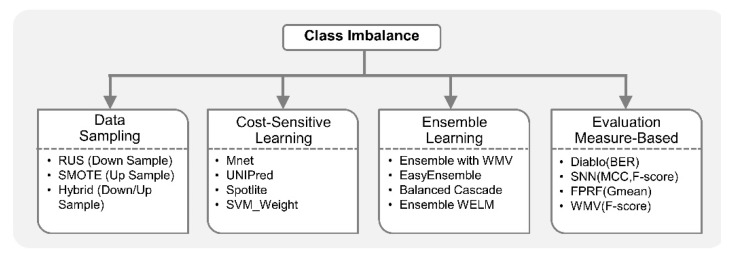
Verification
Claims the paper makes
The claims and statistics of this paper haven’t been checked yet.
Run the check — free, no account needed. It reads the open-access text and checks the sources it cites.
Claims other papers make about this one
Each is checked against this paper’s own text: does it say what the citing paper says it does?
In the citing paper
“Machine learning (ML) and artificial intelligence (AI) have shown promise in overcoming some of these hindrances (e.g., Mirza et al., 2019; Zhu, 2020) and have gained popularity in recent years.”
From Missing data in multi-omics integration: Recent advances through artificial intelligence (2023) · cites this paper as Mirza et al., 2019
Self-check
Percentages, sums and reported differences re-computed from the paper’s own numbers.
The self-check needs the paper’s full text.
Citations
Cites
1 retracted
Rouillard, A. D., Wang, Z., & Ma’ayan, A. (2015) · Computational Biology and Chemistry · doi:10.1016/j.compbiolchem.2015.06.003 · Cited by 3
RetractedLeCun, Y., Bengio, Y., & Hinton, G. (2015) · Nature · doi:10.1038/nature14539 · Cited by 84,126
Cortes, C., & Vapnik, V. (1995) · Machine Learning · doi:10.1007/bf00994018 · Cited by 59,421
(2008) · Journal of Machine Learning Research · Cited by 33,051
SMOTE synthetic minority over-sampling technique
Chawla, N. V., Bowyer, K. W., Hall, L. O., & Kegelmeyer, W. P. (2002) · Journal of Artificial Intelligence Research · doi:10.1613/jair.953 · Cited by 32,865
Learning representations by back-propagating errors
Rumelhart, D. E., Hinton, G. E., & Williams, R. J. (1986) · Nature · doi:10.1038/323533a0 · Cited by 31,892
WGCNA: an R package for weighted correlation network analysis
Langfelder, P., & Horvath, S. (2008) · BMC Bioinformatics · doi:10.1186/1471-2105-9-559 · Cited by 27,252
The Elements of Statistical Learning
Hastie, T., Friedman, J., & Tibshirani, R. (2001) · Springer Series in Statistics · doi:10.1007/978-0-387-21606-5 · Cited by 24,162
Regularization and Variable Selection Via the Elastic Net
Zou, H., & Hastie, T. (2005) · Journal of the Royal Statistical Society Series B: Statistical Methodology · doi:10.1111/j.1467-9868.2005.00503.x · Cited by 20,957
Reducing the dimensionality of data with neural networks
Hinton, G. E., & Salakhutdinov, R. R. (2006) · Science · doi:10.1126/science.1127647 · Cited by 20,928
Research works printed but not linked: 9
- Narvaez-Bandera, I., and Sanchez, F. (2017). Integration of Multi Omics Data for Breast Cancer Subtype Classification. IIE Annual Conference Proceedings, Institute of Industrial and Systems Engineers (IISE).
- Rakotomamonjy, 2008, SimpleMKL, J. Mach. Learn. Res., 9, 2491
- Koller, D., and Friedman, N. (2009). Probabilistic Graphical Models: Principles and Techniques, MIT Press.
- Tsuyuzaki, K., and Nikaido, I. (arXiv, 2017). Biological Systems as Heterogeneous Information Networks: A Mini-review and Perspectives, arXiv.
- Rubin, D.B. (2004). Multiple Imputation for Nonresponse in Surveys, John Wiley & Sons.
- Singh, A., Gautier, B., Shannon, C.P., Rohart, F., Vacher, M., Tebutt, S.J., and Le Cao, K.-A. (2018). DIABLO: From multi-omics assays to biomarker discovery, an integrative approach. bioRxiv.
- Song, Y., Westerhuis, J.A., Aben, N., Wessels, L.F., Groenen, P.J., and Smilde, A.K. (arXiv, 2018). Generalized Simultaneous Component Analysis of Binary and Quantitative data, arXiv.
- Jaeger, 2003, Adaptive nonlinear system identification with echo state networks, Proceedings of the Advances in Neural Information Processing Systems, Volume 15, 593
- Hoi, S.C., Sahoo, D., Lu, J., and Zhao, P. (arXiv, 2018). Online Learning: A Comprehensive Survey, arXiv.
Cited by
Sorted by citations
Using machine learning approaches for multi-omics data analysis: A review
Reel, P. S., Reel, S., Pearson, E., Trucco, E., & Jefferson, E. (2021) · Biotechnology Advances · doi:10.1016/j.biotechadv.2021.107739 · Cited by 903
Loh, H. W., Ooi, C. P., Seoni, S., Barua, P. D., Molinari, F., & Acharya, U. R. (2022) · Computer Methods and Programs in Biomedicine · doi:10.1016/j.cmpb.2022.107161 · Cited by 734
Integration strategies of multi-omics data for machine learning analysis
Picard, M., Scott-Boyer, M.-P., Bodein, A., Périn, O., & Droit, A. (2021) · Computational and Structural Biotechnology Journal · doi:10.1016/j.csbj.2021.06.030 · Cited by 696
Artificial intelligence-based multi-omics analysis fuels cancer precision medicine
He, X., Liu, X., Zuo, F., Shi, H., & Jing, J. (2022) · Seminars in Cancer Biology · doi:10.1016/j.semcancer.2022.12.009 · Cited by 494
Big data and artificial intelligence modeling for drug discovery
Zhu, H. (2020) · Annual Review of Pharmacology and Toxicology · doi:10.1146/annurev-pharmtox-010919-023324 · Cited by 455
Metadata
- Authors
- Mirza, B., Wang, W., Wang, J., Choi, H., Chung, N. C., & Ping, P.
- Affiliations
- University of California, Los Angeles (US)
- Corresponding author
- Mirza, Bilal
- Ping, Peipei
- Venue
- Genes
- Publisher
- MDPI AG
- Published
- 2019-01-28
- Volume
- 10
- Issue
- 2
- Pages
- 87
- ISSN
- 2073-4425 (ISSN-L)
- PMC
- PMC6410075
- OpenAlex
- W2912411326
- Cited by
- 380
- References
- 231
- Citations by year
- 2026: 36 · 2025: 68 · 2024: 51 · 2023: 58 · 2022: 72 · 2021: 54 · 2020: 31 · 2019: 9
- FWCI
- 3.66
- Type
- journal article
- Language
- en
- Open access
- gold
- dx.doi.org
- Licence
- Locations
- Genes (publishedVersion, cc-by)
- Europe PMC (PubMed Central) (publishedVersion, cc-by)
- PubMed Central (publishedVersion, cc-by)
- PubMed (publishedVersion)
- eScholarship (California Digital Library) (submittedVersion, cc-by)
- DOAJ (DOAJ: Directory of Open Access Journals) (submittedVersion, cc-by-sa)
- eScholarship (California Digital Library) (submittedVersion)
- Funders
- National Institutes of Health (R35-HL135772, U54-GM114833)
- Topics
- Life Sciences › Biochemistry, Genetics and Molecular Biology › Molecular Biology › Bioinformatics and Genomic Networks
- Life Sciences › Biochemistry, Genetics and Molecular Biology › Molecular Biology › Gene expression and cancer classification
- Health Sciences › Health Professions › Health Information Management › Artificial Intelligence in Healthcare
- Keywords
- multi-omics integration, integrative analysis, machine learning, precision medicine, curse of dimensionality, data heterogeneity, missing data, class imbalance, scalability, omics data, clinical data
- MeSH terms
- Machine Learning, Big Data, Animals, Humans, Computational Biology
About these checks
Registry, retraction, Cites and statistics results are computed, not judged, with one exception: a printed reference that no index lists is read once by a model before it counts as a citation error. Claims are extracted by a model and kept only when their quote appears verbatim in the text; each cited source is then checked, with a model’s help, for whether it says what the claim relies on. Those verdicts can be wrong — read the claim’s quote and the cited source before relying on one.
Statistics and arithmetic are recomputed, not judged.
Confidence bands are shown only for fields calibrated on our annotated test set. None is calibrated yet, so no band is shown.
What counts as a claim ›How we measure confidence ›How we check this ›
Are you an author, or do you see a problem with this page? Request a review
