

The DOI matches its Crossref record; 163 of the 167 references it cites were found in a registry or an index.
Contribution of Organically Grown Crops to Human Health
Open accessAbstract
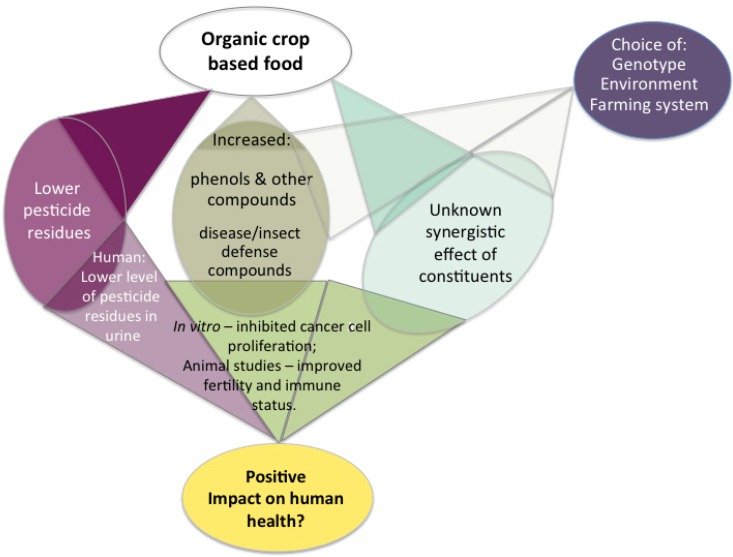
An increasing interest in organic agriculture for food production is seen throughout the world and one key reason for this interest is the assumption that organic food consumption is beneficial to public health. The present paper focuses on the background of organic agriculture, important public health related compounds from crop food and variations in the amount of health related compounds in crops. In addition, influence of organic farming on health related compounds, on pesticide residues and heavy metals in crops, and relations between organic food and health biomarkers as well as in vitro studies are also the focus of the present paper. Nutritionally beneficial compounds of highest relevance for public health were micronutrients, especially Fe and Zn, and bioactive compounds such as carotenoids (including pro-vitamin A compounds), tocopherols (including vitamin E) and phenolic compounds. Extremely large variations in the contents of these compounds were seen, depending on genotype, climate, environment, farming conditions, harvest time, and part of the crop. Highest amounts seen were related to the choice of genotype and were also increased by genetic modification of the crop. Organic cultivation did not influence the content of most of the nutritional beneficial compounds, except the phenolic compounds that were increased with the amounts of pathogens. However, higher amounts of pesticide residues and in many cases also of heavy metals were seen in the conventionally produced crops compared to the organic ones. Animal studies as well as in vitro studies showed a clear indication of a beneficial effect of organic food/extracts as compared to conventional ones. Thus, consumption of organic food seems to be positive from a public health point of view, although the reasons are unclear, and synergistic effects between various constituents within the food are likely.
Overview
The claims and statistics of this paper haven’t been checked yet.
Run the check — free, no account needed. It reads the open-access text and checks the sources it cites.
Integrity signals
Registry
Cites
Statistics
Figures
Verification
Claims the paper makes
The claims and statistics of this paper haven’t been checked yet.
Run the check — free, no account needed. It reads the open-access text and checks the sources it cites.
Claims other papers make about this one
Each is checked against this paper’s own text: does it say what the citing paper says it does?
In the citing paper
“Evidence for health relevance of the observed differences in certain trace compounds has generally not been identified and remains controversial.127-129”
From Dietary and Policy Priorities for Cardiovascular Disease, Diabetes, and Obesity: A Comprehensive Review (2016) · cites this paper as [129]
Self-check
Percentages, sums and reported differences re-computed from the paper’s own numbers.
The self-check needs the paper’s full text.
Citations
Cites
Diet, nutrition and the prevention of chronic diseases
Joint, W. (2002) · Medical Entomology and Zoology · Cited by 4,890
Effects of a combination of beta carotene and vitamin A on lung cancer and cardiovascular disease
Omenn, G. S., Goodman, G. E., Thornquist, M. D., Balmes, J., Cullen, M. R., Glass, A., Keogh, J. P., Meyskens, F. L., Valanis, B., Williams, J. H., et al. (1996) · New England Journal of Medicine · doi:10.1056/nejm199605023341802 · Cited by 3,638
Diet, Nutrition, and the Prevention of Chronic Diseases
Leong, A. (1992) · Pathology · doi:10.1016/s0031-3025(16)36541-2 · Cited by 1,633
Breeding for micronutrients in staple food crops from a human nutrition perspective
Welch, R. M., & Graham, R. D. (2004) · Journal of Experimental Botany · doi:10.1093/jxb/erh064 · Cited by 1,525
Improving the nutritional value of Golden Rice through increased pro-vitamin A content
Paine, J. A., Shipton, C. A., Chaggar, S., Howells, R. M., Kennedy, M. J., Vernon, G., Wright, S. Y., Hinchliffe, E., Adams, J. L., Silverstone, A. L., et al. (2005) · Nature Biotechnology · doi:10.1038/nbt1082 · Cited by 1,457
Bazzano, L. A., He, J., Ogden, L. G., Loria, C. M., Vupputuri, S., Myers, L., & Whelton, P. K. (2002) · The American Journal of Clinical Nutrition · doi:10.1093/ajcn/76.1.93 · Cited by 1,035
Effect of Endocrine Disruptor Pesticides: A Review
Mnif, W., Hassine, A. I. H., Bouaziz, A., Bartegi, A., Thomas, O. P., & Roig, B. (2011) · International Journal of Environmental Research and Public Health · doi:10.3390/ijerph8062265 · Cited by 1,016
The World of Organic Agriculture: Statistics and Emerging Trends 2008
(2008) · Management of Environmental Quality An International Journal · doi:10.1108/meq.2008.08319fae.004 · Cited by 1,005
Asami, D. K., Hong, Y., Barrett, D. M., & Mitchell, A. E. (2003) · Journal of Agricultural and Food Chemistry · doi:10.1021/jf020635c · Cited by 997
Maiani, G., Periago Castón, M. J., Catasta, G., Toti, E., Cambrodón, I. G., Bysted, A., Granado‐Lorencio, F., Olmedilla‐Alonso, B., Knuthsen, P., Valoti, M., et al. (2009) · Molecular Nutrition & Food Research · doi:10.1002/mnfr.200800053 · Cited by 773
Research works printed but not linked: 5
- Ciolek, 2012, Content of selected nutrients in wheat, barley and oat grain from organic and conventional farming, J. Elementol., 17, 181
- Dolgun, 2010, Comparison of olive oils derived from certified organic and conventional agricultural methods, Asian J. Chem., 22, 2339
- Kazimierczak, 2009, A comparison of the polyphenol and vitamin C content in jams of several varieties of black currants Ribes. nigrum L. from the organic and conventional cultivations, J. Res. Appl. Agr. Eng., 54, 123
- Rossi, 2006, Preliminary survey on composition and quality of conventional and organic wheat, Ital. J. Food Sci., 18, 355
- Muchova, 1996, The influence of growing conditions on the cadmium and lead accumulation in food wheat, Rostl. Vyroba, 42, 59
Cited by
Sorted by citations
Mozaffarian, D. (2016) · Circulation · doi:10.1161/circulationaha.115.018585 · Cited by 2,216
Increasing organic food consumption: An integrating model of drivers and barriers
Hansmann, R., Baur, I., & Binder, C. R. (2020) · Journal of Cleaner Production · doi:10.1016/j.jclepro.2020.123058 · Cited by 253
Organic Farming, Soil Health, and Food Quality: Considering Possible Links
Reeve, J. R., Hoagland, L., Villalba, J. J., Carr, P. M., Atucha, A., Cambardella, C. A., Davis, D. R., & Delate, K. M. (2016) · Advances in agronomy · doi:10.1016/bs.agron.2015.12.003 · Cited by 186
The willingness to consume organic food: A review
Eyinade, G. A., Mushunje, A., & Yusuf, S. F. G. (2021) · Food and Agricultural Immunology · doi:10.1080/09540105.2021.1874885 · Cited by 172
“Additionally, Clark (2002), Crinnion (2010), Johansson et al. (2014), Mie et al. (2017) revealed that organically grown products contain a higher vitamin C content, while the findings of Esch et al. (2010) reported a higher level of vitamin C content also in non-organically grown produces.”
BackgroundOrganic food and the impact on human health
Hurtado‐Barroso, S., Tresserra‐Rimbau, A., Vallverdú‐Queralt, A., & Lamuela-Raventós, R. M. (2017) · Critical Reviews in Food Science and Nutrition · doi:10.1080/10408398.2017.1394815 · Cited by 175
Metadata
- Authors
- Johansson, E., Hussain, A., Kuktaite, R., Andersson, S., & Olsson, M.
- Affiliations
- Swedish University of Agricultural Sciences (SE)
- COMSATS University Islamabad (PK)
- Corresponding author
- Johansson, Eva
- Venue
- International Journal of Environmental Research and Public Health
- Publisher
- MDPI AG
- Published
- 2014-04-08
- Volume
- 11
- Issue
- 4
- Pages
- 3870-3893
- ISSN
- 1660-4601 (ISSN-L)
- PMC
- PMC4025038
- OpenAlex
- W2135919196
- Cited by
- 122
- References
- 167
- Citations by year
- 2026: 4 · 2025: 9 · 2024: 15 · 2023: 15 · 2022: 9 · 2021: 18 · 2020: 16 · 2019: 5 · 2018: 4 · 2017: 5 · 2016: 11 · 2015: 9 · 2014: 2
- FWCI
- 1.01
- Type
- journal article
- Language
- en
- Open access
- gold
- doi.org
- Licence
- Locations
- International Journal of Environmental Research and Public Health (publishedVersion, cc-by)
- Europe PMC (PubMed Central) (publishedVersion, cc-by)
- PubMed Central (publishedVersion, cc-by)
- PubMed (publishedVersion)
- RePEc: Research Papers in Economics (submittedVersion)
- DOAJ (DOAJ: Directory of Open Access Journals) (submittedVersion)
- Funders
- VINNOVA
- Higher Education Commission, Pakistan
- Ekhagastiftelsen
- Topics
- Life Sciences › Agricultural and Biological Sciences › Plant Science › Organic Food and Agriculture
- Health Sciences › Medicine › Biochemistry (medical) › Phytochemicals and Antioxidant Activities
- Life Sciences › Agricultural and Biological Sciences › Food Science › Food Nutrient Composition and Product Development
- Keywords
- organic food, organic farming, micronutrients, iron, zinc, carotenoids, provitamin A, tocopherols, vitamin E, phenolic compounds, bioactive compounds, pesticide residues, heavy metals, health biomarkers, genotype effects, genetic modification, synergistic effect
- MeSH terms
- Animals, Food Contamination, Humans, Pesticide Residues, Public Health, Metals, Heavy, Food, Organic, Organic Agriculture
About these checks
Registry, retraction, Cites and statistics results are computed, not judged, with one exception: a printed reference that no index lists is read once by a model before it counts as a citation error. Claims are extracted by a model and kept only when their quote appears verbatim in the text; each cited source is then checked, with a model’s help, for whether it says what the claim relies on. Those verdicts can be wrong — read the claim’s quote and the cited source before relying on one.
Statistics and arithmetic are recomputed, not judged.
Confidence bands are shown only for fields calibrated on our annotated test set. None is calibrated yet, so no band is shown.
What counts as a claim ›How we measure confidence ›How we check this ›
Are you an author, or do you see a problem with this page? Request a review
