

Does the Absence of a Supportive Family Environment Influence the Outcome of a Universal Intervention for the Prevention of Depression?
Open accessThe DOI matches its Crossref record; 23 of the 24 references it cites were found in a registry or an index.
Abstract
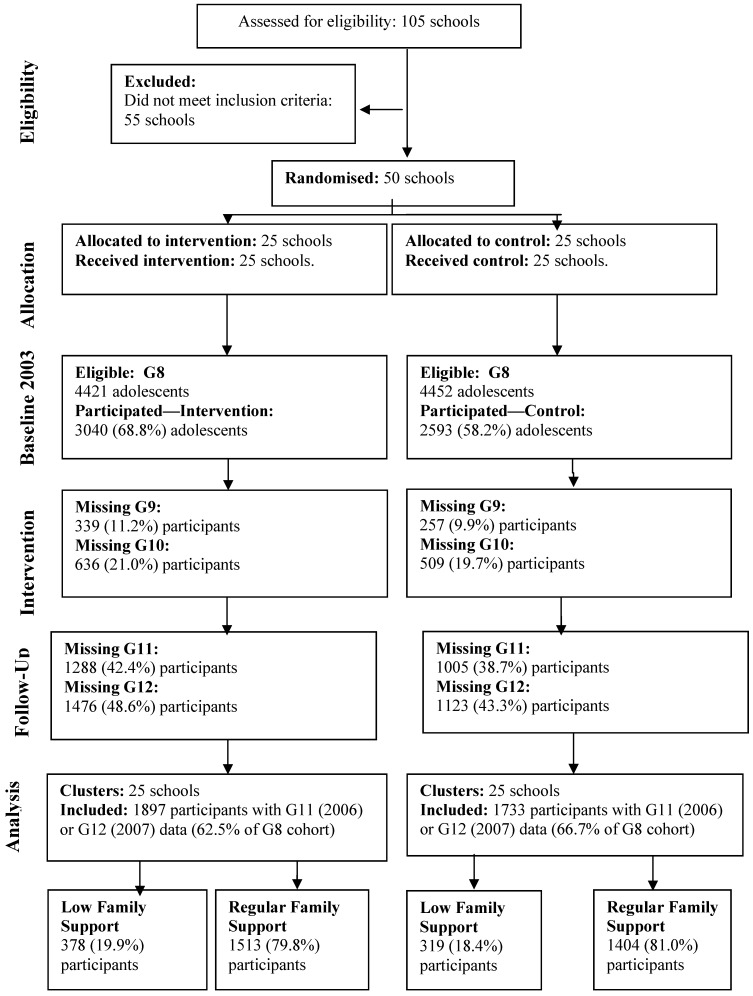
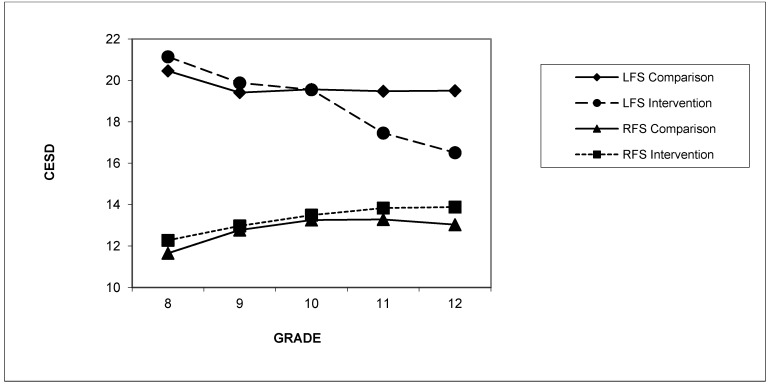
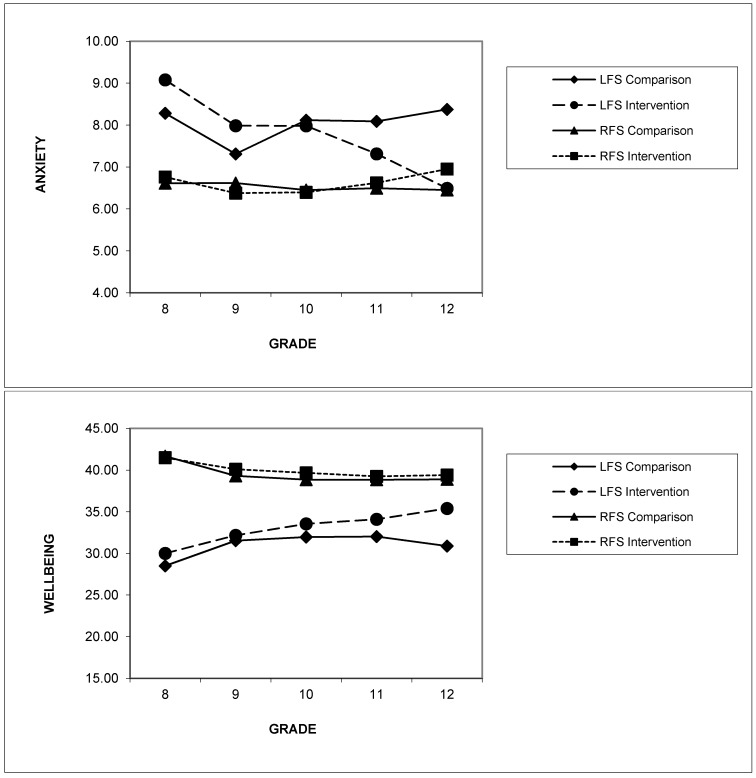
To date, universal, school-based interventions have produced limited success in the long-term prevention of depression in young people. This paper examines whether family relationship support moderates the outcomes of a universal, school-based preventive intervention for depression in adolescents. It reports a secondary analysis of data from the beyondblue schools research initiative. Twenty-five matched pairs of secondary schools were randomly assigned to an intervention or control condition (N = 5633 Grade 8 students). The multi-component, school-based intervention was implemented over a 3-year period, with 2 years of follow-up in Grades 11 and 12. For those available at follow-up, small but significantly greater reductions in depressive and anxiety symptoms and improvements in emotional wellbeing were found over time for the intervention group compared to the control among those who experienced low family relationship support in Grade 8. For those who did not experience low family relationship support in Grade 8, no significant effects of the invention were found over the control condition. This pattern of results was also found for the intent-to-treat sample for measures of depression and anxiety. Previous research may have overlooked important moderating variables that influence the outcome of universal approaches to the prevention of depression. The findings raise issues of the relative costs and benefits of universal versus targeted approaches to the prevention of depression.
Overview
The claims and statistics of this paper haven’t been checked yet.
Free: it reads the open-access text and checks the first 5 claims that cite a source we can check. Create a free account to check every claim.
Integrity signals
Registry
Cites
Statistics
Figures
Verification
Claims the paper makes
The claims and statistics of this paper haven’t been checked yet.
Free: it reads the open-access text and checks the first 5 claims that cite a source we can check. Create a free account to check every claim.
Claims other papers make about this one
Each is checked against this paper’s own text: does it say what the citing paper says it does?
The source backs part of the claim, not all of it — or backs it for a different population, condition or comparison.
In the citing paper
“The CAS-8 has demonstrated good reliability and provides population-level, gender-standardized norms for comparison [18].”
From Large-scale dissemination of internet-based cognitive behavioral therapy for youth anxiety: Feasibility and acceptability study (2018) · cites this paper as [18]
Experimental — accuracy not yet measuredThe check wasn’t confident either way, so it gives no verdict — never disputed.
In the citing paper
“Scores of ≥84th percentile (ie, above a T-score of 60: CAS-8 score ≥10 for males and ≥12 for females) are considered indicative of elevated anxiety, while scores of ≥94th percentile (ie, above a T-score of 65: CAS-8 score ≥13 for males and ≥16 for females) are considered representative of clinical levels of anxiety.”
From Large-scale dissemination of internet-based cognitive behavioral therapy for youth anxiety: Feasibility and acceptability study (2018) · cites this paper as [18]
Experimental — accuracy not yet measuredThe check wasn’t confident either way, so it gives no verdict — never disputed.
In the citing paper
“Furthermore, RCI was estimated to be equivalent to a 4-point change for males and a 5-point change for females using reliability coefficients and gender-standardized norms for the CAS-8 based on Australian school-aged youth [18].”
From Large-scale dissemination of internet-based cognitive behavioral therapy for youth anxiety: Feasibility and acceptability study (2018) · cites this paper as [18]
Experimental — accuracy not yet measured
Self-check
Percentages, sums and reported differences re-computed from the paper’s own numbers.
The self-check needs the paper’s full text.
Citations
Cites
The CES-D Scale: A Self-Report Depression Scale for Research in the General Population
Radloff, L. S. (1977) · Applied Psychological Measurement · doi:10.1177/014662167700100306 · Cited by 53,267
Multiple Imputation for Nonresponse in Surveys
Rubin, D. B. (1987) · Wiley Series in Probability and Statistics · doi:10.1002/9780470316696 · Cited by 20,701
The Multidimensional Scale of Perceived Social Support
Zimet, G. D., Dahlem, N. W., Zimet, S. G., & Farley, G. K. (1988) · Journal of Personality Assessment · doi:10.1207/s15327752jpa5201_2 · Cited by 13,339
Analysis of Incomplete Multivariate Data
Schafer, J. L. (1997) · doi:10.1201/9781439821862 · Cited by 6,012
Analysis of Incomplete Multivariate Data
Booth, D. E. (2000) · Technometrics · doi:10.1080/00401706.2000.10486013 · Cited by 5,627 · cited 1×
“Five imputations were used, with results being pooled as outlined by Schafer [23].”
The structure of psychological distress and well-being in general populations.
Veit, C. T., & Ware, J. E. (1983) · Journal of Consulting and Clinical Psychology · doi:10.1037//0022-006x.51.5.730 · Cited by 1,967 · cited 1×
“The degree to which students were satisfied with life and engaged in positive emotional thoughts, acts and feelings was assessed using the 12-item short form of the Mental Health Inventory— Emotional Well-being Scale [20].”
A measure of anxiety symptoms among children
Spence, S. H. (1998) · Behaviour Research and Therapy · doi:10.1016/s0005-7967(98)00034-5 · Cited by 1,928 · cited 1×
“The frequency with which adolescents experienced anxiety was measured using an 8-item scale adapted from the Spence Children’s Anxiety Scale [19].”
Self-citationStice, E., Shaw, H., Bohon, C., Marti, C. N., & Rohde, P. (2009) · Journal of Consulting and Clinical Psychology · doi:10.1037/a0015168 · Cited by 553 · cited 1×
“Reviews of the research have typically concluded that the effects are weak and, where significant, are not generally maintained over time [1].”
Epidemiology of Depressive Symptoms in the National Longitudinal Study of Adolescent Health
RUSHTON, J. L., FORCIER, M., & SCHECTMAN, R. M. (2002) · Journal of the American Academy of Child & Adolescent Psychiatry · doi:10.1097/00004583-200202000-00014 · Cited by 551 · cited 1×
“In terms of clinical cut-off points, research has demonstrated that scores >24 are indicative of moderate/severe depression among adolescents [17].”
Calear, A. L., Christensen, H., Mackinnon, A., Griffiths, K. M., & O'Kearney, R. (2009) · Journal of Consulting and Clinical Psychology · doi:10.1037/a0017391 · Cited by 327 · cited 1×
“This cut-off has also been used in previous research evaluating universal prevention of depression among adolescents and thus enables comparability of findings with the present study [18].”
Research works printed but not linked: 1
- Newton S. Docter S. Reddin E. Merlin T. Hiller J. Depression in Adolescents and Young Adults: Evidence Review Adelaide Health Technology Assessment (AHTA), University of Adelaide Adelaide, Australia 2010
Cited by
Hetrick, S. E., Cox, G. R., Witt, K. G., Bir, J. J., & Merry, S. N. (2016) · Cochrane Database of Systematic Reviews · doi:10.1002/14651858.cd003380.pub4 · Cited by 290
Garber, J., Brunwasser, S. M., Zerr, A. A., Schwartz, K. T. G., Sova, K., & Weersing, V. R. (2016) · Depression and Anxiety · doi:10.1002/da.22519 · Cited by 91
March, S., Spence, S. H., Donovan, C. L., & Kenardy, J. A. (2018) · Journal of Medical Internet Research · doi:10.2196/jmir.9211 · Cited by 84
“Furthermore, RCI was estimated to be equivalent to a 4-point change for males and a 5-point change for females using reliability coefficients and gender-standardized norms for the CAS-8 based on Australian school-aged youth [18].”
BackgroundMethodInfluentialSelf-citationTennant, M., Youssef, G. J., McGillivray, J., Clark, T.-J., McMillan, L., & McCarthy, M. (2020) · European Journal of Oncology Nursing · doi:10.1016/j.ejon.2020.101804 · Cited by 105
Lekamge, R. B., Jain, R., Sheen, J., Solanki, P., Zhou, Y., Romero, L., Barry, M. M., Chen, L., Karim, M. N., & Ilić, D. (2025) · Journal of Youth and Adolescence · doi:10.1007/s10964-025-02135-6 · Cited by 91
Spence, S. H., March, S., & Donovan, C. L. (2019) · Internet Interventions · doi:10.1016/j.invent.2019.100268 · Cited by 52
“It has demonstrated good reliability and provides population-level genderstandardized norms for comparison (Spence et al., 2014).”
BackgroundMethodInfluentialSelf-citationA Review of Scales to Measure Social Anxiety Disorder in Clinical and Epidemiological Studies
Wong, Q. J. J., Gregory, B., & McLellan, L. F. (2016) · Current Psychiatry Reports · doi:10.1007/s11920-016-0677-2 · Cited by 56
Silverstone, P. H., Bercov, M., Suen, V. Y. M., Allen, A., Cribben, I., Goodrick, J., Henry, S., Pryce, C., Langstraat, P., Rittenbach, K., et al. (2015) · PLOS ONE · doi:10.1371/journal.pone.0125527 · Cited by 41
“It is possible that other factors, such as family relationship support, may be important in the outcome of these interventions [51].”
BackgroundWerner‐Seidler, A., Maston, K., Calear, A. L., Batterham, P. J., Larsen, M. E., Torok, M., O’Dea, B., Huckvale, K., Beames, J. R., Brown, L., et al. (2023) · International Journal of Methods in Psychiatric Research · doi:10.1002/mpr.1954 · Cited by 37
Gunawardena, H., Voukelatos, A., Nair, S. V., Cross, S. P. M., & Hickie, I. B. (2023) · International Journal of Environmental Research and Public Health · doi:10.3390/ijerph20156508 · Cited by 38
“Eighteen out of 29 interventions had a follow-up which varied from eight-weeks [72] to 24 months [58].”
BackgroundInfluentialShelemy, L., Harvey, K., & Waite, P. (2020) · Mental Health & Prevention · doi:10.1016/j.mhp.2020.200182 · Cited by 40
GROUP-BASED SYMPTOM TRAJECTORIES IN INDICATED PREVENTION OF ADOLESCENT DEPRESSION
Brière, F. N., Rohde, P., Stice, E. M., & Morizot, J. (2015) · Depression and Anxiety · doi:10.1002/da.22440 · Cited by 31
March, S., Donovan, C. L., Baldwin, S., Ford, M., & Spence, S. H. (2019) · Internet Interventions · doi:10.1016/j.invent.2019.100281 · Cited by 23
“The CAS-8 is based on the Spence Children's Anxiety Scale (below) and demonstrates excellent reliability (Spence et al., 2014).”
MethodSelf-citationAnxiety Trajectories in Adolescents and the Impact of Social Support and Peer Victimization
Spence, S. H., Lawrence, D. M., & Zubrick, S. R. (2022) · Research on Child and Adolescent Psychopathology · doi:10.1007/s10802-021-00887-w · Cited by 30
Self-citationA Comprehensive Evaluation of a Universal School-Based Depression Prevention Program for Adolescents
Tomyn, J. D., Fuller‐Tyszkiewicz, M., Richardson, B., & Colla, L. (2016) · Research on Child and Adolescent Psychopathology · doi:10.1007/s10802-016-0136-x · Cited by 31
“programs, such as the impact of baseline symptomology (Spence et al., 2014).”
BackgroundResultInfluentialMarch, S., Batterham, P. J., Rowe, A., Donovan, C. L., Calear, A. L., & Spence, S. H. (2021) · JMIR Mental Health · doi:10.2196/27981 · Cited by 20
“The CAS-8 has been used in large-scale school-based prevention program trials with subsequent population-level, gender-standardized norms for comparison [25].”
MethodResultInfluentialSelf-citationMüller, S., Rohde, P., Gau, J. M., & Stice, E. M. (2015) · Behaviour Research and Therapy · doi:10.1016/j.brat.2015.10.002 · Cited by 27
Spence, S. H., & Rapee, R. M. (2021) · Journal of Anxiety Disorders · doi:10.1016/j.janxdis.2021.102495 · Cited by 20
Self-citationBurns, J. R., & Rapee, R. M. (2018) · Child and Adolescent Mental Health · doi:10.1111/camh.12258 · Cited by 24
Longitudinal Associations Between COVID-19 Stress and the Mental Health of Children With ADHD
Summerton, A., Bellows, S. T., Westrupp, E. M., Stokes, M. A., Coghill, D., Bellgrove, M. A., Hutchinson, D. M., Becker, S. P., Melvin, G. A., Quach, J., et al. (2023) · Journal of Attention Disorders · doi:10.1177/10870547231168334 · Cited by 20
“The brief 8-item version (Spence et al., 2014) measures anxiety on a 4-point Likert scale (0 = never to 3 = always), with higher scores indicating greater symptoms of anxiety.”
BackgroundKishida, K., Hida, N., Matsubara, K., Oguni, M., & Ishikawa, S. (2022) · Journal of Prevention · doi:10.1007/s10935-022-00709-9 · Cited by 16
“The Short CAS is a self-report questionnaire that assesses anxiety symptoms in children and adolescents (Spence et al., 2014).”
BackgroundKishida, K., Hida, N., & Ishikawa, S. (2022) · Child and Adolescent Psychiatry and Mental Health · doi:10.1186/s13034-022-00445-2 · Cited by 17
“CAS) The Short CAS is a self-reported scale that measures anxiety symptoms in children and adolescents [29, 30].”
BackgroundMarch, S., Spence, S. H., Myers, L. S., Ford, M., Smith, G., & Donovan, C. L. (2023) · Internet Interventions · doi:10.1016/j.invent.2023.100675 · Cited by 18
Self-citationMoreno-Peral, P., Bellón, J. Á., Motrico, E., Campos-Paíno, H., Gómez, C. M., Ebert, D. D., Buntrock, C., Roca, M., & Cerón, S. C. (2020) · Journal of Anxiety Disorders · doi:10.1016/j.janxdis.2020.102317 · Cited by 17
Ishikawa, S., Ishii, R., Fukuzumi, N., Murayama, K., Ohtani, K., Sakaki, M., Suzuki, T., & Tanaka, A. (2018) · Anxiety Disorder Research · doi:10.14389/jsad.10.1_64 · Cited by 13
Wuthrich, V. M., Rapee, R. M., McLellan, L. F., Wignall, A., Jagiello, T., Norberg, M. M., & Belcher, J. (2021) · Psychiatry Research · doi:10.1016/j.psychres.2021.114066 · Cited by 10
Tulloch, C., Hing, N., Browne, M., Rockloff, M., & Hilbrecht, M. (2022) · Applied Research in Quality of Life · doi:10.1007/s11482-022-10052-0 · Cited by 7
Connor, C., Yap, M. B. H., Warwick, J., Birchwood, M. J., Valliere, N. D., Madan, J. J., Melvin, G. A., Padfield, E., Patterson, P. H., Petrou, S., et al. (2022) · Trials · doi:10.1186/s13063-022-06563-8 · Cited by 7
“Adolescent anxiety • The Children’s Anxiety Scale-8 (CAS-8 [55]) The CAS-8 is a brief screening instrument for anxiety symptoms in children.”
BackgroundInfluentialLekamge, R. B., Jain, R., Sheen, J., Solanki, P., Zhou, Y., Romero, L., Barry, M. M., Chen, L., Karim, M. N., & Ilić, D. (2025) · Campbell Systematic Reviews · doi:10.1002/cl2.70024 · Cited by 15
March, S., Spence, S. H., Myers, L. S., Ford, M., Smith, G., & Donovan, C. L. (2024) · JMIR Mental Health · doi:10.2196/57405 · Cited by 5
Self-citationDepression and Anxiety Among Young Gender- and Sexuality-Diverse Adolescents
Bista, S., Werner‐Seidler, A., Maston, K., Lin, A. P., Perry, Y., Davies, C., Graham, P. L., Christensen, H. M., Marino, J. L., & Skinner, S. R. (2025) · JAMA Network Open · doi:10.1001/jamanetworkopen.2025.51570 · Cited by 7
Yang, L., Ye, J., Zhu, H., Tang, Y., & Li, X. (2024) · Frontiers in Psychiatry · doi:10.3389/fpsyt.2024.1390430 · Cited by 7
Caplan, R. (2014) · Epilepsy & Behavior · doi:10.1016/j.yebeh.2014.08.025 · Cited by 4
“only in youth who experienced poor family support [61].”
BackgroundCalear, A. L., Batterham, P. J., Werner‐Seidler, A., Maston, K., Torok, M. H., O’Dea, B., Larsen, M. E., & Christensen, H. M. (2025) · Journal of Child Psychology and Psychiatry · doi:10.1111/jcpp.70024 · Cited by 6
Spence, S. H., March, S., & Donovan, C. L. (2019) · Cambridge University Press eBooks · doi:10.1017/9781108235655.005 · Cited by 4
Self-citationAddressing the public health concern of depression and anxiety disorders: Financial perspective
Shrivastava, S. R., Shrivastava, P., & Ramasamy, J. (2017) · Annals of Tropical Medicine and Public Health · doi:10.4103/1755-6783.196801 · Cited by 3
Kishida, K., Takebe, M., Kuribayashi, C., Tanabe, Y., & Ishikawa, S. (2022) · Behavioural and Cognitive Psychotherapy · doi:10.1017/s135246582200025x · Cited by 3
“Japanese version of Short Spence Children’s Anxiety Scale (Short CAS) The Short CAS is an 8-item scale that measures anxiety symptoms (Ishikawa et al., 2018; Spence et al., 2014).”
Tennant, M., Youssef, G. J., McGillivray, J., Clark, T.-J., MCMILLAN, L., & McCarthy, M. (2020) · PsyArXiv (OSF Preprints) · doi:10.31234/osf.io/hujgz · Cited by 3
Braund, T. A., Bal, D., Christensen, H. M., Batterham, P. J., Vilus, B., Maston, K., Larsen, M. E., Werner‐Seidler, A., Huckvale, K., Whitton, A. E., et al. (2025) · NPP—Digital Psychiatry and Neuroscience · doi:10.1038/s44277-025-00033-0 · Cited by 2
“” The CAS-8 has demonstrated good reliability and provides population-level, standardized norms, with a range of 0 – 24 (higher score indicates greater anxiety; [20, 21]).”
Rowe, A., Evans, J. L., Donovan, C. L., Spence, S. H., & March, S. (2023) · Child and Adolescent Mental Health · doi:10.1111/camh.12637 · Cited by 2
Self-citationSkaarnes, H., Sørensen, N. M., Wisnewski, A. H., Lomholt, J. J., Thastum, M., McLellan, L. F., & Mathiasen, K. (2024) · Trials · doi:10.1186/s13063-024-08511-0 · Cited by 4
“The 8-item Children’s Anxiety Scale (CAS-8) [61].”
BackgroundOhashi, S., Urao, Y., Fujiwara, K., Koshiba, T., Ishikawa, S., & Shimizu, E. (2024) · BMC Psychiatry · doi:10.1186/s12888-024-06264-3 · Cited by 5
Mustamin, S. N., Angraini, S., Salsabila, S., Simanjuntak, M., & Riany, Y. E. (2022) · Journal of Family Sciences · doi:10.29244/jfs.vi.36541 · Cited by 2
“This condition is following the research that someone who has low family support in a stressful situation, especially with a health problem will cause various pathological symptoms, ranging from anxiety depression to low emotional well-being and self-esteem problem also caused a low level in quality of life (Apriliant…”
BackgroundSenyard, E., Rowe, A., Krishnamoorthy, G., Spence, S. H., Donovan, C. L., & March, S. (2025) · JMIR Pediatrics and Parenting · doi:10.2196/60523 · Cited by 1
“During the registration process, participants provided demographic information (see below) and completed the CAS-8 [22].”
InfluentialSelf-citationWen, C., Liu, Y., Li, Y., Chen, R., Zhao, H., Zhang, X., Zhuang, X., Liao, Y., Hao, J., Chen, Y., et al. (2025) · BMC Psychiatry · doi:10.1186/s12888-025-06947-5 · Cited by 5
“Certain arrangements have been associated with improved PWB, particularly by offering emotional and practical support for individuals with depression [8].”
Kishida, K., Hida, N., Matsubara, K., Oguni, M., & Ishikawa, S. (2022) · Research Square · doi:10.21203/rs.3.rs-1264505/v1 · Cited by 1
“Short version of the Spence Children’s Anxiety Scale (Short CAS) The Short CAS is a self-report questionnaire that assesses anxiety symptoms in children and adolescents (Spence et al., 2014).”
MethodParent-Adolescent Communication and Adolescent Depression After a Partial Hospitalization Program
Cook, R. M. (2016) · OhioLink ETD Center (Ohio Library and Information Network) · Cited by 2
Senyard, E., Rowe, A., Krishnamoorthy, G., Spence, S. H., Donovan, C. L., & March, S. (2024) · doi:10.2196/preprints.60523
Self-citationThompson, A. D., Bouliotis, G., Yap, M. B. H., Birchwood, M. J., Cardamone-Breen, M. C., Valliere, N. D., Khan, K., Melvin, G. A., Michelet, F., Olivier, P. L., et al. (2025) · doi:10.2196/preprints.77421
Mendes, R. A., Wilson, D., & Loxton, N. J. (2025) · Australian Journal of Primary Health · doi:10.1071/py25155 · Cited by 2
Connor, C., Yap, M. B. H., Warwick, J., Birchwood, M., Valliere, N. D., Madan, J. J., Melvin, G. A., Padfield, E., Patterson, P. H., Petrou, S., et al. (2022) · Figshare · doi:10.6084/m9.figshare.20495844
Connor, C., Yap, M. B. H., Warwick, J., Birchwood, M., Valliere, N. D., Madan, J. J., Melvin, G. A., Padfield, E., Patterson, P. H., Petrou, S., et al. (2022) · Figshare · doi:10.6084/m9.figshare.20495850
Connor, C., Yap, M. B. H., Warwick, J., Birchwood, M., Valliere, N. D., Madan, J. J., Melvin, G. A., Padfield, E., Patterson, P. H., Petrou, S., et al. (2022) · Figshare · doi:10.6084/m9.figshare.20495847
Connor, C., Yap, M. B. H., Warwick, J., Birchwood, M., Valliere, N. D., Madan, J. J., Melvin, G. A., Padfield, E., Patterson, P. H., Petrou, S., et al. (2022) · Figshare · doi:10.6084/m9.figshare.20495853
Evaluating the Japanese Version of the Child Anxiety Life Interference Scale
Shirotsuki, K., Nishiuchi, M., Sasaki, Y., Nakao, M., Lyneham, H. J., & Rapee, R. M. (2026) · Journal of Child and Family Studies · doi:10.1007/s10826-026-03276-3
Kishida, K., Hida, N., Matsubara, K., Kihara, H., Sakaue, Y., Takeuchi, Y., & Ishikawa, S.-I. (2026) · Child and Adolescent Psychiatry and Mental Health · doi:10.1186/s13034-026-01070-z
“The Short CAS [29] was used to assess anxiety symptoms in children and adolescents.”
Okawa, S., Blackwell, S. E., Violato, M., Creswell, C., Ishikawa, S.-I., Obikane, E., Takahashi, T., Arai, H., Nakamura, H., Ishitsuka, K., et al. (2026) · BMJ Open · doi:10.1136/bmjopen-2025-114705
“25 The Japanese version of the Short CAS has good psychometric properties.”
Thompson, A., Bouliotis, G., Yap, M. B. H., Birchwood, M. J., Cardamone-Breen, M. C., Valliere, N. D., Khan, K., Melvin, G. A., Michelet, F., Olivier, P. L., et al. (2026) · Journal of Affective Disorders · doi:10.1016/j.jad.2026.122272
March, S., Hayixibayi, A., Rowe, A., Stevens, J. M., Zieschank, K. L., Donovan, C. L., & Spence, S. H. (2026) · Journal of Medical Internet Research · doi:10.2196/97810
“For the purposes of this study, users were categorized into “no elevated anxiety,” “elevated anxiety,” or “clinical anxiety” based on population-level and gender-standardized norms produced via large-scale, school-based prevention program trials [24].”
InfluentialSelf-citationWrigglesworth, J., Chirokoff, V., Fransquet, P., Anderson, V. A., Bellgrove, M. A., & Silk, T. J. (2026) · bioRxiv (Cold Spring Harbor Laboratory) · doi:10.64898/2026.10.20.760579
“Assessments include the Conners’ 3 ADHD index (Conners, 2008), the Spence Children’s Anxiety Scale (Spence et al., 2014), the Social Experience Questionnaires (SEQ, Crick & Grotpeter, 1996), the Paediatric Quality of Life Inventory (PedsQL, Varni et al., 2003), the Conners’ Adult ADHD Rating Scale…”
Metadata
- Authors
- Spence, S., Sawyer, M., Sheffield, J., Patton, G., Bond, L., Graetz, B., & Kay, D.
- Affiliations
- Griffith University (AU)
- Women's and Children's Hospital (AU)
- The University of Queensland (AU)
- The University of Melbourne (AU)
- Centre of Excellence in Intervention and Prevention Science, 15-31 Pelham Street South Carlton, VIC 3053, Australia
- Beyondblue (AU)
- University of South Australia (AU)
- Corresponding author
- Spence, Susan
- Venue
- International Journal of Environmental Research and Public Health
- Publisher
- MDPI AG
- Published
- 2014-05-13
- Volume
- 11
- Issue
- 5
- Pages
- 5113-5132
- ISSN
- 1660-4601 (ISSN-L)
- PMC
- PMC4053893
- OpenAlex
- W2024083048
- Cited by
- 60
- References
- 24
- Citations by year
- 2026: 6 · 2025: 9 · 2024: 5 · 2023: 4 · 2022: 13 · 2021: 3 · 2020: 4 · 2019: 3 · 2018: 3 · 2017: 1 · 2016: 5 · 2015: 3 · 2014: 1
- FWCI
- 3.94
- Type
- journal article
- Language
- en
- Open access
- gold
- doi.org
- Licence
- Locations
- International Journal of Environmental Research and Public Health (publishedVersion, cc-by)
- Europe PMC (PubMed Central) (publishedVersion, cc-by)
- PubMed Central (publishedVersion, cc-by)
- PubMed (publishedVersion)
- Victoria University Research Repository (Victoria University) (submittedVersion, cc-by)
- Minerva Access (University of Melbourne) (submittedVersion, cc-by)
- RePEc: Research Papers in Economics (submittedVersion)
- Adelaide Research & Scholarship (AR&S) (University of Adelaide) (submittedVersion, cc-by)
- DOAJ (DOAJ: Directory of Open Access Journals) (submittedVersion)
- Griffith Research Online (submittedVersion, cc-by)
- UniSA Research Outputs Repository (University of South Australia) (submittedVersion, other-oa)
- Funders
- Beyond Blue
- Queensland Government
- Medical Research Council
- National Health and Medical Research Council
- National Medical Research Council
- Topics
- Social Sciences › Psychology › Clinical Psychology › Child and Adolescent Psychosocial and Emotional Development
- Health Sciences › Medicine › Public Health, Environmental and Occupational Health › School Health and Nursing Education
- Health Sciences › Medicine › Psychiatry and Mental health › Mental Health Treatment and Access
- Keywords
- depression prevention, universal prevention, school-based intervention, adolescents, moderating effect, depressive symptoms, anxiety symptoms, emotional well-being
- MeSH terms
- Adolescent, Child, Depression, Family Relations, Female, Humans, Male, Queensland, Random Allocation, School Health Services, Social Support, South Australia, Students, Victoria
About these checks
Registry, retraction, Cites and statistics results are computed, not judged, with one exception: a printed reference that no index lists is read once by a model before it counts as a citation error. Claims are extracted by a model and kept only when their quote appears verbatim in the text; each cited source is then checked, with a model’s help, for whether it says what the claim relies on. Those verdicts can be wrong — read the claim’s quote and the cited source before relying on one.
Statistics and arithmetic are recomputed, not judged.
Confidence bands are shown only for fields calibrated on our annotated test set. None is calibrated yet, so no band is shown.
What counts as a claim ›How we measure confidence ›How we check this ›
Are you an author, or do you see a problem with this page? Request a review
Data sources
Bibliographic data: Semantic Scholar, OpenAlex, Crossref.
Contains information from the Semantic Scholar Academic Graph Datasets, made available under the ODC Attribution License (ODC-BY 1.0).
Semantic Scholar’s data is described in: Kinney, R., et al. (2023). The Semantic Scholar Open Data Platform. arXiv:2301.10140.
