

The DOI matches its Crossref record; 31 of the 31 references it cites were found in a registry or an index.
Behavior Change without Behavior Change Communication: Nudging Handwashing among Primary School Students in Bangladesh
Open accessAbstract
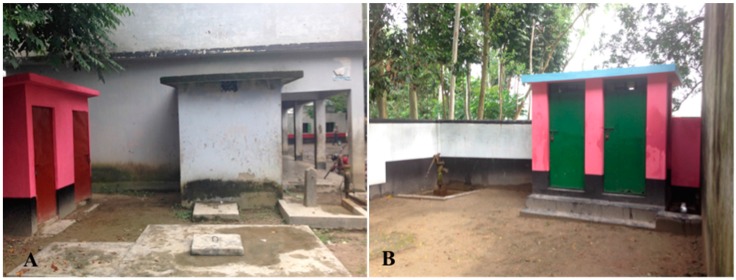
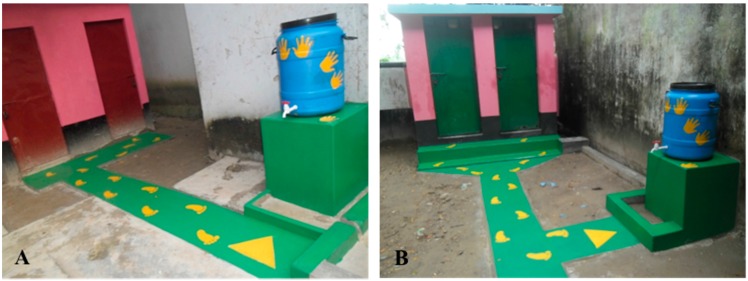
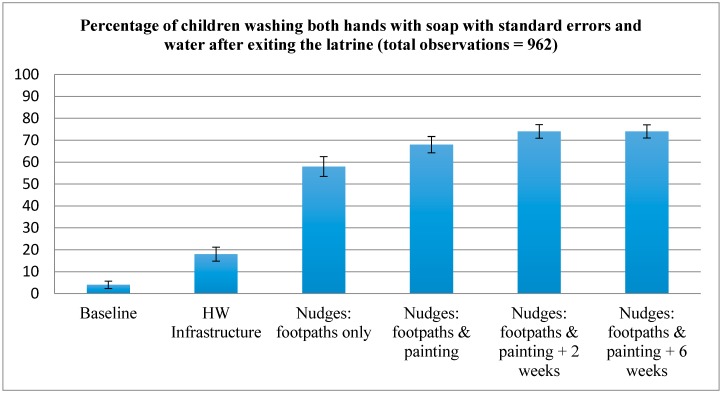
Behavior change communication for improving handwashing with soap can be labor and resource intensive, yet quality results are difficult to achieve. Nudges are environmental cues engaging unconscious decision-making processes to prompt behavior change. In this proof-of-concept study, we developed an inexpensive set of nudges to encourage handwashing with soap after toilet use in two primary schools in rural Bangladesh. We completed direct observation of behaviors at baseline, after providing traditional handwashing infrastructure, and at multiple time periods following targeted handwashing nudges (1 day, 2 weeks, and 6 weeks). No additional handwashing education or motivational messages were completed. Handwashing with soap among school children was low at baseline (4%), increasing to 68% the day after nudges were completed and 74% at both 2 weeks and 6 weeks post intervention. Results indicate that nudge-based interventions have the potential to improve handwashing with soap among school-aged children in Bangladesh and specific areas of further inquiry are discussed.
Overview
The claims and statistics of this paper haven’t been checked yet.
Run the check — free, no account needed. It reads the open-access text and checks the sources it cites.
Integrity signals
Registry
Cites
Statistics
Figures
Verification
Claims the paper makes
The claims and statistics of this paper haven’t been checked yet.
Run the check — free, no account needed. It reads the open-access text and checks the sources it cites.
Claims other papers make about this one
Each is checked against this paper’s own text: does it say what the citing paper says it does?
The source backs part of the claim, not all of it — or backs it for a different population, condition or comparison.
In the citing paper
“Studies assessing the impact of hygiene behaviour change interventions on hand washing practice demonstrate that presence of infrastructure alone is unlikely to sustainably improve hygiene behaviours [31,32]”
From Menstrual hygiene management and school absenteeism among adolescent students in Indonesia: evidence from a cross-sectional school-based survey (2018) · cites this paper as [31]
Experimental — accuracy not yet measuredThe cited source says what the claim attributes to it.
In the citing paper
“All of the 13 publications that examined changes in WASH knowledge, attitudes and hygiene behaviours reported evidence of positive change among students in intervention schools including hand-washing with soap or sanitizer [8,16,29,30,31], improved knowledge of WASH-related diseases, and improved hygiene habits [7,13].”
From Water, Sanitation and Hygiene (WASH) in Schools in Low-Income Countries: A Review of Evidence of Impact (2019) · cites this paper as [29]
Self-check
Percentages, sums and reported differences re-computed from the paper’s own numbers.
The self-check needs the paper’s full text.
Citations
Cites
Nudge: improving decisions about health, wealth, and happiness
(2008) · Choice Reviews Online · doi:10.5860/choice.46-0977 · Cited by 11,624
The Hawthorne Effect: a randomised, controlled trial
McCarney, R., Warner, J. P., Iliffe, S., van Haselen, R. A., Griffin, M., & Fisher, P. (2007) · BMC Medical Research Methodology · doi:10.1186/1471-2288-7-30 · Cited by 1,838
Habits in everyday life: Thought, emotion, and action.
Wood, W., Quinn, J. M., & Kashy, D. A. (2002) · Journal of Personality and Social Psychology · doi:10.1037/0022-3514.83.6.1281 · Cited by 1,028
Judging nudging: can nudging improve population health?
Marteau, T. M., Ogilvie, D., Roland, M. O., Suhrcke, M., & Kelly, M. P. (2011) · BMJ · doi:10.1136/bmj.d228 · Cited by 667
Handwashing and risk of respiratory infections: a quantitative systematic review
Rabie, T., & Curtis, V. (2006) · Tropical Medicine & International Health · doi:10.1111/j.1365-3156.2006.01568.x · Cited by 556
Hand washing for preventing diarrhoea
Ejemot-Nwadiaro, R. I., Ehiri, J. E., Meremikwu, M. M., & Critchley, J. A. (2008) · Cochrane Database of Systematic Reviews · doi:10.1002/14651858.cd004265.pub2 · Cited by 321
Biran, A., Schmidt, W., Varadharajan, K. S., Rajaraman, D., Kumar, R., Greenland, K., Gopalan, B., Aunger, R. V., & Curtis, V. (2014) · The Lancet Global Health · doi:10.1016/s2214-109x(13)70160-8 · Cited by 284
Talaat, M., Afifi, S., Dueger, E., El-Ashry, N., Marfin, A., Kandeel, A., Mohareb, E., & El-Sayed, N. (2011) · Emerging Infectious Diseases · doi:10.3201/eid1704.101353 · Cited by 238
Freeman, M. C., Greene, L. E., Dreibelbis, R., Saboori, S., Muga, R., Brumback, B., & Rheingans, R. (2012) · Tropical Medicine & International Health · doi:10.1111/j.1365-3156.2011.02927.x · Cited by 228
Self-citationBOWEN, A., MA, H., OU, J., BILLHIMER, W., LONG, T., MINTZ, E., HOEKSTRA, R. M., & LUBY, S. (2007) · The American Journal of Tropical Medicine and Hygiene · doi:10.4269/ajtmh.2007.76.1166 · Cited by 208 · cited 1×
“Improving hand hygiene in schools—alone or in combination with other water, sanitation, and hygiene interventions—has been shown to reduce pupil absence [9,18] and pupil illness [19,20].”
BackgroundRam, P. K., Halder, A. K., Granger, S. P., Jones, T., Hall, P., Hitchcock, D., Wright, R. L., Nygren, B., Islam, M. S., Molyneaux, J. W., et al. (2010) · American Journal of Tropical Medicine and Hygiene · doi:10.4269/ajtmh.2010.09-0763 · Cited by 164
Self-citationHuda, T. M. N., Unicomb, L., Johnston, R. B., Halder, A. K., Yushuf Sharker, M. A., & Luby, S. P. (2012) · Social Science & Medicine · doi:10.1016/j.socscimed.2011.10.042 · Cited by 147 · cited 3×
“Observed rates of handwashing in our study after nudges were installed are comparable to those seen following intensive educational and/or motivational messaging in both community [3,4,6] and educational settings [16,17].”
BackgroundMethodBiran, A., Schmidt, W., Wright, R. L., Jones, T., Seshadri, M. S., Isaac, P., Nathan, N. A., Hall, P., McKenna, J., Granger, S. P., et al. (2009) · Tropical Medicine & International Health · doi:10.1111/j.1365-3156.2009.02373.x · Cited by 127
Contzen, N., Meili, I., & Mosler, H. (2014) · Social Science & Medicine · doi:10.1016/j.socscimed.2014.11.006 · Cited by 108
FREEMAN, M. C., CLASEN, T., DREIBELBIS, R., SABOORI, S., GREENE, L. E., BRUMBACK, B., MUGA, R., & RHEINGANS, R. (2014) · Epidemiology and Infection · doi:10.1017/s0950268813001118 · Cited by 99
Self-citationReactivity and repeatability of hygiene behaviour: Structured observations from Burkina Faso
Cousens, S., Kanki, B., Touré, S., Diallo, I., & Curtis, V. A. (1996) · Social Science & Medicine · doi:10.1016/0277-9536(95)00380-0 · Cited by 95
Luby, S. P., & Halder, A. K. (2008) · Tropical Medicine & International Health · doi:10.1111/j.1365-3156.2008.02074.x · Cited by 94
Dreibelbis, R., Freeman, M. C., Greene, L. E., Saboori, S., & Rheingans, R. (2014) · American Journal of Public Health · doi:10.2105/ajph.2013.301412 · Cited by 84
Self-citationPickering, A. J., Davis, J., Blum, A. G., Scalmanini, J., Oyier, B., Okoth, G., Breiman, R. F., & Ram, P. K. (2013) · The American Society of Tropical Medicine and Hygiene · doi:10.4269/ajtmh.13-0008 · Cited by 73
Self-citationAlexander, K. T., Dreibelbis, R., Freeman, M. C., Ojeny, B., & Rheingans, R. (2013) · Journal of Water and Health · doi:10.2166/wh.2013.213 · Cited by 59
Self-citationThe Hawthorne effect : a randomized controlled trial
McCarney, R. (2007) · Cited by 54
Saboori, S., Greene, L. E., Moe, C. L., Freeman, M. C., Caruso, B. A., Akoko, D., & Rheingans, R. D. (2013) · The American Society of Tropical Medicine and Hygiene · doi:10.4269/ajtmh.12-0387 · Cited by 53
Sustaining school hand washing and water treatment programmes: Lessons learned and to be learned
Saboori, S., Mwaki, A., Porter, S. P. S., Okech, B. O. B., Freeman, M. F. M., & Rheingans, R. (2011) · Waterlines · doi:10.3362/1756-3488.2011.040 · Cited by 42
Beyond tippy-taps: The role of enabling products in scaling up and sustaining handwashing
Devine, J. (2010) · Waterlines · doi:10.3362/1756-3488.2010.033 · Cited by 40
Cochrane review: Hand washing for preventing diarrhoea
Ejemot-Nwadiaro, R. I., Ehiri, J. E., Meremikwu, M. M., & Critchley, J. (2009) · Evidence-Based Child Health A Cochrane Review Journal · doi:10.1002/ebch.373 · Cited by 37
Pickering, A. J., Blum, A. G., Breiman, R. F., Ram, P. K., & Davis, J. (2014) · PLoS ONE · doi:10.1371/journal.pone.0092571 · Cited by 36
Self-citationRajaraman, D., Varadharajan, K. S., Greenland, K., Curtis, V., Kumar, R., Schmidt, W., Aunger, R. V., & Biran, A. (2014) · BMC Public Health · doi:10.1186/1471-2458-14-1179 · Cited by 30
Arnold, B. F., Khush, R. S., Ramaswamy, P., Rajkumar, P., Natesan, D., Ramaprabha, P., Balakrishnan, K., & Colford, J. M. (2014) · American Journal of Tropical Medicine and Hygiene · doi:10.4269/ajtmh.14-0306 · Cited by 30
Increasing handwashing with soap: emotional drivers or social norms?
Leontsini, E., & WINCH, P. J. (2014) · The Lancet Global Health · doi:10.1016/s2214-109x(14)70030-0 · Cited by 14
The Visual Illusions of Food: Why Plates, Bowls, and Spoons Can Bias Consumption Volume
Wansink, B. C., & van Ittersum, K. (2006) · The FASEB Journal · doi:10.1096/fasebj.20.4.a618-c · Cited by 14
Level of behaviour change achievable by handwashing with soap interventions: a rapid review
Heijnen, M., & Greenland, K. (2015) · doi:10.12774/eod_hd.april2015.heijnenmetal · Cited by 8
Cited by
Sorted by citations
Hand washing promotion for preventing diarrhoea
Ejemot-Nwadiaro, R. I., Ehiri, J. E., Arikpo, D., Meremikwu, M. M., & Critchley, J. (2015) · Cochrane Database of Systematic Reviews · doi:10.1002/14651858.cd004265.pub3 · Cited by 367
McMichael, C. (2019) · International Journal of Environmental Research and Public Health · doi:10.3390/ijerph16030359 · Cited by 220
“11 Dreibelbis et al.2016 [29] Bangladesh Before and after intervention study 2 primary schools (220 and 514 students) Inexpensive nudges—i.e., environmental cues to prompt behaviour change—to encourage hand-washing with soap.”
BackgroundBehaviour Centred Design: towards an applied science of behaviour change
Aunger, R. V., & Curtis, V. A. (2016) · Health Psychology Review · doi:10.1080/17437199.2016.1219673 · Cited by 234
Davis, J., Macintyre, A., Odagiri, M., Suriastini, W., Cordova, A., Huggett, C., Agius, P. A., Budiyani, A. E., Quillet, C., Cronin, A. A., et al. (2018) · Tropical Medicine & International Health · doi:10.1111/tmi.13159 · Cited by 200
“Studies assessing the impact of hygiene behaviour change interventions on hand washing practice demonstrate that presence of infrastructure alone is unlikely to sustainably improve hygiene behaviours [31, 32], suggesting that other factors are important in determining hand washing behaviour and therefore appropriate M…”
BackgroundThe determinants of handwashing behaviour in domestic settings: An integrative systematic review
White, S., Thorseth, A. H., Dreibelbis, R., & Curtis, V. (2020) · International Journal of Hygiene and Environmental Health · doi:10.1016/j.ijheh.2020.113512 · Cited by 177
Self-citation
Metadata
- Authors
- Dreibelbis, R., Kroeger, A., Hossain, K., Venkatesh, M., & Ram, P.
- Affiliations
- University of Oklahoma (US)
- Save the Children (BD)
- Save the Children (US)
- University at Buffalo, State University of New York (US)
- Corresponding author
- Dreibelbis, Robert
- Venue
- International Journal of Environmental Research and Public Health
- Publisher
- MDPI AG
- Published
- 2016-01-14
- Volume
- 13
- Issue
- 1
- Pages
- 129
- ISSN
- 1660-4601 (ISSN-L)
- PMC
- PMC4730520
- OpenAlex
- W2234246835
- Cited by
- 151
- References
- 31
- Citations by year
- 2026: 7 · 2025: 17 · 2024: 10 · 2023: 10 · 2022: 10 · 2021: 28 · 2020: 33 · 2019: 15 · 2018: 6 · 2017: 7 · 2016: 6
- FWCI
- 11.87
- Type
- journal article
- Language
- en
- Open access
- gold
- doi.org
- Licence
- Locations
- International Journal of Environmental Research and Public Health (publishedVersion, cc-by)
- PubMed Central (publishedVersion, cc-by)
- PubMed (publishedVersion)
- LSHTM Research Online (London School of Hygiene and Tropical Medicine) (acceptedVersion)
- RePEc: Research Papers in Economics (submittedVersion)
- DOAJ (DOAJ: Directory of Open Access Journals) (submittedVersion)
- Funders
- University of Oklahoma
- Topics
- Health Sciences › Nursing › Nutrition and Dietetics › Child Nutrition and Water Access
- Health Sciences › Medicine › Public Health, Environmental and Occupational Health › School Health and Nursing Education
- Social Sciences › Psychology › Applied Psychology › Behavioral Health and Interventions
- Keywords
- handwashing with soap, nudging, behavior change, behavior change communication, elementary school students, toilet use, environmental cues, hygiene practices, low-cost interventions, rural Bangladesh
- MeSH terms
- Adolescent, Audiovisual Aids, Bangladesh, Child, Communication, Decision Making, Female, Hand Disinfection, Health Promotion, Humans, Male, Motivation, Pilot Projects, Rural Population, Schools, Students, Health Behavior, Risk Reduction Behavior
About these checks
Registry, retraction, Cites and statistics results are computed, not judged, with one exception: a printed reference that no index lists is read once by a model before it counts as a citation error. Claims are extracted by a model and kept only when their quote appears verbatim in the text; each cited source is then checked, with a model’s help, for whether it says what the claim relies on. Those verdicts can be wrong — read the claim’s quote and the cited source before relying on one.
Statistics and arithmetic are recomputed, not judged.
Confidence bands are shown only for fields calibrated on our annotated test set. None is calibrated yet, so no band is shown.
What counts as a claim ›How we measure confidence ›How we check this ›
Are you an author, or do you see a problem with this page? Request a review
