

Exercise-Based Interventions to Enhance Long-Term Sustainability of Physical Activity in Older Adults: A Systematic Review and Meta-Analysis of Randomized Clinical Trials
Open accessThe DOI matches its Crossref record; 66 of the 67 references it cites were found in a registry or an index.
Abstract
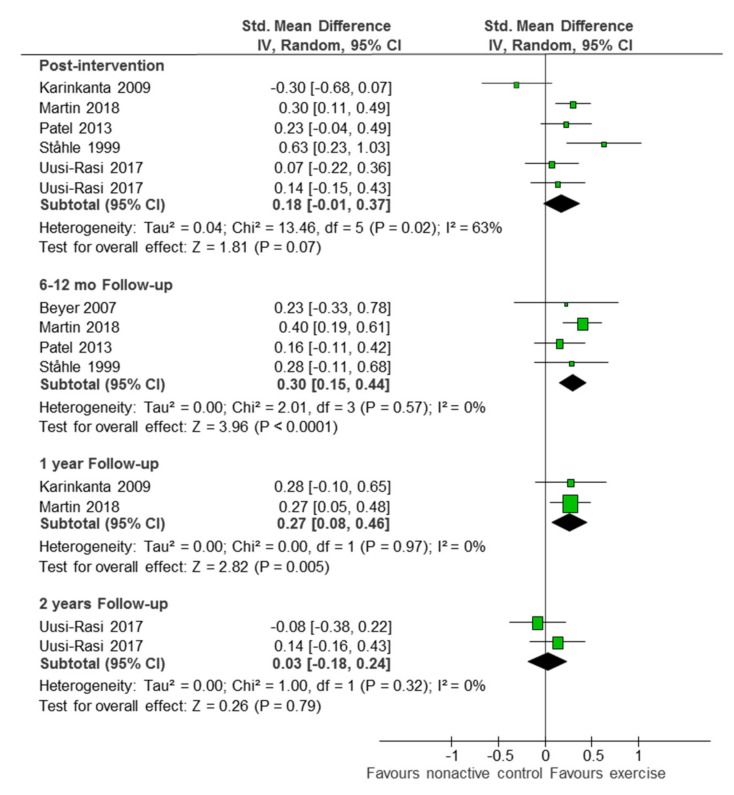
Exercise is a form of physical activity (PA). PA is an important marker of health and quality of life in older adults. The purpose of this study was to conduct a systematic review of the literature to assess the effect of exercise-based interventions on an at least six-month follow up PA measure, and to describe the specific strategies implemented during the intervention to strengthen the sustainability of PA in community-dwelling 65+ year-old adults. We registered and conducted a systematic review and meta-analysis (PROSPERO: CRD42017070892) of randomized clinical trials (RCT). We searched three electronic databases during January 2018 to identify RCT assessing any type of exercise-based intervention. Studies had to report a pre-, post-, and at least 6-month post-intervention follow-up. To be included, at least one PA outcome had to be assessed. The effect of exercise-based interventions was assessed compared to active (e.g., a low-intensity type of exercise, such as stretching or toning activities) and non-active (e.g., usual care) control interventions at several time points. Secondary analyses were conducted, restricted to studies that reported specific strategies to enhance the sustainability of PA. The intervention effect was measured on self-reported and objective measures of time spent in PA, by means of standardized mean differences. Standardized mean differences of PA level were pooled. Pooled estimates of effect were computed with the DerSimonian–Laird method, applying a random effects model. The risk of bias was also assessed. We included 12 studies, comparing 18 exercise intervention groups to four active and nine non-active control groups. Nine studies reported specific strategies to enhance the long-term sustainability of PA. The strategies were mostly related to the self-efficacy, self-control, and behavior capability principles based on the social cognitive theory. Exercise interventions compared to active control showed inconclusive and heterogeneous results. When compared to non-active control, exercise interventions improved PA time at the six-months follow up (standardized mean difference (SMD) 0.30; 95%CI 0.15 to 0.44; four studies; 724 participants; I2 0%), but not at the one- or two-years follow-ups. No data were available on the mid- and long-term effect of adding strategies to enhance the sustainability of PA. Exercise interventions have small clinical benefits on PA levels in community-dwelling older adults, with a decline in the observed improvement after six months of the intervention cessation.
Overview
The claims and statistics of this paper haven’t been checked yet.
Free: it reads the open-access text and checks the first 5 claims that cite a source we can check. Create a free account to check every claim.
Integrity signals
Registry
Cites
Statistics
Figures
Verification
Claims the paper makes
The claims and statistics of this paper haven’t been checked yet.
Free: it reads the open-access text and checks the first 5 claims that cite a source we can check. Create a free account to check every claim.
Claims other papers make about this one
Each is checked against this paper’s own text: does it say what the citing paper says it does?
The source backs part of the claim, not all of it — or backs it for a different population, condition or comparison.
In the citing paper
“These studies are heterogeneous regarding duration, physical activity intervention, degree of supervision, and study population.”
From Healthy weight loss maintenance with exercise, GLP-1 receptor agonist, or both combined followed by one year without treatment: a post-treatment analysis of a randomised placebo-controlled trial (2024) · cites this paper as [21]
Experimental — accuracy not yet measuredThe source backs part of the claim, not all of it — or backs it for a different population, condition or comparison.
In the citing paper
“Most, but not all, studies on physical activity treatment programs have reported small, sustained increases in physical activity levels after termination of the supervised program.20, 21, 22, 23, 24”
From Healthy weight loss maintenance with exercise, GLP-1 receptor agonist, or both combined followed by one year without treatment: a post-treatment analysis of a randomised placebo-controlled trial (2024) · cites this paper as [21]
Experimental — accuracy not yet measuredThe cited source says what the claim attributes to it.
In the citing paper
“In adults aged +65 years, exercise-based interventions led to sustained increases in physical activity six months after interventions, but not after one year.21”
Self-check
Percentages, sums and reported differences re-computed from the paper’s own numbers.
The self-check needs the paper’s full text.
Citations
Cites
Preferred Reporting Items for Systematic Reviews and Meta-Analyses: the PRISMA statement
Moher, D., Liberati, A., Tetzlaff, J., Altman, D. G., & for the PRISMA Group (2009) · BMJ · doi:10.1136/bmj.b2535 · Cited by 83,823
Preferred reporting items for systematic reviews and meta-analyses: the PRISMA Statement.
(2009) · PubMed Central · Cited by 44,859
Preferred reporting items for systematic reviews and meta-analyses: The PRISMA statement
Moher, D., Liberati, A., Tetzlaff, J., Altman, D. G., & the PRISMA Group* (2009) · Annals of Internal Medicine · doi:10.7326/0003-4819-151-4-200908180-00135 · Cited by 37,554
Social Cognitive Theory: An Agentic Perspective
Bandura, A. (2001) · Annual Review of Psychology · doi:10.1146/annurev.psych.52.1.1 · Cited by 15,510
The Transtheoretical Model of Health Behavior Change.
Prochaska, J. O., & Velicer, W. F. (1997) · American Journal of Health Promotion · doi:10.4278/0890-1171-12.1.38 · Cited by 7,782 · cited 1×
“Some of the most used theories in health behavior change include psychological theories, such as the transtheoretical model [29] and the social cognitive theory (SCT) [30].”
MethodCochrane Handbook for Systematic Reviews of Interventions Version 5.0.1. The Cochrane Collaboration
Higgins, J. P. T., Green, S. R., & Higgins, J. P. T. (2008) · Cited by 7,247
Nutbeam, D. (2000) · Health Promotion International · doi:10.1093/heapro/15.3.259 · Cited by 5,286 · cited 1×
“Some of the most cited strategies used in the included studies were education [55], self-monitoring [56], and action planning [57].”
MethodEffective techniques in healthy eating and physical activity interventions: A meta-regression.
Michie, S., Abraham, C., Whittington, C., McAteer, J., & Gupta, S. (2009) · Health Psychology · doi:10.1037/a0016136 · Cited by 2,229
The burden of disease in older people and implications for health policy and practice
Prince, M. J., Wu, F., Guo, Y., Gutierrez Robledo, L. M., O'Donnell, M., Sullivan, R., & Yusuf, S. (2015) · The Lancet · doi:10.1016/s0140-6736(14)61347-7 · Cited by 1,989 · cited 1×
“The incidence rate of many chronic diseases increases with age [5,6].”
BackgroundExercise as a treatment for depression: a meta-analysis adjusting for publication bias
Schuch, F. B., Vancampfort, D., Richards, J., Rosenbaum, S., Ward, P. B., & Stubbs, B. (2016) · Journal of Psychiatric Research · doi:10.1016/j.jpsychires.2016.02.023 · Cited by 1,529
Research works printed but not linked: 2
- Greenhalgh T. How to Spread Good Ideas: A Systematic Review of the Literature on Diffusion, Dissemination, and Sustainability of Innovations in Health Service Delivery and Organization Report for the National Coordinating Centre for NHS Service Delivery and Organisation R & D (NCCSDO) London University College London, UK 2004 362
- Finegood D. Johnston L. Steinberg M. Matteson C.L. Deck P. Complexity, systems thinking, and health behavior change Health Behavior Change in Populations Kahan S. Gielen A.C. Fagan P.J. Lawrence W.G. Oxford University Press New York, NY, USA 2011 208 236
Cited by
Items 101–167 of 167
King, A. C., Espinosa, P. R., Rovzar, C., la Vega‐Taboada, E. D., & Stathi, A. (2026) · The Lancet Healthy Longevity · doi:10.1016/j.lanhl.2026.100915 · Cited by 2
Assessing the Person-Environment Fit Framework for Active Ageing
MacCarthy, D., Silva, C., & Adlakha, D. (2023) · S.M.A.R.T. environments · doi:10.1007/978-3-031-32840-4_2 · Cited by 2
Impact of BRACTS exercises on muscular strength in eumenorrheic women
Shahid, W., & Noor, R. (2025) · Scientific Reports · doi:10.1038/s41598-025-87352-6 · Cited by 2
Şentürk, H. E., Tanir, G., Yüce, Ü. E., Karatut, A., & Karakaş, E. (2026) · Healthcare · doi:10.3390/healthcare14070842 · Cited by 2
Singh, N., Sulkers, E., van Dijk, H. W., Sanderman, R., & Ranchor, A. V. (2022) · Journal of Aging and Physical Activity · doi:10.1123/japa.2021-0182 · Cited by 2
Chen, L., Li, A., Chen, W., Wang, H., Zhou, J., & Sun, M. (2025) · Frontiers in Public Health · doi:10.3389/fpubh.2025.1672415 · Cited by 1
Sheng, J., Wang, H., & Hitchcock, M. (2025) · Cancer Causes & Control · doi:10.1007/s10552-025-02104-1 · Cited by 1
“Although short-term improvements in activity levels and self-efficacy were reported, it remains unclear whether participants maintained these behaviors post-intervention, which is a significant concern given the well-documented challenge of sustaining PA after intervention cessation [24, 25].”
Schneider, A., Leite, L. B., Teixeira, J. E., Forte, P. M., Barbosa, T. M., & Monteiro, A. M. (2026) · Women · doi:10.3390/women6020024 · Cited by 1
Ye, Q., Liu, Q., Li, X., Peng, J., Li, N., Deng, Q., Hu, J., Yong, C., Li, S., Wang, Y., et al. (2026) · International Journal of Behavioral Medicine · doi:10.1007/s12529-026-10461-7 · Cited by 1
Efficacy of Tailored Messages for 28-Week Exercise Sustainability in People with HIV
Cook, P. F., Webel, A. R., Wilson, M. P., Davey, C. H., Oliveira, V. H. F., Khuu, V., Matzio, S., Kulik, G. L., MaWhinney, S., Jankowski, C. M., et al. (2026) · AIDS and Behavior · doi:10.1007/s10461-026-05317-w · Cited by 1
Hornbuckle, L. M., Cooke, W. M., Rauer, A., & Barroso, C. S. (2022) · International Journal of Environmental Research and Public Health · doi:10.3390/ijerph19074190 · Cited by 1
“The potential research benefits of the opportunity presented by the pandemic were particularly relevant for exercise intervention researchers, who often struggle to facilitate a smooth transition for participants from the supervised, laboratory-based setting to independent exercise in order to foster an environment su…”
BackgroundDoyle–Baker, P. K., Petersen, J. A., Ghoneim, D., Blackstaffe, A., Naish, C., & McCormack, G. R. (2024) · ISPRS International Journal of Geo-Information · doi:10.3390/ijgi13120454 · Cited by 1
Saçıkara, Z., & Cingil, D. (2023) · Hemşirelikte araştırma geliştirme dergisi. · doi:10.69487/hemarge.1311441 · Cited by 1
Macháčová, K., Šteffl, M., Bártová, A., Novotná, B., & Holmerová, I. (2026) · Journal of Aging and Physical Activity · doi:10.1123/japa.2025-0180 · Cited by 1
Stockwell, S. (2021) · Anglia Ruskin Research Online (Anglia Ruskin University) · Cited by 1
Exercise in older adults with rheumatoid arthritis - a person-centred approach
Lange, E. (2019) · Gothenburg University Publications Electronic Archive (Gothenburg University)
Tiemessen, K. G. S. (2020) · ScholarWorks at University of Montana
Andrews, S. C., Parekh, D., Brady, B., Delbaere, K., Killcross, S., & Anstey, K. J. (2020) · Alzheimer s & Dementia · doi:10.1002/alz.047510
Sedentary Behavior and Physical Activity of Older Adults
Webster, K. (2021) · Deep Blue (University of Michigan) · doi:10.7302/3845
MitoFit: Evaluation of a Mitochondrial Fitness Science Communication Intervention for Aging AdultsPreprint
Maxwell, C. A., Patel, M. R., Boon, J. T., Grubbs, B. F., Dietrich, M. S., Dunavan, J., & Knickerbocker, K. J. (2024) · medRxiv · doi:10.1101/2024.07.04.24309859
Lassell, R., Metaxas, A., Wang, K. W., Hantgan, S. L., Gottipati, P., Zwerling, S., Pena, T., Pollak, C., Gitlin, L. N., & Jariwala, S. P. (2025) · JMIR Formative Research · doi:10.2196/64930
“A concern with existing physical activity interventions is that they are difficult to sustain [8,9], and often lack input from the end user in the development process.”
Shankar, R., Devi, F., & Qian, X. (2025) · medRxiv · doi:10.1101/2025.09.30.25337030
“…widely in format, intensity, setting, and delivery mode, ranging from high-intensity functional training in fitness facilities to gentle chair-based exercises in residential care settings, and from instructor-led group classes to self-directed home programmes supported by digital technologies [25].”
Furtado, G. E., Caldo‐Silva, A., Mamede-Pereira, D., Palotino-Ferreira, B. M., Rocha, S. V., & Campos, F. (2025) · Lecture notes in bioengineering · doi:10.1007/978-3-031-77282-5_28
Barrett, S., Begg, S. J., O’Halloran, P., Howlett, O., Lawrence, J., & Kingsley, M. (2021) · Figshare · doi:10.6084/m9.figshare.13544135
Crist, K., Full, K. M., Linke, S., Tuz‐Zahra, F., Bolling, K., Lewars, B., Liu, C., Shi, Y., Rosenberg, D. E., Jankowska, M. M., et al. (2022) · Figshare · doi:10.6084/m9.figshare.20167962
Ratz, T., Pischke, C. R., Voelcker‐Rehage, C., & Lippke, S. (2022) · Figshare · doi:10.6084/m9.figshare.17913195
Karlsson, E., Hanafi, R., Brisby, H., Fors, A., Kemani, M. K., Hedman, H., Nijs, J., & Lundberg, M. (2024) · Figshare · doi:10.6084/m9.figshare.25092495
Ratz, T., Pischke, C. R., Voelcker‐Rehage, C., & Lippke, S. (2022) · Figshare · doi:10.6084/m9.figshare.17913204
Ratz, T., Pischke, C. R., Voelcker‐Rehage, C., & Lippke, S. (2022) · Figshare · doi:10.6084/m9.figshare.17913198
Crist, K., Full, K. M., Linke, S., Tuz‐Zahra, F., Bolling, K., Lewars, B., Liu, C., Shi, Y., Rosenberg, D. E., Jankowska, M. M., et al. (2022) · Figshare · doi:10.6084/m9.figshare.20167980
Crist, K., Full, K. M., Linke, S., Tuz‐Zahra, F., Bolling, K., Lewars, B., Liu, C., Shi, Y., Rosenberg, D. E., Jankowska, M. M., et al. (2022) · Figshare · doi:10.6084/m9.figshare.20167965
Crist, K., Full, K. M., Linke, S., Tuz‐Zahra, F., Bolling, K., Lewars, B., Liu, C., Shi, Y., Rosenberg, D. E., Jankowska, M. M., et al. (2022) · Figshare · doi:10.6084/m9.figshare.20167968
Sparks, M. R. (2024) · Library, Museums and Press - UDSpace (University of Delaware) · doi:10.58088/y6d6-w704
Barrett, S., Begg, S. J., O’Halloran, P., Howlett, O., Lawrence, J., & Kingsley, M. (2021) · Figshare · doi:10.6084/m9.figshare.13544129
Crist, K., Full, K. M., Linke, S., Tuz‐Zahra, F., Bolling, K., Lewars, B., Liu, C., Shi, Y., Rosenberg, D. E., Jankowska, M. M., et al. (2022) · Figshare · doi:10.6084/m9.figshare.20167974
Karlsson, E., Hanafi, R., Brisby, H., Fors, A., Kemani, M. K., Hedman, H., Nijs, J., & Lundberg, M. (2024) · Figshare · doi:10.6084/m9.figshare.25092551
Crist, K., Full, K. M., Linke, S., Tuz‐Zahra, F., Bolling, K., Lewars, B., Liu, C., Shi, Y., Rosenberg, D. E., Jankowska, M., et al. (2022) · Figshare · doi:10.6084/m9.figshare.20167977
Crist, K., Full, K. M., Linke, S., Tuz‐Zahra, F., Bolling, K., Lewars, B., Liu, C., Shi, Y., Rosenberg, D. E., Jankowska, M., et al. (2022) · Figshare · doi:10.6084/m9.figshare.20167983
Barrett, S., Begg, S. J., O’Halloran, P., Howlett, O., Lawrence, J., & Kingsley, M. (2021) · Figshare · doi:10.6084/m9.figshare.13544126
Barrett, S., Begg, S. J., O’Halloran, P., Howlett, O., Lawrence, J., & Kingsley, M. (2021) · Figshare · doi:10.6084/m9.figshare.13544132
Vrinceanu, T. (2022) · Papyrus : Institutional Repository (Université de Montréal) · doi:10.71781/29318
Oskarsson, C., & Marklin, M. (2024) · DiVA at Umeå University (Umeå University)
Barbosa, A. R. R. (2024) · Portuguese National Funding Agency for Science, Research and Technology (RCAAP Project by FCT) · doi:10.34626/f8x2-te09
Thongwachira, C., Harnirattisai, T., & Morris, D. L. (2025) · The Journal of Behavioral Science · doi:10.69523/tjbs.2025.275134
Karlovy, F. H. S. U., Macháčová, K., Polanská, H., Šteffl, M., Novotná, B., & Holmerová, I. (2025) · E-psychologie · doi:10.29364/epsy.541
Long‐Term Effects of a Web‐Based Exercise Programme for People With Intellectual Disabilities
Fjellström, S., Stuffler, N., Andersson, E. P., Nordström, A., Wallén, E. F., Hansen, E., & Ohlsson, M. L. (2026) · Journal of Intellectual Disability Research · doi:10.1111/jir.70082
“The target group was older adults, and the study presented similar results as the present study, with improvements observed for post-intervention but no improvements for the long-term fol- low-up (Sansano-Nadal et al. 2019).”
Awosika, O. J., Joel, K. I., Agbaje, S. O., Dominic, O. L., & ADEOYE, S. A. (2026) · SustainE · doi:10.55366/suse.v3i3.18
Tang, Q., Shan, S., Chen, H., & Zhou, W. (2026) · Age and Ageing · doi:10.1093/ageing/afag045
Hakim, L., Nofianti, K. A., Utomo, G. M., Rachmadtullah, R., Guntur, M., & Suganda, M. A. (2026) · Physical Education Theory and Methodology · doi:10.17309/tmfv.2026.2.08
“However, participation often declines once external monitoring decreases (Sansano-Nadal et al., 2019).”
Sugiyama, Y., Ishizu, Y., YOKOYAMA, S., Yamamoto, K., Ito, T., Imai, N., Yamamura, T., Ishikawa, T., Furukawa, K., Honda, T., et al. (2026) · European Journal of Gastroenterology & Hepatology · doi:10.1097/meg.0000000000003188
Broda, B., Schmidt, D., & Jekauc, D. (2026) · Research Square · doi:10.21203/rs.3.rs-8945571/v1
Dinse, D., Haak, M., Möller, U. O., Karlsson, S., & Nilsson, M. (2026) · Journal of Aging Research · doi:10.1155/jare/6833782
Woodard, N., Xu, J., Perreault, T.-A., Lopez, N., Conklin, J. L., Hoover, R. L., & Hirschey, R. (2026) · American Journal of Lifestyle Medicine · doi:10.1177/15598276261451750
Zwingmann, K. V. (2026) · Qucosa (Saxon State and University Library Dresden) · doi:10.60687/2026-0105
Innovative Models for Community Health: Integrative Approaches to Public Health and Wellness
(2026) · Frontiers research topics · doi:10.3389/978-2-8325-8323-4
Stefanick, M. L., Mackey, S., Larson, J. C., Tinker, L. F., McGuire, V. M., Rovzar, C., Oppezzo, M., LaMonte, M. J., Kooperberg, C. L., LaCroix, A. Z., et al. (2026) · The Journals of Gerontology Series A · doi:10.1093/gerona/glag189
“Strengths of the WHISH trial include the large number of women aged 66–99 years and the long-term “light touch” intervention, which resembles many booster strategies to promote maintenance of physical activity, 14 and the many motivational principles that were promoted.”
Aswad, M., Wakhidah, N., Qomar, M., Majid, A., & Budiman, M. A. (2026) · SAMARAH Jurnal Hukum Keluarga dan Hukum Islam · doi:10.22373/end3b419
Shin, J. C. (2026) · The Asian Journal of Kinesiology · doi:10.15758/jk.2026.28.3.1
“This distinction may help explain why short-term improvements in physical activity do not always translate into sustained behavioral change [2].”
Michael, P., McCormick, S. A., Alexanders, J., Innes, A. Q., Harwood, A. E., Fatoye, F., Doherty, P., Cable, N. T., Deniszczyc, D., & Yeowell, G. (2026) · Frontiers in Psychology · doi:10.3389/fpsyg.2026.1807688
Leadbetter, B., Kendall, K. D., Shields, C. A., & Fowles, J. R. (2026) · Translational Journal of the American College of Sports Medicine · doi:10.1249/tjx.0000000000000389
Intervenção remota e atividade física de trabalhadores administrativos
NETO, J. B. M., Bertochi, G. F. A., Xavier, J. D. F., Meneguci, J., Tribess, S., Sebastião, É., Júnior, J. S. V., & Sasaki, J. E. (2023) · Arquivos de Ciências do Esporte
Toledo, A. J., Tiene, C. V. M., dos Reis, L. G. S., Ogata, M. E. D. M. C., da Silva, R. N., & Tavares, B. (2025) · Revista Saúde UniCV
運動施設における地域在住高齢者向け多要素運動プログラムの実装研究 (本文)
Nakamura, M. (2026) · Institutional Repositories DataBase (IRDB)
Blue, M. N. M., Smith‐Ryan, A. E., Davis-Wilson, H. C., Blackburn, T., & Pietrosimone, B. (2026) · Journal of Science in Sport and Exercise · doi:10.1007/s42978-026-00403-w
Villa-García, L., Davey, V., Peréz, L. M., Soto-Bagaria, L., Risco, E., Díaz, P., Kuluski, K., Giné-Garriga, M., Castellano-Tejedor, C., & Inzitari, M. (2023) · doi:10.3389/fpubh.2023.1062843.s001
Self-citation
Metadata
- Authors
- Sansano-Nadal, O., Giné-Garriga, M., Brach, J. S., Wert, D. M., Jerez-Roig, J., Guerra-Balic, M., Oviedo, G., Fortuño, J., Gómara-Toldrà, N., Soto-Bagaria, L., Pérez, L. M., Inzitari, M., Solà, I., Martin-Borràs, C., & Roqué, M.
- Affiliations
- Universitat Ramon Llull (ES)
- Department of Physical Activity and Sport Sciences, Faculty of Psychology, Education and Sport Sciences (FPCEE) Blanquerna, Ramon Llull University, Císter 34, 08022 Barcelona, Spain
- University of Pittsburgh (US)
- Universitat de Vic - Universitat Central de Catalunya (ES)
- Intermediate Care Hospital, Parc Sanitari Pere Virgili, Avinguda de Vallcarca 169-205, 08023 Barcelona, Spain
- Vall d'Hebron Institut de Recerca (ES)
- Universitat Autònoma de Barcelona (ES)
- Iberoamerican Cochrane Centre, Institute of Biomedical Research Sant Pau (IIB-Sant Pau), Sant Antoni Marià Claret 167, pavilion 18, 08025 Barcelona, Spain
- ORCID
- Venue
- International Journal of Environmental Research and Public Health
- Publisher
- MDPI AG
- Published
- 2019-07-15
- Volume
- 16
- Issue
- 14
- Pages
- 2527
- ISSN
- 1660-4601 (ISSN-L)
- PMC
- PMC6678490
- OpenAlex
- W2957454043
- Cited by
- 142
- References
- 67
- Citations by year
- 2026: 19 · 2025: 20 · 2024: 24 · 2023: 11 · 2022: 22 · 2021: 32 · 2020: 13 · 2019: 1
- FWCI
- 2.00
- Type
- journal article
- Language
- en
- Open access
- gold
- dx.doi.org
- Licence
- Locations
- International Journal of Environmental Research and Public Health (publishedVersion, cc-by)
- Europe PMC (PubMed Central) (publishedVersion, cc-by)
- PubMed Central (publishedVersion, cc-by)
- PubMed (publishedVersion)
- D-Scholarship@Pitt (University of Pittsburgh) (acceptedVersion)
- Dipòsit Digital de Documents de la UAB (Universitat Autònoma de Barcelona) (submittedVersion, cc-by)
- ResearchOnline (submittedVersion, cc-by)
- RePEc: Research Papers in Economics (submittedVersion)
- LA Referencia (Red Federada de Repositorios Institucionales de Publicaciones Científicas) (submittedVersion, cc-by)
- DOAJ (DOAJ: Directory of Open Access Journals) (submittedVersion)
- RECERCAT (Consorci de Serveis Universitaris de Catalunya) (submittedVersion, cc-by)
- ResearchOnline (Glasgow Caledonian University) (submittedVersion, cc-by)
- Funders
- National Institute on Aging (K24AG057728, P30AG024827)
- Topics
- Health Sciences › Medicine › Public Health, Environmental and Occupational Health › Physical Activity and Health
- Health Sciences › Medicine › Physiology (medical) › Cardiovascular and exercise physiology
- Health Sciences › Health Professions › Physical Therapy, Sports Therapy and Rehabilitation › Balance, Gait, and Falls Prevention
- Keywords
- exercise-based interventions, older adults, community-dwelling older adults, long-term follow-up, social cognitive theory, self-efficacy, self-control, behavior change strategies, exercise adherence, physical activity maintenance, low-intensity exercise, risk of bias, quality of life, quality of life in old age
- MeSH terms
- Aged, Aging, Health Promotion, Humans, Quality of Life, Models, Statistical, Exercise, Randomized Controlled Trials as Topic, Independent Living
About these checks
Registry, retraction, Cites and statistics results are computed, not judged, with one exception: a printed reference that no index lists is read once by a model before it counts as a citation error. Claims are extracted by a model and kept only when their quote appears verbatim in the text; each cited source is then checked, with a model’s help, for whether it says what the claim relies on. Those verdicts can be wrong — read the claim’s quote and the cited source before relying on one.
Statistics and arithmetic are recomputed, not judged.
Confidence bands are shown only for fields calibrated on our annotated test set. None is calibrated yet, so no band is shown.
What counts as a claim ›How we measure confidence ›How we check this ›
Are you an author, or do you see a problem with this page? Request a review
Data sources
Bibliographic data: Semantic Scholar, OpenAlex, Crossref.
Contains information from the Semantic Scholar Academic Graph Datasets, made available under the ODC Attribution License (ODC-BY 1.0).
Semantic Scholar’s data is described in: Kinney, R., et al. (2023). The Semantic Scholar Open Data Platform. arXiv:2301.10140.
