

The DOI matches its Crossref record; 1 of the 1 references it cites were found in a registry or an index.
Secondhand Smoke Exposure in Public Places and Support for Smoke-Free Laws in Japan: Findings from the 2018 ITC Japan Survey
Abstract
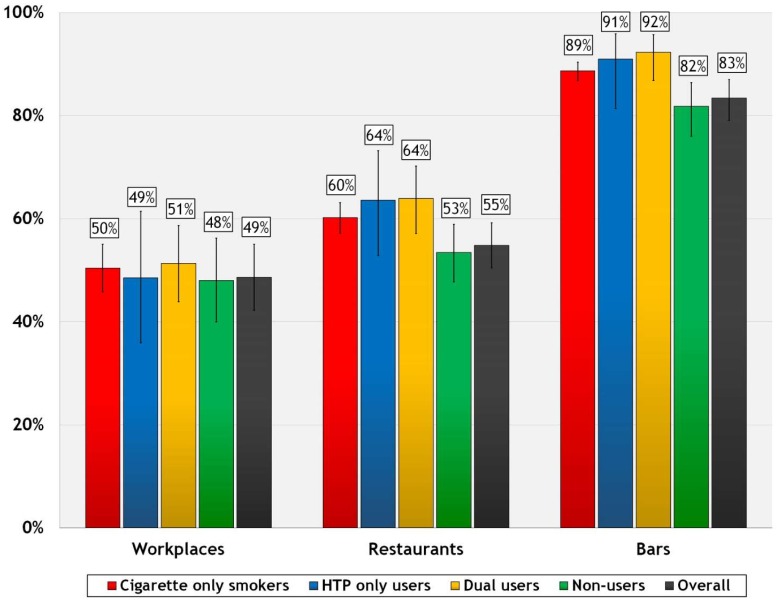
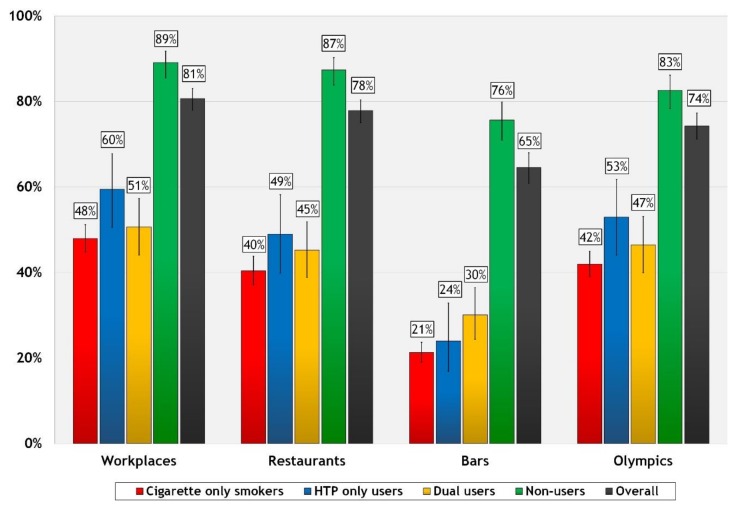
Comprehensive smoke-free policies such as those called for by the WHO FCTC are the only way to protect the public effectively from the harms of secondhand smoke (SHS), yet Japan has been slow to implement this important health measure. This study examines baseline levels of smoking and SHS exposure in public places and support for smoking bans in Japan prior to the implementation of the 2018 national smoke-free law. Data are from the International Tobacco Control (ITC) Japan Wave 1 Survey (Feb–Mar 2018), a web survey of adult cigarette smokers, heated tobacco product users, dual users, and non-users (total N = 4684). Measures included prevalence of smoking (whether respondents noticed people smoking inside restaurants and bars at their last visit, and workplaces in the last month), and support for complete smoking bans in these venues. Smoking prevalence in each venue was high overall in 2018 (49% of workplaces, 55% of restaurants, and 83% of bars), even higher than in China, the country with the greatest toll of SHS. Support for complete smoking bans was very high overall (81% for workplaces, 78% for restaurants, and 65% for bars). Non-users were less likely to be exposed to SHS and had higher support for smoking bans than tobacco users. These findings point to the ineffectiveness of partial smoke-free laws in Japan and reinforce the call for comprehensive smoke-free laws, which even smokers would support at higher levels than in many other ITC countries.
Overview
The claims and statistics of this paper haven’t been checked yet.
Run the check — free, no account needed. It reads the open-access text and checks the sources it cites.
Integrity signals
Registry
Cites
Statistics
Figures
Verification
Claims the paper makes
The claims and statistics of this paper haven’t been checked yet.
Run the check — free, no account needed. It reads the open-access text and checks the sources it cites.
Claims other papers make about this one
Each is checked against this paper’s own text: does it say what the citing paper says it does?
In the citing paper
“In Japan, a recent study showed that the overall prevalence of SHS exposure in workplaces, restaurants, and bars were 49, 55, and 83% (Sansone et al., 2020).”
From Mutation analysis links angioimmunoblastic T-cell lymphoma to clonal hematopoiesis and smoking (2021) · cites this paper as Sansone et al., 2020
Self-check
Percentages, sums and reported differences re-computed from the paper’s own numbers.
The self-check needs the paper’s full text.
Citations
Cites
Courtesy and the challenges of implementing smoke‐free policies in Japan
Bialous, S. A., Mochizuki‐Kobayashi, Y., & Stillman, F. (2006) · Nicotine & Tobacco Research · doi:10.1080/14622200600576297 · Cited by 16
Research works printed but not linked: 17
- Frazer, 2016, Legislative smoking bans for reducing harms from secondhand smoke exposure, smoking prevalence and tobacco consumption, Cochrane Database Syst. Rev., 2, CD005992
- Katanoda, 2014, Tobacco control challenges in East Asia: Proposals for change in the world’s largest epidemic region, Tob. Control, 23, 359, 10.1136/tobaccocontrol-2012-050852 · DOI
- Iida, 2018, ‘The industry must be inconspicuous’: Japan Tobacco’s corruption of science and health policy via the Smoking Research Foundation, Tob. Control, 27, e3, 10.1136/tobaccocontrol-2017-053971 · DOI
- Kashiwabara, 2013, Mind your “smoking manners”: The tobacco industry tactics to normalize smoking in Japan, Kobe J. Med. Sci., 59, 132
- Nomura, 2017, Population health and regional variations of disease burden in Japan, 1990–2015: A systematic subnational analysis for the Global Burden of Disease Study 2015, Lancet, 390, 1521, 10.1016/S0140-6736(17)31544-1 · DOI
- Tabuchi, 2014, Complete workplace indoor smoking ban and smoking behavior among male workers and female nonsmoking workers’ husbands: A pseudo cohort study of Japanese public workers, Biomed. Res. Int., 2014, 303917, 10.1155/2014/303917 · DOI
- Tabuchi, T., and Colwell, B. (2016). Disparity and trends in secondhand smoke exposure among Japanese employees, particularly smokers vs. non-smokers. PLoS ONE, 11. · DOI
- Tabuchi, 2016, Are partial workplace smoking bans as effective as complete smoking bans? A national population-based study of smoke-free policy among Japanese employees, Nicotine Tob. Res., 18, 1265, 10.1093/ntr/ntv115 · DOI
- Sutanto, E., Smith, D.M., Miller, C., O’Connor, R.J., Hyland, A., Tabuchi, T., Quah, A.C.K., Cummings, K.M., Xu, S., and Fong, G.T. (2019). Use of heated tobacco products within indoor spaces: Findings from the 2018 ITC Japan Survey. Int. J. Environ. Res. Public Health, 16. · DOI
- Sansone, 2019, Secondhand smoke exposure and support for smoke-free policies in cities and rural areas of China from 2009 to 2015: A population-based cohort study (the ITC China Survey), BMJ Open, 9, e031891, 10.1136/bmjopen-2019-031891 · DOI
- Fong, 2006, Reductions in tobacco smoke pollution and increases in support for smoke-free public places following the implementation of comprehensive smoke-free workplace legislation in the Republic of Ireland: Findings from the ITC Ireland/UK Survey, Tob. Control, 15, iii51, 10.1136/tc.2005.013649 · DOI
- Fong, G.T., Craig, L.V., Guignard, R., Nagelhout, G.E., Tait, M.K., Driezen, P., Kennedy, R.D., Boudreau, C., Wilquin, J.-L., and Deutsch, A. (2013). Evaluating the effectiveness of France’s indoor smoke-free law 1 year and 5 years after implementation: Findings from the ITC France Survey. PLoS ONE, 8. · DOI
- Mons, 2012, Comprehensive smoke-free policies attract more support from smokers in Europe than partial policies, Eur. J. Public Health, 22, 10, 10.1093/eurpub/ckr202 · DOI
- Hyland, 2009, Attitudes and beliefs about secondhand smoke and smoke-free policies in four countries: Findings from the International Tobacco Control Four Country Survey, Nicotine Tob. Res., 11, 642, 10.1093/ntr/ntp063 · DOI
- Thrasher, 2010, Policy support, norms, and secondhand smoke exposure before and after implementation of a comprehensive smoke-free law in Mexico City, Am. J. Public Health, 100, 1789, 10.2105/AJPH.2009.180950 · DOI
- Fong, 2015, Evaluation of smoke-free policies in seven cities in China, 2007–2012, Tob. Control, 24, iv14, 10.1136/tobaccocontrol-2015-052508 · DOI
- Conference of the Parties to the WHO Framework Convention on Tobacco Control (2019, August 15). DECISION FCTC/COP8(22) Novel and Emerging Tobacco Products. Available online: https://www.who.int/fctc/cop/sessions/cop8/FCTC_COP8(22).pdf.
Cited by
Mutation analysis links angioimmunoblastic T-cell lymphoma to clonal hematopoiesis and smoking
Cheng, S., Zhang, W., Inghirami, G., & Tam, W. (2021) · eLife · doi:10.7554/elife.66395 · Cited by 37
Metadata
- Authors
- Sansone, G., Fong, G. T., Meng, G., Craig, L. V., Xu, S. S., Quah, A. C. K., Ouimet, J., Mochizuki, Y., Yoshimi, I., & Tabuchi, T.
- Affiliations
- Department of Psychology, University of Waterloo, 200 University Ave W., Waterloo, ON N2L 3G1, Canada
- Japan Cancer Society, 13th Floor, Yurakucho Center Bldg. 2-5-1, Yurakucho, Chiyoda-ku, Tokyo 100-0006, Japan
- Division of Tobacco Policy Research, National Cancer Center Japan, 5-1-1 Tsukiji, Chuo-ku, Tokyo 104-0045, Japan
- Cancer Control Center, Osaka International Cancer Institute, Chome-1-69 Otemae, Chuo Ward, Osaka 541-8567, Japan
- Venue
- International Journal of Environmental Research and Public Health
- Publisher
- MDPI AG
- Published
- 2020-02-04
- Volume
- 17
- Issue
- 3
- Pages
- 979
- ISSN
- 1660-4601
- PMC
- PMC7037123
- Cited by
- 14
- References
- 1
- Language
- en
- Funders
- National Cancer Center (28-A-24)
- Canadian Institutes of Health Research (FDN-148477)
About these checks
Registry, retraction, Cites and statistics results are computed, not judged, with one exception: a printed reference that no index lists is read once by a model before it counts as a citation error. Claims are extracted by a model and kept only when their quote appears verbatim in the text; each cited source is then checked, with a model’s help, for whether it says what the claim relies on. Those verdicts can be wrong — read the claim’s quote and the cited source before relying on one.
Statistics and arithmetic are recomputed, not judged.
Confidence bands are shown only for fields calibrated on our annotated test set. None is calibrated yet, so no band is shown.
What counts as a claim ›How we measure confidence ›How we check this ›
Are you an author, or do you see a problem with this page? Request a review
