

The DOI matches its Crossref record; 45 of the 45 references it cites were found in a registry or an index.
Prevalence of Internet Addiction and Gaming Disorders in Southeast Asia: A Meta-Analysis
Open accessAbstract
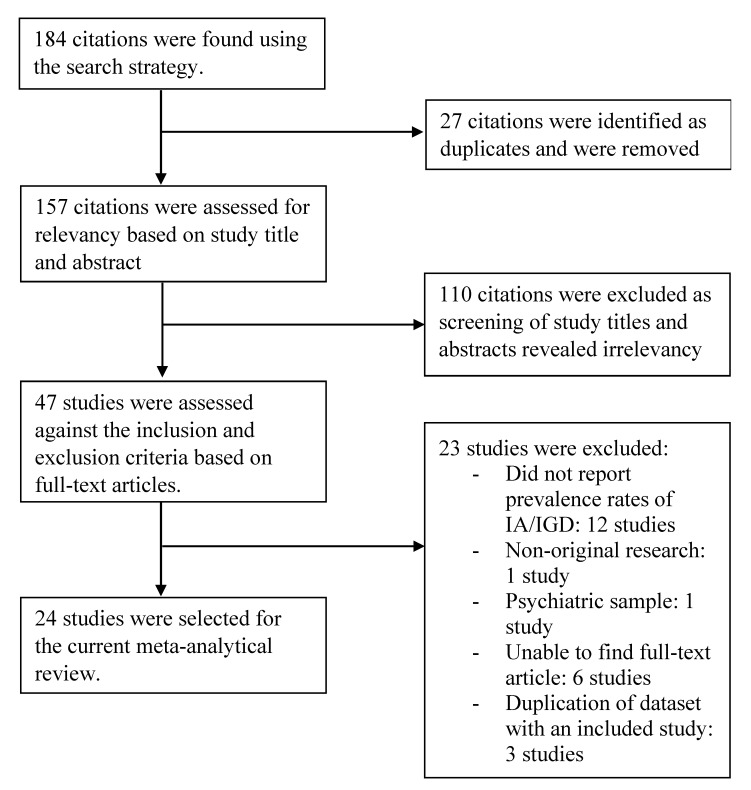
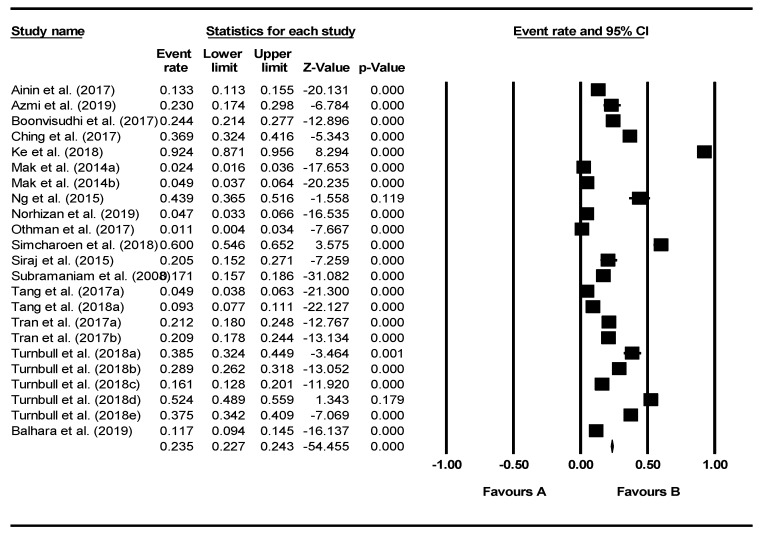
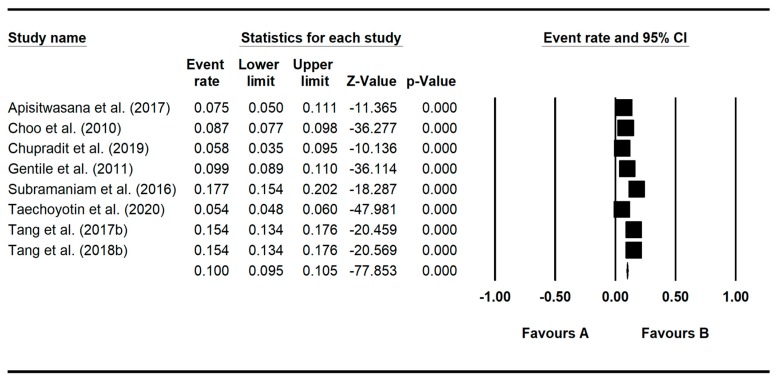
This meta-analytic review aimed to examine the pooled prevalence rates of Internet addiction and gaming disorders in Southeast Asia. Several databases including PubMed, MEDLINE, PsycINFO, Web of Science, Embase, and Cochrane Central were searched and a total of 24 studies were included in this study. The selection of studies was conducted in accordance to the preferred reporting items for systematic reviews and meta-analyses (PRISMA) guidelines. Two meta-analyses were conducted to examine data on Internet addiction and gaming disorders separately. A random-effects model was employed to derive the pooled prevalence rate. Mixed-effects meta-regression and subgroup analyses were performed to examine the moderators of the between-study heterogeneity. Publication bias was tested using the Egger’s regression test and funnel plot. Only seven out of the 11 Southeast Asian countries were represented in the literature. All except for two of the included studies were cross-sectional in nature. The findings revealed a pooled prevalence rate of 20.0% (95% confidence interval: 14.5%–27.0%) and 10.1% (95% confidence interval: 7.3%–13.8%) for Internet addiction and gaming disorders respectively. Mean age and study population were significant moderators of the between-study heterogeneity in the prevalence rates of gaming disorders such that samples involving older participants showed higher prevalence rate than those involving younger individuals. Country of study was found to be significant moderator of the between-heterogeneity for both Internet addiction and gaming disorders, however the findings should be interpreted with caution due to the small and unbalanced sample sizes. There was no significant publication bias. Such epidemiology research should be extended to the Southeast Asian countries that have not been studied or are under-studied. Given that the prevalence rates appear to be higher in Southeast Asia than in other world regions, future research should also explore the factors behind these inter-regional differences. Further longitudinal studies should also be conducted to examine the trajectories of such disorders.
Overview
The claims and statistics of this paper haven’t been checked yet.
Run the check — free, no account needed. It reads the open-access text and checks the sources it cites.
Integrity signals
Registry
Cites
Statistics
Figures
Verification
Claims the paper makes
The claims and statistics of this paper haven’t been checked yet.
Run the check — free, no account needed. It reads the open-access text and checks the sources it cites.
Self-check
Percentages, sums and reported differences re-computed from the paper’s own numbers.
The self-check needs the paper’s full text.
Citations
Cites
Measuring inconsistency in meta-analyses
Higgins, J. P. T., Thompson, S. G., Deeks, J. J., & Altman, D. G. (2003) · BMJ · doi:10.1136/bmj.327.7414.557 · Cited by 63,139
A basic introduction to fixed-effect and random-effects models for meta-analysis
Borenstein, M., Hedges, L. V., Higgins, J. P. T., & Rothstein, H. R. (2010) · Research Synthesis Methods · doi:10.1002/jrsm.12 · Cited by 6,793
Rethinking individualism and collectivism: Evaluation of theoretical assumptions and meta-analyses.
Oyserman, D., Coon, H. M., & Kemmelmeier, M. (2002) · Psychological Bulletin · doi:10.1037/0033-2909.128.1.3 · Cited by 5,758
Meta-analysis: Principles and procedures
Egger, M., Smith, G. D., & Phillips, A. N. (1997) · BMJ · doi:10.1136/bmj.315.7121.1533 · Cited by 2,415
Meta-Analysis: Recent Developments in Quantitative Methods for Literature Reviews
Rosenthal, R., & DiMatteo, M. R. (2001) · Annual Review of Psychology · doi:10.1146/annurev.psych.52.1.59 · Cited by 1,780
Does culture influence what and how we think? Effects of priming individualism and collectivism.
Oyserman, D., & Lee, S. W. S. (2008) · Psychological Bulletin · doi:10.1037/0033-2909.134.2.311 · Cited by 1,390
Internet addiction: a systematic review of epidemiological research for the last decade
Kuss, D., Griffiths, M., Karila, L., & Billieux, J. (2014) · Current Pharmaceutical Design · doi:10.2174/13816128113199990617 · Cited by 1,374
Pathological Video Game Use Among Youths: A Two-Year Longitudinal Study
Gentile, D. A., Choo, H., Liau, A., Sim, T., Li, D., Fung, D., & Khoo, A. (2011) · Pediatrics · doi:10.1542/peds.2010-1353 · Cited by 1,314
Internet Gaming Addiction: A Systematic Review of Empirical Research
Kuss, D. J., & Griffiths, M. D. (2012) · International Journal of Mental Health and Addiction · doi:10.1007/s11469-011-9318-5 · Cited by 1,113 · cited 1×
“Notably, there has been a proliferation of epidemiological studies done to establish the prevalence rates of Internet and gaming disorders globally [5,6].”
BackgroundPathological Video-Game Use Among Youth Ages 8 to 18
Gentile, D. A. (2009) · Psychological Science · doi:10.1111/j.1467-9280.2009.02340.x · Cited by 1,107
Cited by
Sorted by citations
Global prevalence of digital addiction in general population: A systematic review and meta-analysis
Meng, S.-Q., Cheng, J.-L., Li, Y.-Y., Yang, X.-Q., Zheng, J.-W., Chang, X.-W., Shi, Y., Chen, Y., Lu, L., Sun, Y., et al. (2022) · Clinical Psychology Review · doi:10.1016/j.cpr.2022.102128 · Cited by 622
Prevalence of gaming disorder: A meta-analysis
Kim, H. S., Son, G., Roh, E.-B., Ahn, W., Kim, J., Shin, S.-H., Chey, J., & Choi, K. (2021) · Addictive Behaviors · doi:10.1016/j.addbeh.2021.107183 · Cited by 328
Cai, Z., Mao, P., Wang, Z., Wang, D., He, J., & Fan, X. (2023) · Adolescent Research Review · doi:10.1007/s40894-022-00201-9 · Cited by 192
Liao, Z., Huang, Q., Huang, S., Tan, L., Shao, T., Fang, T., Chen, X., Lin, S., Qi, J., Cai, Y., et al. (2020) · Frontiers in Psychiatry · doi:10.3389/fpsyt.2020.598585 · Cited by 142
Rehman, W. U., Bhatti, A. R., Awan, A. B., Sajjad, I. A., Khan, A. A., Bo, R., Haroon, S. S., Amin, S., Tlili, I., & Oboreh-Snapps, O. (2020) · IEEE Access · doi:10.1109/access.2020.3022738 · Cited by 113
Metadata
- Authors
- Chia, D. X. Y., Ng, C. W. L., Kandasami, G., Seow, M. Y. L., Choo, C. C., Chew, P. K. H., Lee, C., & Zhang, M. W. B.
- Affiliations
- Institute of Mental Health (SG)
- James Cook University Singapore (SG)
- University of Waikato (NZ)
- James Cook University (AU)
- Nanyang Technological University (SG)
- Corresponding author
- Zhang, Melvyn W. B.
- Venue
- International Journal of Environmental Research and Public Health
- Publisher
- MDPI AG
- Published
- 2020-04-09
- Volume
- 17
- Issue
- 7
- Pages
- 2582
- ISSN
- 1660-4601 (ISSN-L)
- PMC
- PMC7177828
- OpenAlex
- W3015987463
- Cited by
- 190
- References
- 45
- Citations by year
- 2026: 9 · 2025: 47 · 2024: 31 · 2023: 32 · 2022: 40 · 2021: 28 · 2020: 3
- FWCI
- 4.53
- Type
- journal article
- Language
- en
- Open access
- gold
- dx.doi.org
- Licence
- Locations
- International Journal of Environmental Research and Public Health (publishedVersion, cc-by)
- PubMed Central (publishedVersion, cc-by)
- PubMed (publishedVersion)
- ResearchOnline - JCU (James Cook University) (submittedVersion)
- Research Commons (University of Waikato) (submittedVersion, cc-by)
- RePEc: Research Papers in Economics (submittedVersion)
- DOAJ (DOAJ: Directory of Open Access Journals) (submittedVersion, cc-by-sa)
- DR-NTU (Nanyang Technological University) (submittedVersion, cc-by)
- Topics
- Social Sciences › Sociology and Political Science › Impact of Technology on Adolescents
- Social Sciences › Psychology › Clinical Psychology › Gambling Behavior and Treatments
- Social Sciences › Psychology › Clinical Psychology › Sexuality, Behavior, and Technology
- Keywords
- internet addiction, gaming disorder, prevalence, Southeast Asia, age as moderator, regional variation, gambling addiction, internet gaming disorder
- MeSH terms
- Adolescent, Adult, Asia, Southeastern, Child, Cross-Sectional Studies, Female, Humans, Male, Prevalence, Behavior, Addictive, Video Games, Internet
About these checks
Registry, retraction, Cites and statistics results are computed, not judged, with one exception: a printed reference that no index lists is read once by a model before it counts as a citation error. Claims are extracted by a model and kept only when their quote appears verbatim in the text; each cited source is then checked, with a model’s help, for whether it says what the claim relies on. Those verdicts can be wrong — read the claim’s quote and the cited source before relying on one.
Statistics and arithmetic are recomputed, not judged.
Confidence bands are shown only for fields calibrated on our annotated test set. None is calibrated yet, so no band is shown.
What counts as a claim ›How we measure confidence ›How we check this ›
Are you an author, or do you see a problem with this page? Request a review
