

The DOI matches its Crossref record; 76 of the 76 references it cites were found in a registry or an index.
Nomophobia: Is the Fear of Being without a Smartphone Associated with Problematic Use?
Open accessAbstract
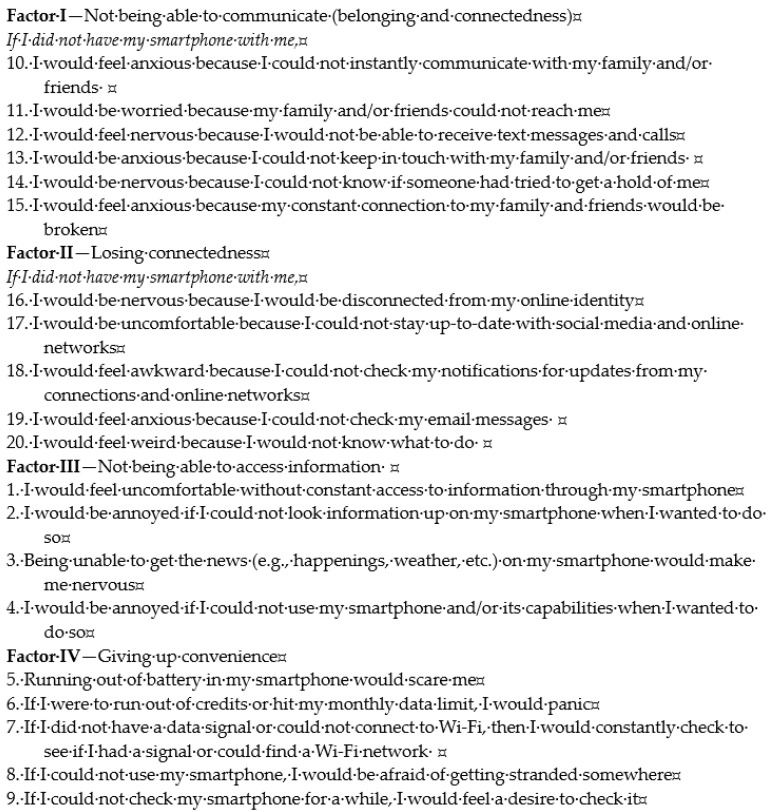
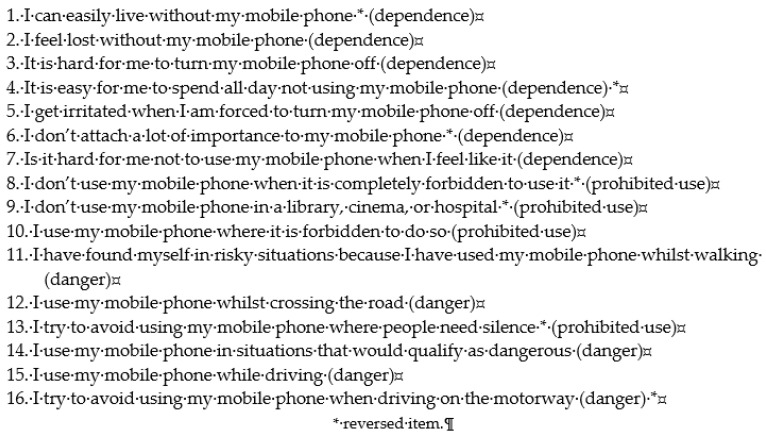
Mobile phones are changing behaviour, relationships, communication and the dynamics of physical environments. As such, reliance on the device for everyday activities has increased. Consequently, “nomophobia”, defined as the fear of being without one’s mobile phone, has emerged as a new phobia. The current study aimed to determine if nomophobia can increase the likelihood of problematic dependent, prohibited and dangerous mobile phone use. The sample comprised 2838 participants (males n = 1337 females n = 1501) recruited from various online platforms. The instrument used to measure nomophobia was the Nomophobia Questionnaire (NMP-Q), while problematic mobile phone use was measured using the Problematic Mobile Phone Use Questionnaire (PMPUQ-R). The findings revealed a strong positive correlation between nomophobia and all three problematic use factors. In addition to nomophobia, regression models revealed younger age and more time spent on a mobile phone per day significantly increased problematic dependency, prohibited use and dangerous use. Males were more likely to engage in prohibited and dangerous use, while no significant gender differences were found in dependent use. These findings support the need for further research into the relationship between nomophobia and specific aspects of problematic mobile phone use, such as using a mobile phone while driving.
Overview
The claims and statistics of this paper haven’t been checked yet.
Run the check — free, no account needed. It reads the open-access text and checks the sources it cites.
Integrity signals
Registry
Cites
Statistics
Figures
Verification
Claims the paper makes
The claims and statistics of this paper haven’t been checked yet.
Run the check — free, no account needed. It reads the open-access text and checks the sources it cites.
Claims other papers make about this one
Each is checked against this paper’s own text: does it say what the citing paper says it does?
The source backs part of the claim, not all of it — or backs it for a different population, condition or comparison.
In the citing paper
“Therefore, nomophobia is now considered an antecedent variable or predictor of problematic social media use, in which fear (not being able to communicate or access these media) increases negative consequences for users (Kaviani et al., 2020).”
From Problematic use of social media in adolescents or excessive social gratification? The mediating role of nomophobia (2024) · cites this paper as Kaviani et al., 2020
Experimental — accuracy not yet measuredThe source backs part of the claim, not all of it — or backs it for a different population, condition or comparison.
In the citing paper
“Significantly, the fear of not being connected to social networks can increase the negative consequences of excessive or inappropriate social media use among adolescents (Galhardo et al., 2020;Kaviani et al., 2020).”
From Problematic use of social media in adolescents or excessive social gratification? The mediating role of nomophobia (2024) · cites this paper as Kaviani et al., 2020
Experimental — accuracy not yet measuredThe source backs part of the claim, not all of it — or backs it for a different population, condition or comparison.
In the citing paper
“The positive and significant relationship between social use and nomophobia (β = .53,p < .001)indicates that the constant gratification obtained using social networks produces negative consequences on the well-being of adolescents, such as the fear of not being connected or a negative mood (Galhardo et al., 2020;Kaviani et al., 2020).”
From Problematic use of social media in adolescents or excessive social gratification? The mediating role of nomophobia (2024) · cites this paper as Kaviani et al., 2020
Experimental — accuracy not yet measured
Self-check
Percentages, sums and reported differences re-computed from the paper’s own numbers.
The self-check needs the paper’s full text.
Citations
Cites
Perpetual Contact: Notes on the contributors
Katz, J., & Aakhus, M. (2002) · Cambridge University Press eBooks · doi:10.1017/cbo9780511489471 · Cited by 1,283
Relationships among smartphone addiction, stress, academic performance, and satisfaction with life
Samaha, M., & Hawi, N. S. (2016) · Computers in Human Behavior · doi:10.1016/j.chb.2015.12.045 · Cited by 1,246
Billieux, J., Maurage, P., Lopez-Fernandez, O., Kuss, D. J., & Griffiths, M. D. (2015) · Current Addiction Reports · doi:10.1007/s40429-015-0054-y · Cited by 1,205
A dual systems model of adolescent risk‐taking
Steinberg, L. (2010) · Developmental Psychobiology · doi:10.1002/dev.20445 · Cited by 1,187 · cited 2×
“Indeed, prohibited use requires greater risk taking, which males [52] and younger people [53] are more inclined to do.”
BackgroundThe future of mental health care: peer-to-peer support and social media
Naslund, J. A., Aschbrenner, K. A., Marsch, L. A., & Bartels, S. J. (2016) · Epidemiology and Psychiatric Sciences · doi:10.1017/s2045796015001067 · Cited by 1,180
Exploring the dimensions of nomophobia: Development and validation of a self-reported questionnaire
Yildirim, C., & Correia, A.-P. (2015) · Computers in Human Behavior · doi:10.1016/j.chb.2015.02.059 · Cited by 1,106
Modeling habitual and addictive smartphone behavior
van Deursen, A. J. A. M., Bolle, C. L., Hegner, S. M., & Kommers, P. A. M. (2015) · Computers in Human Behavior · doi:10.1016/j.chb.2014.12.039 · Cited by 1,031
Smartphone use and smartphone addiction among young people in Switzerland
Haug, S., Castro, R. P., Kwon, M., Filler, A., Kowatsch, T., & Schaub, M. P. (2015) · Journal of Behavioral Addictions · doi:10.1556/2006.4.2015.037 · Cited by 903
Converging Conventions of Comfort, Cleanliness and Convenience
Shove, E. (2003) · Journal of Consumer Policy · doi:10.1023/a:1026362829781 · Cited by 723
Cell-phone addiction: a review
De-Sola Gutiérrez, J., Rodríguez de Fonseca, F., & Rubio, G. (2016) · Frontiers in Psychiatry · doi:10.3389/fpsyt.2016.00175 · Cited by 722
Research works printed but not linked: 3
- Bauman, Z. (2001). The Individualized Society, Polity Press.
- Bauman, Z. (2000). Liquid Modernity, Polity Press.
- Bennington, G., and Massumi, B. (1984). The Postmodern Condition: A Report on Knowledge, Manchester University Press.
Cited by
Sorted by citations
Osorio-Molina, C., Martos-Cabrera, M. B., Membrive‐Jiménez, M. J., Vargas-Román, K., Suleiman‐Martos, N., Ortega‐Campos, E., & Gómez‐Urquiza, J. L. (2020) · Nurse Education Today · doi:10.1016/j.nedt.2020.104741 · Cited by 169
Humood, A. M., Altooq, N. J., Altamimi, A. D., Almoosawi, H., Alzafiri, M., Bragazzi, N. L., Husni, M., & Jahrami, H. (2021) · Psych · doi:10.3390/psych3020019 · Cited by 106
Jahrami, H. A., Trabelsi, K., Boukhris, O., Hussain, J. H., Alenezi, A. F., Humood, A., Saif, Z., Pandi-Perumal, S., & Seeman, M. (2022) · Behavioral Science · doi:10.3390/bs13010035 · Cited by 68
Problematic smartphone usage, prevalence and patterns among university students: A systematic review
Candussi, C. J., Kabir, R., & Sivasubramanian, M. (2023) · Journal of Affective Disorders Reports · doi:10.1016/j.jadr.2023.100643 · Cited by 83
Zhou, Z., Liu, H., Zhang, D., Wei, H., Zhang, M., & Huang, A. (2022) · Nurse Education Today · doi:10.1016/j.nedt.2022.105471 · Cited by 61
Metadata
- Authors
- Kaviani, F., Robards, B., Young, K. L., & Koppel, S.
- Affiliations
- Monash University (AU)
- Corresponding author
- Kaviani, Fareed
- Venue
- International Journal of Environmental Research and Public Health
- Publisher
- MDPI AG
- Published
- 2020-08-19
- Volume
- 17
- Issue
- 17
- Pages
- 6024
- ISSN
- 1660-4601 (ISSN-L)
- PMC
- PMC7504166
- OpenAlex
- W3050290818
- Cited by
- 120
- References
- 76
- Citations by year
- 2026: 17 · 2025: 27 · 2024: 28 · 2023: 20 · 2022: 18 · 2021: 8 · 2020: 2
- FWCI
- 16.05
- Type
- journal article
- Language
- en
- Open access
- gold
- doi.org
- Licence
- Locations
- International Journal of Environmental Research and Public Health (publishedVersion, cc-by)
- PubMed Central (publishedVersion, cc-by)
- PubMed (publishedVersion)
- Monash University Research Portal (Monash University) (submittedVersion, cc-by)
- RePEc: Research Papers in Economics (submittedVersion)
- DOAJ (DOAJ: Directory of Open Access Journals) (submittedVersion)
- Funders
- Australian Government
- Monash University
- Topics
- Social Sciences › Sociology and Political Science › Impact of Technology on Adolescents
- Social Sciences › Education › Child Development and Digital Technology
- Social Sciences › Psychology › Clinical Psychology › Sexuality, Behavior, and Technology
- Keywords
- nomophobia, problematic mobile phone use, smartphone addiction, mobile phone use while driving, gender differences, age differences, daily screen time, Nomophobia Questionnaire
- MeSH terms
- Smartphone, Cell Phone Use, Adolescent, Adult, Fear, Female, Humans, Male, Middle Aged, Phobic Disorders, Surveys and Questionnaires, Young Adult
About these checks
Registry, retraction, Cites and statistics results are computed, not judged, with one exception: a printed reference that no index lists is read once by a model before it counts as a citation error. Claims are extracted by a model and kept only when their quote appears verbatim in the text; each cited source is then checked, with a model’s help, for whether it says what the claim relies on. Those verdicts can be wrong — read the claim’s quote and the cited source before relying on one.
Statistics and arithmetic are recomputed, not judged.
Confidence bands are shown only for fields calibrated on our annotated test set. None is calibrated yet, so no band is shown.
What counts as a claim ›How we measure confidence ›How we check this ›
Are you an author, or do you see a problem with this page? Request a review
