

The association between green space and adolescents' mental well-being: a systematic review
Open accessThe DOI matches its Crossref record; 116 of the 116 references it cites were found in a registry or an index.
Abstract
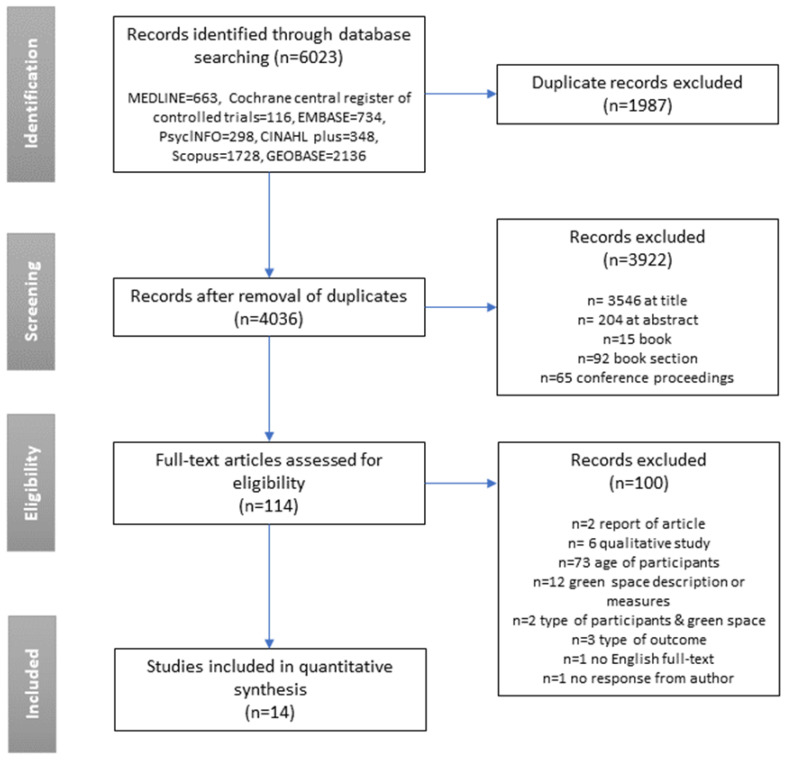
This systematic review summarised and evaluated the evidence for associations between green space and adolescents’ mental well-being. The PRISMA statement guidelines were followed for reporting systematic reviews. Fourteen articles met the inclusion criteria for this review. Synthesis suggests beneficial associations between green space exposure and reduced stress, positive mood, less depressive symptoms, better emotional well-being, improved mental health and behaviour, and decreased psychological distress in adolescents. Several studies found the relationship varied by demographic and socio-economic factors. The limited number of studies and the risk of bias were the main limitations, together with heterogeneity regarding green space and mental well-being assessments. Overall, this review highlights the potential contribution of green space in schoolyards. Improving the availability, accessibility and quality of green space is likely to generate positive impacts on adolescents’ mental well-being. More consistent evidence on the use of different types of green space and perceptions of features are needed in the future.
Overview
The claims and statistics of this paper haven’t been checked yet.
Free: it reads the open-access text and checks the first 5 claims that cite a source we can check. Create a free account to check every claim.
Integrity signals
Registry
Cites
Statistics
Figures
Verification
Claims the paper makes
The claims and statistics of this paper haven’t been checked yet.
Free: it reads the open-access text and checks the first 5 claims that cite a source we can check. Create a free account to check every claim.
Claims other papers make about this one
Each is checked against this paper’s own text: does it say what the citing paper says it does?
The cited source says what the claim attributes to it.
In the citing paper
“Previous literature reviews focusing on younger people refer to theories developed in relation to adults (Zhang et al., 2020).”
From Exploring the role of exposure to green and blue spaces in preventing anxiety and depression among young people aged 14–24 years living in urban settings: A systematic review and conceptual framework (2022) · cites this paper as Zhang et al., 2020
Self-check
Percentages, sums and reported differences re-computed from the paper’s own numbers.
The self-check needs the paper’s full text.
Citations
Cites
On Happiness and Human Potentials: A Review of Research on Hedonic and Eudaimonic Well-Being
Ryan, R. M., & Deci, E. L. (2001) · Annual Review of Psychology · doi:10.1146/annurev.psych.52.1.141 · Cited by 11,567 · cited 1×
“Mental well-being is a fundamental component of health and quality of life, encompassing aspects of hedonic and eudaimonic well-being [1,2].”
BackgroundKirschbaum, C., Pirke, K.-M., & Hellhammer, D. H. (2008) · Neuropsychobiology · doi:10.1159/000119004 · Cited by 6,093 · cited 1×
“The results demonstrate that classroom views onto green space increased students’ recovery from a modified Trier Social Stress Test [57].”
BackgroundHartig, T., Mitchell, R., de Vries, S., & Frumkin, H. (2014) · Annual Review of Public Health · doi:10.1146/annurev-publhealth-032013-182443 · Cited by 3,638 · cited 4×
“Individuals’ subjective perception of green space also vary across sociocultural contexts [30].”
BackgroundInfluentialEncyclopedia of Survey Research Methods
Lavrakas, P. (2008) · doi:10.4135/9781412963947 · Cited by 2,689
Exploring pathways linking greenspace to health: theoretical and methodological guidance
Markevych, I., Schoierer, J., Hartig, T., Chudnovsky, A., Hystad, P., Dzhambov, A. M., de Vries, S., Triguero-Mas, M., Brauer, M., Nieuwenhuijsen, M. J., et al. (2017) · Environmental Research · doi:10.1016/j.envres.2017.06.028 · Cited by 2,543 · cited 1×
“Theories and recent studies from adults indicated that the perception of green space, physical activity and social cohesion can mediate the relationship between green space and mental well-being [30,84,85].”
BackgroundA systematic review of evidence for the added benefits to health of exposure to natural environments
Bowler, D. E., Buyung-Ali, L. M., Knight, T. M., & Pullin, A. S. (2010) · BMC Public Health · doi:10.1186/1471-2458-10-456 · Cited by 1,993 · cited 2×
“Matsuoka [97] indicated that not all types of green space are beneficial for high school students and some studies have shown that benefits depend on the quality of green spaces [38,87,98].”
BackgroundThompson Coon, J., Boddy, K., Stein, K., Whear, R., Barton, J., & Depledge, M. H. (2011) · Environmental Science & Technology · doi:10.1021/es102947t · Cited by 1,391
Social contacts as a possible mechanism behind the relation between green space and health
Maas, J., van Dillen, S. M. E., Verheij, R. A., & Groenewegen, P. P. (2009) · Health & Place · doi:10.1016/j.healthplace.2008.09.006 · Cited by 1,195
Gascon, M., Triguero-Mas, M., Martínez, D., Dadvand, P., Forns, J., Plasència, A., & Nieuwenhuijsen, M. (2015) · International Journal of Environmental Research and Public Health · doi:10.3390/ijerph120404354 · Cited by 1,171 · cited 2×
“The quality of included studies was evaluated using the Lachowycz and Jones [46] methodological quality assessment tool as employed in the previous similar review [34].”
MethodGreen space as a buffer between stressful life events and health
van den Berg, A. E., Maas, J., Verheij, R. A., & Groenewegen, P. P. (2010) · Social Science & Medicine · doi:10.1016/j.socscimed.2010.01.002 · Cited by 1,126
Research works printed but not linked: 2
- 77. Openshaw, S. The Modifiable Areal Unit problem. In Quantitative Geography: A British View; Routledge & Kegan Paul: London, UK, 1981; pp. 60-69.
- Oldenburg, R. (1999). The Great Good Place: Cafes, Coffee Shops, Bookstores, Bars, Hair Salons, and Other Hangouts at the Heart of a Community, Da Capo Press.
Cited by
The social determinants of mental health and disorder: evidence, prevention and recommendations
Kirkbride, J. B., Anglin, D. M., Colman, I., Dykxhoorn, J., Jones, P. B., Patalay, P., Pitman, A., Soneson, E., Steare, T., Wright, T., et al. (2024) · World Psychiatry · doi:10.1002/wps.21160 · Cited by 1,253
Greenspace and human health: An umbrella review
Yang, B.-Y., Zhao, T., Hu, L.-X., Browning, M. H. E. M., Heinrich, J., Dharmage, S. C., Jalaludin, B., Knibbs, L. D., Liu, X.-X., Luo, Y.-N., et al. (2021) · The Innovation · doi:10.1016/j.xinn.2021.100164 · Cited by 313
“Zhang et al.(9,19) Y Y Y Y Y N N Y N N N/A N/A Y Y N/A Y”
InfluentialNature and Children’s Health: A Systematic Review
Fyfe-Johnson, A. L., Hazlehurst, M. F., Perrins, S. P., Bratman, G. N., Thomas, R., Garrett, K. A., Hafferty, K. R., Cullaz, T. M., Marcuse, E. K., & Tandon, P. S. (2021) · Pediatrics · doi:10.1542/peds.2020-049155 · Cited by 181
How Does Urban Green Space Impact Residents’ Mental Health: A Literature Review of Mediators
Kai-li, C., Zhang, T., Liu, F., Zhang, Y., & Song, Y. (2021) · International Journal of Environmental Research and Public Health · doi:10.3390/ijerph182211746 · Cited by 194
“still need to be addressed in this research field are the causes and mediators of green space’s beneficial effects [7,8].”
BackgroundSelf-citationGreen Gentrification and Health: A Scoping Review
Jelks, N. O., Jennings, V., & Rigolon, A. (2021) · International Journal of Environmental Research and Public Health · doi:10.3390/ijerph18030907 · Cited by 142
Green space exposure on depression and anxiety outcomes: A meta-analysis
Liu, Z., Chen, X., Cui, H., Ma, Y., Gao, N., Li, X., Meng, X., Lin, H., Abudou, H., Guo, L., et al. (2023) · Environmental Research · doi:10.1016/j.envres.2023.116303 · Cited by 155
Bray, I., Reece, R., Sinnett, D., Martin, F., & Hayward, R. (2022) · Environmental Research · doi:10.1016/j.envres.2022.114081 · Cited by 124
“Further relevant studies were added from reference lists of previously published systematic reviews (McCormick, 2017; Tillmann et al., 2018; Vanaken and Danck-aerts, 2018; Zhang et al., 2020).”
BackgroundLehberger, M., Kleih, A., & Sparke, K. (2021) · Landscape and Urban Planning · doi:10.1016/j.landurbplan.2021.104108 · Cited by 118
Sakhvidi, M. J. Z., Mehrparvar, A. H., Sakhvidi, F. Z., & Dadvand, P. (2023) · Current Opinion in Environmental Science & Health · doi:10.1016/j.coesh.2023.100445 · Cited by 108
Greenspace and health outcomes in children and adolescents: A systematic review
Ye, T., Yu, P., Wen, B., Yang, Z., Huang, W., Guo, Y., Abramson, M. J., & Li, S. (2022) · Environmental Pollution · doi:10.1016/j.envpol.2022.120193 · Cited by 102
Visible green space predicts emotion: Evidence from social media and street view data
Wang, R., Browning, M. H. E. M., Qin, X., He, J., Wu, W., Yao, Y., & Liu, Y. (2022) · Applied Geography · doi:10.1016/j.apgeog.2022.102803 · Cited by 79
The urban public realm and adolescent mental health and wellbeing: A systematic review
Fleckney, P., & Bentley, R. (2021) · Social Science & Medicine · doi:10.1016/j.socscimed.2021.114242 · Cited by 86
Trauma-Informed Design of Supported Housing: A Scoping Review through the Lens of Neuroscience
Owen, C., & Crane, J. W. (2022) · International Journal of Environmental Research and Public Health · doi:10.3390/ijerph192114279 · Cited by 68
The Potential for Outdoor Nature-Based Interventions in the Treatment and Prevention of Depression
Owens, M., & Bunce, H. L. I. (2022) · Frontiers in Psychology · doi:10.3389/fpsyg.2022.740210 · Cited by 59
Nguyen, N. T., Collins, A., & Collins, C. M. (2023) · Environmental Science & Policy · doi:10.1016/j.envsci.2023.103642 · Cited by 62
How university blue and green space affect students’ mental health: A scoping review
Aghabozorgi, K., van der Jagt, A., Bell, S., & Smith, H. C. (2024) · Urban forestry & urban greening · doi:10.1016/j.ufug.2024.128394 · Cited by 71
Associations Between Urban Green Space Quality and Mental Wellbeing: Systematic Review
Xu, Z., Marini, S., Mauro, M., Latessa, P. M., Grigoletto, A., & Toselli, S. (2025) · Land · doi:10.3390/land14020381 · Cited by 72
Influence of Green Areas on the Urban Sound Environment
Gozalo, G. R., Morillas, J. M. B., González, D. M., & Vílchez-Gómez, R. (2023) · Current Pollution Reports · doi:10.1007/s40726-023-00284-5 · Cited by 67
“Improved mental health [20], reduced cardiovascular morbidity and mortality [21, 22 • ], obesity and risk of type 2 diabetes [23, 24], and better pregnancy outcomes [25] are some of the beneficial effects of urban green spaces reported in current studies and evidenced in a 2016 report by the WHO…”
Roche, I. V., Ubalde-López, M., Daher, C., Nieuwenhuijsen, M. J., & Gascón, M. (2024) · Current Environmental Health Reports · doi:10.1007/s40572-024-00431-0 · Cited by 66
Yu, C., & Kwan, M. (2024) · Health & Place · doi:10.1016/j.healthplace.2024.103213 · Cited by 60
He, F., Wei, J., Dong, Y., Liu, C., Zhao, K., Peng, W., Lu, Z., Zhang, B., Xue, F., Guo, X., et al. (2022) · The Science of The Total Environment · doi:10.1016/j.scitotenv.2022.158046 · Cited by 59
Effect of nature on the mental health and well-being of children and adolescents: meta-review
Lomax, T., Butler, J. A., Cipriani, A., & Singh, I. (2024) · The British Journal of Psychiatry · doi:10.1192/bjp.2024.109 · Cited by 58
Ly, V., & Vella‐Brodrick, D. (2024) · Educational Psychology Review · doi:10.1007/s10648-024-09963-1 · Cited by 58
“…exploring the impact of nature on children’s and adolescents’ wellbeing often include a wide range of nature interventions, such as residential greenspace, neighbourhood parks, and school greenspace (e.g., Mygind et al., 2019; Roberts et al., 2020; Vanaken & Danckaerts, 2018; Zhang et al., 2020).”
Hutson, P., & Hutson, J. (2023) · Journal of Organizational Psychology · doi:10.33423/jop.v23i2.6159 · Cited by 64
Smith, M., Cui, J., Ikeda, E., Mavoa, S., Hasanzadeh, K., Zhao, J., Rinne, T. E., Donnellan, N., & Kyttä, M. (2020) · Health & Place · doi:10.1016/j.healthplace.2020.102489 · Cited by 48
“A study-specific data chart was developed, drawing from the environmental quality measures framework presented in Zhang et al. (Zhang et al., 2020) and the Spatial Lifecourse Epidemiology Reporting Standards (ISLE-ReST) statement (Jia et al., 2019).”
BackgroundMethodSelf-citationOutdoor artificial light at night: A forgotten factor in green space and health research
Stanhope, J., Liddicoat, C., & Weinstein, P. (2021) · Environmental Research · doi:10.1016/j.envres.2021.111012 · Cited by 49
Demand Priority of Green Space from the Perspective of Carbon Emissions and Storage
Xu, L., Fang, K., Huang, Y. J., & Xu, S. (2023) · Sustainability · doi:10.3390/su151411199 · Cited by 44
Arriazu-Ramos, A., Santamaría, J. M., Monge-Barrio, A., Bes‐Rastrollo, M., Gutiérrez, S., Frias, N. B., & Gutiérrez, A. S.-O. (2025) · Sustainability · doi:10.3390/su17104336 · Cited by 50
Mapping urban green equity and analysing its impacted mechanisms: A novel approach
Cao, Y., Li, Y., Shen, S., Wang, W., Peng, X., Chen, J., Liao, J., Lv, X., Liu, Y., Ma, L., et al. (2023) · Sustainable Cities and Society · doi:10.1016/j.scs.2023.105071 · Cited by 45
Dong, X., & Geng, L. (2023) · Journal of Environmental Psychology · doi:10.1016/j.jenvp.2023.101995 · Cited by 50
Suicide and Transportation Noise: A Prospective Cohort Study from Switzerland
Wicki, B., Schäffer, B., Wunderli, J. M., Müller, T., Pervilhac, C., Röösli, M., & Vienneau, D. (2023) · Environmental Health Perspectives · doi:10.1289/ehp11587 · Cited by 44
“39 Multiple pathways are posited for this positive association, including that greener living environments or green space availability encourage healthy behavior, and that such factors can aid in stress relief.”
Green spaces for mental disorders
Wood, C., Wicks, C. L., & Barton, J. (2022) · Current Opinion in Psychiatry · doi:10.1097/yco.0000000000000830 · Cited by 43
“[27] reported reduced stress and depression and improved mood, emotional wellbeing and mental health in young people with greater green space exposure.”
BackgroundEllyatt, W. (2022) · Challenges · doi:10.3390/challe13020058 · Cited by 47
Urban landscape and climate affect residents’ sentiments based on big data
He, H., Sun, R., Li, J., & Li, W. (2023) · Applied Geography · doi:10.1016/j.apgeog.2023.102902 · Cited by 41
Zhang, X., Wei, F., Yu, Z., Guo, F., Wang, J., Jin, M., Shui, L., Lin, H., Tang, M., & Chen, K. (2021) · The Science of The Total Environment · doi:10.1016/j.scitotenv.2021.152372 · Cited by 37
Physical education and student well-being: Promoting health and fitness in schools
Sun, H., Du, C.-R., & Wei, Z.-F. (2024) · PLoS ONE · doi:10.1371/journal.pone.0296817 · Cited by 48
“According to Zhang, Mavoa [29], although many students participate in sports, they must improve their health.”
BackgroundShrestha, T., Chi, C. V. Y., Cassarino, M., Foley, S., & Blasi, Z. D. (2025) · Environment International · doi:10.1016/j.envint.2024.109217 · Cited by 40
Long-term exposure to greenspace and anxiety from preschool and primary school children
de la Osa, N., Navarro, J. B., Penelo, E., Valentí, A., Ezpeleta, L., & Dadvand, P. (2023) · Journal of Environmental Psychology · doi:10.1016/j.jenvp.2023.102207 · Cited by 37
Zhang, Y., Zhao, J., Mavoa, S., & Smith, M. (2024) · Cities · doi:10.1016/j.cities.2024.104972 · Cited by 35
Self-citationAccessibility Improvement and Renewal of Urban Park Green Space for the Elderly and the Disabled
Zhang, R., Huang, L., & Wang, H. (2023) · Forests · doi:10.3390/f14091801 · Cited by 36
Lin, Y., Wood, S. A., & Lawler, J. J. (2022) · Landscape and Urban Planning · doi:10.1016/j.landurbplan.2022.104539 · Cited by 32
Yang, W., Yang, R., & Li, X. (2023) · Journal of Urban Health · doi:10.1007/s11524-023-00756-5 · Cited by 33
Adolescents’ perceptions of park characteristics that discourage park visitation
Rivera, E., Timperio, A. F., Loh, V. H. Y., Deforche, B. I., & Veitch, J. (2022) · Urban forestry & urban greening · doi:10.1016/j.ufug.2022.127669 · Cited by 28
Feltynowski, M. (2023) · Land Use Policy · doi:10.1016/j.landusepol.2023.106570 · Cited by 28
Lee, J., & Kwon, K. H. (2023) · Sustainability · doi:10.3390/su151713247 · Cited by 30
Ricciardi, E., Spano, G., Tinella, L., Lopez, A., Clemente, C., Bosco, A., & Caffò, A. O. (2023) · International Journal of Environmental Research and Public Health · doi:10.3390/ijerph20085540 · Cited by 29
A systematic review on the relationship between the built environment and children’s quality of life
Kodali, H., Hitch, L., Dunlap, A. F., Starvaggi, M., Wyka, K., & Huang, T. T. ‐. (2023) · BMC Public Health · doi:10.1186/s12889-023-17388-8 · Cited by 33
“Similarly, green space accessibility and use have been shown to improve mental health by reducing stress, promoting resilience, and improving mood [18, 19].”
BackgroundSystematic Review: Landscape Characteristics Correlated with Physical Activity of the Elderly People
Li, D., Xu, H., Kang, Y., & Steemers, K. (2023) · Land · doi:10.3390/land12030605 · Cited by 32
Is green space exposure beneficial in a developing country?
Asri, A. K., Lee, H., Pan, W., Tsai, H., Chang, H.-T., Lung, S. C., Su, H.-J. J., Yu, C.-P., Ji, J. S., Wu, C., et al. (2021) · Landscape and Urban Planning · doi:10.1016/j.landurbplan.2021.104226 · Cited by 27
Wang, J., Liu, N., Zou, J., Guo, Y., & Chen, H. (2023) · Frontiers in Public Health · doi:10.3389/fpubh.2023.1232216 · Cited by 24
Kodali, H., Ferris, E., Wyka, K., Evenson, K. R., Dorn, J. M., Thorpe, L. E., & Huang, T. T. ‐. (2023) · Frontiers in Public Health · doi:10.3389/fpubh.2023.1038288 · Cited by 26
Fleckney, P. (2023) · Landscape and Urban Planning · doi:10.1016/j.landurbplan.2023.104753 · Cited by 28
Patwary, M. M., Bardhan, M., Browning, M. H. E. M., Astell‐Burt, T., van den Bosch, M. A., Dong, J., Dzhambov, A. M., Dadvand, P., Fasolino, T. K., Markevych, I., et al. (2023) · The Science of The Total Environment · doi:10.1016/j.scitotenv.2023.169635 · Cited by 28
“…park, natural environments, land use, land cover, exposure to nature, nature exposure, and nature contact selected from prior reviews (de Keijzer, Bauwelinck and Dadvand, 2020; Zhang et al. , 2020; Vella-Brodrick and Gilowska, 2022; Buczyłowska et al. , 2023; Zare Sakhvidi et al. , 2023).”
BackgroundAnyanwu, C., & Beyer, K. M. M. (2024) · Social Sciences & Humanities Open · doi:10.1016/j.ssaho.2024.100845 · Cited by 30
“The link between greenspace and health benefits such as mental wellbeing is strong (Barton & Rogerson, 2017; Zhang et al., 2020).”
BackgroundElevating the Role of the Outdoor Environment for Adolescent Wellbeing in Everyday Life
Wales, M., Mårtensson, F., Hoff, E. V., & Jansson, M. (2022) · Frontiers in Psychology · doi:10.3389/fpsyg.2022.774592 · Cited by 28
Cernicova-Bucă, M., Gherheș, V., & Obrad, C. (2023) · Land · doi:10.3390/land12030689 · Cited by 22
On how natural and urban soundscapes alter brain activity during cognitive performance
Stobbe, E., Lorenz, R. C., & Kühn, S. (2023) · Journal of Environmental Psychology · doi:10.1016/j.jenvp.2023.102141 · Cited by 27
Urban Adolescence: The Role of Neighbourhood Greenspace in Mental Well-Being
Mueller, M. A. E., & Flouri, E. (2021) · Frontiers in Psychology · doi:10.3389/fpsyg.2021.712065 · Cited by 23
“Therefore, although the link is certainly plausible, the evidence to date is inconclusive (for reviews, see Vanaken and Danckaerts, 2018; Weeland et al., 2019b; Zhang et al., 2020).”
BackgroundRowley, M., Topciu, R. A., & Owens, M. (2022) · International Journal of Environmental Research and Public Health · doi:10.3390/ijerph191912649 · Cited by 23
“Other systematic reviews on the benefits of access to nature on mental health and wellbeing in children and adolescents report similar positive outcomes [6,20,23,24].”
BackgroundSupporting biodiversity: Structures of participatory actions in urban green spaces
Martens, D., Öztürk, Ö., Rindt, L., Twarok, J., Steinhardt, U., & Molitor, H. (2022) · Frontiers in Sustainable Cities · doi:10.3389/frsc.2022.952790 · Cited by 25
Greenery hypothesis: An evolutionary explanation for why presence/absence of green affects humans
Fukano, Y., & Soga, M. (2024) · People and Nature · doi:10.1002/pan3.10619 · Cited by 23
Advancing Understanding on Greenspace and Mental Health in Young People
Ryan, S. C., Sugg, M. M., Runkle, J. D., & Thapa, B. (2024) · GeoHealth · doi:10.1029/2023gh000959 · Cited by 25
“Less focus has been directed at additional mental health outcomes (Vanaken & Danckaerts, 2018); papers report conflicting findings, especially for young adults and adolescents (Mueller et al., 2023; Vanaken & Danckaerts, 2018; Zhang et al., 2020).”
BackgroundTesler, R., Endevelt, R., & Plaut, P. (2021) · Health Promotion International · doi:10.1093/heapro/daab145 · Cited by 20
Albaum, C. S., Chan, V., Sellitto, T., Vashi, N., Hastings, R. P., & Weiss, J. A. (2021) · International review of research in developmental disabilities · doi:10.1016/bs.irrdd.2021.08.003 · Cited by 23
Brons, M. E., Bolt, G., Helbich, M., Visser, K., & Stevens, G. W. J. M. (2022) · Health & Place · doi:10.1016/j.healthplace.2022.102765 · Cited by 20
Shareck, M., Aubé, E., & Sersli, S. (2023) · International Journal of Environmental Research and Public Health · doi:10.3390/ijerph20085474 · Cited by 21
“Public Health 2023, 20, 5474 13 of 20 with mental health are comparable to those of Zhang et al. (2020), even though we used a more fine-grained characterization of mental health and well-being outcomes [23].”
BackgroundMethodBolanis, D., Vergunst, F., Mavoa, S., Schmelefske, E., Khoury, B., Turecki, G., Orri, M., & Geoffroy, M. (2023) · The Science of The Total Environment · doi:10.1016/j.scitotenv.2023.167451 · Cited by 23
Self-citationCosta, M. S., Almeida, D. Q., Silva, J. P., Barros, H., Ribeiro, A. I., & Leão, T. I. C. (2024) · Cities & Health · doi:10.1080/23748834.2024.2313927 · Cited by 21
“2022), and lower stress levels (Zhang et al .”
Li, H., Browning, M. H. E. M., Bardhan, M., Ying, M., Zhang, X., Cao, Y., & Zhang, G. (2024) · International Journal of Environmental Health Research · doi:10.1080/09603123.2024.2334767 · Cited by 21
“This notion has been supported by numerous studies (McCormick 2017; Houlden et al. 2018; Zhang et al. 2020; Reyes-Riveros et al. 2021).”
Zhang, T., Wang, L., Zhang, Y., Hu, Y., & Zhang, W. (2024) · Frontiers in Public Health · doi:10.3389/fpubh.2024.1402536 · Cited by 28
“Our novel methods and results align with other research in this field (66, 67).”
BackgroundResultInfluentialSelf-citationCooley, S. J., Jones, C. R., Moss, D., & Robertson, N. (2021) · British Journal of Clinical Psychology · doi:10.1111/bjc.12315 · Cited by 19
“…health and physiological stress responses), psychological (e.g., awe, mood, and cognition), social (e.g., openness and connection with others), and spiritual (e.g., interconnectivity and life purpose) (Cipriani et al., 2017; Twohig-Bennett & Jones, 2018; Zhang, Mavoa, Zhao, Raphael, & Smith, 2020).”
Pool, U., Kenyon, A., Froggett, L., & Dooris, M. (2023) · International Journal of Environmental Research and Public Health · doi:10.3390/ijerph20146355 · Cited by 18
Associations between the urban environment and psychotic experiences in adolescents
Bouter, D. C., Ravensbergen, S. J., Lakerveld, J., Hoogendijk, W. J. G., & Mil, N. H. G. (2023) · Schizophrenia Research · doi:10.1016/j.schres.2023.08.016 · Cited by 21
“A meta-analysis showed there are few studies specifically in adolescents, but they found beneficial effects of greenspace on adolescents' symptoms and well-being (Zhang et al., 2020).”
Walking in nature may improve affect but not cognition
Trammell, J. P., Harriger, J. A., & Krumrei-Mancuso, E. J. (2024) · Frontiers in Psychology · doi:10.3389/fpsyg.2023.1258378 · Cited by 18
Shen, X., Chen, M., Li, X., Gao, S., Yang, Q., Wen, Y., & Sun, Q. (2024) · Journal of Forestry Research · doi:10.1007/s11676-024-01772-0 · Cited by 18
“Beyond environmental factors, urban forests enhance mental health and wellbeing, with access to green spaces linked to reduced stress levels, improved mood, and overall better mental health (Zhang et al. 2020).”
Smith, M., Spencer, G., Fouché, C., & Hoare, K. (2021) · Wellbeing Space and Society · doi:10.1016/j.wss.2021.100053 · Cited by 20
Self-citationDevonald, M., Jones, N., & Youssef, S. (2022) · Sustainability · doi:10.3390/su14042001 · Cited by 21
Well‐Being Unveiled: A Concept Analysis of Mental, Psychological, and Subjective Well‐Being
Cilar, L. (2025) · Health Science Reports · doi:10.1002/hsr2.71149 · Cited by 22
Health geographies II: Resilience, health and place
Wiles, J. L. (2023) · Progress in Human Geography · doi:10.1177/03091325231166398 · Cited by 17
“tree canopy or open grass) are associated with health outcomes and healthy activities, especially cardiovascular and mental health but also cognitive wellbeing, sleep, loneliness, and physical activity or active transport (Astell-Burt and Feng, 2020; Astell-Burt et al., 2021; Nawrath et al., 2022; Zhang et al., 2020).”
BackgroundAssociation Between Neighborhood Opportunity, Cognitive Function, and Brain Structure in Youths
Zhou, L., Cai, T., & Ip, K. I. (2025) · Biological Psychiatry Global Open Science · doi:10.1016/j.bpsgos.2025.100533 · Cited by 20
“Potential mechanisms may involve improved physical and mental well-being, cognitive restoration through interaction with nature, and stress reduction (75,77).”
How Nature Benefits Mental Health: Empirical Evidence, Prominent Theories, and Future Directions
Herchet, M., Varadarajan, S., Kolassa, I., & Hofmann, M. (2022) · Zeitschrift für Klinische Psychologie und Psychotherapie · doi:10.1026/1616-3443/a000674 · Cited by 19
Eco-Cities: Sustainable Urban Living
Riffat, S., Ahmad, M. I., & Shakir, M. A. (2024) · Lecture notes in energy · doi:10.1007/978-3-031-78853-6_6 · Cited by 24
Ugarte, E., Johnson, L. E., Robins, R. W., Guyer, A. E., & Hastings, P. D. (2022) · New Directions for Child and Adolescent Development · doi:10.1002/cad.20462 · Cited by 16
“…and psychological health benefits associated with green/blue spaces (Crouse et al., 2018; Mygind et al., 2021; Thompson et al., 2012, 2014; Y. Zhang et al., 2020) and community social support (Anthony & O’Brien, 2002; Farrell et al., 2015; Wight et al., 2006), this is an important direction…”
BackgroundMental Well-Being in Adolescence: A Systematic Review
EKİNCİ, N. (2023) · Psikiyatride Guncel Yaklasimlar - Current Approaches in Psychiatry · doi:10.18863/pgy.1315698 · Cited by 17
Shaughnessy, S., Messinger, D. S., & Evans, S. C. (2025) · Child and Adolescent Mental Health · doi:10.1111/camh.12763 · Cited by 14
“Some prior work has found more robust associations between green space and internalizing problems than with externalizing problems (Madzia et al., 2019; Zhang et al., 2020).”
Ruíz-Mallén, I., Baró, F., Satorras, M., Atún, F., Blanc, N., Bortolamiol, S., Casas, L., Clauzel, C., Gallez, E., Grand-Meyer, E., et al. (2023) · Urban sustainability · doi:10.1007/978-981-99-2695-4_6 · Cited by 23
Subiza‐Pérez, M., García‐Baquero, G., Fernández‐Somoano, A., Guxens, M., González, L., Tardón, A., Dadvand, P., Estarlich, M., de Castro, M., McEachan, R., et al. (2023) · Health & Place · doi:10.1016/j.healthplace.2023.103136 · Cited by 15
Meng, L., Xiang, P., & Li, S. (2023) · Ecological Indicators · doi:10.1016/j.ecolind.2023.111238 · Cited by 17
Abbasi, B., Pourmirzaei, M., Hariri, S., Heshmat, R., Qorbani, M., Dadvand, P., & Kelishadi, R. (2020) · Journal of Environmental and Public Health · doi:10.1155/2020/8886241 · Cited by 14
Zhang, Y., Zhao, J., Mavoa, S., Fenaughty, J., Clark, T. C., Crengle, S. M., & Smith, M. (2024) · SSM - Population Health · doi:10.1016/j.ssmph.2024.101603 · Cited by 16
“As highlighted in systematic reviews (Bray et al., 2022; Fernandez Nunez et al., 2022; Zhang et al., 2020), few studies have explored possible differences between green space and mental well-being associations among adolescents with different sociodemo-graphic characteristics, and perceived safety…”
BackgroundResultSelf-citationWang, A., Meng, Z., Zhao, B., & Zhang, F. (2024) · Sustainability · doi:10.3390/su16020691 · Cited by 14
“…mental health, with adolescents’ regular exposure to green spaces helping to reduce stress, decrease depressive symptoms, alleviate psychological distress, enhance positive emotions, and increase well-being, comprehensively demonstrating the potential contribution of campus green spaces [13].”
BackgroundAdiwiyata as an Effective Environmental Education Program: How to Create and Maintain It?
Anggraini, R., Utaya, S., & Ruja, I. N. (2024) · Jurnal Komunikasi Pendidikan · doi:10.32585/jurnalkomdik.v8i2.5440 · Cited by 16
“(Zhang et al., 2020).”
Implementation of the 3-30-300 Green City Concept: Warsaw Case Study
Wyrzykowski, B., & Mościcka, A. (2024) · Applied Sciences · doi:10.3390/app142210566 · Cited by 12
Drivers in the conservation of urban green space depletion: A case study of Wa Municipality, Ghana
Batasuma, S., Cao, W., Atigah, N. A., Emefa, A. G., Bonzo, J. K., & Gyimah, J. (2024) · City and Environment Interactions · doi:10.1016/j.cacint.2024.100186 · Cited by 12
Grzankowska, I., Wójtowicz-Dacka, M., & Deja, M. (2025) · Frontiers in Public Health · doi:10.3389/fpubh.2024.1480416 · Cited by 13
“Similar results had been found by Zhang et al. (19), which emphasized the impact of global crises, such as climate change, the COVID-19 pandemic, and the Russo-Ukrainian war, on the mental health of youth in Germany.”
de Vries, S., Kamphorst, D. A., & Langers, F. (2022) · doi:10.18174/569997 · Cited by 19
Greenspace exposure and associated health outcomes: a systematic review of reviews
Bryer, B., Odebeatu, C. C., Lee, W. R., Vitangcol, K. J., Gallegos-Rejas, V. M., Osborne, N. J., Williams, G., & Darssan, D. (2024) · F1000Research · doi:10.12688/f1000research.148878.1 · Cited by 16
“%) systematic reviews (Oh et al., 2017; Roberts et al., 2019; Soga et al., 2017; Yeo et al., 2019; Zhang et al., 2020), whereas two reviews could not draw conclusions due to mixed results (Kondo et al., 2018) and inadequate evidence (de Keijzer et al., 2020).”
Luo, M., Zhou, Y., Sultan, M. S., o'g'li, H. H. A., & Yu, Y. (2025) · Ecological Indicators · doi:10.1016/j.ecolind.2025.114009 · Cited by 11
RetractedJia, Y., & Turcu, C. (2025) · International Journal of Environmental Research and Public Health · doi:10.3390/ijerph22121842 · Cited by 16
“They also support mental health through better cognitive function [21] and enhance well-being by increasing life satisfaction and happiness [22].”
Urban green space and mental well-being of Aotearoa New Zealand adolescents: A path analysis
Zhang, Y., Zhao, J., Mavoa, S., Ikeda, E., Clark, T. C., Crengle, S. M., & Smith, M. (2022) · Wellbeing Space and Society · doi:10.1016/j.wss.2022.100085 · Cited by 13
“As highlighted by the systematic reviews (Vanaken & Danckaerts, 2018; Zhang et al., 2020), few studies have explored plausible mediators in the green space and mental well-being associations in adolescents, where multiple mediators were seldom included simultaneously and the mediatory role of sleep…”
InfluentialSelf-citation
Metadata
- Authors
- Zhang, Y., Mavoa, S., Zhao, J., Raphael, D., & Smith, M.
- Affiliations
- University of Auckland (NZ)
- The University of Melbourne (AU)
- Corresponding author
- Zhang, Yijun
- Venue
- International Journal of Environmental Research and Public Health
- Publisher
- MDPI AG
- Published
- 2020-09-11
- Volume
- 17
- Issue
- 18
- Pages
- 6640
- ISSN
- 1660-4601 (ISSN-L)
- PMC
- PMC7557737
- OpenAlex
- W3084722879
- Cited by
- 240
- References
- 115
- Citations by year
- 2026: 37 · 2025: 48 · 2024: 50 · 2023: 57 · 2022: 28 · 2021: 18 · 2020: 2
- FWCI
- 2.27
- Type
- journal article
- Language
- en
- Open access
- gold
- doi.org
- Licence
- Locations
- International Journal of Environmental Research and Public Health (publishedVersion, cc-by)
- PubMed Central (publishedVersion, cc-by)
- PubMed (publishedVersion)
- Minerva Access (University of Melbourne) (submittedVersion, cc-by)
- RePEc: Research Papers in Economics (submittedVersion)
- DOAJ (DOAJ: Directory of Open Access Journals) (submittedVersion)
- ResearchSpace (University of Auckland) (submittedVersion, cc-by)
- Funders
- Medical Research Council
- National Health and Medical Research Council (1121035)
- Topics
- Social Sciences › Urban Studies › Urban Green Space and Health
- Physical Sciences › Environmental Science › Management, Monitoring, Policy and Law › Urban Arborization and Environmental Studies
- Social Sciences › Sociology and Political Science › Environmental Justice and Health Disparities
- Keywords
- green spaces, adolescents, psychological well-being, stress, depressive symptoms, psychological distress, positive mood, schoolyard, socioeconomic factors, environmental exposure
- MeSH terms
- Parks, Recreational, Adolescent, Cross-Sectional Studies, Humans, Longitudinal Studies, Mental Health, Cohort Studies
About these checks
Registry, retraction, Cites and statistics results are computed, not judged, with one exception: a printed reference that no index lists is read once by a model before it counts as a citation error. Claims are extracted by a model and kept only when their quote appears verbatim in the text; each cited source is then checked, with a model’s help, for whether it says what the claim relies on. Those verdicts can be wrong — read the claim’s quote and the cited source before relying on one.
Statistics and arithmetic are recomputed, not judged.
Confidence bands are shown only for fields calibrated on our annotated test set. None is calibrated yet, so no band is shown.
What counts as a claim ›How we measure confidence ›How we check this ›
Are you an author, or do you see a problem with this page? Request a review
Data sources
Bibliographic data: Semantic Scholar, OpenAlex, Crossref.
Contains information from the Semantic Scholar Academic Graph Datasets, made available under the ODC Attribution License (ODC-BY 1.0).
Semantic Scholar’s data is described in: Kinney, R., et al. (2023). The Semantic Scholar Open Data Platform. arXiv:2301.10140.
