

The association between green space and adolescents' mental well-being: a systematic review
Open accessThe DOI matches its Crossref record; 116 of the 116 references it cites were found in a registry or an index.
Abstract
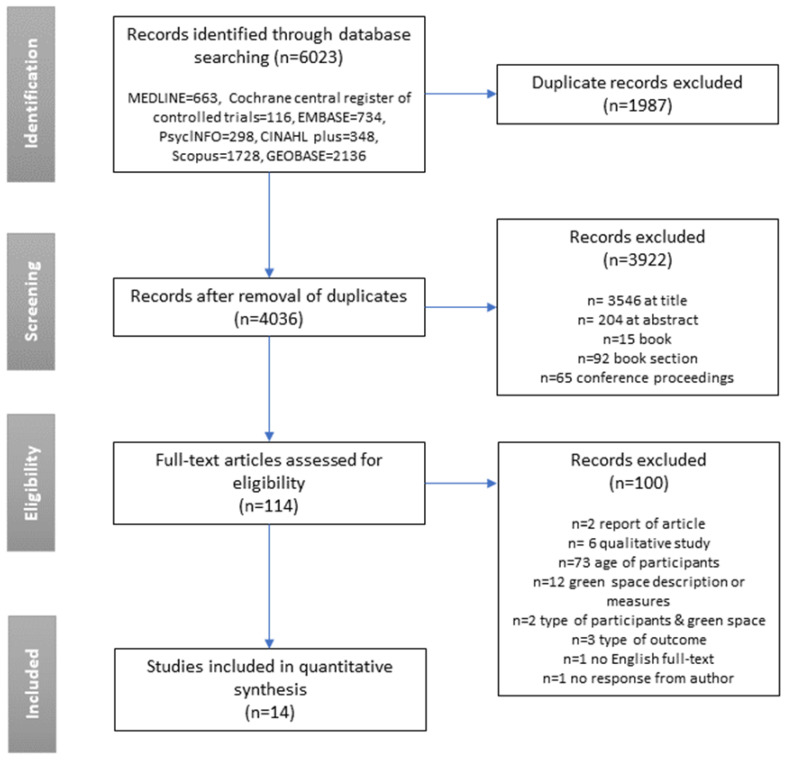
This systematic review summarised and evaluated the evidence for associations between green space and adolescents’ mental well-being. The PRISMA statement guidelines were followed for reporting systematic reviews. Fourteen articles met the inclusion criteria for this review. Synthesis suggests beneficial associations between green space exposure and reduced stress, positive mood, less depressive symptoms, better emotional well-being, improved mental health and behaviour, and decreased psychological distress in adolescents. Several studies found the relationship varied by demographic and socio-economic factors. The limited number of studies and the risk of bias were the main limitations, together with heterogeneity regarding green space and mental well-being assessments. Overall, this review highlights the potential contribution of green space in schoolyards. Improving the availability, accessibility and quality of green space is likely to generate positive impacts on adolescents’ mental well-being. More consistent evidence on the use of different types of green space and perceptions of features are needed in the future.
Overview
The claims and statistics of this paper haven’t been checked yet.
Free: it reads the open-access text and checks the first 5 claims that cite a source we can check. Create a free account to check every claim.
Integrity signals
Registry
Cites
Statistics
Figures
Verification
Claims the paper makes
The claims and statistics of this paper haven’t been checked yet.
Free: it reads the open-access text and checks the first 5 claims that cite a source we can check. Create a free account to check every claim.
Claims other papers make about this one
Each is checked against this paper’s own text: does it say what the citing paper says it does?
The cited source says what the claim attributes to it.
In the citing paper
“Previous literature reviews focusing on younger people refer to theories developed in relation to adults (Zhang et al., 2020).”
From Exploring the role of exposure to green and blue spaces in preventing anxiety and depression among young people aged 14–24 years living in urban settings: A systematic review and conceptual framework (2022) · cites this paper as Zhang et al., 2020
Self-check
Percentages, sums and reported differences re-computed from the paper’s own numbers.
The self-check needs the paper’s full text.
Citations
Cites
On Happiness and Human Potentials: A Review of Research on Hedonic and Eudaimonic Well-Being
Ryan, R. M., & Deci, E. L. (2001) · Annual Review of Psychology · doi:10.1146/annurev.psych.52.1.141 · Cited by 11,567 · cited 1×
“Mental well-being is a fundamental component of health and quality of life, encompassing aspects of hedonic and eudaimonic well-being [1,2].”
BackgroundKirschbaum, C., Pirke, K.-M., & Hellhammer, D. H. (2008) · Neuropsychobiology · doi:10.1159/000119004 · Cited by 6,093 · cited 1×
“The results demonstrate that classroom views onto green space increased students’ recovery from a modified Trier Social Stress Test [57].”
BackgroundHartig, T., Mitchell, R., de Vries, S., & Frumkin, H. (2014) · Annual Review of Public Health · doi:10.1146/annurev-publhealth-032013-182443 · Cited by 3,638 · cited 4×
“Individuals’ subjective perception of green space also vary across sociocultural contexts [30].”
BackgroundInfluentialEncyclopedia of Survey Research Methods
Lavrakas, P. (2008) · doi:10.4135/9781412963947 · Cited by 2,689
Exploring pathways linking greenspace to health: theoretical and methodological guidance
Markevych, I., Schoierer, J., Hartig, T., Chudnovsky, A., Hystad, P., Dzhambov, A. M., de Vries, S., Triguero-Mas, M., Brauer, M., Nieuwenhuijsen, M. J., et al. (2017) · Environmental Research · doi:10.1016/j.envres.2017.06.028 · Cited by 2,543 · cited 1×
“Theories and recent studies from adults indicated that the perception of green space, physical activity and social cohesion can mediate the relationship between green space and mental well-being [30,84,85].”
BackgroundA systematic review of evidence for the added benefits to health of exposure to natural environments
Bowler, D. E., Buyung-Ali, L. M., Knight, T. M., & Pullin, A. S. (2010) · BMC Public Health · doi:10.1186/1471-2458-10-456 · Cited by 1,993 · cited 2×
“Matsuoka [97] indicated that not all types of green space are beneficial for high school students and some studies have shown that benefits depend on the quality of green spaces [38,87,98].”
BackgroundThompson Coon, J., Boddy, K., Stein, K., Whear, R., Barton, J., & Depledge, M. H. (2011) · Environmental Science & Technology · doi:10.1021/es102947t · Cited by 1,391
Social contacts as a possible mechanism behind the relation between green space and health
Maas, J., van Dillen, S. M. E., Verheij, R. A., & Groenewegen, P. P. (2009) · Health & Place · doi:10.1016/j.healthplace.2008.09.006 · Cited by 1,195
Gascon, M., Triguero-Mas, M., Martínez, D., Dadvand, P., Forns, J., Plasència, A., & Nieuwenhuijsen, M. (2015) · International Journal of Environmental Research and Public Health · doi:10.3390/ijerph120404354 · Cited by 1,171 · cited 2×
“The quality of included studies was evaluated using the Lachowycz and Jones [46] methodological quality assessment tool as employed in the previous similar review [34].”
MethodGreen space as a buffer between stressful life events and health
van den Berg, A. E., Maas, J., Verheij, R. A., & Groenewegen, P. P. (2010) · Social Science & Medicine · doi:10.1016/j.socscimed.2010.01.002 · Cited by 1,126
Research works printed but not linked: 2
- 77. Openshaw, S. The Modifiable Areal Unit problem. In Quantitative Geography: A British View; Routledge & Kegan Paul: London, UK, 1981; pp. 60-69.
- Oldenburg, R. (1999). The Great Good Place: Cafes, Coffee Shops, Bookstores, Bars, Hair Salons, and Other Hangouts at the Heart of a Community, Da Capo Press.
Cited by
Items 101–200 of 279
Scaioli, G., Squillacioti, G., Bersia, M., Bellisario, V., Borraccino, A., Bono, R., Dalmasso, P., & Lemma, P. (2023) · Frontiers in Public Health · doi:10.3389/fpubh.2022.1050533 · Cited by 12
Increased urban greenspace in childhood associated with lower inattention deficit among adolescents
Bolanis, D., Orri, M., Vergunst, F., Bouchard, S., Robitaille, É., Philippe, F. L., Ouellet‐Morin, I., Girard, A., Paquin, V., Gauvin, L. I., et al. (2023) · Social Psychiatry and Psychiatric Epidemiology · doi:10.1007/s00127-023-02575-0 · Cited by 16
“First, although NDVI objectively quantifies the level of surrounding greenspace in a given area, it does not capture the quality, access, and use of greenspace, which has been previously associated with improved mental health in youth [74, 75].”
Elementary Classroom Views of Nature Are Associated with Lower Child Externalizing Behavior Problems
Pearson, A. L., Brown, C. D., Reuben, A., Nicholls, N., Pfeiffer, K. A., & Clevenger, K. A. (2023) · International Journal of Environmental Research and Public Health · doi:10.3390/ijerph20095653 · Cited by 12
Kim, E., Lee, W., Lee, J., Kim, Y., Lee, J. H., Hong, Y., Park, H., Kim, Y., Ha, M., Kim, Y., et al. (2023) · The Science of The Total Environment · doi:10.1016/j.scitotenv.2023.164888 · Cited by 10
Prochnow, T. M., Senthil, R., Poulos, A., Patterson, M. S., Blake, J. J., & Massey, P. M. (2025) · Cyberpsychology Behavior and Social Networking · doi:10.1177/21522715251377377 · Cited by 11
Greenspace Exposure and Obsessive-Compulsive Behaviors in Schoolchildren
Ezpeleta, L., Navarro, J. B., Alonso, L., de la Osa, N., Ambrós, A., Ubalde, M., Penelo, E., & Dadvand, P. (2022) · Environment and Behavior · doi:10.1177/00139165221095384 · Cited by 11
Contact with Nature in Social Deprivation during COVID-19: The Positive Impact on Anxiety
Fornara, F., Rinallo, E., & Scopelliti, M. (2023) · International Journal of Environmental Research and Public Health · doi:10.3390/ijerph20146361 · Cited by 10
Oe, H., & Yamaoka, Y. (2023) · SocioEconomic Challenges · doi:10.61093/sec.7(3).76-93.2023 · Cited by 10
Zeng, Y., Zhang, Q., Yan, J., Qi, K., Ai, M., Liu, X., & Xiao, J. (2024) · Frontiers in Psychology · doi:10.3389/fpsyg.2024.1252864 · Cited by 10
Hutson, P. (2024) · International Journal of Emerging and Disruptive Innovation in Education VISIONARIUM · doi:10.62608/2831-3550.1020 · Cited by 11
Brons, M. E., Helbich, M., Elgar, F. J., Lenzi, M., Bolt, G., Dierckens, M., Cosma, A. P., Visser, K., & Stevens, G. W. J. M. (2024) · Social Science & Medicine · doi:10.1016/j.socscimed.2024.117062 · Cited by 11
Wales, M., Hoff, E. V., Mårtensson, F., & Englund, J. (2024) · Landscape and Urban Planning · doi:10.1016/j.landurbplan.2024.105023 · Cited by 14
Relaxation and Fascination through Outside Views of Mexican Dwellings
Suárez, L. A. D. L. F., & Martínez-Soto, J. (2022) · Architecture · doi:10.3390/architecture2020019 · Cited by 10
Dash, S. P., Adhesh, A., & Prabhu, S. (2024) · Journal of Infrastructure Policy and Development · doi:10.24294/jipd.v8i8.4383 · Cited by 10
Rivera, E., Arundell, L., Parker, K. E., Veitch, J., Salmon, J., Ridgers, N. D., Timperio, A. F., Sahlqvist, S., & Loh, V. H. Y. (2024) · Health Promotion International · doi:10.1093/heapro/daae137 · Cited by 10
“Similar to pre-pandemic research among adolescents and adults (Houlden et al ., 2018; Zhang et al ., 2020), we observed positive associations between park visitation and park visit frequency (≥1/week) with well-being, suggesting that visiting parks and visiting at least once per week may improve…”
BackgroundResultLi, M., Li, F., & Shan, X.-Z. (2023) · Building and Environment · doi:10.1016/j.buildenv.2023.110768 · Cited by 9
Brons, M. E., Helbich, M., Bolt, G., Visser, K., & Stevens, G. W. J. M. (2023) · Health & Place · doi:10.1016/j.healthplace.2023.103140 · Cited by 9
Maternal mental health improvement in Ghana: role of green spaces exposure
Boakye, S. K., Danquah, L., & Antwi, M. (2025) · BMC Women s Health · doi:10.1186/s12905-025-03886-x · Cited by 9
Shrivastava, A., & Mehrotra, S. (2022) · Reviews on Environmental Health · doi:10.1515/reveh-2022-0091 · Cited by 8
Lyons, R., Colbert, A. M., Browning, M. H. E. M., & Jakub, K. (2023) · Journal of Advanced Nursing · doi:10.1111/jan.15905 · Cited by 10
Zhao, Y., Yang, X., He, D., Wei, W., Cheng, B., & Zhang, F. (2025) · GeroScience · doi:10.1007/s11357-025-01597-7 · Cited by 8
“Many epidemiological studies have evaluated the association between green space and a series of health outcomes, especially in high-income countries, such as CVD, [24] mental health, [25] allergic diseases[26] and blood biomarkers [21].”
Validating a geospatial healthfulness index with self-reported chronic disease and health outcomes
Sadler, R. C., Wojciechowski, T. W., Buchalski, Z., Smart, M. J., Mulheron, M., & Todem, D. (2022) · Social Science & Medicine · doi:10.1016/j.socscimed.2022.115291 · Cited by 7
Comparison Algorithm on Machine Learning for Student Mental Health Data
Nuarini, S., Fauziah, S., Mayangky, N. A., & Nurfalah, R. (2023) · Journal Medical Informatics Technology · doi:10.37034/medinftech.v1i3.18 · Cited by 7
Multi-scale Intervention Planning Based on Generative Design
Kavouras, I., Rallis, I., Sardis, E., Protopapadakis, E. E., Doulamis, A. D., & Doulamis, N. D. (2024) · Lecture notes in computer science · doi:10.1007/978-3-031-63031-6_20 · Cited by 7
School built environment and children’s health: a scientometric analysis
Zhang, M., & Meng, X. (2025) · Reviews on Environmental Health · doi:10.1515/reveh-2024-0137 · Cited by 10
Marchionatti, L. E., Caye, A., & Kieling, C. (2021) · Current Opinion in Psychiatry · doi:10.1097/yco.0000000000000769 · Cited by 9
Vidal, C., Philippe, F. L., Geoffroy, M., & Paquin, V. (2024) · International Journal of Mental Health and Addiction · doi:10.1007/s11469-024-01313-0 · Cited by 13
“There is extensive research on green spaces and health (Zhang, J. et al., 2020a).”
Invisible and overlooked: young people’s perceptions of managing green spaces for mental wellbeing
Whitten, M. (2025) · Cities & Health · doi:10.1080/23748834.2025.2458394 · Cited by 9
“Yet, urban green spaces can contribute positively to young people’s health and wellbeing (Zhang et al .”
Sadat, S. A., Del, M. S. T. T., & Tabrizi, S. K. (2025) · Journal of Housing and the Built Environment · doi:10.1007/s10901-025-10221-1 · Cited by 8
Double-layered health benefits: green space as a Third Place for everyday active mobility trips
Liu, Y., Maurer, M. L., Skov-Petersen, H., Tollin, N., & Olafsson, A. S. (2023) · Frontiers in Sustainable Cities · doi:10.3389/frsc.2023.1195259 · Cited by 7
“However, the relevance of urban green spaces being Third Places to health and daily living activities is under-researched, and there is a need to investigate (Finlay et al., 2019; Zhang et al., 2020).”
BackgroundAhmed, S. M., Mishra, G. D., Moss, K. M., Mouly, T. A., Yang, I. A., & Knibbs, L. D. (2022) · Environmental Research · doi:10.1016/j.envres.2022.113759 · Cited by 8
Ariff, A. A. A., Shahril, M. I. S. M., Samadi, Z., & Mohamad, E. (2025) · Springer eBooks · doi:10.1007/978-981-96-1486-8_9 · Cited by 5
Urban biodiversity and adolescent mental health and well-being
Mueller, M. A. E., & Flouri, E. (2023) · Journal of Environmental Psychology · doi:10.1016/j.jenvp.2023.102154 · Cited by 5
“In recent years, there has also been much interest in the association between greenspace and mental health and well-being, especially among young people (Tillmann et al., 2018; Vanaken & Danckaerts, 2018; Zhang et al., 2020).”
BackgroundSocial risk, health inequity, and patient safety
Boisvert, S. (2022) · Journal of Healthcare Risk Management · doi:10.1002/jhrm.21519 · Cited by 5
School greenness: how does it impact students’ health and what do students expect from it?
Akpınar, A. (2024) · Journal of Environmental Planning and Management · doi:10.1080/09640568.2024.2317895 · Cited by 5
“Finally, while the majority of the studies were conducted with quantitative methods (Zhang et al. 2020; Vella-Brodrick and Gilowska 2022), this study used both quantitative and qualitative methods to investigate how green spaces benefit students and understand why.”
Reed, Z. E., Morris, T., Davis, O. S. P., Smith, G. D., Munafo, M. R., & Griffith, G. J. (2022) · medRxiv · doi:10.1101/2022.04.21.22274122 · Cited by 5
Mikhail, M. E., Klump, K. L., Pearson, A. L., & Burt, S. A. (2025) · International Journal of Eating Disorders · doi:10.1002/eat.24441 · Cited by 4
Zhang, Y., Li, Z., Mandic, S., Astell‐Burt, T., Hipp, J. A., Fainu, H. M., Zhao, J., & Smith, M. (2025) · Landscape and Urban Planning · doi:10.1016/j.landurbplan.2025.105498 · Cited by 6
Self-citationDa, M., Yang, H., Zhang, S., Sun, H., & Wang, X. (2023) · Journal of the Knowledge Economy · doi:10.1007/s13132-023-01591-4 · Cited by 4
“As individuals grapple with the emotional challenges posed by the pandemic, the availability of these spaces within residential areas becomes even more critical (Zhang et al., 2020).”
RetractedGoing Back to School: Reflecting on School Space as “Shared Space” to Shape Cities and Communities
Cilliers, E. J., Herath, S., & Ghosh, S. (2024) · Urban Planning · doi:10.17645/up.7711 · Cited by 4
“…celebrated in the academic literature for their contribution towards liveable, sustainable, and resilient cities, achieved through improved microclimate, reduced urban heat, better access to neighbourhood green spaces (Wolff & Haase, 2019), and physical and mental wellbeing (Zhang et al., 2020).”
BackgroundMethodology for Increasing Urban Greenery According to the 3-30-300 Concept: A Warsaw Case Study
Siok, K., & Wyrzykowski, B. (2025) · Sustainability · doi:10.3390/su17125563 · Cited by 4
Green infrastructure and well-being nexus within slums: a Lagos case
Adegun, O. B., Olanrewaju, O. S., Elias, P., & Olusoga, O. O. (2024) · Cities & Health · doi:10.1080/23748834.2024.2403908 · Cited by 6
“In the Netherlands, Zhang et al .”
A New Era of Consumer Behavior - In and Beyond the Pandemic
Ayman, U. (2022) · Business, management and economics · doi:10.5772/intechopen.100829 · Cited by 7
Mental Well-Being of Nursing Staff and Destructive Role of COVID-19 Fear and Perceived Stress
BinSaeed, R. H., Grigorescu, A., Patru, C., Yousaf, Z., Nassani, A. A., & Pătru, L. (2023) · Brain Sciences · doi:10.3390/brainsci13071047 · Cited by 4
“MWB concerns satisfaction with life, positive and negative emotions, and a focus on meaning in life [20,21].”
BackgroundDetermining The Needs of Social Affordance in an Open Public Space for Gen Z
Almadina, A. F., & Marcillia, S. R. (2024) · IOP Conference Series Earth and Environmental Science · doi:10.1088/1755-1315/1301/1/012005 · Cited by 4
“Good mental health for adolescents can support social, intelligence, and emotional development, and then help the transition from children to the adult phase [13].”
Background“This space is definitely a difference”: the effects of a new building on school climate
Goss, A. C. (2024) · Learning Environments Research · doi:10.1007/s10984-024-09503-2 · Cited by 4
Fry, D., Roman, L. A., & Kondo, M. C. (2024) · International Journal of Health Geographics · doi:10.1186/s12942-024-00370-x · Cited by 3
“Studies have found beneficial associations between living near parks and visiting parks on both physical [2] and mental [3] health outcomes.”
BackgroundXu, Z., Moro, F., Baldoni, N., Mauro, M., Marini, S., Bragonzoni, L., Dallolio, L., Pinelli, E., Zinno, R., Astorino, G., et al. (2025) · Urban Science · doi:10.3390/urbansci9060192 · Cited by 3
“Green spaces, defined as natural or semi-natural areas within urban environments, have independently demonstrated positive associations with mental health [8–10].”
Bucher, K. A., Moriarty, C. M., Lazarchak, A., & McIntire, R. K. (2025) · International Journal of Environmental Research and Public Health · doi:10.3390/ijerph22071135 · Cited by 3
“As Zhang et al. [27] note, for adolescents, green space exposure is associated with stress relief, improved mood, and better emotional well-being, improvements which can contribute to a positive classroom atmosphere.”
Robat, E. S., Bayazi, M. H., Nayyeri, M., Yasaghi, A. A., & Taimory, S. (2026) · Nature Human Behaviour · doi:10.1038/s41562-026-02433-4 · Cited by 5
Measuring Disparity in the Distribution of ROS in Adolescents Using Geospatial Analysis
Shrivastava, A., & Mehrotra, S. (2024) · Journal of Urban Planning and Development · doi:10.1061/jupddm.upeng-5041 · Cited by 4
Built Environment and Anxiety Among Adolescents: To What Extent Can Resilient Family Protect Youth?
Park, Y., Wood, B. M., Crutchfield, J. M., & Park, K. (2024) · Families in Society The Journal of Contemporary Social Services · doi:10.1177/10443894241265530 · Cited by 3
“Aligning with the built environment theory (Evans, 2003), the built environmental aspects of the neighborhood often mean limited access to health care, mental health services, and green spaces, which are all associated with increased anxiety (Zhang et al., 2020).”
Baldessari, S., MEO, I. D., Cantiani, M. G., & Paletto, A. (2025) · Land · doi:10.3390/land14020230 · Cited by 3
Barrette, M., Naylor, P., Grouzet, F. M. E., & Harper, N. J. (2025) · Health Promotion International · doi:10.1093/heapro/daaf010 · Cited by 4
“…mental, and cognitive health (Chawla et al. 2014, Adams and Savahl 2017, Tillmann et al. 2018, Chawla and Gould 2020, Roberts et al. 2020, Zhang et al. 2020, Barfield et al. 2021, Fyfe-Johnson et al. 2021, Jackson et al. 2021, Vella-Brodrick and Gilowska 2022, Barragan-Jason et al. 2023,…”
Yen, Y.-T., Schinasi, L. H., Sánchez, B. N., Melly, S. J., Moore, K., Forrest, C. B., Kenyon, C. C., Kondo, M. C., & Roos, A. J. D. (2025) · International Journal of Hygiene and Environmental Health · doi:10.1016/j.ijheh.2025.114546 · Cited by 3
Mazur, J., Kleszczewska, D. W., Porwit, K., Zawadzka, D., & Małkowska‐Szkutnik, A. (2023) · Annals of Agricultural and Environmental Medicine · doi:10.26444/aaem/161852 · Cited by 3
Medically Attended Suicidality in Youth Who Live on Farms
VanWormer, J. J., Berg, R. L., Wieckhorst, M., Burke, R., & Weichelt, B. P. (2023) · Journal of Agromedicine · doi:10.1080/1059924x.2023.2264287 · Cited by 3
“Children who grow up on farms are likely exposed to green space and its associated emotional benefits, 16 and typically have early life exposures to animals that confer health benefits such as less asthma, atopic disease, and obesity.”
BackgroundGürbüz, B., & Doğan, M. (2024) · Gençlik Araştırmaları Dergisi · doi:10.52528/genclikarastirmalari.1431468 · Cited by 3
Ankori‐Karlinsky, R., Kache, P. A., Abreu, G., Fox, J., Smith, J., Huddell, A. M., Dutta, M., Schoen, J. M., Johnston, A., Pereira, K. A. C., et al. (2024) · Urban Ecosystems · doi:10.1007/s11252-024-01652-9 · Cited by 3
“In densely populated cities such as New York City (NYC), adolescents’ physical and mental health are influenced by access to greenspaces (Gaffin et al. 2008; Russell et al. 2013; Reyes-Riveros et al. 2021; Zhang et al. 2020).”
Residential greenness and children working memory. An EU Child Cohort Network consortium study
Subiza‐Pérez, M., García‐Baquero, G., Rebagliato, M., Estarlich, M., Guxens, M., Vrijheid, M., de Castro, M., Nieuwenhuijsen, M. J., Fernández-Barrés, S., Sunyer, J., et al. (2025) · Environmental Research · doi:10.1016/j.envres.2025.121016 · Cited by 2
Zhu, X., Lin, W. C., Bao, Z., Zeng, C., Li, J., Qin, X., Qu, Y., Wang, W., & Yao, T. (2025) · Trees Forests and People · doi:10.1016/j.tfp.2025.100965 · Cited by 3
Lu, J., Zhang, Y., Yuan, X., Zhang, K., Shao, W., & Wang, H. C. (2025) · International Journal of Environmental Science and Technology · doi:10.1007/s13762-025-06971-8 · Cited by 2
“Overall, "green spaces" refers to communal or public open spaces with amenities, including both human-made areas and vegetated natural areas (Zhang et al. 2020).”
Self-citationChen, S., Yi, L., Wang, S., & Yang, C. (2025) · Journal of Environmental Psychology · doi:10.1016/j.jenvp.2025.102887 · Cited by 3
Alkhatib, A., Olsen, J., & Mitchell, R. (2021) · Health & Place · doi:10.1016/j.healthplace.2021.102677 · Cited by 2
Asri, A. K., Yeh, C.-H., Chang, H.-T., Lee, H., Lung, S. C., Spengler, J. D., & Wu, C. (2023) · Health & Place · doi:10.1016/j.healthplace.2023.103097 · Cited by 2
Effects of Bioceramic Material and Colored Light Irradiation on Learning and Memory in Aging Rats
Leung, T., Chen, Y., Chao, M., & Tseng, C. (2023) · Experimental Aging Research · doi:10.1080/0361073x.2023.2278983 · Cited by 2
“…support the hypothesis that the different color light spectrums utilized in our study may have activated specific enzymes and physiological pathways, contributing to the observed cognitive enhancements in aging rats (Elliot, 2015; Sun et al., 2023; Zhang, Mavoa, Zhao, Raphael, & Smith, 2020).”
Kareem, S. M., & Abdullah, H. K. (2023) · Journal of Studies in Science and Engineering · doi:10.53898/josse2023322 · Cited by 4
Castilla, D. G., Capin, T., Cabatingan, R. M., Lacson, D. R. Y., Lauro, E. K., & Lima, K. A. (2024) · International Journal of Earth & Environmental Sciences (IJEES) · doi:10.58885/ijees.v09i1.030.dc · Cited by 2
Factors impacting urban greenspace usage: new evidence from South Africa
Struwig, C., Davis, N. C., & Breetzke, G. D. (2024) · GeoJournal · doi:10.1007/s10708-024-11228-x · Cited by 2
“They are the primary pillar for a sustainable urban place for individuals in that they enhance individuals’ mental (Houlden et al., 2018; Zhang et al., 2020) as well as physical well-being (D’Alessandro et al., 2015; Ward et al., 2016).”
Ferrari, V., Marzana, D., & D’Angelo, C. (2024) · Journal of Prevention & Intervention in the Community · doi:10.1080/10852352.2025.2479999 · Cited by 2
“…behavior (Islam et al., 2020; Sakhvidi et al., 2022; Younan et al., 2016), and mental health-related outcomes such as the mitigation of psychological distress and the rise of overall psychological well-being (Fleckney & Bentley, 2021; Mnich et al., 2019; Tillmann et al., 2018; Zhang et al., 2020).”
The Association of Exposure to Urban Greenspace and Depression in Women
Taheri, E. S., Faramarzinia, A., Khosrorad, R., Najafi, M. L., Joveini, H., Khamirchi, M., Heydari, H., Kaffash, L. H., Ghorbani, A., Niko, F., et al. (2025) · Journal of Urban Health · doi:10.1007/s11524-025-00987-8 · Cited by 3
García, I. A. (2021) · UVaDOC UVaDOC University of Valladolid Documentary Repository (University of Valladolid) · doi:10.35376/10324/51836 · Cited by 4
Discussion of Purchasing Virtual Digital Nature and Tourism
Oe, H., & Yamaoka, Y. (2022) · Business, management and economics · doi:10.5772/intechopen.105869 · Cited by 2
Öz Kontrolün Yeşil Satın Alma Davranışına Etkisinde Mental İyi Oluşun Rolü
İŞLEK, M. S., & AŞIK, E. (2023) · Alanya Akademik Bakış · doi:10.29023/alanyaakademik.1273900 · Cited by 2
Adolescent outdoor life and well-being
Wales, M. (2024) · Acta universitatis agriculturae Sueciae · doi:10.54612/a.sdqucoei3v · Cited by 1
Olusola, J. A., Ike, F., Olofinl, O. E., & Eludoyin, A. O. (2025) · Palgrave Studies in Sustainable Futures. · doi:10.1007/978-3-031-24952-5_29-1 · Cited by 1
Munira, L., & Herman, B. Z. (2025) · Asian Journal of Social Health and Behavior · doi:10.4103/shb.shb_370_24 · Cited by 1
Knowles, C., Thornton, E., Mills-Webb, K., Petersen, K. J., Marquez, J., Stojiljković, S., & Humphrey, N. (2025) · International Journal of Environmental Research and Public Health · doi:10.3390/ijerph22060951 · Cited by 2
Darvishpour, A., Mansouri, F., Fashtami, S. M., Aramesh, S., & Nouri-Saeed, A. (2025) · Health Science Reports · doi:10.1002/hsr2.71104 · Cited by 1
“The results of a systematic review provided evidence of the positive benefits of green space for adolescents, especially in terms of reduced stress, positive mood, fewer depressive symptoms, better emotional well ‐ being, improved mental health and behavior, and lower psychological distress [48].”
Exploring the Impacts of Green Space and Healthcare Accessibility on Small for Gestational Age
Ma, J., Li, X., Xu, J., & Dong, G. (2025) · Applied Spatial Analysis and Policy · doi:10.1007/s12061-025-09736-5 · Cited by 1
“Beyond physical health, green spaces enhance emotional well-being by reducing stress and promoting psychologi - cal health through various restorative processes (Vanaken & Danckaerts, 2018; White et al., 2021; Zhang et al., 2020; Dzhambov et al., 2019a , b ; Bai et al., 2024).”
Pi‐Sunyer, B. P., Bignardi, G., García‐Baquero, G., Dadvand, P., Vrijheid, M., Guxens, M., Esplugues, A., Delgado-Saborit, J. M., Ibarluzea, J. M., Blakemore, S., et al. (2025) · Scientific Reports · doi:10.1038/s41598-025-22753-1 · Cited by 1
“While evidence is mixed for child and adolescent samples 46,47 , one study showed that more frequent use of green spaces was associated with social connectedness with friends (quantity and time spent) in young people aged 10–18, and this relationship was particularly strong for adolescents aged 14…”
Arnberger, A., Eder, R., Allex, B., Wallner, P., Weitensfelder, L., Kundi, M., & Hutter, H.-P. (2026) · Urban forestry & urban greening · doi:10.1016/j.ufug.2026.129302 · Cited by 1
Goh, K., Rachdan, S., Altenburg, T. M., & Chinapaw, M. J. M. (2026) · Cities · doi:10.1016/j.cities.2026.106891 · Cited by 2
Sun, Z., Gao, X., Yang, Y., Bell, S., Hu, X., & Yin, J. (2026) · Environment International · doi:10.1016/j.envint.2026.110541 · Cited by 2
Youssef, R., Dassuki, N., Natour, D. E., Achcar, J. A., MAADARANI, R., Krayker, G., Azakir, B., Masri, J. E., & Salameh, P. (2026) · PLoS ONE · doi:10.1371/journal.pone.0344534 · Cited by 1
Mussina, Z., & Lawrence, K. C. (2026) · BMC Psychology · doi:10.1186/s40359-026-04046-y · Cited by 2
“…conceptualized not merely as the absence of illness but as a state of flourishing encompassing both hedonic (feeling well) and eudaimonic (functioning well) components [35, 45]—is essential for fostering successful transition into adulthood, academic achievement, and prosocial development [47].”
Fortmann, L., & Rajbhandari, I. (2026) · PLoS ONE · doi:10.1371/journal.pone.0347301 · Cited by 1
“Research has found that children and adolescents who live in close proximity to parks are more likely to be physically active [1,2] have lower obesity rates [3], reduced stress levels, and better emotional wellbeing [4,5].”
Kong, J. (2026) · Lifespan development and mental health. · doi:10.70322/ldmh.2026.10014 · Cited by 1
Bubalo, M., van den Broek, K. L., Helbich, M., & Labib, S. M. (2026) · Journal of Environmental Psychology · doi:10.1016/j.jenvp.2026.103254 · Cited by 1
Penerapan Model Pertanian Perkotaan dalam Mewujudkan Ekosistem Sekolah Berkelanjutan
Sapar, S., Hidayat, W., & Isdayani, B. (2026) · Jurnal Medika. · doi:10.31004/dqcsbj03 · Cited by 1
Boraita, R. J., Ibort, E. G., Alsina, D. A., & Torres, J. M. D. (2022) · PubMed · Cited by 2
Ferhati, K., & Gottschald, M. (2023) · Journal of Salutogenic Architecture · doi:10.38027/jsalutogenic_vol2no1_1 · Cited by 1
“Furthermore, integrating green spaces and nature within the built environment has shown positive effects on stress reduction, cognitive function, and overall psychological well-being (Zhang et al., 2020).”
BackgroundGreenness Exposure Assessment Methods
Mazumdar, S., Knibbs, L. D., Browning, M. H. E. M., Huang, W., & Jalaludin, B. B. (2024) · Springer eBooks · doi:10.1007/978-981-97-3102-2_2 · Cited by 3
A Comprehensive Model of Green Brand Assessment in the IT Industry
Nan, L.-M., Păcurariu, R. L., Lakatos, E. S., Bacali, L., Hoinaru, R., & Cioca, L. (2025) · Sustainability · doi:10.3390/su17031336 · Cited by 1
“A product is considered “greener”, according to Jones and Smith [1] and Siva Raman [2] if its environmental and human health impacts are lower than those of comparable products.”
Rum för skolans utemiljö – Fördjupad analys kring yta för förskolegård och skolgård
Jansson, M., Schneider, J., Mårtensson, F., Kylin, M., & Fridell, L. (2021) · Epsilon Open Archive (Sveriges lantbruksuniversitet biblioteket (Swedish University of Agricultural Sciences)) · Cited by 29
Green Space and Mental Wellbeing in Kigali City, Rwanda: An Exploratory Mixed-Method StudyPreprint
Draus, P., Habimana, S., Qureshi, S., Roddy, J. K., Biracyaza, E., Rutembesa, E., Lacey, K. K., & Montgomery, S. (2023) · SSRN Electronic Journal · doi:10.2139/ssrn.4661435 · Cited by 1
Deepika, K., Venkateswaran, C., Singh, A., Tejaswini, B. D., & John, D. (2025) · Research Square · doi:10.21203/rs.3.rs-7183081/v1 · Cited by 1
Parsons, N. (2021) · The Knowledge Bank (The Ohio State University)
O lazer ativo em parques urbanos no estado do Paraná
Tagliari, I. A., & Pawlowsky, U. (2024) · Caderno Pedagógico · doi:10.54033/cadpedv21n1-073
The impact of outdoor activities on adolescents' mental health during the COVID-19 pandemic
Saxena, S., Pooja, P., Homavazir, Z., & Dani, T. S. (2024) · Multidisciplinary Science Journal · doi:10.31893/multiscience.2024ss0524
Metadata
- Authors
- Zhang, Y., Mavoa, S., Zhao, J., Raphael, D., & Smith, M.
- Affiliations
- University of Auckland (NZ)
- The University of Melbourne (AU)
- Corresponding author
- Zhang, Yijun
- Venue
- International Journal of Environmental Research and Public Health
- Publisher
- MDPI AG
- Published
- 2020-09-11
- Volume
- 17
- Issue
- 18
- Pages
- 6640
- ISSN
- 1660-4601 (ISSN-L)
- PMC
- PMC7557737
- OpenAlex
- W3084722879
- Cited by
- 240
- References
- 115
- Citations by year
- 2026: 37 · 2025: 48 · 2024: 50 · 2023: 57 · 2022: 28 · 2021: 18 · 2020: 2
- FWCI
- 2.27
- Type
- journal article
- Language
- en
- Open access
- gold
- doi.org
- Licence
- Locations
- International Journal of Environmental Research and Public Health (publishedVersion, cc-by)
- PubMed Central (publishedVersion, cc-by)
- PubMed (publishedVersion)
- Minerva Access (University of Melbourne) (submittedVersion, cc-by)
- RePEc: Research Papers in Economics (submittedVersion)
- DOAJ (DOAJ: Directory of Open Access Journals) (submittedVersion)
- ResearchSpace (University of Auckland) (submittedVersion, cc-by)
- Funders
- Medical Research Council
- National Health and Medical Research Council (1121035)
- Topics
- Social Sciences › Urban Studies › Urban Green Space and Health
- Physical Sciences › Environmental Science › Management, Monitoring, Policy and Law › Urban Arborization and Environmental Studies
- Social Sciences › Sociology and Political Science › Environmental Justice and Health Disparities
- Keywords
- green spaces, adolescents, psychological well-being, stress, depressive symptoms, psychological distress, positive mood, schoolyard, socioeconomic factors, environmental exposure
- MeSH terms
- Parks, Recreational, Adolescent, Cross-Sectional Studies, Humans, Longitudinal Studies, Mental Health, Cohort Studies
About these checks
Registry, retraction, Cites and statistics results are computed, not judged, with one exception: a printed reference that no index lists is read once by a model before it counts as a citation error. Claims are extracted by a model and kept only when their quote appears verbatim in the text; each cited source is then checked, with a model’s help, for whether it says what the claim relies on. Those verdicts can be wrong — read the claim’s quote and the cited source before relying on one.
Statistics and arithmetic are recomputed, not judged.
Confidence bands are shown only for fields calibrated on our annotated test set. None is calibrated yet, so no band is shown.
What counts as a claim ›How we measure confidence ›How we check this ›
Are you an author, or do you see a problem with this page? Request a review
Data sources
Bibliographic data: Semantic Scholar, OpenAlex, Crossref.
Contains information from the Semantic Scholar Academic Graph Datasets, made available under the ODC Attribution License (ODC-BY 1.0).
Semantic Scholar’s data is described in: Kinney, R., et al. (2023). The Semantic Scholar Open Data Platform. arXiv:2301.10140.
