

The association between green space and adolescents' mental well-being: a systematic review
Open accessThe DOI matches its Crossref record; 116 of the 116 references it cites were found in a registry or an index.
Abstract
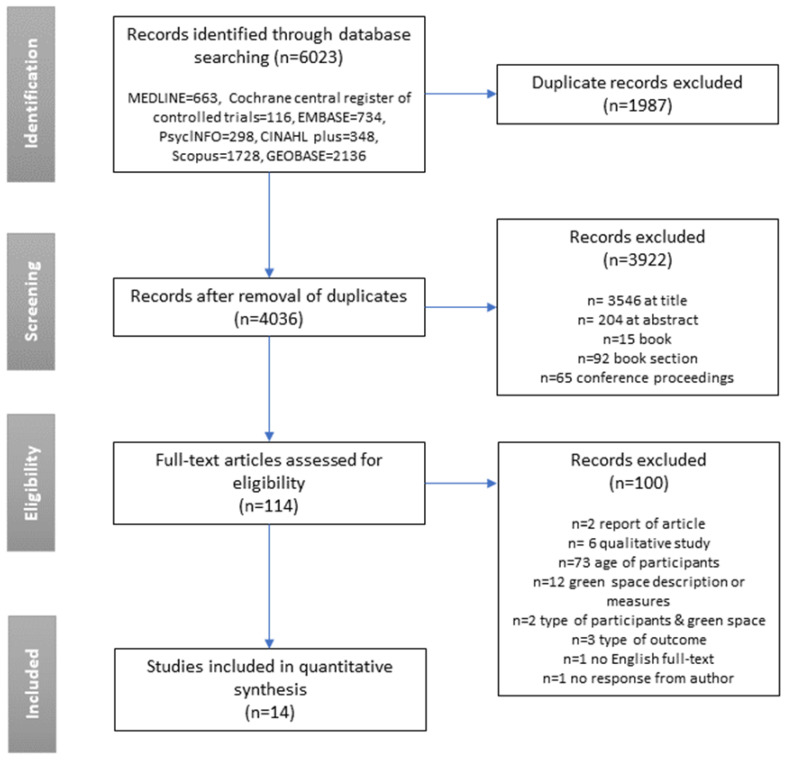
This systematic review summarised and evaluated the evidence for associations between green space and adolescents’ mental well-being. The PRISMA statement guidelines were followed for reporting systematic reviews. Fourteen articles met the inclusion criteria for this review. Synthesis suggests beneficial associations between green space exposure and reduced stress, positive mood, less depressive symptoms, better emotional well-being, improved mental health and behaviour, and decreased psychological distress in adolescents. Several studies found the relationship varied by demographic and socio-economic factors. The limited number of studies and the risk of bias were the main limitations, together with heterogeneity regarding green space and mental well-being assessments. Overall, this review highlights the potential contribution of green space in schoolyards. Improving the availability, accessibility and quality of green space is likely to generate positive impacts on adolescents’ mental well-being. More consistent evidence on the use of different types of green space and perceptions of features are needed in the future.
Overview
The claims and statistics of this paper haven’t been checked yet.
Free: it reads the open-access text and checks the first 5 claims that cite a source we can check. Create a free account to check every claim.
Integrity signals
Registry
Cites
Statistics
Figures
Verification
Claims the paper makes
The claims and statistics of this paper haven’t been checked yet.
Free: it reads the open-access text and checks the first 5 claims that cite a source we can check. Create a free account to check every claim.
Claims other papers make about this one
Each is checked against this paper’s own text: does it say what the citing paper says it does?
The cited source says what the claim attributes to it.
In the citing paper
“Previous literature reviews focusing on younger people refer to theories developed in relation to adults (Zhang et al., 2020).”
From Exploring the role of exposure to green and blue spaces in preventing anxiety and depression among young people aged 14–24 years living in urban settings: A systematic review and conceptual framework (2022) · cites this paper as Zhang et al., 2020
Self-check
Percentages, sums and reported differences re-computed from the paper’s own numbers.
The self-check needs the paper’s full text.
Citations
Cites
On Happiness and Human Potentials: A Review of Research on Hedonic and Eudaimonic Well-Being
Ryan, R. M., & Deci, E. L. (2001) · Annual Review of Psychology · doi:10.1146/annurev.psych.52.1.141 · Cited by 11,567 · cited 1×
“Mental well-being is a fundamental component of health and quality of life, encompassing aspects of hedonic and eudaimonic well-being [1,2].”
BackgroundKirschbaum, C., Pirke, K.-M., & Hellhammer, D. H. (2008) · Neuropsychobiology · doi:10.1159/000119004 · Cited by 6,093 · cited 1×
“The results demonstrate that classroom views onto green space increased students’ recovery from a modified Trier Social Stress Test [57].”
BackgroundHartig, T., Mitchell, R., de Vries, S., & Frumkin, H. (2014) · Annual Review of Public Health · doi:10.1146/annurev-publhealth-032013-182443 · Cited by 3,638 · cited 4×
“Individuals’ subjective perception of green space also vary across sociocultural contexts [30].”
BackgroundInfluentialEncyclopedia of Survey Research Methods
Lavrakas, P. (2008) · doi:10.4135/9781412963947 · Cited by 2,689
Exploring pathways linking greenspace to health: theoretical and methodological guidance
Markevych, I., Schoierer, J., Hartig, T., Chudnovsky, A., Hystad, P., Dzhambov, A. M., de Vries, S., Triguero-Mas, M., Brauer, M., Nieuwenhuijsen, M. J., et al. (2017) · Environmental Research · doi:10.1016/j.envres.2017.06.028 · Cited by 2,543 · cited 1×
“Theories and recent studies from adults indicated that the perception of green space, physical activity and social cohesion can mediate the relationship between green space and mental well-being [30,84,85].”
BackgroundA systematic review of evidence for the added benefits to health of exposure to natural environments
Bowler, D. E., Buyung-Ali, L. M., Knight, T. M., & Pullin, A. S. (2010) · BMC Public Health · doi:10.1186/1471-2458-10-456 · Cited by 1,993 · cited 2×
“Matsuoka [97] indicated that not all types of green space are beneficial for high school students and some studies have shown that benefits depend on the quality of green spaces [38,87,98].”
BackgroundThompson Coon, J., Boddy, K., Stein, K., Whear, R., Barton, J., & Depledge, M. H. (2011) · Environmental Science & Technology · doi:10.1021/es102947t · Cited by 1,391
Social contacts as a possible mechanism behind the relation between green space and health
Maas, J., van Dillen, S. M. E., Verheij, R. A., & Groenewegen, P. P. (2009) · Health & Place · doi:10.1016/j.healthplace.2008.09.006 · Cited by 1,195
Gascon, M., Triguero-Mas, M., Martínez, D., Dadvand, P., Forns, J., Plasència, A., & Nieuwenhuijsen, M. (2015) · International Journal of Environmental Research and Public Health · doi:10.3390/ijerph120404354 · Cited by 1,171 · cited 2×
“The quality of included studies was evaluated using the Lachowycz and Jones [46] methodological quality assessment tool as employed in the previous similar review [34].”
MethodGreen space as a buffer between stressful life events and health
van den Berg, A. E., Maas, J., Verheij, R. A., & Groenewegen, P. P. (2010) · Social Science & Medicine · doi:10.1016/j.socscimed.2010.01.002 · Cited by 1,126
Research works printed but not linked: 2
- 77. Openshaw, S. The Modifiable Areal Unit problem. In Quantitative Geography: A British View; Routledge & Kegan Paul: London, UK, 1981; pp. 60-69.
- Oldenburg, R. (1999). The Great Good Place: Cafes, Coffee Shops, Bookstores, Bars, Hair Salons, and Other Hangouts at the Heart of a Community, Da Capo Press.
Cited by
Items 201–279 of 279
Galán, A. S. (2024) · Elsevier eBooks · doi:10.1016/b978-0-443-29240-8.00005-5 · Cited by 1
Bhatti, F., Leeuwerik, T., Savins, C., & Jackson, L. (2025) · Journal of Health Psychology · doi:10.1177/13591053251315380 · Cited by 2
“This is supported by literature exploring NBTIs with adults and CYP with LTC (Gillard and Allsop, 2016; Moola et al., 2014; Roberts et al., 2020; Tillmann et al., 2018; Trøstrup et al., 2019; Zhang et al., 2020).”
Harsanto, B., & Alam, M. (2025) · SSRN Electronic Journal · doi:10.2139/ssrn.5177448
Chimalapati, V., & Mehta, P. V. (2025) · GIScience and geo-environmental modelling · doi:10.1007/978-3-031-77189-7_15
The Impact of Urban Green Space Accessibility on High School Students' Mental Health in Toronto
Pillai, H., Dutta, R., Singh, J., & Haider, S. (2025) · Queen s Science Undergraduate Research Journal · doi:10.71044/qsurjvol820253
Boakye, S. K., & Danquah, L. (2025) · BMC Pregnancy and Childbirth · doi:10.1186/s12884-025-07856-x
Šipulová, M. H., Yamu, C., & Östh, J. (2025) · Economic Themes · doi:10.2478/ethemes-2025-0002
Visual Voices: Hispanic and African American Youth Perspectives on Neighborhood and School Health
Olvera, N. E., Scherer, R., Roy, T. J., Cubas, N. W. C., Matthews‐Ewald, M. R., & Arbona, C. (2025) · Children · doi:10.3390/children12091165
“In addition, our findings regarding the relevance of having access to nutritious food and safe spaces for engaging in physical activity as essential components of youth health are consistent with previous studies [1,26].”
Emotional intelligence: the key to managing cognitive overload and enhancing quality of life
Mohamed, D. A. A., & Shehata, G. M. (2025) · Management & Sustainability An Arab Review · doi:10.1108/msar-02-2025-0049 · Cited by 1
Shankar, R., Joshua, J. W., & Xu, Q. (2025) · medRxiv · doi:10.1101/2025.10.14.25338032
A PheWAS Analysis of the Risks and Benefits of Growing Up on a Farm
Burke, R., Berg, R. L., Weichelt, B. P., Gabor, R. M., Rudolphi, J. M., Bendixsen, C. G., & VanWormer, J. J. (2025) · Journal of Agromedicine · doi:10.1080/1059924x.2025.2591079 · Cited by 1
“39 In contrast, alongside the broad emotionally protective effects of adequate green-space (presumed to be greater in farm settings) for youth, 40 at least one prior study has observed less psychological distress in girls who live on farms relative to those who do not, 41 and another found fewer…”
The sound of the environment: Effects on brain, cognitive performance and affect
Stobbe, E. (2024) · Refubium (Universitätsbibliothek der Freien Universität Berlin) · doi:10.17169/refubium-45471
Αστικοί χώροι πράσινου και επιπτώσεις στην ψυχική υγεία στην Τανζανία
Βαρδάκα, Μ.-Λ. (2022) · Institutional Repository Hellanicus · doi:10.26215/heal.uoa.8023
Kodali, H., Hitch, L., Dunlap, A. F., Starvaggi, M., Wyka, K., & Huang, T. T. ‐. (2024) · Figshare · doi:10.6084/m9.figshare.24792429
Kodali, H., Hitch, L., Dunlap, A. F., Starvaggi, M., Wyka, K. E., & Huang, T. T. ‐. (2023) · Figshare · doi:10.6084/m9.figshare.24792246
Kodali, H., Hitch, L., Dunlap, A. F., Starvaggi, M., Wyka, K., & Huang, T. T. ‐. (2024) · Figshare · doi:10.6084/m9.figshare.26652210
Kodali, H., Hitch, L., Dunlap, A. F., Starvaggi, M., Wyka, K., & Huang, T. T. ‐. (2024) · Figshare · doi:10.6084/m9.figshare.26652207
Balasingam, M. (2024) · Uppsala University Publications (Uppsala University)
Stephenson, H. (2024) · Open Research Exeter (University of Exeter) · Cited by 1
Seosed elukohalähedase roheluse ja vaimse heaolu vahel
Pikk, J. (2024) · DSpace repository (University of Tartu) · Cited by 1
Mueller, M. A. E. (2023) · UCL Discovery (University College London)
Borelli, C. (2024) · Archivio istituzionale della ricerca (Alma Mater Studiorum Università di Bologna) · Cited by 1
Associations between greenspace exposure and mental health and suicide: Evidence across the lifespan
Bolanis, D. (2024) · doi:10.82308/1480 · Cited by 1
Rodrigues, P. (2023) · Archipel (Université du Québec à Montréal)
Anderson, L. (2021) · University of Minnesota Digital Conservancy (University of Minnesota)
Factors that affect adolescents’ mental health : A literature review
Wånggren, F. (2024) · University Library of Skövde (University of Skövde)
Agredano, E. (2021) · eScholarship (California Digital Library)
Zirui, Y. A. O., Schirmer, J., Kanowski, P. J., & Xuemei, B. A. I. (2025) · Urban forestry & urban greening · doi:10.1016/j.ufug.2025.129247
Mulyono, P., Rahmatillah, A., & joseph, L. (2024) · Green Health International Journal of Health Sciences Nursing and Nutrition · doi:10.70062/greenhealth.v1i3.255
Chukwuka, O., Alagbe, T. O., Jason, K., Olusada, M., Anthony, O., & OTUONUYO, G. A. (2026) · Lecture notes in civil engineering · doi:10.1007/978-3-032-08992-2_63
Built environment determinants of mental health in Mashhad metropolis, Iran
Hosseini, S. H., Zarei, M., & Ghodrati, H. (2026) · Cities & Health · doi:10.1080/23748834.2025.2589638 · Cited by 1
Kittisiam, T., Ritter, C., Morabito, E., Stacey, A., Khosa, D. K., & Jones, A. Q. (2026) · Journal of the American Veterinary Medical Association · doi:10.2460/javma.25.09.0630
Eco-anxiété, changement climatique et santé mentale
Heeren, A. (2024) · Carrefour des psychothérapies · doi:10.3917/dbu.heere.2024.01.0201
Saeed, G., Naqvi, S. S. A., & Sohail, J. (2026) · International Research Journal of Arts, Humanities and Social Sciences · doi:10.5281/zenodo.19107199
Beyond Personalization: Cultivating AI-Augmented Human Flourishing in Education
Ukoba, J. O., Okengwu, U. A., Joseph, E. E., & Ochei, L. C. (2026) · Artificial intelligence · doi:10.5772/intechopen.1013548
Mapping Urban Environmental Health and Inequality in San Fernando City, La Union, Philippines
Dizon, J. E. L. (2026) · Portuguese National Funding Agency for Science, Research and Technology (RCAAP Project by FCT)
Shrivastava, A., & Mehrotra, S. (2026) · International Journal of the Sociology of Leisure · doi:10.1007/s41978-026-00202-1
“…these developmental needs by offering safe opportunities for autonomy (Lavin Fueyo et al., 2016), social interaction (Feng & Astell-burt, 2017; Zhang et al., 2020 ), physical activity (Hecke et al., 2018), and healthy risk-taking (Mmako et al., 2020 ), thereby helping adolescents learn and…”
Mavoungou, J., Amin, Z., Oginni, J., McDonough, D. J., Liu, W., & Gao, Z. (2026) · doi:10.2196/preprints.95291
Tackling the Challenges in Greening Our Cities for Health and Wellbeing
Williams, C., Tefera, Y., Kandulu, J., Lowe, M., Croeser, T., Humphrey, J., & Soebarto, V. I. (2026) · Urban sustainability · doi:10.1007/978-981-95-5487-4_3
Ulset, V. S., Tronsen, J., Nordbø, E. C. A., & Venter, Z. S. (2026) · Environmental Research · doi:10.1016/j.envres.2026.124383
Methodology for Determining Tree Visibility from Apartments on Different Floors
Wyrzykowski, B., & Mościcka, A. (2026) · Applied Sciences · doi:10.3390/app16073514
Lorimer, J., Tsiachristas, A., Arshad, S., POLGREEN, K. E., Caseby, R., Menon, S., Letendre, M., Singh, I., & Wilhelm, K. (2026) · Research Square · doi:10.21203/rs.3.rs-9131492/v1
Nature and nurture: Environmental well-being shapes mental health outcomes
Sharma, M., Budhwar, M., Sobti, R. C., & Chopra, M. (2026) · Elsevier eBooks · doi:10.1016/b978-0-443-43986-5.00022-9
A research framework for studying the motivations and obstructions of exposure to urban green spaces
Yue, W., Nan, X., Kang, Y., Zhang, X., Olszewska-Guizzo, A., Zhang, L., & Qi, J. (2026) · International Journal of Environmental Health Research · doi:10.1080/09603123.2026.2659267
“UGS serves as a crucial “social infrastructure” that facilitates both intentional and incidental social encounters, thereby strengthening community cohesion and family bonds (Aliyas et al. 2019; Zhang et al. 2020).”
Park, Y., Murphy, J. L., Vazquez, C. E., Wood, B. M., Park, K., & Lee, S. (2026) · Psychiatric Quarterly · doi:10.1007/s11126-026-10280-9
Zhang, Y., Mandic, S., Fainu, H. M., Zhao, J., & Smith, M. (2026) · Discover Cities · doi:10.1007/s44327-026-00250-y
Self-citationTashok Yusuf, H., Babamboni Adekunle, S., Will, O., Oluwanifemi, O., & Princess, O. (2026) · International Journal of Environment Agriculture and Biotechnology · doi:10.22161/ijeab.113.2
Developing a conservation-based beach sports tourism model for sustainable coastal recreation
Ali, M., Ihsan, F., & Edmiza, E. (2026) · Lentera Negeri · doi:10.29210/992090
“In parallel, the green and blue space theory explains how natural environments, including beaches, contribute to improved psychological well-being, reduced stress, and enhanced mood (K. Chen et al., 2021; Gascon et al., 2015; Groeneveld et al., 2025; Zhang et al., 2020).”
Baranyi, G., Patalay, P., Church, D., de Hoogh, K., Fitzsimons, E., & Tonne, C. C. (2026) · Environment International · doi:10.1016/j.envint.2026.110361
Smolović, V., Zizic, N., & Spalevıć, V. (2026) · Lecture notes in networks and systems · doi:10.1007/978-3-032-30107-9_51
THERAPEUTIC EFFECTS OF URBAN GREEN SPACE ON MENTAL WELL-BEING OF RESIDENTS OF LAGOS MEGA CITY
Adewale, P. S., & Ogundele, F. O. (2026) · Analele Universităţii din Oradea Seria Geografie · doi:10.30892/auog.36105-941
Lyu, Y., Deng, H., & Cheng, Y. (2026) · Building and Environment · doi:10.1016/j.buildenv.2026.114942
Spatial–Temporal Patterns and Inequality in Greenspaces in Chinese Campuses
Yuan, X., Yu, L., Li, X. F., Zhao, Q., Du, Z., & Liu, R. (2026) · Geo Geography and Environment · doi:10.1002/geo2.70098
Tourism Capacity and Green Infrastructure: Evidence from the Eastern part of Lake Alakol
Rakhimzhanova, G., & Mussina, K. P. (2026) · Eurasian Journal of Economic and Business Studies · doi:10.47703/2789-8253-2026-2-37-52
“Moreover, studies in environmental psychology indicate that the restorative effects of green spaces are observed across different population groups, including adolescents, women, and socially vulnerable communities (Zhang et al., 2020; Rigolon, 2021; Russo et al., 2024; Ijatuyi & Yessoufou, 2025).”
African Americans’ Perceptions and Experiences of Aesthetic Environments as a Determinant of Stress
Gardener, C. (2026) · ScholarWorks (Walden University)
Cai, D., Hu, L., Uejio, C. K., & Hess, M. (2026) · Mitigation and Adaptation Strategies for Global Change · doi:10.1007/s11027-026-10344-y
“…heat mitigation to include statistically significant benefits such as the reduction in heat-related mortality and positive influence on air quality, mental health, and physical activities (Kreisler et al. 2025; Pataki et al. 2021; Santamouris and Osmond 2020; Wolf et al. 2020; Zhang et al. 2020 ).”
Maternal and Child Health in the Era of Climate Change: Impacts, Interventions, Research Gaps
Prost, A., Devakumar, D., Sato, P., Nagginda, H. P., Mohamed, M., McGushin, A., & Romanello, M. B. (2026) · Springer eBooks · doi:10.1007/978-1-0716-5436-1_7
Maloney, S., Henning, T., Zhu, H., Martin, B., Hinze, V., Montero‐Marín, J., van der Velden, A. M., Moore, J., Wilhelm, K., Lomax, T., et al. (2026) · The Lancet Planetary Health · doi:10.1016/j.lanplh.2026.101450 · Cited by 2
Qu, Z., Zhai, B., Duan, Y., Tang, S., Zhang, L., Zhang, Z., Dong, X., Zhu, J., & 和锡健 (2026) · Sustainability · doi:10.3390/su18157846
Advancing Urban Resilience and Sustainable Development Through Green Infrastructure
Kumar, R., & Roy, S. (2026) · Springer eBooks · doi:10.1007/978-3-032-31991-3_12
Prasasti, F. E., Kasman, R., & Dewi, R. S. (2026) · Afeksi Jurnal Penelitian dan Evaluasi Pendidikan · doi:10.59698/afeksi.v7i5.1085
“Bukti mengenai nature exposure pada anak dan remaja cenderung menunjukkan manfaat bagi wellbeing, stress, dan beberapa outcome psikologis, tetapi kepastian bukti belum tinggi (Zhang et al., 2020; Lomax et al., 2024; Campbell et al., 2026).”
Explorations of Emotional Intelligence and Thriving Well-being in Early-career Veterinarians
Kittisiam, T. (2025) · The Atrium (University of Guelph)
Jia, Y., & Turcu, C. (2026) · International Journal of Environmental Research and Public Health · doi:10.3390/ijerph23091157
Ciriza-Barea, E., Carballal-Mariño, M., Díaz-Martínez, F., Núñez-Jiménez, C., Sanchez-Almeida, E., Balaguer-Martínez, J. V., García-Sánchez, J. A., Viver-Gómez, S., Gorrotxategi-Gorrotxategi, P. J., Sampera, E. C., et al. (2026) · Revista Española de Salud Pública · doi:10.67113/resp.v100i1.1544
Silva, T. M. D. S., da Costa, B. G. G., dos Santos, G. C., & Neto, A. S. (2026) · Journal of Mental Health · doi:10.1080/09638237.2026.2732881
Ni, W., & Li, J. (2026) · Frontiers in Public Health · doi:10.3389/fpubh.2026.1853526
“Taken together, these findings affirm the conceptual model of this study and provide additional evidence that the psychological benefits of forest settings happen due to two main factors: not just the exposure but also subjective appraisal and individual psychological condition (43).”
Correa-Fernández, J., Garrido‐Cumbrera, M., García-Marín, R., & Braçe, O. (2026) · Urban forestry & urban greening · doi:10.1016/j.ufug.2026.129718
The Influence of Urban Environment on Sentiments: A Systematic ReviewPreprint
Betco, I., Ribeiro, A. I., Viana, C. M., & Rocha, J. (2026) · Research Square · doi:10.21203/rs.3.rs-11281653/v1
Abildgaard, C., & Morgan, K. (2026) · The review of disability studies/Review of disability studies
Wang, C., He, J., Wang, L., & Chen, S. (2026) · Cities · doi:10.1016/j.cities.2026.107673
Camac, G. C. M. D. L. Á. C. (2026) · Repositorio Institucional Universidad de Huanuco
Ansah, J. P., Rua, R. S., Wright, J., Zacharia, H., Mitcham, K., Bikkula, S., Chidi, I., Abraham, Z., Subramanian, A., Patki, A., et al. (2026) · Health & Place · doi:10.1016/j.healthplace.2026.103756
Ojo, J. O., McKay, R., Nwaeke, D., & Ojo, A. B. (2026) · The Human Occupation & Wellbeing Journal · doi:10.18552/276jyc05
Ceka, E., & Kruti, I. (2026) · Research in Agricultural Sciences · doi:10.17097/agricultureatauni.1972677
Growing Up in Geelong, Australia: Together in the Face of Inequality
Kreutz, A., Fan, R., Cridland, S., & Beza, B. B. (2026) · Springer eBooks · doi:10.1007/978-981-95-5343-3_5
Metadata
- Authors
- Zhang, Y., Mavoa, S., Zhao, J., Raphael, D., & Smith, M.
- Affiliations
- University of Auckland (NZ)
- The University of Melbourne (AU)
- Corresponding author
- Zhang, Yijun
- Venue
- International Journal of Environmental Research and Public Health
- Publisher
- MDPI AG
- Published
- 2020-09-11
- Volume
- 17
- Issue
- 18
- Pages
- 6640
- ISSN
- 1660-4601 (ISSN-L)
- PMC
- PMC7557737
- OpenAlex
- W3084722879
- Cited by
- 240
- References
- 115
- Citations by year
- 2026: 37 · 2025: 48 · 2024: 50 · 2023: 57 · 2022: 28 · 2021: 18 · 2020: 2
- FWCI
- 2.27
- Type
- journal article
- Language
- en
- Open access
- gold
- doi.org
- Licence
- Locations
- International Journal of Environmental Research and Public Health (publishedVersion, cc-by)
- PubMed Central (publishedVersion, cc-by)
- PubMed (publishedVersion)
- Minerva Access (University of Melbourne) (submittedVersion, cc-by)
- RePEc: Research Papers in Economics (submittedVersion)
- DOAJ (DOAJ: Directory of Open Access Journals) (submittedVersion)
- ResearchSpace (University of Auckland) (submittedVersion, cc-by)
- Funders
- Medical Research Council
- National Health and Medical Research Council (1121035)
- Topics
- Social Sciences › Urban Studies › Urban Green Space and Health
- Physical Sciences › Environmental Science › Management, Monitoring, Policy and Law › Urban Arborization and Environmental Studies
- Social Sciences › Sociology and Political Science › Environmental Justice and Health Disparities
- Keywords
- green spaces, adolescents, psychological well-being, stress, depressive symptoms, psychological distress, positive mood, schoolyard, socioeconomic factors, environmental exposure
- MeSH terms
- Parks, Recreational, Adolescent, Cross-Sectional Studies, Humans, Longitudinal Studies, Mental Health, Cohort Studies
About these checks
Registry, retraction, Cites and statistics results are computed, not judged, with one exception: a printed reference that no index lists is read once by a model before it counts as a citation error. Claims are extracted by a model and kept only when their quote appears verbatim in the text; each cited source is then checked, with a model’s help, for whether it says what the claim relies on. Those verdicts can be wrong — read the claim’s quote and the cited source before relying on one.
Statistics and arithmetic are recomputed, not judged.
Confidence bands are shown only for fields calibrated on our annotated test set. None is calibrated yet, so no band is shown.
What counts as a claim ›How we measure confidence ›How we check this ›
Are you an author, or do you see a problem with this page? Request a review
Data sources
Bibliographic data: Semantic Scholar, OpenAlex, Crossref.
Contains information from the Semantic Scholar Academic Graph Datasets, made available under the ODC Attribution License (ODC-BY 1.0).
Semantic Scholar’s data is described in: Kinney, R., et al. (2023). The Semantic Scholar Open Data Platform. arXiv:2301.10140.
