

Interventions to Ameliorate the Psychosocial Effects of the COVID-19 Pandemic on Children—A Systematic Review
Open accessThe DOI matches its Crossref record; 50 of the 50 references it cites were found in a registry or an index.
Abstract
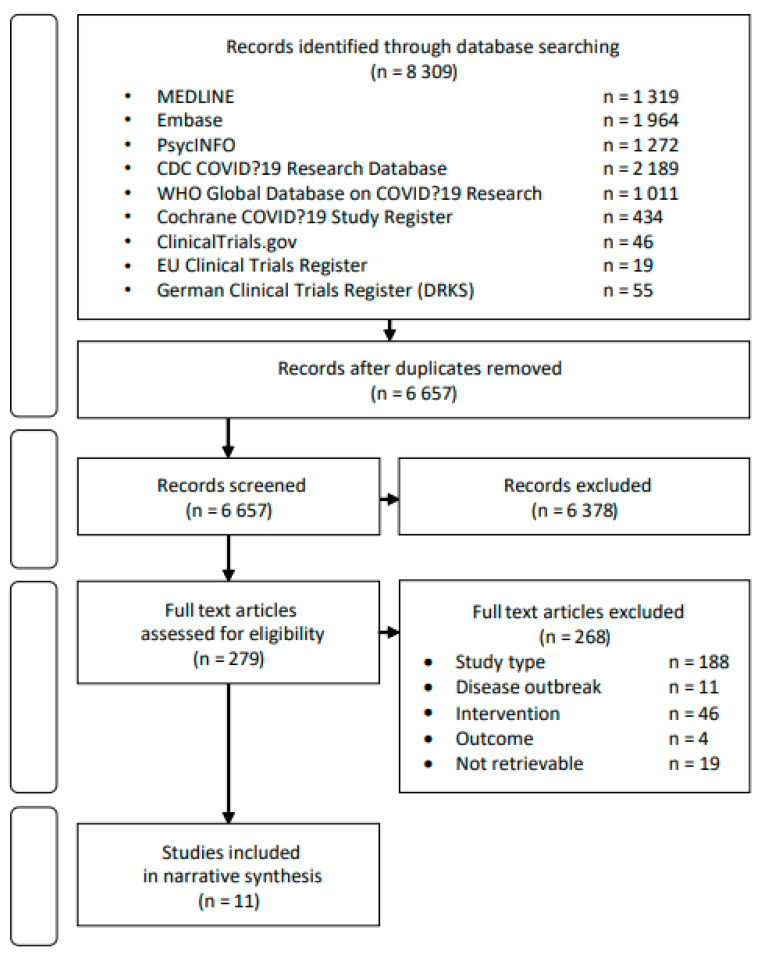
The aim of this study was to identify interventions targeting children and their caregivers to reduce psychosocial problems in the course of the COVID-19 pandemic and comparable outbreaks. The review was performed using systematic literature searches in MEDLINE, Embase, PsycINFO and COVID-19-specific databases, including the CDC COVID-19 Research Database, the World Health Organisation (WHO) Global Database on COVID-19 Research and the Cochrane COVID-19 Study Register, ClinicalTrials.gov, the EU Clinical Trials Register and the German Clinical Trials Register (DRKS) up to 25th September 2020. The search yielded 6657 unique citations. After title/abstract and full text screening, 11 study protocols reporting on trials planned in China, the US, Canada, the UK, and Hungary during the COVID-19 pandemic were included. Four interventions targeted children ≥10 years directly, seven system-based interventions targeted the parents and caregivers of younger children and adolescents. Outcome measures encompassed mainly anxiety and depressive symptoms, different dimensions of stress or psychosocial well-being, and quality of supportive relationships. In conclusion, this systematic review revealed a paucity of studies on psychosocial interventions for children during the COVID-19 pandemic. Further research should be encouraged in light of the expected demand for child mental health management.
Overview
The claims and statistics of this paper haven’t been checked yet.
Free: it reads the open-access text and checks the first 5 claims that cite a source we can check. Create a free account to check every claim.
Integrity signals
Registry
Cites
Statistics
Figures
Verification
Claims the paper makes
The claims and statistics of this paper haven’t been checked yet.
Free: it reads the open-access text and checks the first 5 claims that cite a source we can check. Create a free account to check every claim.
Claims other papers make about this one
Each is checked against this paper’s own text: does it say what the citing paper says it does?
The source backs part of the claim, not all of it — or backs it for a different population, condition or comparison.
In the citing paper
“However, at the time of the search (up to 25 September 2020), several randomized-controlled trials had been initiated but none had been completed.”
From Interventions to build resilience and to ameliorate negative psychosocial effects of the COVID-19 pandemic on children and adolescents: a systematic review and meta-analysis (2024) · cites this paper as [26]
Experimental — accuracy not yet measuredThe cited source says what the claim attributes to it.
In the citing paper
“A previous systematic review conducted by Boldt et al. at an early stage of the COVID-19 pandemic [26] identified multiple study protocols of interventions aiming to mitigate the negative psychosocial consequences of the COVID-19 pandemic on children and adolescents.”
Self-check
Percentages, sums and reported differences re-computed from the paper’s own numbers.
The self-check needs the paper’s full text.
Citations
Cites
Rayyan-a web and mobile app for systematic reviews.
Ouzzani, M., Hammady, H., Fedorowicz, Z., & Elmagarmid, A. (2016) · Systematic Reviews · doi:10.1186/s13643-016-0384-4 · Cited by 26,092
The psychological impact of quarantine and how to reduce it: Rapid review of the evidence
Brooks, S. K., Webster, R. K., Smith, L. E., Woodland, L., Wessely, S., Greenberg, N., & Rubin, G. J. (2020) · The Lancet · doi:10.1016/s0140-6736(20)30460-8 · Cited by 16,378
Mental health of young people: A global public-health challenge
Patel, V., Flisher, A. J., Hetrick, S., & McGorry, P. (2007) · The Lancet · doi:10.1016/s0140-6736(07)60368-7 · Cited by 3,126 · cited 1×
“In this context, early engagement seems to be crucial to prevent long-term consequences such as substance abuse, lower educational achievement, and development of violence [11,12].”
BackgroundLoades, M. E., Chatburn, E., Higson-Sweeney, N., Reynolds, S., Shafran, R., Brigden, A., Linney, C., McManus, M. N., Borwick, C., & Crawley, E. (2020) · Journal of the American Academy of Child & Adolescent Psychiatry · doi:10.1016/j.jaac.2020.05.009 · Cited by 2,906 · cited 1×
“Involuntary social isolation as a consequence of pandemic control measures is likely to result in higher levels of loneliness which in turn are associated with the onset of mental disorders [51].”
Background(2007) · PubMed Central · Cited by 2,521
Fegert, J. M., Vitiello, B., Plener, P. L., & Clemens, V. (2020) · Child and Adolescent Psychiatry and Mental Health · doi:10.1186/s13034-020-00329-3 · Cited by 1,807
Fearon, R. P., Bakermans-Kranenburg, M. J., Van IJzendoorn, M. H., Lapsley, A.-M., & Roisman, G. I. (2010) · Child Development · doi:10.1111/j.1467-8624.2009.01405.x · Cited by 1,326 · cited 1×
“Insecure parent–child attachments, in turn, are associated with higher risk of children developing internalizing and externalizing behavior problems that may persist into later life [31,32].”
BackgroundMoore, S. A., Faulkner, G., Rhodes, R. E., Brussoni, M., Chulak-Bozzer, T., Ferguson, L. J., Mitra, R., O’Reilly, N., Spence, J. C., Vanderloo, L. M., et al. (2020) · International Journal of Behavioral Nutrition and Physical Activity · doi:10.1186/s12966-020-00987-8 · Cited by 1,128
Impact of COVID-19 pandemic on children and adolescents’ lifestyle behavior larger than expected.
Xiang, M., Zhang, Z., & Kuwahara, K. (2020) · Progress in Cardiovascular Diseases · doi:10.1016/j.pcad.2020.04.013 · Cited by 847
Viner, R., Russell, S., Saulle, R., Croker, H., Stansfield, C., Packer, J., Nicholls, D., Goddings, A.-L., Bonell, C., Hudson, L., et al. (2022) · JAMA Pediatrics · doi:10.1001/jamapediatrics.2021.5840 · Cited by 789
Research works printed but not linked: 1
- Abott A COVID’s Mental-Health Toll: How Scientists Are Tracking A Surge in Depression. Researchers Are Using Huge Data Sets to Link Changes in Mental Health to Coronavirus-Response Measures Available online: https://www.nature.com/articles/d41586-021-00175-z (accessed on 3 February 2021)
Cited by
Thorisdottir, I. E., Asgeirsdottir, B. B., Kristjansson, A. L., Valdimarsdottir, H. B., Jonsdottir Tolgyes, E. M., Sigfusson, J., Allegrante, J. P., Sigfusdottir, I. D., & Halldorsdottir, T. (2021) · The Lancet Psychiatry · doi:10.1016/s2215-0366(21)00156-5 · Cited by 278
Scoping review: longitudinal effects of the COVID-19 pandemic on child and adolescent mental health
Wolf, K., & Schmitz, J. (2024) · European Child & Adolescent Psychiatry · doi:10.1007/s00787-023-02206-8 · Cited by 242
“It is known that parent psychopathology is closely linked to their parenting abilities and children’s psychological distress [137].”
BackgroundInfluentialHossain, M. M., Nesa, F., Das, J., Aggad, R., Tasnim, S., Bairwa, M., Ma, P., & Ramirez, G. (2022) · Psychiatry Research · doi:10.1016/j.psychres.2022.114814 · Cited by 177
COVID-19 and mental health disorders in children and adolescents (Review)
Bai, M., Miao, C., Zhang, Y., Xue, Y., Jia, F., & Du, L. (2022) · Psychiatry Research · doi:10.1016/j.psychres.2022.114881 · Cited by 65
“CBT programs supported by interrogative evidence and conducted through scalable networks have great potential during pandemic and in post-pandemic recovery (Boldt et al., 2021).”
BackgroundInfluentialEspinoza, G., & Hernandez, H. L. (2022) · Infant and Child Development · doi:10.1002/icd.2305 · Cited by 51
“A recent review of interventions aimed to ameliorate adolescents' psychosocial impact of the pandemic found that although protocols are currently being tested for digital interventions, such as an online Solution Focused Brief Therapy for adolescents that entails a short-term psychotherapy option, these studies are no…”
Background
Metadata
- Authors
- Boldt, K., Coenen, M., Movsisyan, A., Voss, S., Rehfuess, E., Kunzler, A. M., Lieb, K., & Jung-Sievers, C.
- Affiliations
- Institut für Medizinische Informationsverarbeitung, Biometrie und Epidemiologie (DE)
- Leibniz Institute for Resilience Research (DE)
- Institute for Medical Information Processing, Biometry and Epidemiology—IBE, Chair of Public Health and Health Services Research, LMU Munich, Elisabeth-Winterhalter-Weg 6, 81377 Munich, Germany
- Venue
- International Journal of Environmental Research and Public Health
- Publisher
- MDPI AG
- Published
- 2021-02-28
- Volume
- 18
- Issue
- 5
- Pages
- 2361
- ISSN
- 1660-4601 (ISSN-L)
- PMC
- PMC7967755
- OpenAlex
- W3135616915
- Cited by
- 72
- References
- 49
- Citations by year
- 2026: 1 · 2025: 5 · 2024: 9 · 2023: 27 · 2022: 17 · 2021: 13
- FWCI
- 2.19
- Type
- journal article
- Language
- en
- Open access
- gold
- doi.org
- Licence
- Locations
- International Journal of Environmental Research and Public Health (publishedVersion, cc-by)
- PubMed Central (publishedVersion, cc-by)
- PubMed (publishedVersion)
- Informationszentrum Lebenswissenschaften (ZB MED) (submittedVersion, cc-by)
- RePEc: Research Papers in Economics (submittedVersion)
- DOAJ (DOAJ: Directory of Open Access Journals) (submittedVersion, cc-by-sa)
- Open access LMU (Ludwid Maxmilian's Universitat Munchen) (submittedVersion, cc-by)
- Funders
- Ludwig-Maximilians-Universität München
- Topics
- Social Sciences › Psychology › Clinical Psychology › COVID-19 and Mental Health
- Social Sciences › Psychology › Clinical Psychology › Child and Adolescent Psychosocial and Emotional Development
- Health Sciences › Medicine › Public Health, Environmental and Occupational Health › Maternal Mental Health During Pregnancy and Postpartum
- Keywords
- COVID-19 pandemic, children, psychosocial interventions, child mental health, anxiety, depressive symptoms, caregiver interventions, parent-child relationship, stress, psychosocial well-being, school closures
- MeSH terms
- COVID-19, Adolescent, Anxiety, Canada, Child, China, Clinical Trials as Topic, Depression, United Kingdom, Humans, Hungary, Mental Health, Parents, Social Support, Stress, Psychological, United States, Caregivers, Pandemics
About these checks
Registry, retraction, Cites and statistics results are computed, not judged, with one exception: a printed reference that no index lists is read once by a model before it counts as a citation error. Claims are extracted by a model and kept only when their quote appears verbatim in the text; each cited source is then checked, with a model’s help, for whether it says what the claim relies on. Those verdicts can be wrong — read the claim’s quote and the cited source before relying on one.
Statistics and arithmetic are recomputed, not judged.
Confidence bands are shown only for fields calibrated on our annotated test set. None is calibrated yet, so no band is shown.
What counts as a claim ›How we measure confidence ›How we check this ›
Are you an author, or do you see a problem with this page? Request a review
Data sources
Bibliographic data: Semantic Scholar, OpenAlex, Crossref.
Contains information from the Semantic Scholar Academic Graph Datasets, made available under the ODC Attribution License (ODC-BY 1.0).
Semantic Scholar’s data is described in: Kinney, R., et al. (2023). The Semantic Scholar Open Data Platform. arXiv:2301.10140.
