

Perspectives on the Health Effects of Hurricanes: A Review and Challenges
Open accessThe DOI matches its Crossref record; 121 of the 124 references it cites were found in a registry or an index.
Abstract
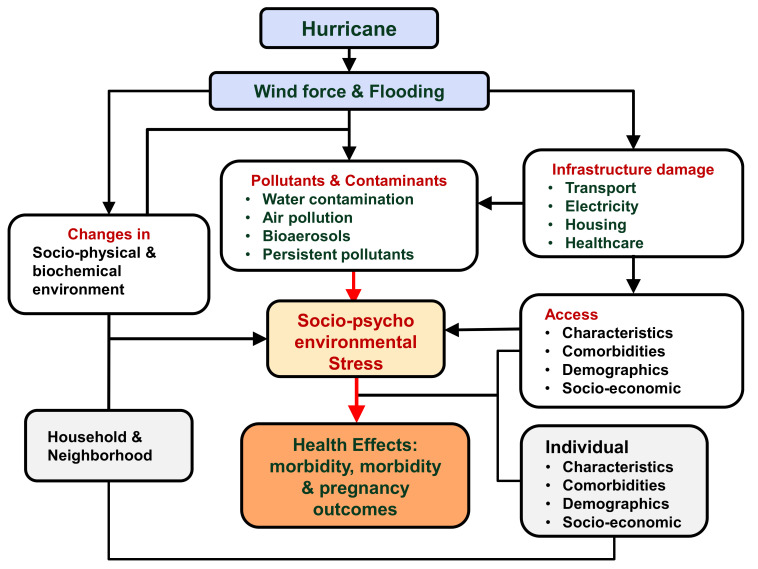
Hurricanes are devastating natural disasters which dramatically modify the physical landscape and alter the socio-physical and biochemical characteristics of the environment, thus exposing the affected communities to new environmental stressors, which persist for weeks to months after the hurricane. This paper has three aims. First, it conceptualizes potential direct and indirect health effects of hurricanes and provides an overview of factors that exacerbate the health effects of hurricanes. Second, it summarizes the literature on the health impact of hurricanes. Finally, it examines the time lag between the hurricane (landfall) and the occurrence of diseases. Two major findings emerge from this paper. Hurricanes are shown to cause and exacerbate multiple diseases, and most adverse health impacts peak within six months following hurricanes. However, chronic diseases, including cardiovascular disease and mental disorders, continue to occur for years following the hurricane impact.
Overview
The claims and statistics of this paper haven’t been checked yet.
Free: it reads the open-access text and checks the first 5 claims that cite a source we can check. Create a free account to check every claim.
Integrity signals
Registry
Cites
Statistics
Figures
Verification
Claims the paper makes
The claims and statistics of this paper haven’t been checked yet.
Free: it reads the open-access text and checks the first 5 claims that cite a source we can check. Create a free account to check every claim.
Claims other papers make about this one
Each is checked against this paper’s own text: does it say what the citing paper says it does?
The source backs part of the claim, not all of it — or backs it for a different population, condition or comparison.
In the citing paper
“Hurricane Katrina was responsible for approximately 1200 deaths, 1.5 million displacements, and an estimated $170 billion US dollars in damages.40”
From Effects of Extreme Weather on Health in Underserved Communities (2024) · cites this paper as [40]
Experimental — accuracy not yet measuredThe cited source says what the claim attributes to it.
In the citing paper
“Heavy rains and extensive flooding create ideal conditions for bioaerosols, such as mold, to grow, and homes having flood damage had increased levels of mold growth.2,40,48”
From Effects of Extreme Weather on Health in Underserved Communities (2024) · cites this paper as [40]
Self-check
Percentages, sums and reported differences re-computed from the paper’s own numbers.
The self-check needs the paper’s full text.
Citations
Cites
Mental Illness and Suicidality after Hurricane Katrina
Kessler, R. (2006) · Bulletin of the World Health Organization · doi:10.2471/blt.06.033019 · Cited by 395 · cited 1×
“However, in a survey employed post-Katrina, suicidal ideation was lower after Katrina due to a strong relationship between dimensions of personal growth after trauma [94].”
BackgroundHurricane Katrina deaths, Louisiana, 2005
Brunkard, J., Namulanda, G., & Ratard, R. (2008) · Disaster Medicine and Public Health Preparedness · doi:10.1097/dmp.0b013e31818aaf55 · Cited by 338
Intimate Partner Violence and Hurricane Katrina: Predictors and Associated Mental Health Outcomes
Schumacher, J. A., Coffey, S. F., Norris, F. H., Tracy, M., Clements, K., & Galea, S. (2010) · Violence and Victims · doi:10.1891/0886-6708.25.5.588 · Cited by 212
Assessment of Pathogens and Toxicants in New Orleans, LA Following Hurricane Katrina
Presley, S. M., Rainwater, T. R., Austin, G. P., Platt, S. G., Zak, J. C., Cobb, G. P., Marsland, E. J., Tian, K., Zhang, B., Anderson, T. A., et al. (2006) · Environmental Science & Technology · doi:10.1021/es052219p · Cited by 187 · cited 6×
“One study concluded that fifteen months after Hurricane Katrina, almost half of New Orleans residents continued to experience poor mental and physical health [91].”
BackgroundInfluentialExperience of Hurricane Katrina and Reported Intimate Partner Violence
Harville, E. W., Taylor, C. A., Tesfai, H., Xiong, X., & Buekens, P. (2011) · Journal of Interpersonal Violence · doi:10.1177/0886260510365861 · Cited by 182
Impact of a Natural Disaster on Diabetes
Fonseca, V. A., Smith, H., Kuhadiya, N., Leger, S. M., Yau, C. L., Reynolds, K., Shi, L., McDuffie, R. H., Thethi, T., & John-Kalarickal, J. (2009) · Diabetes Care · doi:10.2337/dc09-0670 · Cited by 170
Chronic Diseases and Natural Hazards: Impact of Disasters on Diabetic, Renal, and Cardiac Patients
Miller, A. C., & Arquilla, B. (2008) · Prehospital and Disaster Medicine · doi:10.1017/s1049023x00005835 · Cited by 159
Psychological impact of the hurricane Mitch in Nicaragua in a one-year perspective
Caldera, T., Palma, L., Penayo, U., & Kullgren, G. (2001) · Social Psychiatry and Psychiatric Epidemiology · doi:10.1007/s001270050298 · Cited by 153
Increased incidence of inflicted traumatic brain injury in children after a natural disaster.
Keenan, H., Marshall, S., Nocera, M., & Runyan, D. K. (2004) · American Journal of Preventive Medicine · doi:10.1016/j.amepre.2003.10.023 · Cited by 150
Anastario, M., Shehab, N., & Lawry, L. (2009) · Disaster Medicine and Public Health Preparedness · doi:10.1097/dmp.0b013e3181979c32 · Cited by 149
Cited by
Items 101–121 of 121
Schaub, L. R. A., & Gil‐Alana, L. A. (2026) · Natural Hazards · doi:10.1007/s11069-025-07793-0
“…et al. 1999 ; Sadowski and Sutter 2005 ; Borden and Cutter 2008 ; Jonkman et al. 2009 ; Yeo and Blong 2010 ; Haque et al. 2012 ; Zahran et al. 2013 ; Lee et al. 2021 ; Bell et al. 2023 ; Huang et al. 2023 ; Parks et al. 2023 ; Graff Zivin et al. 2023 ; Liu et al. 2025 ; Nguyen and Mitrou 2025).”
Assessing economic value of skilled tropical cyclone forecasts at sites
Gulati, S., Sampson, C. R., Laesser, M., & Howard, A. (2026) · Natural Hazards · doi:10.1007/s11069-025-07750-x
Tefera, F. A., Abid, A., Akram, T., Eboye, R. O., Mohummed, A. H., Noor, M., Uddin, H., & Delgado, R. C. (2026) · Progress in Disaster Science · doi:10.1016/j.pdisas.2026.100576
3D Printing Solutions for Health Care in Emergency Response Scenarios
Ababao, P. M., Agustin, R. R. A., Carreon, C. G., Hong, A. L., Samson, A. J. M., & Limpin, J. E. O. (2026) · International Conference on Artificial Intelligence, Computer, Data Sciences and Applications (ACDSA) · doi:10.1109/acdsa67686.2026.11468087
“Vulnerable populations, such as the elderly and individuals with chronic conditions, faced disproportionate challenges, further highlighting the critical gaps in disaster preparedness and response [4].”
Hurricanes, Neighborhood Disadvantage, and Cardiopulmonary Health in US Veterans
Yip, C. S., Kaboli, P. J., Jones, M. J., Carrel, M., & Thorne, P. S. (2026) · JAMA Network Open · doi:10.1001/jamanetworkopen.2026.7830
Mental health impacts of Hurricane Fiona in Prince Edward Island, Canada
Kınay, P., Guild, R., Lildhar, L., & Wang, X. (2026) · Next Sustainability · doi:10.1016/j.nxsust.2026.100338 · Cited by 2
Health Impact of Climate Change on Older Adults Living With Dementia: A Scoping Review
Gurung, S., Lima, C. A., Hogan, D. B., Shirchindorj, N., Lowe, S. A. J., Dennett, L., Evans, S. M., Jones, C. A., & Yamamoto, S. S. (2026) · Wiley Interdisciplinary Reviews Climate Change · doi:10.1002/wcc.70071 · Cited by 1
“Hurricanes can have a devastating impact on both physical and psychological population health that can last for weeks to months (Lee et al. 2021).”
InfluentialOptimism predicts future economic mobility among hurricane maria migrants
Duque, M., Acaf, Y., Salas‐Wright, C. P., Maldonado‐Molina, M. M., Montero‐Zamora, P., Gualdron, E. O., Cisco, M. M., Sahbaz, S., Scaramutti, C., Watkins, L. G., et al. (2026) · Climate and Development · doi:10.1080/17565529.2026.2664557 · Cited by 1
Han, B. Y., Wood, E. H., & Patel, M. I. (2026) · American Society of Clinical Oncology Educational Book · doi:10.1200/edbk-26-521644
Whalen, C., Boyd, D., Commisso, G., Christner, S., Jones, I., Leslie, K. L., Thirtyacre, J., Díaz‐Morales, D. M., Kuris, A. M., Mann, J., et al. (2026) · Journal of Freshwater Ecology · doi:10.1080/02705060.2026.2690282
Min, J., Chu, J., Oh, J., Min, H., & Franzke, C. L. E. (2026) · Environmental Research · doi:10.1016/j.envres.2026.125129
Rebuilding Lives, Not Just Homes: A Capabilities Approach to Post-Disaster Housing Recovery
Puriya, A., & Biswas, A. (2026) · Journal of Human Development and Capabilities · doi:10.1080/19452829.2026.2696845
Closing the environmental preparedness gap in end-of-life care
Dong, Y., Wang, K., & Rizzo, V. M. (2026) · Public Policy & Aging Report · doi:10.1093/ppar/prag016 · Cited by 1
The Aftermath of Hurricane Helene: Orthopedic Injury Epidemiology at a Level I Trauma Center
Thompson, M., Patel, S., Courson, J., Twibell, H. B., Hurt, J., Hammer, R., Bozzone, A. E., & Parada, S. A. (2026) · Southern Medical Journal · doi:10.14423/smj.0000000000002000
Modeling Culvert Failure and Community Accessibility Impacts During Hazards
Govina, J., Boakye, J., & Okte, E. (2026) · Risk Analysis · doi:10.1111/risa.70310
“Older adults are disproportionately likely to have preexisting health conditions (including cardiovascular disease, diabetes, and chronic respiratory illness) that create an urgent and recurring need for access to medical facilities (Benevolenza and DeRigne 2019 ; Waddell et al. 2021 ).”
Assessing emergency supply kits: Contents, usage, and impacts following Hurricane Ian—Florida, 2022
Tremarelli, M., Hanchey, A., Kieszak, S. M., DiGrande, L., & Schnall, A. H. (2026) · Journal of Emergency Management · doi:10.5055/jem.1024
The Health Impacts of Extreme Weather Events
Joseph, E., Patel, A., & Addison, V. (2026) · Nursing Clinics of North America · doi:10.1016/j.cnur.2026.06.006
Yang, H., Ping, Z., Peng, L., Wang, Y., Li, X., Ju, A., & Jiang, Z. (2026) · Journal of Building Engineering · doi:10.1016/j.jobe.2026.117473
Impact of Hurricane Melissa on neurosurgery care in Jamaica: implications for disaster preparedness
Myers, M., Hamilton, S., Hazle, S., Blake, L., Hylton, L., Holder, S., Samuels, S., Lawrence, A. J., Parker, T., Wade, K., et al. (2026) · British Journal of Neurosurgery · doi:10.1080/02688697.2026.2746369
AI advancements can advance environmental inequities and health harms
Nishigaki, M., & Jochim, A. (2026) · Journal of the National Medical Association · doi:10.1016/j.jnma.2026.09.008
Responding to the Post-Disaster Needs of Children’s Education: Lessons from the United States
Caldwell, B., & Finger, D. (2026) · Springer eBooks · doi:10.1007/978-981-96-1473-8_25-1
Metadata
- Authors
- Waddell, S. L., Jayaweera, D. T., Mirsaeidi, M., Beier, J. C., & Kumar, N.
- Affiliations
- Case Western Reserve University (US)
- University of Miami (US)
- Corresponding author
- Kumar, Naresh
- Venue
- International Journal of Environmental Research and Public Health
- Publisher
- MDPI AG
- Published
- 2021-03-09
- Volume
- 18
- Issue
- 5
- Pages
- 2756
- ISSN
- 1660-4601 (ISSN-L)
- PMC
- PMC7967478
- OpenAlex
- W3134767299
- Cited by
- 121
- References
- 124
- Citations by year
- 2026: 25 · 2025: 30 · 2024: 30 · 2023: 19 · 2022: 15 · 2021: 1
- FWCI
- 3.99
- Type
- journal article
- Language
- en
- Open access
- gold
- doi.org
- Licence
- Locations
- International Journal of Environmental Research and Public Health (publishedVersion, cc-by)
- PubMed Central (publishedVersion, cc-by)
- PubMed (publishedVersion)
- Florida International University Digital Commons (Florida International University) (submittedVersion)
- RePEc: Research Papers in Economics (submittedVersion)
- DOAJ (DOAJ: Directory of Open Access Journals) (submittedVersion)
- Funders
- University of Miami
- National Eye Institute (R01EY026174)
- National Institute of Environmental Health Sciences (R21ES029765)
- Topics
- Health Sciences › Health Professions › Emergency Medical Services › Disaster Response and Management
- Physical Sciences › Environmental Science › Health, Toxicology and Mutagenesis › Climate Change and Health Impacts
- Social Sciences › Sociology and Political Science › Disaster Management and Resilience
- Keywords
- hurricanes, cardiovascular disease, mental illness, chronic disease, disaster health
- MeSH terms
- Disasters, Humans, Cyclonic Storms
About these checks
Registry, retraction, Cites and statistics results are computed, not judged, with one exception: a printed reference that no index lists is read once by a model before it counts as a citation error. Claims are extracted by a model and kept only when their quote appears verbatim in the text; each cited source is then checked, with a model’s help, for whether it says what the claim relies on. Those verdicts can be wrong — read the claim’s quote and the cited source before relying on one.
Statistics and arithmetic are recomputed, not judged.
Confidence bands are shown only for fields calibrated on our annotated test set. None is calibrated yet, so no band is shown.
What counts as a claim ›How we measure confidence ›How we check this ›
Are you an author, or do you see a problem with this page? Request a review
Data sources
Bibliographic data: Semantic Scholar, OpenAlex, Crossref.
Contains information from the Semantic Scholar Academic Graph Datasets, made available under the ODC Attribution License (ODC-BY 1.0).
Semantic Scholar’s data is described in: Kinney, R., et al. (2023). The Semantic Scholar Open Data Platform. arXiv:2301.10140.
