

Prisoners as Users of Digital Health Care and Social Welfare Services: A Finnish Attitude Survey
Open accessThe DOI matches its Crossref record; 40 of the 40 references it cites were found in a registry or an index.
Abstract
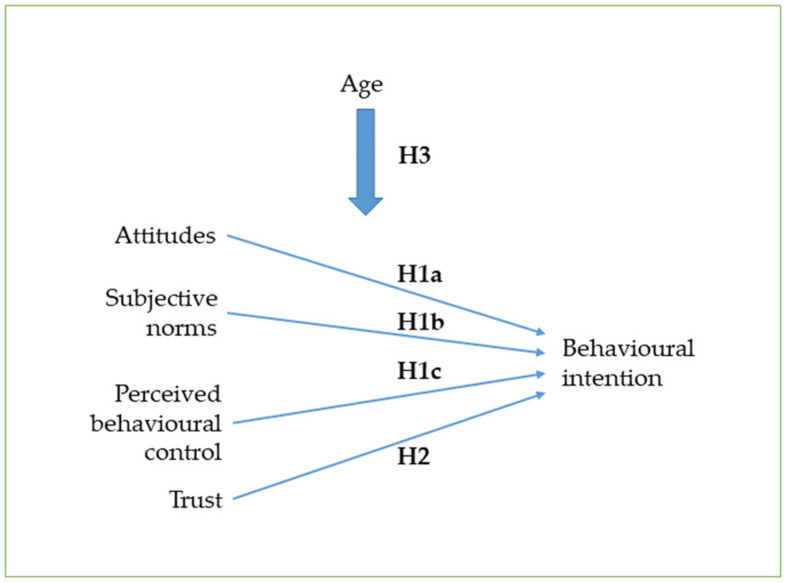
Prisoners are a group of people with many health and social problems. However, in prisons the use of the Internet is controlled. Thus, prisoners’ access to digital health care and social welfare services is limited. In addition, there are many cognitive and attitudinal barriers to the use of digital health care and social welfare services for prisoners. Cross-sectional survey data (N = 225) were collected from eleven prisons in different parts of Finland and analysed using linear regression analysis. The results are consistent with Ajzen’s theory and previous studies on the acceptance of information systems in health care. Prisoners’ behavioural intentions related to the use of digital health care and social welfare services are influenced by their perceptions of their capacity to use digital services, the expectations of their close people and their attitudes, as well as by trust in the Internet and services. In contrast, the age of prisoners’ indirectly affects their willingness to use digital services. The study recommends that prisoners are supported in the use of digital health care and social welfare services by prison staff and other people. Digital skills training is also needed in order to support digital inclusion, especially for older and long-term prisoners.
Overview
The claims and statistics of this paper haven’t been checked yet.
Free: it reads the open-access text and checks the first 5 claims that cite a source we can check. Create a free account to check every claim.
Integrity signals
Registry
Cites
Statistics
Figures
Verification
Claims the paper makes
The claims and statistics of this paper haven’t been checked yet.
Free: it reads the open-access text and checks the first 5 claims that cite a source we can check. Create a free account to check every claim.
Claims other papers make about this one
Each is checked against this paper’s own text: does it say what the citing paper says it does?
The source backs part of the claim, not all of it — or backs it for a different population, condition or comparison.
In the citing paper
“authors of a cross-sectional Finland study of individuals incarcerated at 11 prisons (n ¼ 225) showed that 63.2% of respondents rated digital services as easy to use, and most (69.8%) were confident in their ability to quickly use new digital services.”
From Pain in US corrections settings: the promise of digital solutions for better data and treatment access (2024) · cites this paper as [4]
Experimental — accuracy not yet measuredThe source backs part of the claim, not all of it — or backs it for a different population, condition or comparison.
In the citing paper
“The digitalization of prisons is a trend that offers opportunities to expand health care and social welfare services and increase the efficiency of prison processes.”
From Pain in US corrections settings: the promise of digital solutions for better data and treatment access (2024) · cites this paper as [4]
Experimental — accuracy not yet measured
Self-check
Percentages, sums and reported differences re-computed from the paper’s own numbers.
The self-check needs the paper’s full text.
Citations
Cites
The theory of planned behavior
Ajzen, I. (1991) · Organizational Behavior and Human Decision Processes · doi:10.1016/0749-5978(91)90020-t · Cited by 90,587
User Acceptance of Computer Technology: A Comparison of Two Theoretical Models
Davis, F. D., Bagozzi, R. P., & Warshaw, P. R. (1989) · Management Science · doi:10.1287/mnsc.35.8.982 · Cited by 25,709 · cited 1×
“Previous studies [37–39] have shown that, in particular, the technology acceptance model [40] and the theory of planned behaviour [41] are useful approaches for explaining the adoption of new technology in health care.”
BackgroundEfficacy of the Theory of Planned Behaviour: A meta‐analytic review
Armitage, C. J., & Conner, M. (2001) · British Journal of Social Psychology · doi:10.1348/014466601164939 · Cited by 9,970 · cited 1×
“According to Armitage and Conner’s [51] meta-analyses, previous measures have been related not only to actual intention but also to self-prediction and desire.”
MethodThe Technology Acceptance Model: Its past and its future in health care
Holden, R. J., & Karsh, B.-T. (2010) · Journal of Biomedical Informatics · doi:10.1016/j.jbi.2009.07.002 · Cited by 2,669 · cited 2×
“In the context of the acceptance and use of health technology, the concept of perceived behavioural control refers to the perception of the availability of skills, resources and opportunities necessary for using the technology and the concept of subjective norms means the perception of important (or relevant) others’…”
BackgroundResultThe utilization of e-government services: citizen trust, innovation and acceptance factors
Carter, L., & Bélanger, F. (2005) · Information Systems Journal · doi:10.1111/j.1365-2575.2005.00183.x · Cited by 2,207 · cited 4×
“The measure of trust was based on Carter and Bélanger’s [48] measures of trust in the Internet and of trust in the state government, and it contained a total of seven items.”
BackgroundMethodInfluentialReconsidering Political and Popular Understandings of the Digital Divide
Selwyn, N. (2004) · New Media & Society · doi:10.1177/1461444804042519 · Cited by 1,437 · cited 1×
“can exclude a person from society, also causing a digital divide [12,15], and make them second-class citizens in a digitalised society [16].”
BackgroundInformation technology acceptance by individual professionals: a model comparison approach
Chau, P. Y. K., & Hu, P. J. (2001) · Decision Sciences · doi:10.1111/j.1540-5915.2001.tb00978.x · Cited by 1,409
Chau, P. Y. K., & Hu, P. J. (2002) · Journal of Management Information Systems · doi:10.1080/07421222.2002.11045699 · Cited by 707 · cited 1×
“In the context of the acceptance and use of health technology, the concept of perceived behavioural control refers to the perception of the availability of skills, resources and opportunities necessary for using the technology and the concept of subjective norms means the perception of important (or relevant) others’…”
BackgroundHelsper, E. J. (2012) · Communication Theory · doi:10.1111/j.1468-2885.2012.01416.x · Cited by 692 · cited 3×
“An individual’s digital skills and attitude are also key issues from the perspective of digital service use and digital inclusion [10,11].”
BackgroundZhao, Y., Ni, Q., & Zhou, R. (2018) · International Journal of Information Management · doi:10.1016/j.ijinfomgt.2017.08.006 · Cited by 516 · cited 7×
“The association of these independent variables with the intention to use digital health services has also been found empirically in several studies [46].”
BackgroundMethodResultInfluential
Research works printed but not linked: 3
- Smith V.S. Exploring the Potential of Digital Technology to Reduce Recidivism: A Delphi Study on the Digitalization of Prison Education Ph.D. Thesis Ashford University Ann Arbor, MI, USA 6 2020 Available online: https://search.proquest.com/openview/2fa3293795b3971f713d4b288f6aeb93/1?pq-origsite=gscholar&cbl=51922&diss=y (accessed on 20 May 2021)
- Puolakka P. Hovila S. TIC19012—The Development of Digitalization and “Smart Prison” Solutions for Prisoners in Finnish Criminal Sanctions Agency Proceedings of the Technology in Corrections Conference: Digital Transformation Lisbon, Portugal 2–4 April 2019 Available online: https://icpa.org/library/tic19012-the-development-of-digitalization-and-smart-prison-solutions-for-prisoners-in-finnish-criminal-sanctions-agency/ (accessed on 20 May 2021)
- Thomas J. Barraket J. Wilson C.K. Cook K. Louie Y.M. Holcombe-James I. Ewing S. MacDonald T. Measuring Australia’s Digital Divide: The Australian Digital Inclusion Index RMIT University Melbourne, Australia Telstra Sydney, Australia 2018 10.25916/5b594e4475a00 · DOI
Cited by
A systematic review of consumers’ and healthcare professionals’ trust in digital healthcare
Catapan, S. D. C., Sazon, H., Zheng, S., Gallegos-Rejas, V., Mendis, R., Santiago, P. H. R., & Kelly, J. T. (2025) · npj Digital Medicine · doi:10.1038/s41746-025-01510-8 · Cited by 80
“29,32,57 ; the willingness to rely or depend on something or someone ( n = 5, 10.2”
InfluentialMohammad, A. A. S., Khanfar, I. A. A., Oraini, B. A., Vasudevan, A., Mohammad, S. I., & Al-Momani, A. M. (2024) · Data & Metadata · doi:10.56294/dm2024394 · Cited by 77
Zivanai, E., & Mahlangu, G. (2022) · Cogent Social Sciences · doi:10.1080/23311886.2022.2116809 · Cited by 73
“…the essential services such as social conduct, job seeking, health and business are now embedded in ICTs (Bedford et al., 2014; Järveläinen & Rantanen, 2020; Pamungkas, 2020; Rantanen et al., 2021; Seo et al., 2021; The Centre for Social Justice, 2021; Toreld et al., 2018; Willems et al., 2018b).”
BackgroundInfluentialHwang, Y. I., Hagos, A. K., Withall, A., Hampton, S. E., Snoyman, P., & Butler, T. G. (2024) · PLoS ONE · doi:10.1371/journal.pone.0297482 · Cited by 29
“additional difficulty for digital inclusion, and concluded that digital skills initiatives are particularly warranted for older and longer-term prisoners (Rantanen et al., 2021).”
BackgroundSolbakken, L. E., Bergvik, S., & Wynn, R. (2024) · BMC Psychiatry · doi:10.1186/s12888-024-05736-w · Cited by 33
“Some argue that limited access to online information and digital health services may have consequences for the well-being and successful rehabilitation of those incarcerated [53, 56, 57].”
Background
Metadata
- Authors
- Rantanen, T., Järveläinen, E., & Leppälahti, T.
- Affiliations
- Laurea University of Applied Sciences (FI)
- Corresponding author
- Rantanen, Teemu
- Venue
- International Journal of Environmental Research and Public Health
- Publisher
- MDPI AG
- Published
- 2021-05-21
- Volume
- 18
- Issue
- 11
- Pages
- 5528
- ISSN
- 1660-4601 (ISSN-L)
- PMC
- PMC8196707
- OpenAlex
- W3164252651
- Cited by
- 22
- References
- 40
- Citations by year
- 2026: 2 · 2025: 3 · 2024: 6 · 2023: 3 · 2022: 8
- FWCI
- 5.89
- Type
- journal article
- Language
- en
- Open access
- gold
- doi.org
- Licence
- Locations
- International Journal of Environmental Research and Public Health (publishedVersion, cc-by)
- PubMed Central (publishedVersion, cc-by)
- PubMed (publishedVersion)
- RePEc: Research Papers in Economics (submittedVersion)
- DOAJ (DOAJ: Directory of Open Access Journals) (submittedVersion)
- Theseus (Ammattikorkeakoulujen) (submittedVersion, cc-by)
- Funders
- Strategic Research Council (327169 and 327145)
- Topics
- Social Sciences › Sociology and Political Science › Criminal Justice and Corrections Analysis
- Health Sciences › Medicine › Geriatrics and Gerontology › Technology Use by Older Adults
- Health Sciences › Health Professions › Health Information Management › Health, Technology, Consumer Behavior
- Keywords
- prisoners, digital healthcare, social services, digital inclusion, technology acceptance, UTAUT, behavioral intention, digital skills training, older prisoners, long-term prisoners, Finland
- MeSH terms
- Attitude, Cross-Sectional Studies, Delivery of Health Care, Finland, Humans, Prisoners, Prisons, Social Welfare
About these checks
Registry, retraction, Cites and statistics results are computed, not judged, with one exception: a printed reference that no index lists is read once by a model before it counts as a citation error. Claims are extracted by a model and kept only when their quote appears verbatim in the text; each cited source is then checked, with a model’s help, for whether it says what the claim relies on. Those verdicts can be wrong — read the claim’s quote and the cited source before relying on one.
Statistics and arithmetic are recomputed, not judged.
Confidence bands are shown only for fields calibrated on our annotated test set. None is calibrated yet, so no band is shown.
What counts as a claim ›How we measure confidence ›How we check this ›
Are you an author, or do you see a problem with this page? Request a review
Data sources
Bibliographic data: Semantic Scholar, OpenAlex, Crossref.
Contains information from the Semantic Scholar Academic Graph Datasets, made available under the ODC Attribution License (ODC-BY 1.0).
Semantic Scholar’s data is described in: Kinney, R., et al. (2023). The Semantic Scholar Open Data Platform. arXiv:2301.10140.
