

The DOI matches its Crossref record; 94 of the 94 references it cites were found in a registry or an index.
Resilience, Coping Strategies and Posttraumatic Growth in the Workplace Following COVID-19: A Narrative Review on the Positive Aspects of Trauma
Open accessAbstract
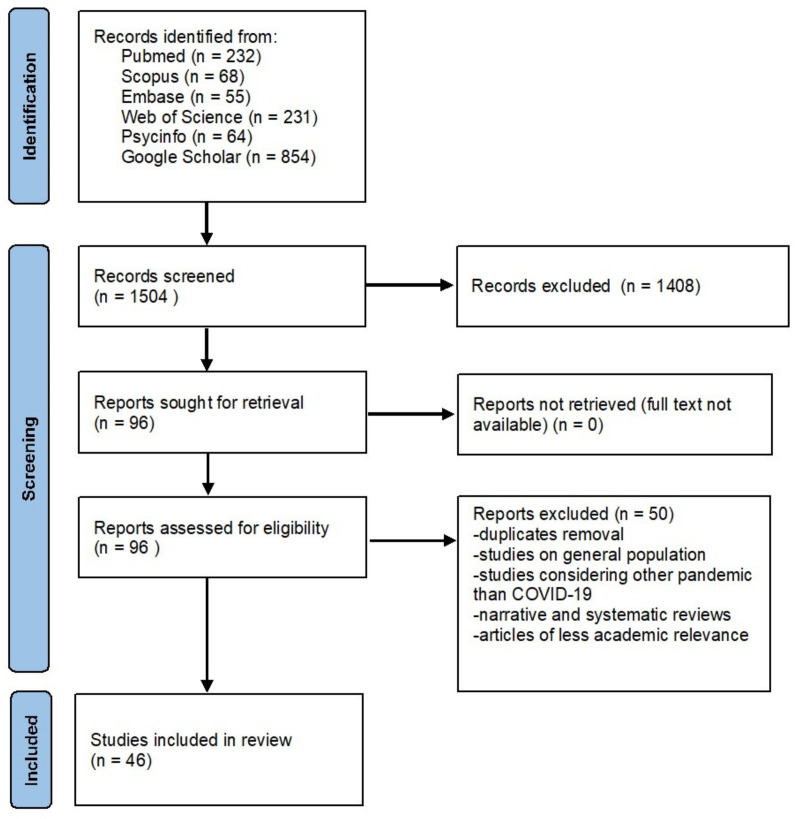
The COVID-19 pandemic represents a traumatic event that has profoundly changed working conditions with detrimental consequences for workers’ health, in particular for the healthcare population directly involved in addressing the emergency. Nevertheless, previous research has demonstrated that traumatic experiences can also lead to positive reactions, stimulating resilience and feelings of growth. The aim of this narrative review is to investigate the positive aspects associated with the COVID-19 pandemic and the possible health prevention and promotion strategies by analyzing the available scientific evidence. In particular, we focus on the constructs of resilience, coping strategies and posttraumatic growth (PTG). A literature search was performed on the PubMed, EMBASE, Scopus, Web of Science, Google Scholar and Psycinfo databases. Forty-six articles were included in the literature synthesis. Psychological resilience is a fundamental variable for reducing and preventing the negative psychological effects of the pandemic and is associated with lower levels of depression, anxiety and burnout. At the individual and organizational level, resilience plays a crucial role in enhancing wellbeing in healthcare and non-healthcare workers. Connected to resilience, adaptive coping strategies are essential for managing the emergency and work-related stress. Several positive factors influencing resilience have been highlighted in the development of PTG. At the same time, high levels of resilience and positive coping strategies can enhance personal growth. Considering the possible long-term coexistence and consequences of COVID-19, organizational interventions should aim to improve workers’ adaptive coping skills, resilience and PTG in order to promote wellbeing.
Overview
The claims and statistics of this paper haven’t been checked yet.
Run the check — free, no account needed. It reads the open-access text and checks the sources it cites.
Integrity signals
Registry
Cites
Statistics
Figures
Verification
Claims the paper makes
The claims and statistics of this paper haven’t been checked yet.
Run the check — free, no account needed. It reads the open-access text and checks the sources it cites.
Claims other papers make about this one
Each is checked against this paper’s own text: does it say what the citing paper says it does?
The source backs part of the claim, not all of it — or backs it for a different population, condition or comparison.
In the citing paper
“Previous studies indicated that variables such as social support and psychological resilience after trauma may be effective mediators on PTG (Ahmadi & Mehrabi, 2020; Finstad et al., 2021).”
From Post-Traumatic Growth in University Students After Earthquakes: The Effect of Perceived Social Support and Psychological Resilience (2025) · cites this paper as Finstad et al., 2021
Experimental — accuracy not yet measuredThe check wasn’t confident either way, so it gives no verdict — never disputed.
In the citing paper
“However, findings regarding the direct effect of social support on PTG are inconsistent in the literature (Finstad et al., 2021).”
From Post-Traumatic Growth in University Students After Earthquakes: The Effect of Perceived Social Support and Psychological Resilience (2025) · cites this paper as Finstad et al., 2021
Experimental — accuracy not yet measured
Self-check
Percentages, sums and reported differences re-computed from the paper’s own numbers.
The self-check needs the paper’s full text.
Citations
Cites
The PRISMA 2020 statement: An updated guideline for reporting systematic reviews
Page, M. J., McKenzie, J. E., Bossuyt, P. M., Boutron, I., Hoffmann, T. C., Mulrow, C. D., Shamseer, L., Tetzlaff, J. M., Akl, E. A., Brennan, S. E., et al. (2021) · BMJ · doi:10.1136/bmj.n71 · Cited by 108,283
TARGET ARTICLE: "Posttraumatic Growth: Conceptual Foundations and Empirical Evidence"
Tedeschi, R. G., & Calhoun, L. G. (2004) · Psychological Inquiry · doi:10.1207/s15327965pli1501_01 · Cited by 7,154
The posttraumatic growth inventory: measuring the positive legacy of trauma
Tedeschi, R. G., & Calhoun, L. G. (1996) · Journal of Traumatic Stress · doi:10.1002/jts.2490090305 · Cited by 7,061 · cited 2×
“Most of the studies used the Post Traumatic Growth Inventory Scale (PTGI by [13]) to assess the impact of this variable on HCWs, one study used the Changes in Outlook Questionnaire (CIOQ by [77]) and one study used a qualitative approach through interviews with the subjects involved.”
BackgroundMethodBonanno, G. A. (2004) · American Psychologist · doi:10.1037/0003-066x.59.1.20 · Cited by 6,851
The PRISMA 2020 statement: An updated guideline for reporting systematic reviews
Page, M. J., McKenzie, J. E., Bossuyt, P. M., Boutron, I., Hoffmann, T. C., Mulrow, C. D., Shamseer, L., Tetzlaff, J. M., Akl, E. A., Brennan, S. E., et al. (2021) · Journal of Clinical Epidemiology · doi:10.1016/j.jclinepi.2021.03.001 · Cited by 4,265
Pappa, S., Ntella, V., Giannakas, T., Giannakoulis, V. G., Papoutsi, E., & Katsaounou, P. (2020) · Brain Behavior and Immunity · doi:10.1016/j.bbi.2020.05.026 · Cited by 3,617 · cited 1×
“Likewise, there is growing evidence that COVID-19 is associated with post-traumatic symptoms and psychological disorders, especially for frontline health workers [8,9].”
BackgroundPsychological Sequelae of the September 11 Terrorist Attacks in New York City
Galea, S., Ahern, J., Resnick, H. S., Kilpatrick, D. G., Bucuvalas, M. J., Gold, J., & Vlahov, D. (2002) · New England Journal of Medicine · doi:10.1056/nejmsa013404 · Cited by 1,905
Supporting the health care workforce during the COVID-19 global epidemic
Adams, J. G., & Walls, R. M. (2020) · JAMA · doi:10.1001/jama.2020.3972 · Cited by 1,498 · cited 1×
“After an initial pandemic phase characterized by a significant lack of resources, the situation continues to exert extreme pressures on healthcare professionals [80,81].”
BackgroundMaunder, R., Lancee, W., Balderson, K., Bennett, J., Borgundvaag, B., Evans, S., Fernandes, C., Goldbloom, D., Gupta, M., Hunter, J., et al. (2006) · Emerging Infectious Diseases · doi:10.3201/eid1212.060584 · Cited by 1,109 · cited 1×
“Data from previous experiences, as in the case of Severe Acute Respiratory Syndrome (SARS) of 2003, Middle East Respiratory Syndrome (MERS) of 2013–2016 and Ebola of 2014–2016, display an alarming picture with symptoms such as anxiety, depression, burnout and post-traumatic stress disorder (PTSD) that persist even aft…”
MethodShechter, A., Diaz, F., Moise, N., Anstey, D. E., Ye, S., Agarwal, S., Birk, J. L., Brodie, D., Cannone, D. E., Chang, B., et al. (2020) · General Hospital Psychiatry · doi:10.1016/j.genhosppsych.2020.06.007 · Cited by 1,008
Cited by
Sorted by citations
Items 201–271 of 271
Litke, N. A., Weber, S., Breckner, A., Roth, C., Peters-Klimm, F., Wensing, M., & Stengel, S. (2024) · Frontiers in Medicine · doi:10.3389/fmed.2024.1322765 · Cited by 1
Muntean, M. I., Colcear, D., Briciu, V. T., Lupșe, M. S., Crișan, C. A., Sidea, M., & Rădulescu, A. L. (2024) · COVID · doi:10.3390/covid4070074 · Cited by 1
Jubin, J., Martin, L., Kabwiku, N., Delmas, P., Gilles, I., Bachmann, A. O., Huber, C., Loiselle, M.-C., Rassy, J., Sampaio, F., et al. (2024) · International Journal of Public Health · doi:10.3389/ijph.2024.1607449 · Cited by 1
Reactions Among Mental Health Professionals During Early Stages of the COVID-19 Pandemic
Cardinalli, J., Foster, E. M., Chand, R. R., Uphold, J., & Rosenfarb, I. F. (2024) · Journal of Loss and Trauma · doi:10.1080/15325024.2024.2390448 · Cited by 1
Rushton, C. H., & Mealer, M. L. (2024) · Oxford University Press eBooks · doi:10.1093/oso/9780197667149.003.0006 · Cited by 1
Subjective well-being and mental health during the COVID-19 pandemic in Hungary
Feifei, X. (2024) · Mental Health and Social Inclusion · doi:10.1108/mhsi-10-2024-0178 · Cited by 1
Bachmann, A. O., Cohen, C., Abt, M., Gilles, I., Delmas, P., & Bucher, C. O. (2024) · International Journal of Qualitative Studies on Health and Well-Being · doi:10.1080/17482631.2024.2432687 · Cited by 1
Ghiasvand, M., Abbasi, E., Saadvandi, M., & Pariab, J. (2024) · Frontiers in Education · doi:10.3389/feduc.2024.1413657 · Cited by 1
Kalaitzaki, A. E., Tamiolaki, A., & Tsouvelas, G. (2024) · Psychology the Journal of the Hellenic Psychological Society · doi:10.12681/psy_hps.39621 · Cited by 1
Pfeiffer, K. M., Cunningham, T., Cranmer, J. N., Harrison, T., Crosby, H., Schroeder, K., Jordan, D., & Coburn, C. V. (2022) · JONA The Journal of Nursing Administration · doi:10.1097/nna.0000000000001240 · Cited by 1
Yi, H., Wei, S., Song, J., Xiao, M., Huang, H., Luo, D., & Zhao, Q. (2023) · Nursing Open · doi:10.1002/nop2.1991 · Cited by 1
Coping Strategies During the COVID-19 Pandemic and Self-Determination: A Review of Russian Studies
Kuznetsova, E. A., Moskvicheva, N., Zinovyeva, E. V., & Николаевна, К. С. (2023) · Psychology in Russia State of Art · doi:10.11621/pir.2023.0201 · Cited by 1
Veterans and Nonveterans Coping With Stress During 4 Months of COVID-19
Butler, J. M., Wang, X., Riddoch, M. S., Thorpe, A., Stevens, V. W., Scherer, L. D., Drews, F. A., Shoemaker, H. E., & Fagerlin, A. (2023) · The Annals of Family Medicine · doi:10.1370/afm.3046 · Cited by 1
Trait resilience protects against depression caused by loneliness during the COVID pandemicPreprint
Han, Y., & Adolphs, R. (2022) · PsyArXiv (OSF Preprints) · doi:10.31234/osf.io/9dac6 · Cited by 1
Li, J., Dou, K., & Liu, Z.-H. (2021) · Research Square · doi:10.21203/rs.3.rs-1038286/v1
Emerging Issues in Occupational Health Psychology
León-Pérez, J. M., Shoss, M., Ferreira, A. I., & Giorgi, G. (2021) · MDPI eBooks · doi:10.3390/books978-3-0365-2480-1
Self-citationMehraban, E. D., Farhangi, A., & Abolghasemi, S. (2022) · Caspian Journal of Health Research · doi:10.32598/cjhr.7.4.427.1
Sobierajski, T., Surma, S., Romańczyk, M., & Krzystanek, M. (2023) · International Journal of Environmental Research and Public Health · doi:10.3390/ijerph20021092
(2023) · Emerald Group Publishing Limited eBooks · doi:10.1108/978-1-80455-956-720231016
Posttraumatic Growth in a Nursing Population During the COVID-19 PandemicPreprint
Levine, H., Pineo, M. M., Li, T., Bellehsen, M. H., Thomas, L., Cook, H. M., Corley, S. S., Yacht, A. C., & Schwartz, R. M. (2023) · Research Square · doi:10.21203/rs.3.rs-3425062/v1
Evaluasi Pencegahan dan Penanggulangan COVID-19 Pada Industri Petrokimia di Sumatera Selatan
Arinda, S., & Modjo, R. (2022) · E-Jurnal Medika Udayana · doi:10.24843/mu.2022.v11.i05.p06
Mazhiyeva, G., Aimurzinov, M., & Serikbayeva, S. (2024) · The economy strategy and practice · doi:10.51176/1997-9967-2023-4-73-89
Zadhasan, Z., & Jofreh, M. G. (2023) · doi:10.61838/kman.aftj.4.1.34 · Cited by 9
Authentic followership in Madurese Public Organization: The role of authentic leadership
Utomo, T., & Rosyidah, R. (2024) · E3S Web of Conferences · doi:10.1051/e3sconf/202449901001
Stress lavoro-correlato nell'operatore sanitario e ruolo del neurodiritto
Parente, F. (2024) · Civitas et Lex · doi:10.31648/cetl.9736
Akinabadi, A. S., Khari, S., Looha, M. A., & Zandi, M. (2024) · International Journal of Healthcare Management · doi:10.1080/20479700.2024.2346878
Maltais, D., Hamel, A., & Lansard, A.-L. (2024) · Canadian social work review · doi:10.7202/1111858ar
Şanlı, M. E. (2024) · Gümüşhane Üniversitesi Sağlık Bilimleri Dergisi · doi:10.37989/gumussagbil.1322545 · Cited by 1
Identifying and Eliminating the Toxic Work Environment in the Clinical Setting: A Narrative Review
Eisner, D. C. (2024) · The Journal of Healthcare Ethics & Administration · doi:10.22461/jhea.9.7169
Zhu, H. (2024) · American Journal of Health Behavior · doi:10.5993/ajhb.48.3.19
Ratnasari, D., Supriatna, M., Abidin, Z., Satrianta, H., Amedome, S. N., Nurihsan, J., & Taufiq, A. (2024) · Lecture notes in educational technology · doi:10.1007/978-981-97-3883-0_12
Personal Factors Impacting the Wellbeing of Students in Universities
Onyango, P. A., & Birech, J. K. (2024) · Advances in higher education and professional development book series · doi:10.4018/979-8-3693-8860-0.ch007
Shifeta, M. F., & Hlongwana, K. W. (2024) · Research Square · doi:10.21203/rs.3.rs-4850449/v1
Azeem, A., & Rauf, N. K. (2024) · Pakistan Journal of Medical Sciences · doi:10.12669/pjms.40.10.8897
Akarslan, T., & Yıldız, E. (2024) · Journal of Community Psychology · doi:10.1002/jcop.23175 · Cited by 2
la Montaigne, A. D., Brown, C., Anderson, S. A., & Turner, T. (2025) · The Open Journal of Occupational Therapy · doi:10.15453/2168-6408.2238
Un programa de formación en el lugar de trabajo para condiciones emergentes en pospandemia
Escobar, A. M. Z. (2023) · Ciencias Sociales y Educación · doi:10.22395/csye.v12n23a9
Uğuz, Ö., & Çam, O. (2025) · Etkili Hemşirelik Dergisi · doi:10.46483/jnef.1446904
Family Centered Approaches to Stunting Prevention
Umar, F. (2021) · Journal of Health Literacy and Qualitative Research · doi:10.61194/jhlqr.v1i2.532
Fathiariani, L., Bella, N., Amirza, N. S., & Radhiah, R. (2025) · Asian Journal of Public Health and Nursing. · doi:10.62377/aptt5s85
Dehghani, A., Keshavarzi, A., & Pourfarid, Y. (2025) · BMC Neurology · doi:10.1186/s12883-025-04270-w
Yimenu, D. K., Quek, H. W., Rafeld, P., Hareem, A., Gebreyohannes, E. A., Wang, K., Seubert, L., Lee, K., & Page, A. T. (2025) · International Journal of Pharmacy Practice · doi:10.1093/ijpp/riaf060 · Cited by 1
Seo, J. K., Seol, J. H., & Lee, S. E. (2025) · Workplace Health & Safety · doi:10.1177/21650799251367064
Akdağ, B., Kopuz, H. Y., Günenç, M., & Taşkum, İ. (2025) · Current Psychology · doi:10.1007/s12144-025-08473-9
Lalani, N. S., Ali, G., Hamash, K. I., & Paladines, A. I. J. (2025) · Healthcare · doi:10.3390/healthcare13212757
From burnout to growth: how job burnout links to posttraumatic growth in healthcare workers
Lv, M., Liu, J., Wang, Y., & Zhang, D. (2025) · BMC Psychology · doi:10.1186/s40359-025-03610-2 · Cited by 1
Resilience and travel intentions during crisis: A social perspective
Chang, W., Chao, R.-F., & Pitiyanuvath, S. (2025) · International Journal of Research in Business and Social Science (2147-4478) · doi:10.20525/ijrbs.v14i7.4324 · Cited by 2
Nyberg, P. M., Günther, M., Fagerdahl, A., & Älgå, A. (2025) · Nursing in Critical Care · doi:10.1111/nicc.70251
Mallon, A., Mitchell, G., Carter, G., McLaughlin, D., & Wilson, C. B. (2024) · Figshare · doi:10.6084/m9.figshare.26587464
Mallon, A., Mitchell, G., Carter, G., McLaughlin, D., & Wilson, C. B. (2024) · Figshare · doi:10.6084/m9.figshare.26587467
Depression and Post-Traumatic Growth among Adults Following the Covid-19 Pandemic
Kale, K., & Yalçın, S. B. (2025) · Research on Education and Psychology · doi:10.54535/rep.1816477
Hardiyati, Yosep, I., Dhamayanti, M., & Pandia, V. (2026) · International Journal of Africa Nursing Sciences · doi:10.1016/j.ijans.2026.101033
Hindrance Job Demands as Factors Undermining Employee Resilience
Stankevičiūtė, Ž., Staniškienė, E., Daunorienė, A., & Ramanauskaitė, J. (2026) · Sustainability · doi:10.3390/su18062692
Khoury, S. E., Freiha, M., Malhab, S. B., Doumit, R., & Khoury-Malhame, M. E. (2026) · European Journal of Psychotraumatology · doi:10.1080/20008066.2026.2647549
Strickland, M. E., & Martins, A. (2026) · SA Journal of Human Resource Management · doi:10.4102/sajhrm.v24i0.3365
Angelone, C., Pira, G. L., & Ruini, C. (2026) · Journal of Nursing Scholarship · doi:10.1111/jnu.70080
Espinosa, M. B. O., Chamorro, S. J. V., Cruz, E. M. M., & Noroña, E. R. S. (2026) · Atlas Research Journal · doi:10.65305/arj.v4n1.2026.61
Special Considerations for Navigating the Institutional Review Board Process
Benjamin, E., Wolf, L., Moon, M. D., Clark, P., & Strout, T. D. (2026) · Journal of Emergency Nursing · doi:10.1016/j.jen.2026.01.010
Jiang, H., Xu, X. R., Li, Y., Zhang, J., & Wei, B. (2026) · International Journal of Nursing Studies Advances · doi:10.1016/j.ijnsa.2026.100561
Posttraumatic growth in a nursing population: Implications for future crises
Levine, H., Pineo, M. M., Cook, H. M., Li, T., Bellehsen, M. H., Thomas, L., Corley, S. S., Yacht, A. C., Gorlin, M., & Schwartz, R. M. (2026) · Archives of Environmental & Occupational Health · doi:10.1080/19338244.2026.2671041
L’effet protecteur de la résilience sur le bien-être psychologique au travail : une revue de portée
Bœuf, É. L., Sénéchal, C., & Larivée, S. J. (2026) · Revue québécoise de psychologie · doi:10.7202/1125445ar
Coping in healthcare personnel: certain coping strategies as predictors of anxiety and depression
García-Barja, P., Talavera‐Velasco, B., Vázquez-Estévez, D., & Moreno, L. (2026) · BJPsych Open · doi:10.1192/bjo.2026.12020
Gahane, V., Deshpande, Y., & Goyal, A. (2026) · Indian Journal of Otolaryngology and Head & Neck Surgery · doi:10.1007/s12070-026-06701-7
Thi, T. B. (2026) · Tạp chí Khoa học Thương mại · doi:10.54404/jts.2026.216v.05
Gilardi, S., Fattori, A., Converso, D., & Loera, B. L. (2026) · Current Psychology · doi:10.1007/s12144-026-09942-5 · Cited by 1
Behar, Y. A., Hadash, Y., Dar, O., & Bernstein, A. (2026) · Mindfulness · doi:10.1007/s12671-026-02982-9
Baldiris, K. B., Restrepo, W. E. M., Payares, E. P. P., Gómez, F. A. P., & Delgado, M. G. (2026) · Reincisol · doi:10.65835/reincisol.v6(10)1851
Metadata
- Authors
- Finstad, G. L., Giorgi, G., Lulli, L. G., Pandolfi, C., Foti, G., León-Perez, J. M., Cantero-Sánchez, F. J., & Mucci, N.
- Affiliations
- European University of Rome (IT)
- University of Florence (IT)
- Department of Social Psychology, Universidad de Sevilla, 41004 Sevilla, Spain
- Corresponding author
- Finstad, Georgia Libera
- ORCID
- Venue
- International Journal of Environmental Research and Public Health
- Publisher
- MDPI AG
- Published
- 2021-09-08
- Volume
- 18
- Issue
- 18
- Pages
- 9453
- ISSN
- 1660-4601 (ISSN-L)
- PMC
- PMC8468098
- OpenAlex
- W3196750800
- Cited by
- 273
- References
- 94
- Citations by year
- 2026: 19 · 2025: 41 · 2024: 76 · 2023: 80 · 2022: 51 · 2021: 6
- FWCI
- 7.07
- Type
- journal article
- Language
- en
- Open access
- gold
- doi.org
- Licence
- Locations
- International Journal of Environmental Research and Public Health (publishedVersion, cc-by)
- Europe PMC (PubMed Central) (publishedVersion, other-oa)
- PubMed Central (publishedVersion, cc-by)
- PubMed (publishedVersion)
- Florence Research (University of Florence) (submittedVersion, other-oa)
- DOAJ (DOAJ: Directory of Open Access Journals) (submittedVersion)
- Deposito de Investigacion Universidad de Sevilla (University of Seville) (submittedVersion, cc-by-nc-nd)
- Topics
- Social Sciences › Psychology › Clinical Psychology › COVID-19 and Mental Health
- Social Sciences › Psychology › Clinical Psychology › Resilience and Mental Health
- Social Sciences › Psychology › Social Psychology › Stress and Burnout Research
- Keywords
- COVID-19 pandemic, psychological resilience, coping strategies, posttraumatic growth, employee well-being, healthcare workers, occupational stress, burnout, anxiety and depression, organizational interventions, positive psychology
- MeSH terms
- Posttraumatic Growth, Psychological, COVID-19, SARS-CoV-2, Adaptation, Psychological, Health Personnel, Humans, Workplace, Resilience, Psychological, Pandemics
About these checks
Registry, retraction, Cites and statistics results are computed, not judged, with one exception: a printed reference that no index lists is read once by a model before it counts as a citation error. Claims are extracted by a model and kept only when their quote appears verbatim in the text; each cited source is then checked, with a model’s help, for whether it says what the claim relies on. Those verdicts can be wrong — read the claim’s quote and the cited source before relying on one.
Statistics and arithmetic are recomputed, not judged.
Confidence bands are shown only for fields calibrated on our annotated test set. None is calibrated yet, so no band is shown.
What counts as a claim ›How we measure confidence ›How we check this ›
Are you an author, or do you see a problem with this page? Request a review
