

Age of Onset and Its Related Factors in Cocaine or Methamphetamine Use in Adults from the United States: Results from NHANES 2005–2018
Open accessThe DOI matches its Crossref record; 38 of the 39 references it cites were found in a registry or an index.
Abstract
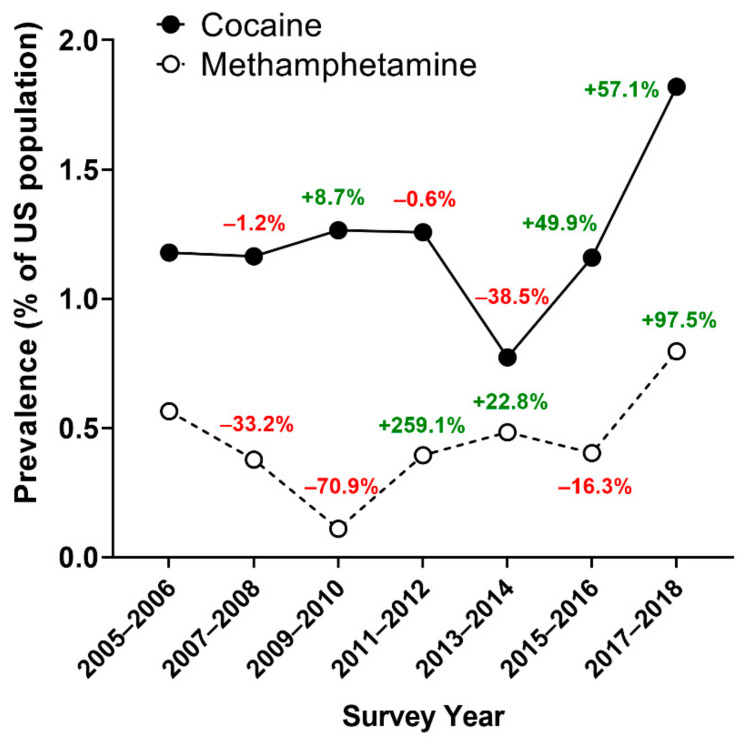
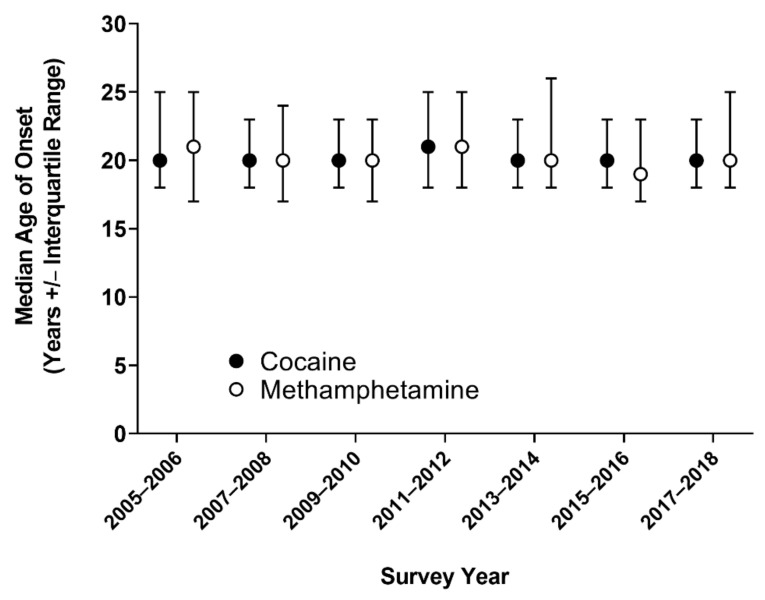
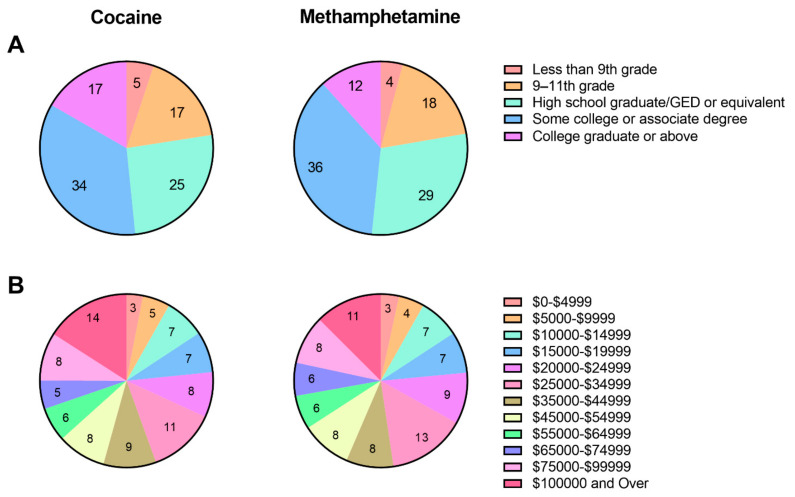
Cocaine and methamphetamine are widely used illicit psychostimulants worldwide, with steadily increasing global markets that may impact on the frequency of use. Importantly, their use typically begins in youth. This is a particular concern because there is a link between the early age of first substance use and severity of substance use disorder later in life. The aim of the present study was therefore to investigate trends in prevalence, frequency, and age of onset of cocaine or methamphetamine use between 2005 and 2018 in the United States, using the nationally representative NHANES datasets. Factors associated with the ages of cocaine or methamphetamine use onset were also identified. From 2005 to 2018, prevalence and frequencies of cocaine or methamphetamine use increased, while age of onset remained relatively stable (~20 years of age). Annual household income, use of other substances, and intravenous drug use were identified as factors associated with early onset cocaine or methamphetamine use. These factors have important implications toward developing new prevention programs to reduce psychostimulant use.
Overview
The claims and statistics of this paper haven’t been checked yet.
Free: it reads the open-access text and checks the first 5 claims that cite a source we can check. Create a free account to check every claim.
Integrity signals
Registry
Cites
Statistics
Figures
Verification
Claims the paper makes
The claims and statistics of this paper haven’t been checked yet.
Free: it reads the open-access text and checks the first 5 claims that cite a source we can check. Create a free account to check every claim.
Self-check
Percentages, sums and reported differences re-computed from the paper’s own numbers.
The self-check needs the paper’s full text.
Citations
Cites
In vivo evidence for post-adolescent brain maturation in frontal and striatal regions
Sowell, E. R., Thompson, P. M., Holmes, C. J., Jernigan, T. L., & Toga, A. W. (1999) · Nature Neuroscience · doi:10.1038/13154 · Cited by 1,439 · cited 1×
“These median ages of onset of ~20 is a concern because the adolescent brain is still maturing well into our 20s [30,31].”
Schulenberg, J., & Johnston, L. (2020) · doi:10.3998/2027.42/162576 · Cited by 1,054
Sowell, E. R., Thompson, P. M., Tessner, K. D., & Toga, A. W. (2001) · The Journal of Neuroscience · doi:10.1523/jneurosci.21-22-08819.2001 · Cited by 983 · cited 1×
“These median ages of onset of ~20 is a concern because the adolescent brain is still maturing well into our 20s [30,31].”
A review of the clinical pharmacology of methamphetamine
Cruickshank, C. C., & Dyer, K. R. (2009) · Addiction · doi:10.1111/j.1360-0443.2009.02564.x · Cited by 769 · cited 1×
“Intravenous use is associated with higher drug bioavailability [38,39], which may lead to ongoing use of the drug into adulthood.”
Grant, B. F., & Dawson, D. A. (1998) · Journal of Substance Abuse · doi:10.1016/s0899-3289(99)80131-x · Cited by 582
(2022) · doi:10.15620/cdc:122556 · Cited by 562
Age at first drink and the first incidence of adult-onset DSM-IV alcohol use disorders
Dawson, D. A., Goldstein, R. B., Patricia Chou, S., June Ruan, W., & Grant, B. F. (2008) · Alcoholism: Clinical and Experimental Research · doi:10.1111/j.1530-0277.2008.00806.x · Cited by 548
Early-onset drug use and risk of later drug problems
Anthony, J. C., & Petronis, K. R. (1995) · Drug and Alcohol Dependence · doi:10.1016/0376-8716(95)01194-3 · Cited by 531
Early-onset drug use and risk for drug dependence problems
Chen, C.-Y., Storr, C. L., & Anthony, J. C. (2009) · Addictive Behaviors · doi:10.1016/j.addbeh.2008.10.021 · Cited by 466 · cited 1×
“7 times more likely to develop clinical features of substance use disorders within two years following onset compared to people who started in adulthood [11].”
InfluentialSocioeconomic Status and Substance Use Among Young Adults: A Comparison Across Constructs and Drugs
Patrick, M. E., Wightman, P., Schoeni, R. F., & Schulenberg, J. E. (2012) · Journal of Studies on Alcohol and Drugs · doi:10.15288/jsad.2012.73.772 · Cited by 446
Cited by
The ASAM/AAAP Clinical Practice Guideline on the Management of Stimulant Use Disorder
(2024) · Journal of Addiction Medicine · doi:10.1097/adm.0000000000001299 · Cited by 78
Curran, L., Nah, G., Marcus, G. M., Tseng, Z. H., Crawford, M. H., & Parikh, N. I. (2022) · Journal of the American Heart Association · doi:10.1161/jaha.121.023663 · Cited by 43
Guerin, A. A., Bridson, T. L., Plapp, H. M., & Bedi, G. (2023) · Neuroscience & Biobehavioral Reviews · doi:10.1016/j.neubiorev.2023.105380 · Cited by 41
Self-citationThe gut microbiota contributes to methamphetamine-induced reproductive toxicity in male mice
Liu, J.-L., Chen, L., Liu, Y., Li, J.-H., Zhang, K.-K., Hsu, C., Li, X., Yang, J.-Z., Chen, L., Zeng, J., et al. (2024) · Ecotoxicology and Environmental Safety · doi:10.1016/j.ecoenv.2024.116457 · Cited by 15
Genes, Cognition, and Their Interplay in Methamphetamine Use Disorder
Khan, R., Turner, A., Berk, M., Walder, K. R., Rossell, S. L., Guerin, A. A., & Kim, J. H. (2025) · Biomolecules · doi:10.3390/biom15020306 · Cited by 16
“For example, understanding the age of onset of methamphetamine use and its relationship with genetic predisposition as well as drug use characteristics is particularly important for advancing our knowledge of the disorder’s trajectory [14,170].”
Self-citationTreating addiction with deep brain stimulation: Ethical and legal considerations
Lo, C., Mane, M., Kim, J. H., Berk, M., Sharp, R. R., Lee, K. H., & Yuen, J. (2023) · International Journal of Drug Policy · doi:10.1016/j.drugpo.2023.103964 · Cited by 15
Self-citationPeters, M. S., Park, C. H. J., Turner, A., Guerin, A. A., & Kim, J. H. (2023) · Addiction Neuroscience · doi:10.1016/j.addicn.2023.100064 · Cited by 11
Self-citationNeural substrates of substance use disorders
Paulus, M. P. (2022) · Current Opinion in Neurology · doi:10.1097/wco.0000000000001077 · Cited by 11
“or methamphetamine have increased over the past 5 years [2], with overdose deaths involving psy-”
BackgroundBarbic, D., Whyte, M., Sidhu, G., Luongo, A., Stenstrom, R. J., Chakraborty, A. T., Scheuermeyer, F. X., Honer, W. G., & Lane, D. J. (2022) · Canadian Journal of Emergency Medicine · doi:10.1007/s43678-022-00364-3 · Cited by 10
“Data from the United States indicate that younger age of first use, but not gender, is associated with more frequent and intense stimulant use [20].”
BackgroundYoung‐Wolff, K. C., Slama, N. E., Sarovar, V., Terplan, M., Ansley, D. R., Adams, S. R., & Alexeeff, S. (2022) · JAMA Network Open · doi:10.1001/jamanetworkopen.2022.48055 · Cited by 9
Methamphetamine alters nucleus accumbens neural activation to monetary loss in healthy young adults
Crane, N. A., Molla, H. M., & de Wit, H. (2023) · Psychopharmacology · doi:10.1007/s00213-023-06398-4 · Cited by 9
“Use of stimulant drugs like methamphetamine (MA) has significantly increased over the past decade (Guerin and Kim 2021).”
BackgroundLuikinga, S. J., Madsen, H. B., Zbukvic, I., Perry, C. J., Lawrence, A. J., & Kim, J. H. (2025) · Drug and Alcohol Dependence · doi:10.1016/j.drugalcdep.2025.112599 · Cited by 7
Self-citationPredictors of abstinence maintenance after cocaine inpatient detoxification: A prospective study
Poireau, M., Clergue‐Duval, V., Maillard, A., Icick, R., Azuar, J., Smith, P., Faurent, M., Volle, E., Delmaire, C., Cabé, J., et al. (2024) · American Journal on Addictions · doi:10.1111/ajad.13571 · Cited by 8
Computational mechanisms underlying multi-step planning deficits in methamphetamine use disorder
Lavalley, C. A., Mehta, M., Taylor, S., Chuning, A. E., Stewart, J. L., Huys, Q. J. M., Khalsa, S. S., Paulus, M. P., & Smith, R. S. (2025) · Translational Psychiatry · doi:10.1038/s41398-025-03390-8 · Cited by 4
“The growing prevalence of this disorder, poor treatment outcomes, and high rates of relapse all necessitate a better understanding of its etiology and maintenance factors [4, 5].”
Flores-López, M., García‐Marchena, N., Pavón, F. J., Requena-Ocaña, N., Sánchez‐Marín, L., Martín-Chaves, L., García-Medina, M., Pedraza, C., Castilla‐Ortega, E., Ruiz, J. J., et al. (2023) · Translational Psychiatry · doi:10.1038/s41398-023-02523-1 · Cited by 3
Walter, L. A., Prados, M. D., Lloyd, A. R., Sontheimer, S., Heimann, M. A., Rodgers, J. B., Hand, D. T., & Franco, R. (2024) · Journal of Viral Hepatitis · doi:10.1111/jvh.13930 · Cited by 4
Charpentier, A. N. H., Olekanma, D. I., Valade, C. T., Reeves, C. A., Cho, B. R., & Arguello, A. A. (2023) · Scientific Reports · doi:10.1038/s41598-023-39949-y · Cited by 3
Imam, A. L., Adebola, B. O., Sulaimon, F. A., Ibiyeye, K. M., Adedo, A. I., Jaji‐Sulaimon, R., Ambali, D. O., Babalola, A., Omotoso, G. O., & Ajao, M. S. (2026) · BMC Pharmacology and Toxicology · doi:10.1186/s40360-026-01121-3 · Cited by 2
Guerin, A. A., Bridson, T. L., Plapp, H. M., & Bedi, G. (2023) · doi:10.31234/osf.io/r2968 · Cited by 2
Self-citationLove, S., & Rowland, B. (2025) · Traffic Injury Prevention · doi:10.1080/15389588.2025.2541902 · Cited by 1
“Alike past identified trends (Guerin and Kim 2021), an examination of participants’ history with MA showed that regardless of the user type, MA use was prominently reported to start at a young age (typically in the late teens to early twenties) and initiated through social settings, such as at…”
Consumo de metanfetaminas en estudiantes universitarios: prevalencia y factores asociados
Pavón-León, P., Armenta-Arellano, S., García, B. S., Jorge-Cárdenas, X. D. S., Gutiérrez-Alba, G., & Hernández, J. A. M. (2024) · Revista Internacional de Investigación en Adicciones · doi:10.28931/riiad.2024.2.07 · Cited by 1
Li, T., Li, Z., Liu, H., Chen, J., Li, Y., Zhou, X., Zhang, S., Li, B., & Ren, Y. (2026) · Frontiers in Immunology · doi:10.3389/fimmu.2026.1775159
Metadata
- Authors
- Guerin, A., & Kim, J.
- Affiliations
- The University of Melbourne (AU)
- Deakin University (AU)
- Corresponding author
- Guerin, Alexandre
- Venue
- International Journal of Environmental Research and Public Health
- Publisher
- MDPI AG
- Published
- 2021-11-22
- Volume
- 18
- Issue
- 22
- Pages
- 12259
- ISSN
- 1660-4601 (ISSN-L)
- PMC
- PMC8618538
- OpenAlex
- W3217432265
- Cited by
- 22
- References
- 39
- Citations by year
- 2026: 2 · 2025: 4 · 2024: 5 · 2023: 7 · 2022: 4
- FWCI
- 2.88
- Type
- journal article
- Language
- en
- Open access
- gold
- doi.org
- Licence
- Locations
- International Journal of Environmental Research and Public Health (publishedVersion, cc-by)
- PubMed Central (publishedVersion, cc-by)
- PubMed (publishedVersion)
- RePEc: Research Papers in Economics (submittedVersion)
- DOAJ (DOAJ: Directory of Open Access Journals) (submittedVersion, cc-by-sa)
- Own your potential (DEAKIN) (submittedVersion)
- Figshare (submittedVersion, cc-by)
- Minerva Access (University of Melbourne) (submittedVersion, cc-by)
- Funders
- National Health and Medical Research Council (APP1083309)
- Topics
- Health Sciences › Medicine › Epidemiology › Substance Abuse Treatment and Outcomes
- Health Sciences › Medicine › Public Health, Environmental and Occupational Health › Youth, Drugs, and Violence
- Health Sciences › Medicine › Public Health, Environmental and Occupational Health › Opioid Use Disorder Treatment
- Keywords
- cocaine use, methamphetamine use, age of onset, psychostimulants, substance use trends, household income, polydrug use, intravenous drug use, substance use prevention, NHANES
- MeSH terms
- Adolescent, Adult, Central Nervous System Stimulants, Cocaine, Humans, Methamphetamine, Nutrition Surveys, United States, Age of Onset, Young Adult
About these checks
Registry, retraction, Cites and statistics results are computed, not judged, with one exception: a printed reference that no index lists is read once by a model before it counts as a citation error. Claims are extracted by a model and kept only when their quote appears verbatim in the text; each cited source is then checked, with a model’s help, for whether it says what the claim relies on. Those verdicts can be wrong — read the claim’s quote and the cited source before relying on one.
Statistics and arithmetic are recomputed, not judged.
Confidence bands are shown only for fields calibrated on our annotated test set. None is calibrated yet, so no band is shown.
What counts as a claim ›How we measure confidence ›How we check this ›
Are you an author, or do you see a problem with this page? Request a review
Data sources
Bibliographic data: Semantic Scholar, OpenAlex, Crossref.
Contains information from the Semantic Scholar Academic Graph Datasets, made available under the ODC Attribution License (ODC-BY 1.0).
Semantic Scholar’s data is described in: Kinney, R., et al. (2023). The Semantic Scholar Open Data Platform. arXiv:2301.10140.
