

Sick Leave and Intention to Quit the Job among Nursing Staff in German Hospitals during the COVID-19 Pandemic
Open accessThe DOI matches its Crossref record; 43 of the 44 references it cites were found in a registry or an index.
Abstract
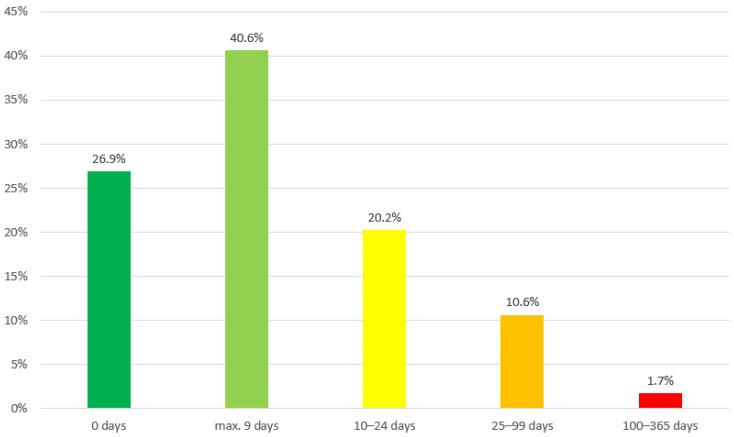
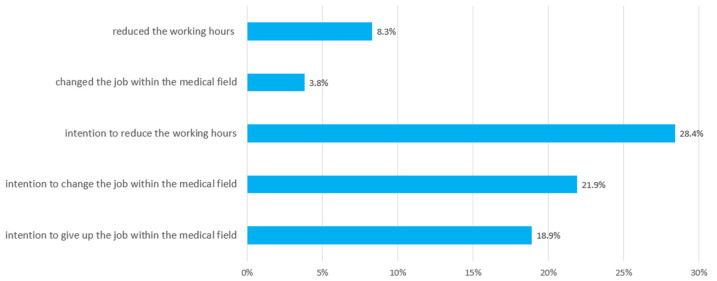
Background: Sick leave and turnover of nurses exacerbate an already existing nursing shortage during the COVID-19 pandemic in Germany and other countries. Frequency and associated factors of sick leave and intention to quit among nurses need to be examined to maintain healthcare. Methods: An online survey among nursing staff (N = 757) in German hospitals was conducted between May and July 2021. Sick leave days, intention to quit, working conditions, depression, anxiety and sleep disorder symptoms, effort-reward imbalance (ERI), COVID-19-related and sociodemographic variables were measured. Regression analyses were performed. Results: The intention to quit was present in 18.9%. One third (32.5%) reported sick leave of ≥10 and 12.3% more than 25 days in 12 months. Significant predictors for ≥10 sick leave days were infection with SARS-CoV-2, a pre-existing illness, exhaustion, trust in colleagues and fear of becoming infected. Higher ERI reward levels, perception of sufficient staff and contact with infected patients were associated with lower odds for ≥10 sick leave days. Lower reward levels, having changed work departments during the pandemic, working part-time and higher depression levels significantly predicted turnover intention. Conclusion: Alarmingly, many nurses intend to quit working in healthcare. Perceived reward seems to buffer both sick leave and turnover intention. Enhancing protection from COVID-19 and reducing workload might also prevent sick leave. Depression prevention, improved change management and support of part-time workers could contribute to reducing turnover intention among nurses.
Overview
The claims and statistics of this paper haven’t been checked yet.
Free: it reads the open-access text and checks the first 5 claims that cite a source we can check. Create a free account to check every claim.
Integrity signals
Registry
Cites
Statistics
Figures
Verification
Claims the paper makes
The claims and statistics of this paper haven’t been checked yet.
Free: it reads the open-access text and checks the first 5 claims that cite a source we can check. Create a free account to check every claim.
Claims other papers make about this one
Each is checked against this paper’s own text: does it say what the citing paper says it does?
The cited source says what the claim attributes to it.
In the citing paper
“a study from Germany linked higher levels of depression to greater turnover intention [60].”
From A global overview of healthcare workers’ turnover intention amid COVID-19 pandemic: a systematic review with future directions (2022) · cites this paper as [60]
The cited source says what the claim attributes to it.
In the citing paper
“HCWs were also more likely to experience turnover intention if they faced changes at work [63] or deployment to other departments [55, 60].”
From A global overview of healthcare workers’ turnover intention amid COVID-19 pandemic: a systematic review with future directions (2022) · cites this paper as [60]
The cited source says what the claim attributes to it.
In the citing paper
“HCWs who perceived low rewards from work were also more prone to experiencing turnover intention [47, 48, 60].”
From A global overview of healthcare workers’ turnover intention amid COVID-19 pandemic: a systematic review with future directions (2022) · cites this paper as [60]
Self-check
Percentages, sums and reported differences re-computed from the paper’s own numbers.
The self-check needs the paper’s full text.
Citations
Cites
Bundesgesundheitsblatt - Gesundheitsforschung - Gesundheitsschutz
(2013) · Bundesgesundheitsblatt - Gesundheitsforschung - Gesundheitsschutz · doi:10.1007/103.1437-1588 · Cited by 11,796
Anxiety disorders in primary care: prevalence, impairment, comorbidity, and detection
Kroenke, K., Spitzer, R. L., Williams, J. B. W., Monahan, P. O., & Löwe, B. (2007) · Annals of Internal Medicine · doi:10.7326/0003-4819-146-5-200703060-00004 · Cited by 4,741 · cited 1×
“Scores ≥3 are considered likely cases of clinically relevant generalized anxiety [41].”
BackgroundPappa, S., Ntella, V., Giannakas, T., Giannakoulis, V. G., Papoutsi, E., & Katsaounou, P. (2020) · Brain Behavior and Immunity · doi:10.1016/j.bbi.2020.05.026 · Cited by 3,617 · cited 1×
“The COVID-19 pandemic also leads to an elevated psychological burden for those working in the healthcare sector [9] with nursing staff showing higher prevalence of depression and anxiety than other frontline healthcare workers [10].”
BackgroundLöwe, B., Wahl, I., Rose, M., Spitzer, C., Glaesmer, H., Wingenfeld, K., Schneider, A., & Brähler, E. (2010) · Journal of Affective Disorders · doi:10.1016/j.jad.2009.06.019 · Cited by 2,473 · cited 5×
“Anxiety symptoms were assessed with the ultra-short screening for generalized anxiety GAD-2 [39].”
MethodInfluentialChange Recipients’ Reactions to Organizational Change: A 60-Year Review of Quantitative Studies
Oreg, S., Vakola, M., & Armenakis, A. (2011) · The Journal of Applied Behavioral Science · doi:10.1177/0021886310396550 · Cited by 1,595 · cited 2×
“[48] highlights the role of organizational trust for successful change processes.”
BackgroundDetecting and monitoring depression with a two-item questionnaire (PHQ-2)
Löwe, B., Kroenke, K., & Gräfe, K. (2005) · Journal of Psychosomatic Research · doi:10.1016/j.jpsychores.2004.09.006 · Cited by 1,473 · cited 1×
“Scores ≥3 are considered likely cases of clinically relevant depression [40].”
BackgroundLabrague, L. J., & Santos, J. A. A. (2021) · Journal of Nursing Management · doi:10.1111/jonm.13168 · Cited by 882 · cited 2×
“Fear of becoming infected was associated with turnover intention in previous research [33] and with sick leave in this study.”
BackgroundResultIlmarinen, J. (2006) · Occupational Medicine · doi:10.1093/occmed/kqm008 · Cited by 667 · cited 1×
“We used this item based on the fifth item of the German version of the Work Ability Index [36] published by the German Federal Institute for Occupational Safety and Health [37].”
MethodAronsson, G., & Gustafsson, K. (2005) · Journal of Occupational and Environmental Medicine · doi:10.1097/01.jom.0000177219.75677.17 · Cited by 646 · cited 1×
“Factors associated with presenteeism such as insufficient staff and time pressure [46] () might be present in those departments.”
BackgroundA short generic measure of work stress in the era of globalization: effort–reward imbalance
Siegrist, J., Wege, N., Pühlhofer, F., & Wahrendorf, M. (2009) · International Archives of Occupational and Environmental Health · doi:10.1007/s00420-008-0384-3 · Cited by 574 · cited 2×
“Altogether, the findings underline the importance of rewards in the nursing profession regarding financial reward, social recognition by leaders, coworkers, patients and society and career opportunities [38].”
BackgroundMethod
Research works printed but not linked: 3
- Karagiannidis, C.; Schröder, H.; Wicker, S.; Janssens, U. COVID-19-Pandemie: Pflegende deutlich häufiger krank (COVID-19 pandemic: Carers significantly more often ill). Dtsch Arztebl. Int. 2021, 118, A-1352.
- Lauchart, M.; Ascher, P.; Kesel, K.; Weber, S.; Grabein, B.; Schneeweiss, B.; Fischer-Truestedt, C.; Schoenberg, M.; Rogler, G.; Borelli, C. Compatibility of Work and Family Life: Survey of Physicians in the Munich Metropolitan Area. Gesundheitswesen 2019, 81, 299-308. [CrossRef]
- Gräske, J.; Forbrig, T.A.; Koppe, L.; Urban, S.; Neumann, F.; Boguth, K. Effort-Reward Imbalance, Ability to Work and the Desire for Career Exits: A Cross-sectional Study of Nurses. Gesundheitswesen 2021. [CrossRef]
Cited by
Poon, Y.-S. R., Lin, Y. P., Griffiths, P., Yong, K. K., Seah, B., & Liaw, S. Y. (2022) · Human Resources for Health · doi:10.1186/s12960-022-00764-7 · Cited by 394
“HCWs who perceived low rewards from work were also more prone to experiencing turnover intention [47, 48, 60].”
BackgroundResultXueyun, Z., Mamun, A. A., Masukujjaman, M., Rahman, M. K., Gao, J., & Yang, Q. Y. (2023) · Scientific Reports · doi:10.1038/s41598-023-42591-3 · Cited by 264
Berdida, D. J. E., López, V., & Grande, R. A. N. (2023) · International Journal of Mental Health Nursing · doi:10.1111/inm.13179 · Cited by 155
Compassion fatigue in healthcare providers: a scoping review
Garnett, A., Hui, L., Oleynikov, C., & Boamah, S. A. (2023) · BMC Health Services Research · doi:10.1186/s12913-023-10356-3 · Cited by 164
de Vries, N., Maniscalco, L., Matranga, D., Bouman, J., & de Winter, P. (2024) · PLoS ONE · doi:10.1371/journal.pone.0300377 · Cited by 89
Buckley, L., Hall, L. M., Price, S. L., Visekruna, S., & McTavish, C. (2025) · BMJ Open · doi:10.1136/bmjopen-2024-096333 · Cited by 53
Zeng, D., Wang, B., & Chen, W. (2023) · Frontiers in Psychology · doi:10.3389/fpsyg.2022.1100172 · Cited by 44
“, 2021), job burnout (Schug et al., 2022), increased turnover intention (Cole et al.”
BackgroundThe impact of COVID ‐19 on nurse alcohol consumption: A qualitative exploration
Searby, A., Burr, D., & Redley, B. (2022) · Journal of Clinical Nursing · doi:10.1111/jocn.16467 · Cited by 36
Mediavilla, R., Monistrol-Mula, A., McGreevy, K. R., Félez-Nóbrega, M., Delaire, A., Nicaise, P., Palomo-Conti, S., Bayón, C., Bravo‐Ortiz, M. F., Vega, B. R., et al. (2022) · Frontiers in Public Health · doi:10.3389/fpubh.2022.956403 · Cited by 30
Moyo, N., Bhappu, A. D., Bhebhe, M., & Ncube, F. (2022) · International Journal of Environmental Research and Public Health · doi:10.3390/ijerph19116762 · Cited by 35
“Psychological distress is the key driver of increased turnover intentions at work [83,92,93].”
BackgroundMüller, M., Baillés, E., Blanch, J., Torres, X., Rousaud, A., Cañizares, S., Teruel, M. C., Conti, C. M., Dunne, P. J., Stănculete, M. F., et al. (2022) · Journal of Psychosomatic Research · doi:10.1016/j.jpsychores.2022.111102 · Cited by 32
Reme, B., Grøsland, M., Gjefsen, H. M., & Magnusson, K. (2023) · Occupational and Environmental Medicine · doi:10.1136/oemed-2022-108555 · Cited by 28
Sommer, D., Wilhelm, S., & Wahl, F. (2024) · Healthcare · doi:10.3390/healthcare12020172 · Cited by 27
Grasmann, L., Morawa, E., Adler, W., Schug, C., Borho, A., Geiser, F., Beschoner, P., Jerg‐Bretzke, L., Albus, C., Weidner, K., et al. (2024) · Journal of Clinical Nursing · doi:10.1111/jocn.17079 · Cited by 19
“Not least because symptoms of depression (Schug et al., 2022 ), like symptoms of anxiety (Tolksdorf et al., 2022 ), were found to be significant predictors of turnover intention and there is already a nursing shortage in Germany (Bundesministerium für Gesundheit [Federal Ministry for Health], 2021…”
Self-citationBeschoner, P., Jerg‐Bretzke, L., Erim, Y., Geiser, F., Baranowski, A., Weidner, K., Albus, C., Schug, C., Limbrecht-Ecklundt, K., Weimer, K., et al. (2023) · PLoS ONE · doi:10.1371/journal.pone.0287509 · Cited by 24
Self-citationSchneider, A., Hering, C., Peppler, L., & Schenk, L. (2023) · International Archives of Occupational and Environmental Health · doi:10.1007/s00420-022-01947-4 · Cited by 19
D’Alessandro-Lowe, A. M., Brown, A., Sullo, E., Pichtikova, M., Karram, M., Mirabelli, J., McCabe, R. E., McKinnon, M. C., & Ritchie, K. (2024) · Nursing Reports · doi:10.3390/nursrep14030152 · Cited by 23
“Specifically, whereas fear of contracting the virus [10,45,46], depression [11,13], anxiety [11,47], burnout [42,43], moral distress or injury [9,11,34,42,44], adverse working conditions [48,49], and increases in workload [48] were associated with increased turnover intention among HCPs, resilience…”
BackgroundResultInfluentialDigitization in Everyday Nursing Care: A Vignette Study in German Hospitals
Korte, L., & Bohnet-Joschko, S. (2022) · International Journal of Environmental Research and Public Health · doi:10.3390/ijerph191710775 · Cited by 21
“Nursing leaders must focus on these factors in order to reduce the burden experienced by their staff and support their commitment and willingness to learn, especially in current pandemic times, and to face constant changes and innovations [39,60,61].”
BackgroundGuardiano, M., Boy, P., Shapirshteyn, G., Dobrozdravic, L., Chen, L., Yang, H., Robbins, W. A., & Li, J. (2022) · International Journal of Environmental Research and Public Health · doi:10.3390/ijerph191710955 · Cited by 21
Alberque, B., Laporte, C., Mondillon, L., Baker, J. S., Mermillod, M., Brousse, G., Ugbolue, U. C., Bagheri, R., Bouillon‐Minois, J., & Dutheil, F. (2022) · International Journal of Environmental Research and Public Health · doi:10.3390/ijerph192013069 · Cited by 24
“COVID-19 is associated with insufficient staff, and exhaustion may increase sick leave, turnover [49], and even the resignation of HCWs [32,34].”
BackgroundNurse Staffing Configurations and Nurse Absence Due to Sickness
Dall’Ora, C., Meredith, P., Saville, C. E., Jones, J. M., & Griffiths, P. (2025) · JAMA Network Open · doi:10.1001/jamanetworkopen.2025.5946 · Cited by 22
Sommerlatte, S., Lugnier, C., Schoffer, O., Jahn, P., Kraeft, A., Kourti, E., Michl, P., Reinacher‐Schick, A., Schmitt, J. M., Birkner, T., et al. (2023) · Journal of Cancer Research and Clinical Oncology · doi:10.1007/s00432-023-04580-x · Cited by 19
Effects of the pandemic on the care of patients with colorectal cancer
Reinacher‐Schick, A., Ebert, M., Piso, P., Hüppe, D., Schmitt, J. M., & Schildmann, J. (2023) · Deutsches Ärzteblatt international · doi:10.3238/arztebl.m2023.0139 · Cited by 14
Vleminckx, S., Bogaert, P. V., Meulenaere, K. D., Willem, L., & Haegdorens, F. (2024) · BMC Health Services Research · doi:10.1186/s12913-024-11625-5 · Cited by 24
“The COVID-19 pandemic proved to be a catalyst for accelerated levels of absenteeism and nurses who permanently leave the profession [13].”
BackgroundSchwerdtfeger, K. A., Glaesmer, H., & Bahramsoltani, M. (2024) · PLoS ONE · doi:10.1371/journal.pone.0310819 · Cited by 16
“This is also confirmed by several studies carried out in the healthcare sector during the Covid-19 pandemic, which also showed a relationship between the intention to leave the job and depression, whereby depression was assumed to be the cause of the intention to leave the job [62, 63].”
ResultLieb, M., Erim, Y., & Morawa, E. (2024) · BMC Psychology · doi:10.1186/s40359-024-01583-2 · Cited by 23
“Especially since depression symptoms are tightly connected with intention to leave the job in nurses [55] and in employees in general [56], cohesion should be measured and monitored regularly in order to intervene timely.”
Self-citationWinnand, P., Fait, Y., Ooms, M., Bock, A., Heitzer, M., Laurentius, T., Bollheimer, L. C., Hölzle, F., Priebe, J. A., & Modabber, A. (2023) · BMC Nursing · doi:10.1186/s12912-023-01424-4 · Cited by 15
“A meta-analysis revealed that 31.7% of nurses had an intention to leave the profession regardless of functional area [59], whereas 32.14% of OR nurses [60] and 23.4% of ward nurses [61] had an intention to leave the profession.”
BackgroundInfluentialCompassion fatigue in healthcare providers during the COVID-19 pandemic: a scoping review protocol
Hui, L., Garnett, A., Oleynikov, C., & Boamah, S. A. (2023) · BMJ Open · doi:10.1136/bmjopen-2022-069843 · Cited by 14
Arndt, D., & Hering, T. (2024) · Bundesgesundheitsblatt - Gesundheitsforschung - Gesundheitsschutz · doi:10.1007/s00103-024-03984-5 · Cited by 10
Wei, Z., Xia, B., Jiang, L., Zhu, H., Li, L., Wang, L., Zhao, J., Fan, R., Wang, P., & Huang, M. (2024) · Frontiers in Psychiatry · doi:10.3389/fpsyt.2024.1490171 · Cited by 11
Naserian, E., Pouladi, S., Bagherzadeh, R., & Ravanipour, M. (2024) · BMC Nursing · doi:10.1186/s12912-024-02112-7 · Cited by 16
Workplace Violence and Health Status of Female Nurses: A Cross‐Sectional Study
Alhalal, E. (2024) · Research in Nursing & Health · doi:10.1002/nur.22434 · Cited by 8
A Bibliometric Analysis of Nurses’ Job Satisfaction From 2004 to 2023
Huang, T., & Wu, Y. (2025) · Journal of Nursing Management · doi:10.1155/jonm/4285361 · Cited by 7
“In addition, it is because the need for nurses has been growing with an ageing population, pandemics, and high attrition rates, making them indispensable in the provision of care in hospitals, nursing institutions, and the community [32, 33].”
Popa, M. V., Gurzu, I. L., Handra, C. M., Gurzu, B., Pleșea-Condratovici, A., Duceac, M. C., Elkan, E. M., Mîndru, D. E., Dabija, V. A., & Duceac, L. D. (2025) · Healthcare · doi:10.3390/healthcare13101116 · Cited by 7
“Schug et al. (2022) similarly found that perceived support, adequate staffing, and reward systems were linked to fewer sick days among nurses [57].”
Gorjian, Z., Asadizaker, M., Zarea, K., Irajpour, A., Ahmadi, F., & Rokhafroz, D. (2024) · BMC Medical Education · doi:10.1186/s12909-024-05633-6 · Cited by 11
Foster, A. M., Munro, S., Golder, J. E., & Mitchell, D. (2025) · BMC Health Services Research · doi:10.1186/s12913-025-12922-3 · Cited by 9
“…of attrition in the sector identified in the literature include negative psychological responses to stress [20], a lack of team collegiality and connectedness [21], changes in work roles [22] including redeployment [23], a lack of organisational support or rewards [23, 24], and burnout [22, 25].”
Zarei, E., Nikkhah, A., & Farrokhi, P. (2024) · International Journal of Healthcare Management · doi:10.1080/20479700.2024.2318505 · Cited by 8
Wetzel, L., Halfmann, M., Castioni, N., Kiefer, F., Koenig, S., Schmieder, A., & Koopmann, A. (2023) · Frontiers in Psychiatry · doi:10.3389/fpsyt.2023.1068715 · Cited by 6
“At the same time the occupancy pressure in the wards increased as the pandemic continued, along with an increased number of staff absences (20) and a loss of faith in the quick end of the COVID-19 pandemic (21).”
BackgroundSaigusa, T., Yokomichi, H., & Miyamura, T. (2024) · Nursing Forum · doi:10.1155/2024/5510374 · Cited by 8
Arzani, S., Amerzadeh, M., Alizadeh, A., Moosavi, S., & Kalhor, R. (2025) · Scientific Reports · doi:10.1038/s41598-025-19518-1 · Cited by 14
“After the intervention, these values changed to 69.87 and 6.72, indicating that job empowerment effectively reduces JB among teachers 45 .”
InfluentialJones, M. T., Kaltenegger, H. C., Cronin, R. A., & Wright, B. J. (2024) · Work & Stress · doi:10.1080/02678373.2024.2364616 · Cited by 17
Zhai, Z., Cui, C., & Meng, K. (2025) · BMC Family Practice · doi:10.1186/s12875-025-02859-1 · Cited by 4
“The perceived quality of relationships and organizational support in the workplace can influence the frequency of employee sick leave and turnover the organization [19].”
Raamkhumar, M. H., & Swamy, T. N. V. R. (2023) · Multidisciplinary Reviews · doi:10.31893/multirev.2024012 · Cited by 6
NURSE: Five Micropractices to Reduce Stress
Valluri, J., & Gorton, K. L. (2022) · Journal of Radiology Nursing · doi:10.1016/j.jradnu.2022.09.002 · Cited by 7
“Due to increased stress nurses ’ intent to leave their current job is 18% in Germany (Schug et al., 2022), 37.8% in the United Kingdom, and 40% to 54% in the United States (Kelly et al., 2021; 2022; Taylor-Clark et al., 2022).”
InfluentialStock, E., Martani, A., Vinogradova, O., Moser, F., Elger, B. S., & Wangmo, T. (2025) · SSM - Qualitative Research in Health · doi:10.1016/j.ssmqr.2025.100590 · Cited by 3
Tao, Y., Zhang, H., Chen, Z., Huang, X., Wang, D., & Li, W. (2024) · Journal of Occupational and Environmental Medicine · doi:10.1097/jom.0000000000003039 · Cited by 4
Erim, Y., Geiser, F., Beschoner, P., Jerg‐Bretzke, L., Weidner, K., Albus, C., Baranowski, A., Mogwitz, S., & Morawa, E. (2024) · Bundesgesundheitsblatt - Gesundheitsforschung - Gesundheitsschutz · doi:10.1007/s00103-024-03954-x · Cited by 5
Self-citationYıldırım, T. Ö., & KARATEPE, H. K. (2024) · BMC Nursing · doi:10.1186/s12912-024-02413-x · Cited by 5
“One meta-analysis study found that approximately one third of nurses have thoughts of leaving the profession [1], while another study reported that one in five nurses consider leaving [13].”
BackgroundSteiert, C., Lambeck, J., Grauvogel, T. D., Beck, J., & Grauvogel, J. (2023) · Healthcare · doi:10.3390/healthcare11040472 · Cited by 3
“Several reports published in 2022 pointed to a progressive decline in medical staff availability in the aftermath of the COVID-19 pandemic [42,43].”
BackgroundUsing Heart Rate Variability to Assess Nurses’ Stress During the COVID-19 Pandemic
Krieger, H., Rhein, C., Morawa, E., Adler, W., Steffan, J., Lang-Richter, N. R., Struck, M., Erim, Y., & Lieb, M. (2024) · Western Journal of Nursing Research · doi:10.1177/01939459241252078 · Cited by 3
Self-citationThe Impact of COVID-19 on Healthcare Utilization in Turkey
Uğur, Z. B., & Durak, A. (2024) · Value in Health Regional Issues · doi:10.1016/j.vhri.2024.101000 · Cited by 3
Sänger, N., Elling, J. M., Hetzel, C., & Schwarz, B. (2025) · BMC Public Health · doi:10.1186/s12889-025-24769-8 · Cited by 4
“In return, employees with a higher risk of infection were often assigned for remote work or placed on paid or unpaid leave to ensure their safety [51, 84, 85].”
Thiel, K., Schulz, D., Lingl, L., Unbehaun, D., & Wulf, V. (2026) · i-com · doi:10.1515/icom-2025-0041 · Cited by 2
Nurse turnover intention in university hospitals in Iran
Mossadeghrad, A. M., Dargahi, H., Rashidi, N. A. Q., Zahmatkesh, M., Nozarian, M. H., & Ghobeishipour, H. (2026) · BMC Nursing · doi:10.1186/s12912-026-05014-y · Cited by 2
“Finally, the presence of a chronic underlying illness was negatively associated with turn-over intention, a relationship supported by studies showing that nurses with physical or psychological conditions tend to experience more work strain and absenteeism [34].”
Technical Readiness and Stereotypes in Hospital Nursing—A Question of Gender and Age?
Korte, L., & Bohnet-Joschko, S. (2023) · Nursing Reports · doi:10.3390/nursrep13010013 · Cited by 2
Holton, S., Wynter, K. H., Peeters, A., Georgalas, A., Yeomanson, A., & Rasmussen, B. (2023) · Australian Journal of Primary Health · doi:10.1071/py22111 · Cited by 2
Ibach, M. J., Winter, A., Seika, P., Ritschl, P. V., Berndt, N., Dobrindt, E. M., Raakow, J., Pratschke, J., Denecke, C., & Maurer, M. M. (2024) · Journal of Clinical Medicine · doi:10.3390/jcm13061560 · Cited by 4
“Evidence suggests that the rate of nursing personnel quitting accelerated at the end of the pandemic, with many citing burnout and overwork as primary factors for their decision [22,23].”
Sommerlatte, S., Hense, H., Nadolny, S., Kraeft, A., Lugnier, C., Schmitt, J. M., Schoffer, O., Reinacher‐Schick, A., & Schildmann, J. (2024) · Journal of Cancer Research and Clinical Oncology · doi:10.1007/s00432-024-05863-7 · Cited by 2
“…et al. 2020 ; Leung et al. 2020; Reynolds et al. 2020 ; Stevens 2020 ) and the shortage of staff, due to, for example, infec - tions with Sars-CoV-2 as well as other burdens (Lim et al. 2022 ; Schug et al. 2022 ; Sommerlatte et al. 2023; Tabur et al. 2022), were among the reasons for these changes.”
BackgroundImpact of COVID-19 on Selected Nurse and Patient Outcomes in Emergency Units Across South Africa
Pienaar, A., Blignaut, A. J., Coetzee, S. K., Mather, M. F., & Fourie, E. (2025) · Journal of Emergency Nursing · doi:10.1016/j.jen.2025.02.016 · Cited by 3
Gjefsen, H. M., Grøsland, M., Grøtting, M. W., & Reme, B. (2025) · Labour Economics · doi:10.1016/j.labeco.2025.102727 · Cited by 2
Abdollahzade, S., Rafiei, S., & Souri, S. (2022) · International Journal of Human Rights in Healthcare · doi:10.1108/ijhrh-04-2022-0031 · Cited by 3
Vleminckx, S., Bogaert, P. V., Daneels, K., Proost, A., Sarens, S., & Haegdorens, F. (2024) · JONA The Journal of Nursing Administration · doi:10.1097/nna.0000000000001424 · Cited by 1
Psychological resilience and effort-reward imbalance as predictors of work-life balance among nurses
TUSUN, R. B., & Şahin, N. E. (2025) · Psychology Health & Medicine · doi:10.1080/13548506.2025.2494287 · Cited by 1
“Similarly, nurses experiencing effort-reward imbalance have been found to suffer from sleep problems and exhibit a higher intention to leave the profession (Schug et al., 2022; Tzenetidis et al., 2021).”
Quiet Quitting and Burnout in the Mining Industry: Leadership Dynamics in Support of SDG 8 and SDG 3
Chadarisman, A., Ginting, A., Marpaung, U. J. M. P., & Rohman, A. (2025) · Journal of Lifestyle and SDGs Review · doi:10.47172/2965-730x.sdgsreview.v5.n06.pe06897 · Cited by 1
Makassar, S. A., Kurniawaty, K., Tawil, M. R., & Baubau, P. (2023) · Jurnal Aplikasi Manajemen · doi:10.21776/ub.jam.2023.021.03.15 · Cited by 3
Zarchi, M. K. R., Heidari, E., Montazeralfaraj, R., & Farajkhoda, T. (2023) · Emergency Care Journal · doi:10.4081/ecj.2023.11644 · Cited by 2
Rao†, Z., Shi†, H., Jiang†, Z., Hu, J., Hu, L., Xu, M., Ehya, R. E. M., & Bounda, G. (2023) · Trends in Medical Research · doi:10.3923/tmr.2023.161.178 · Cited by 1
COVID-19 pandemic: what factors compromised the mental capacity to work of nursing technicians?
Vieira, K. M. R., Vieira, F. U., & Bittencourt, Z. Z. L. D. C. (2024) · Revista Brasileira de Enfermagem · doi:10.1590/0034-7167-2022-0783 · Cited by 1
“…present symptoms of exhaustion, anxiety, stress, depression and illness (12-15) , with reduced functional capacity of nurses with mild symptoms and moderate infections due to COVID-19 (16-17) and compromised professional performance due to excessive workload (18) , enhanced by absenteeism (19) .”
Naserian, E., Pouladi, S., Bagherzadeh, R., & Ravanipour, M. (2024) · Research Square · doi:10.21203/rs.3.rs-3994923/v1 · Cited by 1
Ojeda, M. G., & Gómez-Luján, M. D. P. (2023) · LATAM Revista Latinoamericana de Ciencias Sociales y Humanidades · doi:10.56712/latam.v4i1.565
How did the COVID-19 pandemic affect burn centres in German-speaking countries?
Akkan, J., Fuchs, P. C., Bagheri, M., Al-Shamsi, M., Seyhan, H., Stromps, J.-P., & Schiefer, J. L. (2023) · Burns · doi:10.1016/j.burns.2023.07.007
Danhieux, K., Martens, M., Chhim, S., Mihevc, M., Yem, S., Susič, A. P., Damme, W. V., Masquillier, C., Wouters, E., & van Olmen, J. (2023) · Research Square · doi:10.21203/rs.3.rs-3781315/v1
Vieira, K. M. R., Vieira, F. U., & Bittencourt, Z. Z. L. D. C. (2024) · Revista Brasileira de Enfermagem · doi:10.1590/0034-7167-2022-0783pt
Gesundheit von Pflegenden während der COVID-19-Pandemie in der Schweiz
Huber, C., Schorro, E., Hofstetter-Hefti, G., Jubin, J., Delmas, P., Bachmann, A. O., Gilles, I., & Bucher, C. O. (2024) · Pflege · doi:10.1024/1012-5302/a001009
Habibov, N., Auchynnikava, A., & Lyu, Y. (2024) · Journal of Health Organization and Management · doi:10.1108/jhom-07-2024-0279
Ngcobo, S. (2024) · Journal of Public Administration and Development Alternatives · doi:10.55190/jpada.2024.342
Wiegand, H. F., Adorjan, K., Stoffers-Winterling, J. M., Scheithauer, S., Schmitt, J. M., Tüscher, O., Falkai, P., & Lieb, K. (2025) · Der Nervenarzt · doi:10.1007/s00115-025-01822-w
Impact of COVID-19 on nurses’ mental health in Thohoyandou area, Limpopo province
Makananisa, M., Baloyi, V., Madzhie, M., & Chueng, M. J. (2025) · International Journal of Business Ecosystem and Strategy (2687-2293) · doi:10.36096/ijbes.v7i2.773 · Cited by 1
“In support of these findings, Schug et al. (2022) assert that during the COVID-19 pandemic in Germany and other countries, sick leave and turnover of nurses worsened to an already existing nursing shortage.”
Cassier-Woidasky, A.-K., Zinn, W. B., Middleton, S., Dale, S., & Pfeilschifter, W. (2025) · International Journal of Nursing Studies Advances · doi:10.1016/j.ijnsa.2025.100374
“They had high impact on the staff workload and might have caused staff exhaustion in many aspects (Schug et al., 2022; Hering et al., 2022).”
Renardias, J., Carros, F., Randall, D. W., Müller, C., & Wulf, V. (2025) · International Conference on Communities and Technologies (C&T) · doi:10.1145/3742800.3742832
Additional file 1 of Compassion fatigue in healthcare providers: a scoping review
Garnett, A., Hui, L., Oleynikov, C., & Boamah, S. A. (2024) · Figshare · doi:10.6084/m9.figshare.26648385
Jerg‐Bretzke, L., Platzek, P., Jarczok, M. N., Kempf, M., Weimer, K., Hirning, C., Kern, S., Geiser, F., Baranowski, A., Erim, Y., et al. (2026) · Frontiers in Organizational Psychology · doi:10.3389/forgp.2026.1634851
Self-citationThe effect of emotional labour on quiet quitting among millennials and Gen Z: burnout and EI roles
Alimmah, B. B., Adawiyah, W. R., & Wulandari, S. Z. (2026) · International journal of organizational analysis · doi:10.1108/ijoa-12-2025-6315
Jung, J.-Y., Cho, I., & Moon, J. H. (2026) · Workplace Health & Safety · doi:10.1177/21650799261454290
“…al., 2024; Lyttelton & Zang, 2022; Mansour et al., 2022; Maurício & Laranjeira, 2023; Mosteiro-Díaz et al., 2020; Ozbozkurt et al., 2024; Parent-Lamarche & Laforce, 2022; Rivkin et al., 2022; Schug et al., 2022; Shimura et al., 2021; Shoss et al., 2023; Taylor et al., 2021; Vinberg et al., 2021).”
ABSENTEÍSMO NA ENFERMAGEM EM HOSPITAIS DE ENSINO
Passos, B. V. D. S., Sampaio, C. L., Bandeira, É. D. S., Oliveira, R. M., Caetano, J. Á., & Tavares, S. D. F. D. V. (2026) · Enfermagem em Foco · doi:10.21675/2357-707x.2026.v17.e-2026039
ABSENTEEISM AMONG NURSES IN TEACHING HOSPITALS
Passos, B. V. D. S., Sampaio, C. L., Bandeira, É. D. S., Oliveira, R. M., Caetano, J. Á., & Tavares, S. D. F. D. V. (2026) · Enfermagem em Foco · doi:10.21675/2357-707x.2026.v17.e-2026039i
ABSENTISMO EN EL PERSONAL DE ENFERMERÍA DE LOS HOSPITALES DE ENSEÑANZA
Passos, B. V. D. S., Sampaio, C. L., Bandeira, É. D. S., Oliveira, R. M., Caetano, J. Á., & Tavares, S. D. F. D. V. (2025) · Enfermagem em Foco · doi:10.21675/2357-707x.2026.v17.e-2026039e
Metadata
- Authors
- Schug, C., Geiser, F., Hiebel, N., Beschoner, P., Jerg-Bretzke, L., Albus, C., Weidner, K., Morawa, E., & Erim, Y.
- Affiliations
- Friedrich-Alexander-Universität Erlangen-Nürnberg (DE)
- University Hospital Bonn (DE)
- Universität Ulm (DE)
- Department of Psychosomatic Medicine and Psychotherapy, Ulm University Medical Center, 89081 Ulm, Germany
- University of Cologne (DE)
- Technische Universität Dresden (DE)
- Department of Psychosomatic Medicine and Psychotherapy, University Hospital of Erlangen, Friedrich-Alexander University Erlangen-Nürnberg (FAU), 91054 Erlangen, Germany
- Corresponding author
- Schug, Caterina
- ORCID
- Venue
- International Journal of Environmental Research and Public Health
- Publisher
- MDPI AG
- Published
- 2022-02-10
- Volume
- 19
- Issue
- 4
- Pages
- 1947
- ISSN
- 1660-4601 (ISSN-L)
- PMC
- PMC8872054
- OpenAlex
- W4211064075
- Cited by
- 87
- References
- 44
- Citations by year
- 2026: 7 · 2025: 18 · 2024: 30 · 2023: 22 · 2022: 10
- FWCI
- 21.57
- Type
- journal article
- Language
- en
- Open access
- gold
- doi.org
- Licence
- Locations
- International Journal of Environmental Research and Public Health (publishedVersion, cc-by)
- PubMed Central (publishedVersion, cc-by)
- PubMed (publishedVersion)
- Kölner Universitäts PublikationsServer (Universität zu Köln) (publishedVersion)
- OPUS FAU (Kooperativer Bibliotheksverbund Berlin-Brandenburg (KOBV), on behalf of the Universitätsbibliothek Erlangen-Nürnberg) (submittedVersion, cc-by)
- RePEc: Research Papers in Economics (submittedVersion)
- DOAJ (DOAJ: Directory of Open Access Journals) (submittedVersion, cc-by-sa)
- OPen Access Repositorium der Universität Ulm (OPARU) (Ulm University) (submittedVersion, cc-by)
- Universität Ulm, Kommunikations- und Informationszentrum (kiz) (cc-by)
- Funders
- Friedrich-Alexander-Universität Erlangen-Nürnberg
- Deutsche Forschungsgemeinschaft
- Topics
- Health Sciences › Nursing › Research and Theory › Nursing education and management
- Social Sciences › Psychology › Clinical Psychology › COVID-19 and Mental Health
- Health Sciences › Medicine › Public Health, Environmental and Occupational Health › Occupational Health and Burnout
- Keywords
- sick leave, turnover intention, nurses, COVID-19 pandemic, nursing shortage, effort-reward imbalance, depression, anxiety, sleep disorders, working conditions, part-time work, employee turnover, German hospitals
- MeSH terms
- COVID-19, SARS-CoV-2, Cross-Sectional Studies, Hospitals, Humans, Job Satisfaction, Nursing Staff, Hospital, Surveys and Questionnaires, Sick Leave, Intention, Pandemics
About these checks
Registry, retraction, Cites and statistics results are computed, not judged, with one exception: a printed reference that no index lists is read once by a model before it counts as a citation error. Claims are extracted by a model and kept only when their quote appears verbatim in the text; each cited source is then checked, with a model’s help, for whether it says what the claim relies on. Those verdicts can be wrong — read the claim’s quote and the cited source before relying on one.
Statistics and arithmetic are recomputed, not judged.
Confidence bands are shown only for fields calibrated on our annotated test set. None is calibrated yet, so no band is shown.
What counts as a claim ›How we measure confidence ›How we check this ›
Are you an author, or do you see a problem with this page? Request a review
Data sources
Bibliographic data: Semantic Scholar, OpenAlex, Crossref.
Contains information from the Semantic Scholar Academic Graph Datasets, made available under the ODC Attribution License (ODC-BY 1.0).
Semantic Scholar’s data is described in: Kinney, R., et al. (2023). The Semantic Scholar Open Data Platform. arXiv:2301.10140.
