

Weekday and weekend differences in eating habits, physical activity and screen time behavior among a sample of primary school children: the "Seven days for my health" Project
Open accessThe DOI matches its Crossref record; 46 of the 48 references it cites were found in a registry or an index.
Abstract
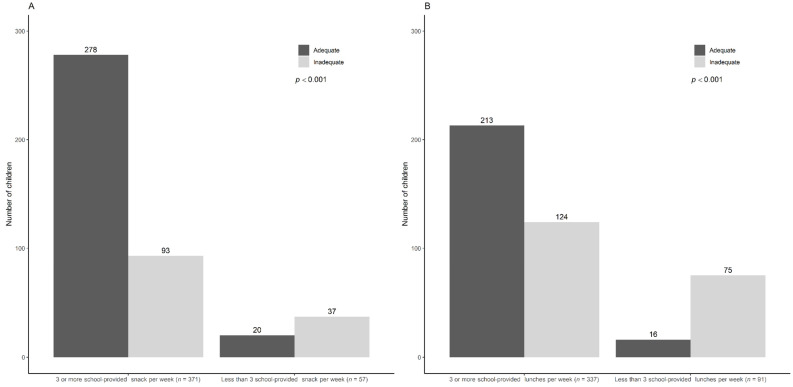
Background: Healthy eating and active lifestyle habits are essential for a child’s development, wellbeing, and health. School setting and family environment play a crucial role in shaping these habits and this could be reflected in different behavior patterns during weekdays and weekends. Methods: We investigated primary school children’s lifestyle habits through a cross-sectional analysis of 428 Italian primary school children, with a mean age of 8.99 years (±1.43). Data were collected from May to June 2017 using a weekly diary to assess children’s lifestyles. Results: Children who eat their morning snack and lunch at school three or more times during the weekdays were 5.47 times more likely (95% CI 3.02, 10.2) to consume adequate snacks and 7.79 times more likely (95% CI 4.43, 14.5) to have adequate meals than those who did not. Conclusion: Consumption of vegetables, lunch, and snacks are significantly more adequate during the weekdays as compared to the weekends. Physical activity levels did not differ between weekdays and weekends. Moreover, children spent more time engaged in physical activities than in front of a screen during both the weekdays and the weekends. The present results are good indicators of the importance of the school canteen in defining correct eating habits. Family-based and school-based interventions could represent valuable integrative strategies for promoting a healthy lifestyle in children.
Overview
The claims and statistics of this paper haven’t been checked yet.
Free: it reads the open-access text and checks the first 5 claims that cite a source we can check. Create a free account to check every claim.
Integrity signals
Registry
Cites
Statistics
Figures
Verification
Claims the paper makes
The claims and statistics of this paper haven’t been checked yet.
Free: it reads the open-access text and checks the first 5 claims that cite a source we can check. Create a free account to check every claim.
Self-check
Percentages, sums and reported differences re-computed from the paper’s own numbers.
The self-check needs the paper’s full text.
Citations
Cites
World Health Organization 2020 guidelines on physical activity and sedentary behaviour
Bull, F. C., Al-Ansari, S. S., Biddle, S., Borodulin, K., Buman, M. P., Cardon, G., Carty, C., Chaput, J.-P., Chastin, S., Chou, R., et al. (2020) · British Journal of Sports Medicine · doi:10.1136/bjsports-2020-102955 · Cited by 11,657 · cited 1×
“Introduction Improving diet quality and overall lifestyle is a key health promotion strategy [1].”
BackgroundElm, E. V., Altman, D. G., Egger, M., Pocock, S. J., Gøtzsche, P. C., & Vandenbroucke, J. P. (2007) · BMJ · doi:10.1136/bmj.39335.541782.ad · Cited by 10,766 · cited 1×
“This study was designed following the Strengthening the Reporting of Observational Studies in Epidemiology (STROBE) reporting guidelines [27].”
MethodExtended international (IOTF) body mass index cut‐offs for thinness, overweight and obesity
Cole, T. J., & Lobstein, T. (2012) · Pediatric Obesity · doi:10.1111/j.2047-6310.2012.00064.x · Cited by 3,117
Body mass index cut offs to define thinness in children and adolescents: international survey
Cole, T. J., Flegal, K. M., Nicholls, D., & Jackson, A. A. (2007) · BMJ · doi:10.1136/bmj.39238.399444.55 · Cited by 2,612
Serra-Majem, L., Ribas, L., Ngo, J., Ortega, R. M., García, A., Pérez-Rodrigo, C., & Aranceta, J. (2004) · Public Health Nutrition · doi:10.1079/phn2004556 · Cited by 1,343 · cited 1×
“We classified the individuals in three distinct categories based on their KIDMED index [34]: (1) 8–12 high; (2) 4–7 medium, and (3) 0–3 poor.”
MethodWhat childhood obesity prevention programmes work? A systematic review and meta‐analysis
Wang, Y., Cai, L., Wu, Y., Wilson, R. F., Weston, C., Fawole, O., Bleich, S. N., Cheskin, L. J., Showell, N. N., Lau, B. D., et al. (2015) · Obesity Reviews · doi:10.1111/obr.12277 · Cited by 575 · cited 1×
“However, recent literature found that multicomponent interventions involving not only school but also family are likely to be most effective [54].”
BackgroundOn behalf of the Determinants of Diet and Physical Activity knowledge hub (DEDIPAC); International Children’s Accelerometry Database (ICAD) Collaborators, I. C. A. H. C., Steene-Johannessen, J., Hansen, B. H., Dalene, K. E., Kolle, E., Northstone, K., Møller, N. C., Grøntved, A., Wedderkopp, N., Kriemler, S., et al. (2020) · International Journal of Behavioral Nutrition and Physical Activity · doi:10.1186/s12966-020-00930-x · Cited by 415 · cited 6×
“This could be linked to the higher than average PA and the lower than average screen time levels reported in our sample compared to the ones shown in the “Okkio alla Salute” report [10].”
BackgroundResultInfluentialTime Spent on Home Food Preparation and Indicators of Healthy Eating
Monsivais, P., Aggarwal, A., & Drewnowski, A. (2014) · American Journal of Preventive Medicine · doi:10.1016/j.amepre.2014.07.033 · Cited by 309 · cited 1×
“This could be explained by the reduced amount of time parents have for food preparation during workdays, as confirmed by other studies [45].”
ResultAdherence to the Mediterranean Diet in children and adolescents: A systematic review
Iaccarino Idelson, P., Scalfi, L., & Valerio, G. (2017) · Nutrition, Metabolism and Cardiovascular Diseases · doi:10.1016/j.numecd.2017.01.002 · Cited by 305 · cited 1×
“We calculated the adherence to the Mediterranean diet using the Diet Quality Index for Children and Adolescents (KIDMED) score (0 to 12) [32,33].”
MethodAubert, S., Brazo-Sayavera, J., González, S. A., Janssen, I., Manyanga, T., Oyeyemi, A. L., Picard, P., Sherar, L. B., Turner, E., & Tremblay, M. S. (2021) · International Journal of Behavioral Nutrition and Physical Activity · doi:10.1186/s12966-021-01155-2 · Cited by 259 · cited 1×
“Even children are affected by this trend, with a significant percentage of the population presenting overweight/obesity [6], albeit with marked subnational differences [7] and low levels of PA [8], one of the lowest at international level [9,10].”
Background
Research works printed but not linked: 1
- Catalani F. Gibertoni D. Lorusso G. Rangone M. Dallolio L. Todelli S. Lorenzini A. Tiso D. Marini S. Leoni E. Consumption and adequacy of breakfast over a week in a sample of primary school children Proceedings of the 51 Congresso Nazionale Societa Italiana di Igiene Abstract Book Riva del Garda, Italy 17–20 October 2018 519
Cited by
Meal timing and its role in obesity and associated diseases
Peters, B., Vahlhaus, J., & Pivovarova-Ramich, O. (2024) · Frontiers in Endocrinology · doi:10.3389/fendo.2024.1359772 · Cited by 72
Lai, N. M., Lim, Y. S., Chaiyakunapruk, N., Lee, S. W. H., Liabsuetrakul, T., Sabbir, M., Mahmud, S. M. H., Siddiqi, U. R., Ahmed, T., Hasan, F. U. L., et al. (2025) · Child and Adolescent Mental Health · doi:10.1111/camh.70022 · Cited by 31
“…instance, we chose the data for weekends based on consistent reports showing children ’ s propensity to have greater screen time during weekends (Esposito et al., 2022; Liangruenrom, Dumuid, & Pedisic, 2023; Sigmundov (cid:1) a et al., 2016; Sigmundov (cid:1) a, Badura, Sigmund, & Bucksch,…”
Masini, A., Sanmarchi, F., Kawalec, A., Esposito, F., Scrimaglia, S., Tessari, A., Scheier, L. M., Sacchetti, R., & Dallolio, L. (2022) · European Journal of Pediatrics · doi:10.1007/s00431-022-04756-6 · Cited by 25
Self-citationRosi, A., Giampieri, F., Abdelkarim, O., Aly, M., Ammar, A., Frías-Toral, E., Pons, J., Vázquez‐Araújo, L., Scuderi, A., Decembrino, N., et al. (2025) · International Journal of Public Health · doi:10.3389/ijph.2025.1608318 · Cited by 21
Minimum days estimation for reliable dietary intake information: findings from a digital cohort
Singh, R. P., Verest, M. T. E., & Salathé, M. (2025) · European Journal of Clinical Nutrition · doi:10.1038/s41430-025-01644-8 · Cited by 25
Marcotrigiano, V., Stingi, G. D., Nugnes, P. T., Mancano, S., Lagreca, V. M., Tarricone, T., Salerno, G., Pasquale, P., Marchet, P., Sava, G. A., et al. (2023) · Healthcare · doi:10.3390/healthcare11091347 · Cited by 16
“Indeed, school catering has been identified as a priority tool for promoting health and educating on correct nutrition, involving children, families and teachers simultaneously [10,11].”
BackgroundLongobucco, Y., Ricci, M., Scrimaglia, S., Camedda, C., Dallolio, L., & Masini, A. (2023) · Healthcare · doi:10.3390/healthcare11111567 · Cited by 10
Self-citationSanmarchi, F., Masini, A., Poli, C., Kawalec, A., Esposito, F., Scrimaglia, S., Scheier, L. M., Dallolio, L., & Sacchetti, R. (2023) · International Journal of Environmental Research and Public Health · doi:10.3390/ijerph20054240 · Cited by 10
Self-citationGarrido-López, B., Villarino, M. Á. F., Valeiro, M. G., Andreu‐Caravaca, L., Martins, J., & Dopico-Calvo, X. (2025) · Education Sciences · doi:10.3390/educsci15040470 · Cited by 9
Liu, L., Ren, X., Li, W., Zhao, S., Guo, X., Yan, R., Guo, X., & Li, R. (2025) · BMC Public Health · doi:10.1186/s12889-025-23420-w · Cited by 9
“In addition, physical activity can promote the development of bones and muscles [26], prevent childhood overweight and obesity [27], as well as improve vision [28].”
Lifestyle Habits in Elementary and High School Education Students: A Systematic Review
Melguizo-Ibáñez, E., González-Valero, G., Ortega, F. Z., Ubago-Jiménez, J. L., Puertas-Molero, P., & Alonso-Vargas, J. M. (2023) · Social Sciences · doi:10.3390/socsci12030113 · Cited by 8
Weekday–Weekend Differences in Chrononutritional Variables Depend on Urban or Rural Living
Santos, J. S., Crispim, C. A., Skene, D. J., & Moreno, C. R. D. C. (2024) · Nutrients · doi:10.3390/nu17010108 · Cited by 7
“Some studies have investigated differences in food consumption between weekdays and weekends demonstrating both increased eating episodes and preference for snacks during the weekdays compared to weekends [31–34].”
Gorini, S., Camajani, E., Feraco, A., Armani, A., Quattrini, C., Tarsitano, M. G., Cava, E., Renzo, L. D., Caprio, M., LORENZO, A. D., et al. (2025) · Frontiers in Nutrition · doi:10.3389/fnut.2025.1578574 · Cited by 6
Chavez, J. W., Christie, A. L., & Zimmern, P. E. (2024) · Women s Health Reports · doi:10.1089/whr.2024.0015 · Cited by 4
Hamid, K. S., & Hasanuzzaman, K. M. (2025) · Universal Journal of Educational Research · doi:10.64637/629054 · Cited by 2
“In a study conducted in Italy, Esposito et al. (2022). found that healthy eating and active lifestyle habits are crucial for children’s development and health.”
de Oliveira, A. D. S., Barros, M., Júnior, A. E. D. S., Lopes, N. G. D. S., Macêna, M. D. L., & Bueno, N. B. (2024) · Obesities · doi:10.3390/obesities4030029 · Cited by 3
Outcome measurement instruments used to measure diet-related outcomes in infancy: A scoping review
Matvienko‐Sikar, K., Duffy, M., Looney, E., Anokye, R., Birken, C. S., Brown, V., Dahly, D. L., Doherty, A. S., Dutch, D. C., Golley, R. K., et al. (2025) · Appetite · doi:10.1016/j.appet.2025.107980 · Cited by 2
“Standardisation is also important in terms of the days specified for data collection because what an infant, and families more generally, eat on weekdays and weekends can differ (Esposito et al., 2022; Molitor & Doerr, 2021; Rothausen et al., 2012).”
Hasan, M. R., & Harrison, A. (2025) · ASIDE Health Sciences · doi:10.71079/aside.hs.01012595 · Cited by 5
The epidemiology and clinical features of pediatric acute pancreatitis in north of Guizhou, China
Bo, S., Gao, J., Zhou, Y., Wang, C., Wenmei, L., & Fu, X. (2023) · Journal of Public Health Research · doi:10.1177/22799036231204322 · Cited by 1
Heneghan, J. L., Velmurugan, K., Weatherwax, C., Bartsch, S. M., Martin, C. K., Powell‐Wiley, T. M., Cohen, N., McCrory, M. A., Horn, A. L., Chin, K. L., et al. (2025) · Health & Place · doi:10.1016/j.healthplace.2025.103575 · Cited by 1
Salybekova, N. N., & Abdukakhar, A. Z. (2022) · Iasaýı ýnıversıtetіnіń habarshysy · doi:10.47526/2022-4/2664-0686.26 · Cited by 1
Martín, C., Rodríguez, R. R., Cruz-Santana, V., & García, P. J. C. (2024) · International Journal of Developmental and Educational Psychology Revista INFAD de psicología · doi:10.17060/ijodaep.2024.n1.v2.2700
Kim, K. W., Wallander, J. L., & Wiebe, D. J. (2025) · International Journal of Adolescence and Youth · doi:10.1080/02673843.2025.2495872
“This method has been previously used (Esposito et al., 2022; Morrison et al., 2021; Sanders et al., 2018).”
(2025) · ASIDE Health Sciences · doi:10.71079/aside.health.sciences
IL DIGIUNO INTERMITTENTE: EFFETTI SULLA SINDROME METABOLICA
Valeria, I. (2024) · Electronic Theses and Dissertations Repository (University of Pisa)
より誠実な世界へ : 環境要因が不正行為に及ぼす影響を解明する統合的実証研究
煥旭, 溜. (2024) · Institutional Repositories DataBase (IRDB)
Pereira, L. J. (2023) · LA Referencia (Red Federada de Repositorios Institucionales de Publicaciones Científicas)
The Impact of Ultra- Processed Food Consumption on Health in Low- and Middle-Income Countries
(2026) · Frontiers Media SA eBooks · doi:10.3389/978-2-8325-7458-4
Spiegler, C., Nowak, N., Döring, M., Clausen, K., Walczak, L., Burgard, L., Brettschneider, A.-K., Ensenauer, R. E., Heuer, T., Straßburg, A., et al. (2026) · Frontiers in Nutrition · doi:10.3389/fnut.2026.1864533
Okafor, C. A. (2026) · International Research Journal of Medical Sciences and Health Care · doi:10.55640/irjmshc-v03i09-02
Perera, T. S. H. (2026) · Massey Research Online (Massey University) · doi:10.82921/mro-98
Metadata
- Authors
- Esposito, F., Sanmarchi, F., Marini, S., Masini, A., Scrimaglia, S., Adorno, E., Soldà, G., Arrichiello, F., Ferretti, F., Rangone, M., Celenza, F., Guberti, E., Tiso, D., Toselli, S., Lorenzini, A., Dallolio, L., & Sacchetti, R.
- Affiliations
- University of Bologna (IT)
- Department of Public Health, Bologna Health Trust, 40121 Bologna, Italy
- Hygiene and Nutrition Service, Department of Public Health, 40121 Bologna, Italy
- Hospital Villa Maria, 47921 Rimini, Italy
- Corresponding author
- Masini, Alice
- ORCID
- Venue
- International Journal of Environmental Research and Public Health
- Publisher
- MDPI AG
- Published
- 2022-04-01
- Volume
- 19
- Issue
- 7
- Pages
- 4215
- ISSN
- 1660-4601 (ISSN-L)
- PMC
- PMC8998659
- OpenAlex
- W4223424660
- Cited by
- 22
- References
- 48
- Citations by year
- 2026: 1 · 2025: 9 · 2024: 5 · 2023: 5 · 2022: 2
- FWCI
- 3.24
- Type
- journal article
- Language
- en
- Open access
- gold
- doi.org
- Licence
- Locations
- International Journal of Environmental Research and Public Health (publishedVersion, cc-by)
- PubMed Central (publishedVersion, cc-by)
- PubMed (publishedVersion)
- Archivio istituzionale della ricerca (Alma Mater Studiorum Università di Bologna) (submittedVersion, cc-by)
- RePEc: Research Papers in Economics (submittedVersion)
- Topics
- Health Sciences › Nursing › Nutrition and Dietetics › Nutrition, Health and Food Behavior
- Health Sciences › Medicine › Public Health, Environmental and Occupational Health › Obesity, Physical Activity, Diet
- Health Sciences › Medicine › Public Health, Environmental and Occupational Health › Health and Lifestyle Studies
- Keywords
- weekday and weekend differences, dietary habits, physical activity, screen time, elementary school students, school canteens, snacks, vegetable consumption, healthy lifestyle promotion, family intervention, school-based intervention
- MeSH terms
- Screen Time, Child, Cross-Sectional Studies, Feeding Behavior, Humans, Schools, Exercise
About these checks
Registry, retraction, Cites and statistics results are computed, not judged, with one exception: a printed reference that no index lists is read once by a model before it counts as a citation error. Claims are extracted by a model and kept only when their quote appears verbatim in the text; each cited source is then checked, with a model’s help, for whether it says what the claim relies on. Those verdicts can be wrong — read the claim’s quote and the cited source before relying on one.
Statistics and arithmetic are recomputed, not judged.
Confidence bands are shown only for fields calibrated on our annotated test set. None is calibrated yet, so no band is shown.
What counts as a claim ›How we measure confidence ›How we check this ›
Are you an author, or do you see a problem with this page? Request a review
Data sources
Bibliographic data: Semantic Scholar, OpenAlex, Crossref.
Contains information from the Semantic Scholar Academic Graph Datasets, made available under the ODC Attribution License (ODC-BY 1.0).
Semantic Scholar’s data is described in: Kinney, R., et al. (2023). The Semantic Scholar Open Data Platform. arXiv:2301.10140.
