

The DOI matches its Crossref record; 45 of the 45 references it cites were found in a registry or an index.
Mental Health Burden of the Russian–Ukrainian War 2022 (RUW-22): Anxiety and Depression Levels among Young Adults in Central Europe
Open accessAbstract
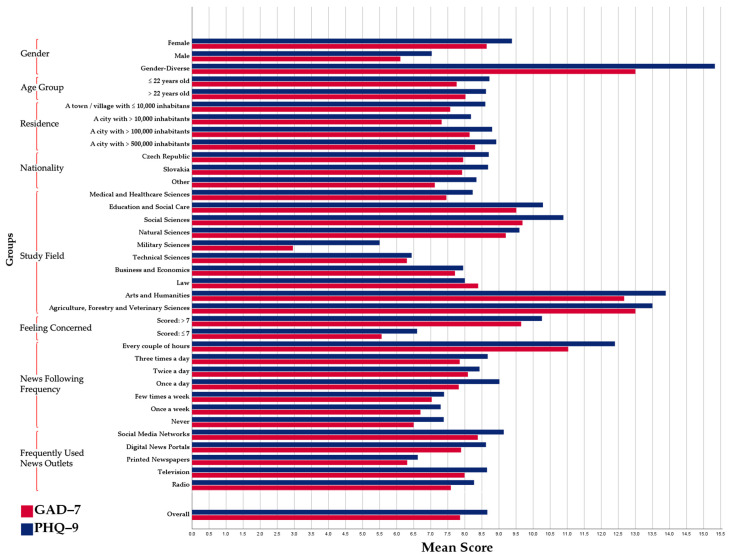
Armed conflicts are public health emergencies that affect human lives at multiple levels. The mental health of adolescents and young adults is at high risk during crisis settings; therefore, this cross-sectional survey-based study aimed to evaluate anxiety and depressive symptoms among university students in the Czech Republic following the Russian-Ukrainian war of 2022 (RUW-22). The study used standardized screening instruments; the Generalized Anxiety Disorder (GAD-7) for anxiety and the Patient Health Questionnaire (PHQ-9) for depression. Of 591 students who participated in this study, 67.7% were females, 68.2% held Czech citizenship, and 63.8% were enrolled in medical or healthcare programs. The participants were highly concerned about the RUW-22 news, with a mean score of 7.17 ± 2.50 (0–10). While 34% and 40.7% of the participants in this study manifested moderate to severe levels of anxiety and depression, respectively, the mental health burden of the RUW-22 was confirmed by the positive correlation between “feeling concerned”, GAD-7 (ρ = 0.454), and PHQ-9 (ρ = 0.326). Female gender, higher frequency of news following, and social media use were associated with higher levels of anxiety and depressive symptoms; thus, proposing them to be risk factors for psychological disorders following the RUW-22.
Overview
The claims and statistics of this paper haven’t been checked yet.
Run the check — free, no account needed. It reads the open-access text and checks the sources it cites.
Integrity signals
Registry
Cites
Statistics
Figures
Verification
Claims the paper makes
The claims and statistics of this paper haven’t been checked yet.
Run the check — free, no account needed. It reads the open-access text and checks the sources it cites.
Claims other papers make about this one
Each is checked against this paper’s own text: does it say what the citing paper says it does?
The source backs part of the claim, not all of it — or backs it for a different population, condition or comparison.
In the citing paper
“Recent research highlights that war-related uncertainty, particularly media-induced exposure to conflict, has significantly augmented levels of stress, anxiety, depression, and posttraumatic stress in Czech, Slovak, German, Polish, Italian, and even Taiwanese populations [55,81-83].”
From Impact of Media-Induced Uncertainty on Mental Health: Narrative-Based Perspective. (2025) · cites this paper as [83]
Experimental — accuracy not yet measured
Self-check
Percentages, sums and reported differences re-computed from the paper’s own numbers.
The self-check needs the paper’s full text.
Citations
Cites
The PHQ-9: Validity of a brief depression severity measure
Kroenke, K., Spitzer, R. L., & Williams, J. B. W. (2001) · Journal of General Internal Medicine · doi:10.1046/j.1525-1497.2001.016009606.x · Cited by 44,910
A Brief Measure for Assessing Generalized Anxiety Disorder: The GAD-7
Spitzer, R. L., Kroenke, K., Williams, J. B. W., & Löwe, B. (2006) · Archives of Internal Medicine · doi:10.1001/archinte.166.10.1092 · Cited by 31,765
von Elm, E., Altman, D. G., Egger, M., Pocock, S. J., Gøtzsche, P. C., Vandenbroucke, J. P., & Initiative, F. T. S. (2007) · PLoS Medicine · doi:10.1371/journal.pmed.0040296 · Cited by 23,020
Interrater reliability: The kappa statistic
McHugh, M. L. (2012) · Biochemia Medica · doi:10.11613/bm.2012.031 · Cited by 19,877
von Elm, E., Altman, D. G., Egger, M., Pocock, S. J., Gøtzsche, P. C., Vandenbroucke, J. P., & Initiative, F. T. S. (2007) · Annals of Internal Medicine · doi:10.7326/0003-4819-147-8-200710160-00010 · Cited by 17,796
Correlation Coefficients: Appropriate Use and Interpretation
Schober, P., Boer, C., & Schwarte, L. A. (2018) · Anesthesia & Analgesia · doi:10.1213/ane.0000000000002864 · Cited by 10,986
Elm, E. V., Altman, D. G., Egger, M., Pocock, S. J., Gøtzsche, P. C., & Vandenbroucke, J. P. (2007) · BMJ · doi:10.1136/bmj.39335.541782.ad · Cited by 10,766
Murray, C. J. L., Aravkin, A. Y., Zheng, P., Abbafati, C., Abbas, K. M., Abbasi-Kangevari, M., Abd-Allah, F., Abdelalim, A., Abdollahi, M., Abdollahpour, I., et al. (2020) · The Lancet · doi:10.1016/s0140-6736(20)30752-2 · Cited by 9,854
Mental health problems and social media exposure during COVID-19 outbreak
Gao, J., Zheng, P., Jia, Y., Chen, H., Mao, Y., Chen, S., Wang, Y., Fu, H., & Dai, J. (2020) · PLoS ONE · doi:10.1371/journal.pone.0231924 · Cited by 2,830 · cited 1×
“Frequent exposure to social media content was associated with higher odds of anxiety among Chinese adults during the COVID-19 outbreak in early 2020 [49,50].”
BackgroundMental Health Problems and Social Media Exposure During COVID-19 Outbreak
Gao, J., Zheng, P., Jia, Y., Chen, H., Mao, Y., Chen, S., Wang, Y., Fu, H., & Dai, J. (2020) · SSRN Electronic Journal · doi:10.2139/ssrn.3541120 · Cited by 2,830
Research works printed but not linked: 1
- (2022, May 28). UNDRR Living with Risk: A Global Review of Disaster Reduction Initiatives. Available online: https://www.undrr.org/publication/living-risk-global-review-disaster-reduction-initiatives.
Cited by
Sorted by citations
Lim, I. C. Z. Y., Tam, W., Chudzicka-Czupała, A. E., McIntyre, R. S., Teopiz, K. M., Ho, R., & Ho, C. S. H. (2022) · Frontiers in Psychiatry · doi:10.3389/fpsyt.2022.978703 · Cited by 241
Lass‐Hennemann, J., Sopp, M. R., Ruf, N., Equit, M., Schäfer, S. K., Wirth, B. E., & Michael, T. (2023) · European Child & Adolescent Psychiatry · doi:10.1007/s00787-023-02300-x · Cited by 134
Limone, P., Toto, G. A., & Messina, G. (2022) · Frontiers in Psychiatry · doi:10.3389/fpsyt.2022.1081013 · Cited by 73
Haydabrus, А. V., Santana-Santana, M., Lazarenko, Y., & Giménez‐Llort, L. (2022) · International Journal of Environmental Research and Public Health · doi:10.3390/ijerph191710536 · Cited by 41
Gatto, A., Mattera, R., & Panarello, D. (2024) · Journal of Environmental Management · doi:10.1016/j.jenvman.2023.119833 · Cited by 42
Metadata
- Authors
- Riad, A., Drobov, A., Krobot, M., Antalová, N., Alkasaby, M. A., Peřina, A., & Koščík, M.
- Affiliations
- Masaryk University (CZ)
- London School of Hygiene & Tropical Medicine (GB)
- Corresponding author
- Riad, Abanoub
- Koščík, Michal
- ORCID
- Venue
- International Journal of Environmental Research and Public Health
- Publisher
- MDPI AG
- Published
- 2022-07-09
- Volume
- 19
- Issue
- 14
- Pages
- 8418
- ISSN
- 1660-4601 (ISSN-L)
- PMC
- PMC9318466
- OpenAlex
- W4285005317
- Cited by
- 128
- References
- 45
- Citations by year
- 2026: 15 · 2025: 38 · 2024: 32 · 2023: 35 · 2022: 8
- FWCI
- 25.80
- Type
- journal article
- Language
- en
- Open access
- gold
- doi.org
- Licence
- Locations
- International Journal of Environmental Research and Public Health (publishedVersion, cc-by)
- PubMed Central (publishedVersion, cc-by)
- PubMed (publishedVersion)
- LSHTM Research Online (London School of Hygiene and Tropical Medicine) (acceptedVersion)
- RePEc: Research Papers in Economics (submittedVersion)
- DOAJ (DOAJ: Directory of Open Access Journals) (submittedVersion, cc-by-sa)
- Veřejné služby Informačního systému (Masarykiana Brunensis Universitas) (submittedVersion, cc-by)
- Funders
- NPO “Systemic Risk Institute” (LX22NPO5101, MUNI/A/1402/2021, MUNI/IGA/1104/2021)
- Masaryk University (LX22NPO5101, MUNI/A/1402/2021, MUNI/IGA/1104/2021)
- Topics
- Social Sciences › Psychology › Clinical Psychology › COVID-19 and Mental Health
- Social Sciences › Psychology › Clinical Psychology › Posttraumatic Stress Disorder Research
- Social Sciences › Psychology › Clinical Psychology › Migration, Health and Trauma
- Keywords
- war-related mental health, anxiety, depression, university students, young adults, news consumption, social media use, gender differences, risk factors, armed conflict, Czech Republic
- MeSH terms
- Armed Conflicts, Adolescent, Anxiety, Anxiety Disorders, Cross-Sectional Studies, Depression, Female, Humans, Male, Mental Health, Young Adult
About these checks
Registry, retraction, Cites and statistics results are computed, not judged, with one exception: a printed reference that no index lists is read once by a model before it counts as a citation error. Claims are extracted by a model and kept only when their quote appears verbatim in the text; each cited source is then checked, with a model’s help, for whether it says what the claim relies on. Those verdicts can be wrong — read the claim’s quote and the cited source before relying on one.
Statistics and arithmetic are recomputed, not judged.
Confidence bands are shown only for fields calibrated on our annotated test set. None is calibrated yet, so no band is shown.
What counts as a claim ›How we measure confidence ›How we check this ›
Are you an author, or do you see a problem with this page? Request a review
