

Mediterranean Diet versus Very Low-Calorie Ketogenic Diet: Effects of Reaching 5% Body Weight Loss on Body Composition in Subjects with Overweight and with Obesity—A Cohort Study
Open accessThe DOI matches its Crossref record; 55 of the 55 references it cites were found in a registry or an index.
Abstract
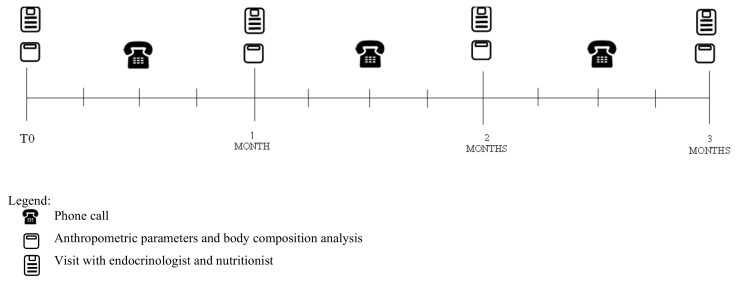
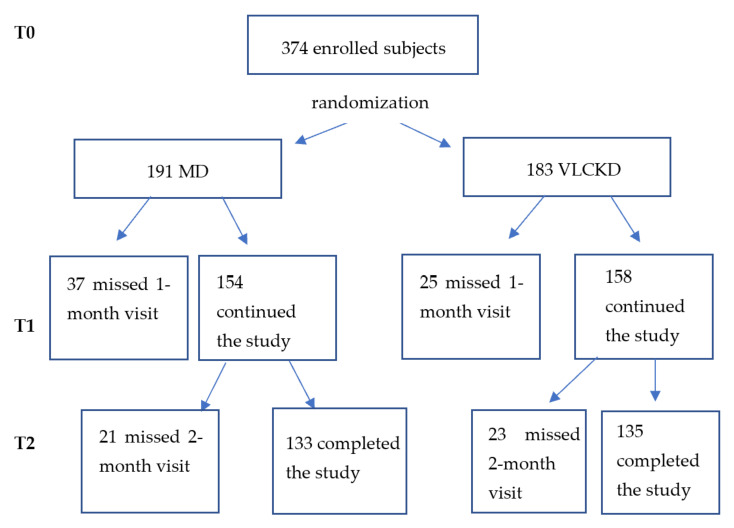
The best nutritional strategy to fight the rise in obesity remains a debated issue. The Mediterranean diet (MD) and the Very Low-Calorie Ketogenic diet (VLCKD) are effective at helping people lose body weight (BW) and fat mass (FM) while preserving fat-free mass (FFM). This study aimed to evaluate the time these two diets took to reach a loss of 5% of the initial BW and how body composition was affected. We randomized 268 subjects with obesity or overweight in two arms, MD and VLCKD, for a maximum of 3 months or until they reached 5% BW loss. This result was achieved after one month of VLCKD and 3 months of MD. Both diets were effective in terms of BW (p < 0.0001) and FM loss (p < 0.0001), but the MD reached a higher reduction in both waist circumference (p = 0.0010) and FM (p = 0.0006) and a greater increase in total body water (p = 0.0017) and FFM (p = 0.0373) than VLCKD. The population was also stratified according to gender, age, and BMI. These two nutritional protocols are both effective in improving anthropometrical parameters and body composition, but they take different time spans to reach the goal. Therefore, professionals should evaluate which is the most suitable according to each patient’s health status.
Overview
The claims and statistics of this paper haven’t been checked yet.
Free: it reads the open-access text and checks the first 5 claims that cite a source we can check. Create a free account to check every claim.
Integrity signals
Registry
Cites
Statistics
Figures
Verification
Claims the paper makes
The claims and statistics of this paper haven’t been checked yet.
Free: it reads the open-access text and checks the first 5 claims that cite a source we can check. Create a free account to check every claim.
Claims other papers make about this one
Each is checked against this paper’s own text: does it say what the citing paper says it does?
The source backs part of the claim, not all of it — or backs it for a different population, condition or comparison.
In the citing paper
“The Mediterranean diet also appears to have favourable effects on SM mass, including the attenuation of aging-related losses of lean mass even in the absence of a concomitant physical exercise programme [99,100].”
From Optimised Skeletal Muscle Mass as a Key Strategy for Obesity Management (2025) · cites this paper as [100]
Experimental — accuracy not yet measured
Self-check
Percentages, sums and reported differences re-computed from the paper’s own numbers.
The self-check needs the paper’s full text.
Citations
Cites
(2000) · PubMed · Cited by 13,173
Estruch, R., Ros, E., Salas-Salvadó, J., Covas, M.-I., Corella, D., Arós, F., Gómez-Gracia, E., Ruiz-Gutiérrez, V., Fiol, M., Lapetra, J., et al. (2018) · New England Journal of Medicine · doi:10.1056/nejmoa1800389 · Cited by 3,616 · cited 1×
“The MD not only helps with weight loss maintenance but also has beneficial effects on cardiovascular risk factors, cognitive functions, and mood [27,28].”
BackgroundEuropean Guidelines for Obesity Management in Adults
Yumuk, V., Tsigos, C., Fried, M., Schindler, K., Busetto, L., Micic, D., & Toplak, H. (2015) · Obesity Facts · doi:10.1159/000442721 · Cited by 3,432 · cited 2×
“To avoid weight gain after a diet period, it is important to define realistic goals to gradually change lifestyle habits and maintain weight loss over time [41].”
BackgroundResultBioelectrical impedance analysis?part I: review of principles and methods
KYLE, U. (2004) · Clinical Nutrition · doi:10.1016/j.clnu.2004.06.004 · Cited by 3,200 · cited 3×
“The results of this study confirmed those of other ones in the literature where both the MD and VLCKD were efficient in reducing body weight, waist circumference, and fat mass while preserving FFM and BCM in subjects with overweight or obesity [24,34–37,42,43].”
MethodInfluentialEsposito, K., Marfella, R., Ciotola, M., Di Palo, C., Giugliano, F., Giugliano, G., D'Armiento, M., D'Andrea, F., & Giugliano, D. (2004) · JAMA · doi:10.1001/jama.292.12.1440 · Cited by 2,126
Wing, R. R., Lang, W., Wadden, T. A., Safford, M., Knowler, W. C., Bertoni, A. G., Hill, J. O., Brancati, F. L., Peters, A., Wagenknecht, L., et al. (2011) · Diabetes Care · doi:10.2337/dc10-2415 · Cited by 1,828
THE DIET AND 15-YEAR DEATH RATE IN THE SEVEN COUNTRIES STUDY
KEYS, A., MIENOTTI, A., KARVONEN, M. J., ARAVANIS, C., BLACKBURN, H., BUZINA, R., DJORDJEVIC, B. S., DONTAS, A. S., FIDANZA, F., KEYS, M. H., et al. (1986) · American Journal of Epidemiology · doi:10.1093/oxfordjournals.aje.a114480 · Cited by 1,790 · cited 1×
“Epidemiological studies have noticed increased longevity and reduced morbidity in Mediterranean countries, which follow the MD, compared to the USA or Northern Europe populations [25,26].”
BackgroundMediterranean diet pyramid today. Science and cultural updates
Bach-Faig, A., Berry, E. M., Lairon, D., Reguant, J., Trichopoulou, A., Dernini, S., Medina, F. X., Battino, M., Belahsen, R., Miranda, G., et al. (2011) · Public Health Nutrition · doi:10.1017/s1368980011002515 · Cited by 1,622
Dinu, M., Pagliai, G., Casini, A., & Sofi, F. (2018) · European Journal of Clinical Nutrition · doi:10.1038/ejcn.2017.58 · Cited by 1,016 · cited 1×
“The MD not only helps with weight loss maintenance but also has beneficial effects on cardiovascular risk factors, cognitive functions, and mood [27,28].”
BackgroundMagkos, F., Fraterrigo, G., Yoshino, J., Luecking, C., Kirbach, K., Kelly, S. C., de las Fuentes, L., He, S., Okunade, A. L., Patterson, B. W., et al. (2016) · Cell Metabolism · doi:10.1016/j.cmet.2016.02.005 · Cited by 886 · cited 15×
“Indeed, losing at least 5% of body weight creates a significant reduction in fat mass (8 ± 3%) and not only an improvement in multi-organ insulin sensitivity and beta cell function but also in blood pressure and heart rate, as was seen in a recent RCT on 40 subjects with obesity [7].”
BackgroundResultInfluential
Research works printed but not linked: 1
- Masood W. Annamaraju P. Uppaluri K.R. Ketogenic Diet StatPearls Publishing Treasure Island, FL, USA 2022 29763005
Cited by
Panganiban, J. A., Kehar, M., Ibrahim, S. H., Hartmann, P., Sood, S., Hassan, S. M., Ramirez, C. M., Kohli, R., Censani, M., Mauney, E. E., et al. (2025) · Obesity Pillars · doi:10.1016/j.obpill.2025.100164 · Cited by 73
Calcaterra, V., Magenes, V. C., Massini, G., De Sanctis, L., Fabiano, V., & Zuccotti, G. (2024) · Nutrients · doi:10.3390/nu16070938 · Cited by 35
“In 2022, Mei et al. [14] conducted a study to evaluate the therapeutic effect of a Mediterranean diet combined with a low-carbohydrate (LC) dietary model in 72 overweight patients with PCOS over a period of 12 weeks.”
BackgroundKetogenic Diets for Body Weight Loss: A Comparison with Other Diets
Dyńka, D., Rodzeń, Ł., Rodzeń, M., Pacholak-Klimas, A., Ede, G., Sethi, S., Łojko, D., Bartoń, K., Berry, K., Deptuła, A., et al. (2025) · Nutrients · doi:10.3390/nu17060965 · Cited by 47
“The KD also significantly reduced triglycerides, insulin, glucose, and inflammatory cytokines compared to the Western diet [209].”
Florkowski, M. R., Abiona, E., Frank, K. M., & Brichacek, A. L. (2024) · Frontiers in Nutrition · doi:10.3389/fnut.2024.1392666 · Cited by 29
Boyajian, J. L., Islam, P., Abosalha, A. K., Schaly, S., Thareja, R., Kassab, A., Arora, K., Santos, M., Shum-Tim, C., & Prakash, S. (2024) · Microbiome Research Reports · doi:10.20517/mrr.2024.05 · Cited by 30
Metadata
- Authors
- Di Rosa, C., Lattanzi, G., Spiezia, C., Imperia, E., Piccirilli, S., Beato, I., Gaspa, G., Micheli, V., De Joannon, F., Vallecorsa, N., Ciccozzi, M., Defeudis, G., Manfrini, S., & Khazrai, Y.
- Affiliations
- Unit of Food Science and Human Nutrition, Campus Bio-Medico University of Rome, 00128 Rome, Italy
- Università Campus Bio-Medico (IT)
- Corresponding author
- Khazrai, Yeganeh
- ORCID
- Venue
- International Journal of Environmental Research and Public Health
- Publisher
- MDPI AG
- Published
- 2022-10-11
- Volume
- 19
- Issue
- 20
- Pages
- 13040
- ISSN
- 1660-4601 (ISSN-L)
- PMC
- PMC9603454
- OpenAlex
- W4304588324
- Cited by
- 47
- References
- 55
- Citations by year
- 2026: 9 · 2025: 19 · 2024: 18 · 2023: 1
- FWCI
- 5.88
- Type
- journal article
- Language
- en
- Open access
- gold
- doi.org
- Licence
- Locations
- International Journal of Environmental Research and Public Health (publishedVersion, cc-by)
- PubMed Central (publishedVersion, cc-by)
- PubMed (publishedVersion)
- RePEc: Research Papers in Economics (submittedVersion)
- DOAJ (DOAJ: Directory of Open Access Journals) (submittedVersion)
- IRIS eCampus Telematic University (Università degli Studi eCampus) (submittedVersion)
- IRIS Research product catalog (Sapienza University of Rome) (submittedVersion)
- Topics
- Health Sciences › Medicine › Physiology (medical) › Diet and metabolism studies
- Health Sciences › Medicine › Physiology (medical) › Dietary Effects on Health
- Health Sciences › Medicine › Public Health, Environmental and Occupational Health › Nutritional Studies and Diet
- Keywords
- Mediterranean diet, very low-calorie ketogenic diet, obesity, overweight, weight loss, body composition, fat mass, fat-free mass, waist circumference, total body water
- MeSH terms
- Body Composition, Humans, Obesity, Cohort Studies, Weight Loss, Diet, Mediterranean, Overweight, Diet, Ketogenic
About these checks
Registry, retraction, Cites and statistics results are computed, not judged, with one exception: a printed reference that no index lists is read once by a model before it counts as a citation error. Claims are extracted by a model and kept only when their quote appears verbatim in the text; each cited source is then checked, with a model’s help, for whether it says what the claim relies on. Those verdicts can be wrong — read the claim’s quote and the cited source before relying on one.
Statistics and arithmetic are recomputed, not judged.
Confidence bands are shown only for fields calibrated on our annotated test set. None is calibrated yet, so no band is shown.
What counts as a claim ›How we measure confidence ›How we check this ›
Are you an author, or do you see a problem with this page? Request a review
How to cite
Cite CoChat for the checks on this page, and the paper for its own findings.
- This page
- CoChat. (2026). Citation check: Mediterranean Diet versus Very Low-Calorie Ketogenic Diet: Effects of Reaching 5% Body Weight Loss on Body Composition in Subjects with Overweight and with Obesity—A Cohort Study. https://app.cochat.ai/papers/10.3390/ijerph192013040
- The paper
- Di Rosa, C., Lattanzi, G., Spiezia, C., Imperia, E., Piccirilli, S., Beato, I., Gaspa, G., Micheli, V., De Joannon, F., Vallecorsa, N., Ciccozzi, M., Defeudis, G., Manfrini, S., & Khazrai, Y. (2022). Mediterranean Diet versus Very Low-Calorie Ketogenic Diet: Effects of Reaching 5% Body Weight Loss on Body Composition in Subjects with Overweight and with Obesity—A Cohort Study. International Journal of Environmental Research and Public Health. https://doi.org/10.3390/ijerph192013040
Data sources
Bibliographic data: Semantic Scholar, OpenAlex, Crossref.
Contains information from the Semantic Scholar Academic Graph Datasets, made available under the ODC Attribution License (ODC-BY 1.0).
Semantic Scholar’s data is described in: Kinney, R., et al. (2023). The Semantic Scholar Open Data Platform. arXiv:2301.10140.
