

The Effects of Public Open Space on Older People’s Well-Being: From Neighborhood Social Cohesion to Place Dependence
Open accessThe DOI matches its Crossref record; 109 of the 109 references it cites were found in a registry or an index.
Abstract
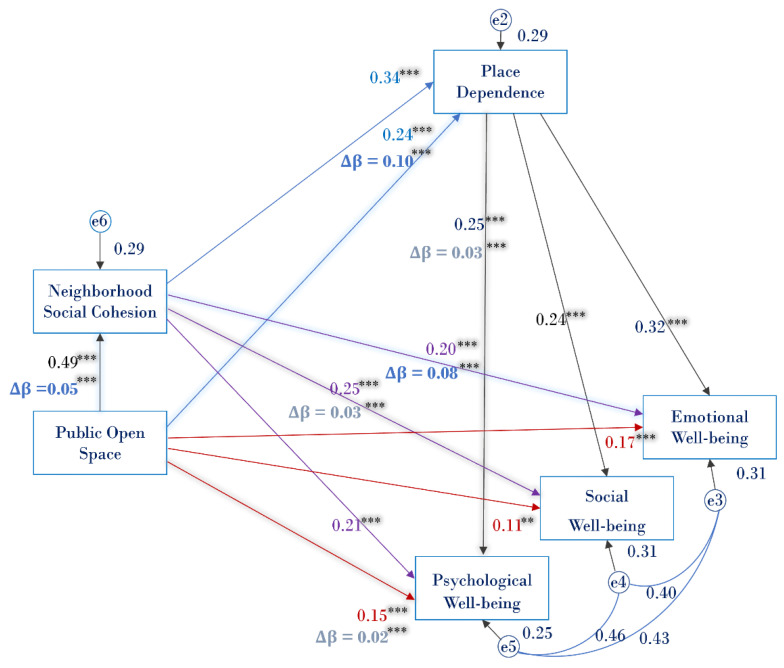
This quantitative study examines the effects of Public Open Space (POS) on older people’s well-being and examines the roles of neighborhood social cohesion (NSC) and place dependence (PD) as series buffers. A questionnaire survey of 501 people aged 65 and over was conducted in various communities of Hong Kong. Structural equation modelling (SEM) was used to analyze the pathways connecting POS and well-being. A multigroup analysis examined differences in the POS–well-being associations between the young-old (aged 65 to 75, n = 166) and old-old group (aged 76 to 95, n = 166). Results show that the association between POS and emotional well-being was stronger than social and psychological well-being. POS promotes three facets of well-being through developing NSC and, subsequently, PD. Multigroup analysis results suggest that the pathway from POS to emotional well-being via NSC is stronger for the old-old group; POS is more important for psychological well-being for the young-old group. This study highlights that the quality of POS, including attractive natural elements, various amenities, and sufficient space for social interactions, is essential for making relationship-rich and health-promotive urban environments.
Overview
The claims and statistics of this paper haven’t been checked yet.
Free: it reads the open-access text and checks the first 5 claims that cite a source we can check. Create a free account to check every claim.
Integrity signals
Registry
Cites
Statistics
Figures
Verification
Claims the paper makes
The claims and statistics of this paper haven’t been checked yet.
Free: it reads the open-access text and checks the first 5 claims that cite a source we can check. Create a free account to check every claim.
Claims other papers make about this one
Each is checked against this paper’s own text: does it say what the citing paper says it does?
The cited source says what the claim attributes to it.
In the citing paper
“Through combing through the literature, we found that the research population focuses on children (36), college student groups (37), and older adults (38), while little research has been done on young urban residents aged 18–35 in China, which we would like to know.”
From The health perception of urban green spaces and its emotional impact on young adults: an empirical study from three cities in China (2023) · cites this paper as [38]
Self-check
Percentages, sums and reported differences re-computed from the paper’s own numbers.
The self-check needs the paper’s full text.
Citations
Cites
1 retracted
Yuan, K., & Wu, T. (2021) · Environmental Science and Pollution Research · doi:10.1007/s11356-021-13244-7 · Cited by 38 · cited 2×
“For example, familiarity facilitates the accumulation and exchange of community-specific information among residents, conducive to PD as residents know places to eat and visit, places that sell fresh or cheaper goods, and places for events and recreation [75,105,106].”
BackgroundRetractedMaslow, A. H. (1943) · Psychological Review · doi:10.1037/h0054346 · Cited by 21,563 · cited 1×
“These feelings are essential components of emotional, social, and psychological well-being [71,72].”
BackgroundPsychological Well-Being Revisited: Advances in the Science and Practice of Eudaimonia
Ryff, C. D. (2014) · Psychotherapy and Psychosomatics · doi:10.1159/000353263 · Cited by 2,976 · cited 1×
“Psychological well-being is a complex construct that concerns optimal psychological functioning and experience, such as environmental mastery, autonomy, sense of fulfillment, and emotion regulation [37,38].”
BackgroundKeyes, C. L. M. (1998) · Social Psychology Quarterly · doi:10.2307/2787065 · Cited by 2,924 · cited 1×
“Social well-being relates to the social functioning of people, such as social acceptance and integration [35,36].”
BackgroundDefining place attachment: A tripartite organizing framework
Scannell, L., & Gifford, R. (2010) · Journal of Environmental Psychology · doi:10.1016/j.jenvp.2009.09.006 · Cited by 2,817 · cited 1×
“The activities and practices that different people bring to POS provide them with shared experiences and values, crystalized as symbolic identity and emotional attachment [87].”
BackgroundEncyclopedia of Survey Research Methods
Lavrakas, P. (2008) · doi:10.4135/9781412963947 · Cited by 2,689
Subjective wellbeing, health, and ageing
Steptoe, A., Deaton, A., & Stone, A. A. (2015) · The Lancet · doi:10.1016/s0140-6736(13)61489-0 · Cited by 2,455
Socioemotional selectivity theory and the regulation of emotion in the second half of life
Carstensen, L. L., Fung, H. H., & Charles, S. T. (2003) · Motivation and Emotion · doi:10.1023/a:1024569803230 · Cited by 1,978 · cited 2×
“Although aging is associated with significant losses and decline, people’s life experience has become more positive due to better emotion regulation as they age [65].”
BackgroundThe Measurement of Place Attachment: Validity and Generalizability of a Psychometric Approach
Williams, D. R., & Vaske, J. J. (2003) · Forest Science · doi:10.1093/forestscience/49.6.830 · Cited by 1,725 · cited 1×
“The former is termed place identity, and the latter is defined as place dependence (PD) [77,78].”
BackgroundEvaluating the psychometric properties of the mental health continuum-short form (MHC-SF)
Lamers, S. M. A., Westerhof, G. J., Bohlmeijer, E. T., ten Klooster, P. M., & Keyes, C. L. M. (2011) · Journal of Clinical Psychology · doi:10.1002/jclp.20741 · Cited by 1,402 · cited 1×
“Social well-being relates to the social functioning of people, such as social acceptance and integration [35,36].”
Background
Research works printed but not linked: 3
- Rossini F. Yiu M.H. lam Public Open Spaces in Private Developments in Hong Kong: New Spaces for Social Activities? J. Urban 2020 1 25 10.1080/17549175.2020.1793803/SUPPL_FILE/RJOU_A_1793803_SM4190.ZIP · doi:10.1080/17549175.2020.1793803/suppl_file/rjou_a_1793803_sm4190.zip
- Robert L. Ryan The Role of Place Attachment in Sustaining Urban Parks The Humane Metropolis: People and Nature in the 21st-Century Platt R.H. University of Massachusetts Press Amherst, MA, USA 2006 61
- Wong H. Saunders P. Wong W.P. Chan M. Chua H.W. Research Study on the Deprivation and Social Exclusion in Hong Kong The Hong Kong Council of Social Service Hong Kong, China 2012
Cited by
Understanding the Relationship between Urban Public Space and Social Cohesion: A Systematic Review
Qi, J., Mazumdar, S., & Vasconcelos, A. C. (2024) · International Journal of Community Well-Being · doi:10.1007/s42413-024-00204-5 · Cited by 212
Wang, J., Liu, N., Zou, J., Guo, Y., & Chen, H. (2023) · Frontiers in Public Health · doi:10.3389/fpubh.2023.1232216 · Cited by 24
Chen, Y., Ying, J., Zhang, Y., Feng, Y., Chen, X., & Zhou, X. (2025) · Ecological Indicators · doi:10.1016/j.ecolind.2025.113786 · Cited by 17
Building rural public cultural spaces for enhanced well-being: evidence from China
Cai, X., He, J., Liu, M., Morrison, A. M., & Yongqi, W. (2024) · Local Environment · doi:10.1080/13549839.2024.2306593 · Cited by 11
“These spaces promote well-being because they foster perceptions of life quality and provide social connections (Francis et al. 2012; Chen, Sun, and Seo 2022).”
BackgroundInfluentialThe impact of rural public spaces on place attachment in older adults
Yu, X. I. A., Wei, W., Chen, W., Wen, X., Chen, C., & CHEN, C. X. R. (2025) · Journal of Environmental Psychology · doi:10.1016/j.jenvp.2025.102633 · Cited by 9
Sun, Y., Zhu, L., Li, J., Zhang, N., Tang, Y., Wang, X., & Wu, H. (2023) · Sustainability · doi:10.3390/su151813326 · Cited by 9
Self-citationButtazzoni, A. N., & Irwin, B. R. (2025) · Cities & Health · doi:10.1080/23748834.2025.2502192 · Cited by 7
“2022) or recruited a sample that was significantly slanted toward an older (>50 years) cohort (Chen, Ryan 2005, Sun et al .”
InfluentialZhong, S., Bian, J., Chen, X., Curran, L. S., & Lee, C. (2025) · Journal of Planning Literature · doi:10.1177/08854122251341355 · Cited by 9
“Speci fi cally, mixed land use was positively correlated with social cohesion in a Chinese study (Wang and Yao 2024); third places were positively correlated with social support in a US study (Lee and Tan 2019), and parks or open spaces were positively correlated with social cohesion in a study from Hong Kong (Chen, Su…”
InfluentialTang, C., He, S., Qiu, T., He, C., Xu, J., Tang, W., & Li, Y. (2024) · Buildings · doi:10.3390/buildings14071895 · Cited by 4
Wang, H., Luo, S., & Furuya, K. (2025) · Urban forestry & urban greening · doi:10.1016/j.ufug.2025.129037 · Cited by 5
Chen, Y., Tang, J., & Dai, D. (2024) · Land · doi:10.3390/land13121996 · Cited by 3
Geneshka, M., McClean, C. J., Bedendo, A., Gilbody, S. M., & Coventry, P. A. (2025) · Wellbeing Space and Society · doi:10.1016/j.wss.2025.100244 · Cited by 5
Lai, H., Lau, S. S. Y., Su, Y., & Sun, C.-Y. (2025) · World · doi:10.3390/world6030101 · Cited by 4
Wang, L., Sun, X., Yan, J., Xie, M., & Qin, H. (2025) · Land · doi:10.3390/land14040893 · Cited by 6
“Additionally, Afshar, Foroughan, Vedadhir and Tabatabaei [53], Han, Li and Chang [33], and Chen, Sun and Seo [54] found a significant positive correlation between place attachment and older adults’ well-being.”
Unraveling Socio-Ecological Inequities in Outer London: Cluster-Based Resilience Planning
Mao, Q., & Chen, M. (2025) · Land · doi:10.3390/land14122303 · Cited by 2
Wu, C., Chen, Y., Liang, S., Yang, J., Zheng, L., Deng, Q., Liang, J., Wang, T., Ding, Y., & Wang, Y. (2026) · Buildings · doi:10.3390/buildings16122398 · Cited by 2
Kuang-Chung, W., & Cheng-En, W. (2023) · Journal of Community Medicine & Public Health · doi:10.29011/2577-2228.100301 · Cited by 4
Senior Citizens and Park Landscape Features: A Well-Being Framework
chi, R., & Kumar, R. (2024) · International Journal of Civil Engineering · doi:10.14445/23488352/ijce-v11i7p111 · Cited by 2
“Furthermore, the existence of well-maintained and easily accessible walking paths within parks can serve as a motivator for older adults to visit parks more frequently, thus enhancing their overall well-being (Petrunoff et al., 2021; Chen et al., 2022).”
BackgroundAging towards walkable futures: insights from a multidisciplinary workshop held in Barcelona, Spain
Vall-Garcia, E., Delgado‐Ortiz, L., Alcock, L., Coll‐Planas, L., García‐Navarro, J. A., Iwarsson, S., Jansà, J. M., Jansen, C.-P., Koch, S., Schwartz, S., et al. (2025) · BMC Public Health · doi:10.1186/s12889-024-21223-z · Cited by 1
Song, P., Qiu, B., Li, M., Wang, Z., & Zhang, J. (2024) · Ecological Indicators · doi:10.1016/j.ecolind.2024.112561 · Cited by 2
Aierken, A., Ding, X., Pan, Y., Chen, Y., & Li, Y. (2024) · Current Psychology · doi:10.1007/s12144-024-05829-5 · Cited by 1
“…cohesion is positively associated with dependency status, which is consistent with a previous mediation analysis conducted in Hong Kong, which reported that community cohesion has a significant and positive path to place dependency, which is one of the types of dependency (Chen et al., 2022).”
Xu, Z., Zhao, D., Mao, W., Wang, J., Yang, Z., Zheng, Y., & Wu, B. (2025) · Aging and Health Research · doi:10.1016/j.ahr.2025.100241 · Cited by 1
K’oyoo, E. O., & Bagenzi, F. (2025) · Journal of Asian Architecture and Building Engineering · doi:10.1080/13467581.2025.2584881 · Cited by 1
“Recent questionnaire-based studies include Huo et al. (2025), who explored recreation specialisation and leisure satisfaction, and Chen, Sun, and Seo (2022), who investigated public open spaces in relation to social cohesion PI and PD. Descriptive statistics were used to summarise perceptions of…”
Li, J., Li, Z., & Wang, K. (2026) · Buildings · doi:10.3390/buildings16061219 · Cited by 1
Methods and Challenges of Community Participation Practices in Planning Public Open Spaces: A Review
(2024) · International Society for the Study of Vernacular Settlements · doi:10.61275/isvsej-2024-11-02-13 · Cited by 1
Envejecimiento, discapacidad y accesibilidad en espacios públicos
Rivero, E. A. M. (2024) · CONTEXTO Revista de la Facultad de Arquitectura de la Universidad Autónoma de Nuevo León · doi:10.29105/contexto17.27-443
Exploring the effects of cultural districts on mental health: the mediating role of social cohesion
Zhang, D., Luo, J., Jiang, P., Du, J., & Chan, E. H. W. (2025) · Journal of Housing and the Built Environment · doi:10.1007/s10901-025-10258-2
“SCO plays a positive role in improving the mental health of people of varied ages, including children (Kingsbury et al., 2015), adolescents (Kingsbury et al., 2020), adults (Olamijuwon et al., 2018), and older persons (Chen et al., 2022; Smith et al., 2022).”
Kirubha, D., & Malarvizhi, G. (2025) · International Journal of Urban Sciences · doi:10.1080/12265934.2025.2591334
“In contrast, earlier works (e.g. S. Chen et al., 2022; Y. Li & Lin, 2024; Mepparambath et al., 2024; Zhao et al., 2024) mainly concentrated on subjective wellbeing or health outcomes, while J. Zhang and Tan (2019) and Elnabawi and Jamei (2024) placed greater weight on quality and personal…”
Neighbourhood environments and later life flourishing: A systematic scoping review
Zhang, Y., Leiva-Granados, R., Soh, Q. R., Zhou, X., Wang, Q., Gomes, M., & Skordis, J. (2026) · Ageing Research Reviews · doi:10.1016/j.arr.2026.103107
Timalsina, K. P., & Subedi, B. P. (2026) · Journal of Urban Management · doi:10.1016/j.jum.2026.03.015
An observational study of older adults’ activities in urban public spaces
Younes, S. R., Marques, B., & McIntosh, J. (2026) · Local Environment · doi:10.1080/13549839.2026.2669763
The influence of urban parkettes on landscape values and place attachment in Kigali city, Rwanda
K’oyoo, E. O. (2026) · Journal of Asian Architecture and Building Engineering · doi:10.1080/13467581.2026.2692290
Moseley, S., West, L., Fleming, S., & Webb, A. (2026) · International Journal of the Sociology of Leisure · doi:10.1007/s41978-026-00219-6
“The wellbeing of older adults is a recurrent theme (e.g., Chen et al., 2022; Toepoel, 2013), as is the use of urban space (e.g., de Vries et al., 2013; Jennings & Bamkole, 2019), and physical activity (e.g., Murillo et al., 2023; Yu, 2025).”
Abubakir, S. S., Rashid, S. J., Qadir, V. S., & Qader, A. L. (2026) · Buildings · doi:10.3390/buildings16153117
Cheng, Y., Pei, J., & Wang, M. (2026) · City and Built Environment · doi:10.1007/s44213-026-00086-7
The role of park environment design in enhancing elderly holistic well-being: an SEM − based study
Qi, W., Sulaiman, M. K. A. M., Samad, N. A. A., & Mohammad, N. (2026) · Ain Shams Engineering Journal · doi:10.1016/j.asej.2026.104477
Park exposure levels in older adults: the more significant influence of objective environment
Chen, Y., Zhuang, W., Li, L., Chen, G., & Huang, L. (2026) · Frontiers in Psychology · doi:10.3389/fpsyg.2026.1945202
“…repeated use and longer stays (Chen et al., 2022); family support and community support correspond to affective place dependence, helping to sustain continued use (Chen et al., 2022); and policy support is an important antecedent of place attachment, helping to stabilize expectations of park use.”
Metadata
- Authors
- Chen, S., Sun, Y., & Seo, B. K.
- Affiliations
- Hong Kong Polytechnic University (HK)
- Corresponding author
- Sun, Yi
- Venue
- International Journal of Environmental Research and Public Health
- Publisher
- MDPI AG
- Published
- 2022-12-02
- Volume
- 19
- Issue
- 23
- Pages
- 16170
- ISSN
- 1660-4601 (ISSN-L)
- PMC
- PMC9737378
- OpenAlex
- W4310675553
- Cited by
- 38
- References
- 107
- Citations by year
- 2026: 12 · 2025: 14 · 2024: 9 · 2023: 3
- FWCI
- 2.55
- Type
- journal article
- Language
- en
- Open access
- gold
- doi.org
- Licence
- Locations
- International Journal of Environmental Research and Public Health (publishedVersion, cc-by)
- PubMed Central (publishedVersion, cc-by)
- PubMed (publishedVersion)
- PolyU Institutional Research Archive (Hong Kong Polytechnic University) (submittedVersion, cc-by)
- RePEc: Research Papers in Economics (submittedVersion)
- DOAJ (DOAJ: Directory of Open Access Journals) (submittedVersion, cc-by-sa)
- Funders
- Policy Innovation and Coordination Office of the Government of the Hong Kong Special Administrative Region (2019.A6.145.19D)
- Topics
- Social Sciences › Urban Studies › Urban Green Space and Health
- Social Sciences › Sociology and Political Science › Place Attachment and Urban Studies
- Social Sciences › Life-span and Life-course Studies › Aging, Elder Care, and Social Issues
- Keywords
- public open space, older adults, well-being, neighborhood cohesion, place dependence, emotional well-being, psychological well-being, social well-being, young-old, old-old, urban environment, Hong Kong
- MeSH terms
- Social Cohesion, Aged, Environment, Humans, Surveys and Questionnaires, Residence Characteristics, Social Environment
About these checks
Registry, retraction, Cites and statistics results are computed, not judged, with one exception: a printed reference that no index lists is read once by a model before it counts as a citation error. Claims are extracted by a model and kept only when their quote appears verbatim in the text; each cited source is then checked, with a model’s help, for whether it says what the claim relies on. Those verdicts can be wrong — read the claim’s quote and the cited source before relying on one.
Statistics and arithmetic are recomputed, not judged.
Confidence bands are shown only for fields calibrated on our annotated test set. None is calibrated yet, so no band is shown.
What counts as a claim ›How we measure confidence ›How we check this ›
Are you an author, or do you see a problem with this page? Request a review
Data sources
Bibliographic data: Semantic Scholar, OpenAlex, Crossref.
Contains information from the Semantic Scholar Academic Graph Datasets, made available under the ODC Attribution License (ODC-BY 1.0).
Semantic Scholar’s data is described in: Kinney, R., et al. (2023). The Semantic Scholar Open Data Platform. arXiv:2301.10140.
