

The DOI matches its Crossref record; 5 of the 5 references it cites were found in a registry or an index.
Blocked Randomization with Randomly Selected Block Sizes
Open accessAbstract
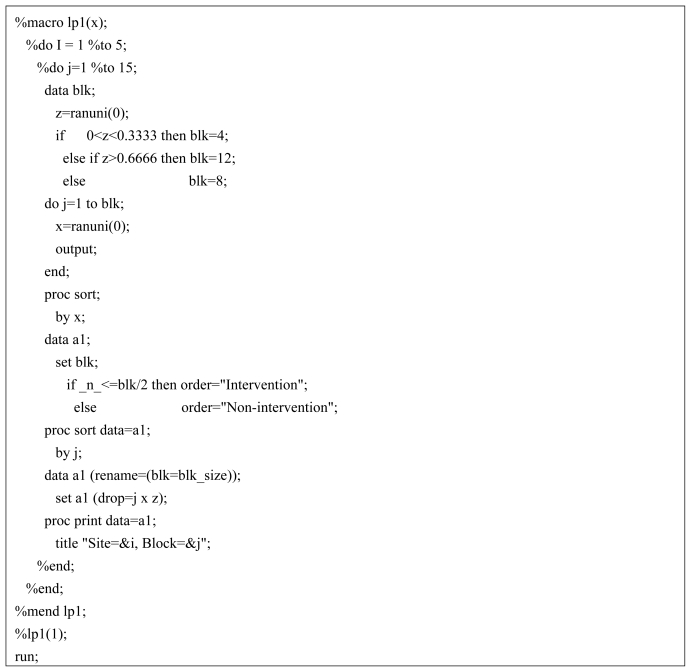
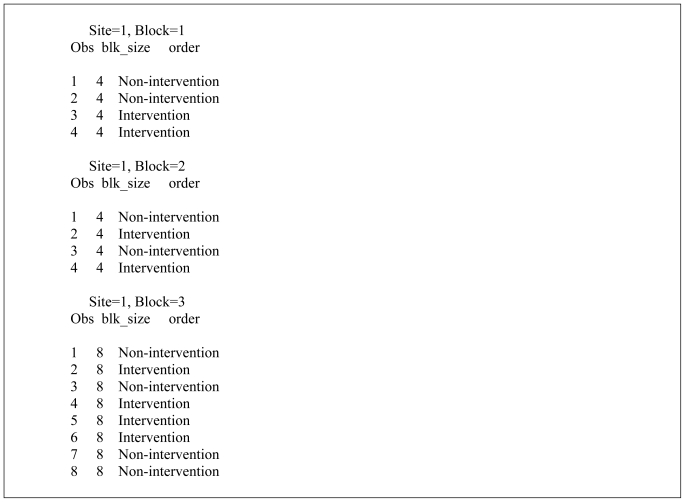
When planning a randomized clinical trial, careful consideration must be given to how participants are selected for various arms of a study. Selection and accidental bias may occur when participants are not assigned to study groups with equal probability. A simple random allocation scheme is a process by which each participant has equal likelihood of being assigned to treatment versus referent groups. However, by chance an unequal number of individuals may be assigned to each arm of the study and thus decrease the power to detect statistically significant differences between groups. Block randomization is a commonly used technique in clinical trial design to reduce bias and achieve balance in the allocation of participants to treatment arms, especially when the sample size is small. This method increases the probability that each arm will contain an equal number of individuals by sequencing participant assignments by block. Yet still, the allocation process may be predictable, for example, when the investigator is not blind and the block size is fixed. This paper provides an overview of blocked randomization and illustrates how to avoid selection bias by using random block sizes.
Overview
The claims and statistics of this paper haven’t been checked yet.
Free: it reads the open-access text and checks the first 5 claims that cite a source we can check. Create a free account to check every claim.
Integrity signals
Registry
Cites
Statistics
Figures
Verification
Claims the paper makes
The claims and statistics of this paper haven’t been checked yet.
Free: it reads the open-access text and checks the first 5 claims that cite a source we can check. Create a free account to check every claim.
Claims other papers make about this one
Each is checked against this paper’s own text: does it say what the citing paper says it does?
The cited source says what the claim attributes to it.
In the citing paper
“To avoid selection bias, we used block randomization using random block sizes [17]. Sealed envelopes were prepared and shuffled by one team member.”
From Mindful Kangaroo Care: mindfulness intervention for mothers during skin-to-skin care: a randomized control pilot study. (2022) · cites this paper as [17]
In the citing paper
“Eligible participants will be randomized into experimental or control groups at 1:1 ratio through a permuted block randomization with a block size of 8 [25].”
Self-check
Percentages, sums and reported differences re-computed from the paper’s own numbers.
The self-check needs the paper’s full text.
Citations
Cites
A heteroskedasticity-consistent covariance matrix estimator and a direct test for heteroskedasticity
White, H. (1980) · Econometrica · doi:10.2307/1912934 · Cited by 25,861
Forcing a sequential experiment to be balanced
EFRON, B. (1971) · Biometrika · doi:10.1093/biomet/58.3.403 · Cited by 873
Properties of permuted-block randomization in clinical trials
Matts, J. P., & Lachin, J. M. (1988) · Controlled Clinical Trials · doi:10.1016/0197-2456(88)90047-5 · Cited by 321 · cited 6×
“This can lead to bias, for example, if the initial participants in the trial are healthier than the later ones [1].”
BackgroundInfluentialProperties of simple randomization in clinical trials
Lachin, J. M. (1988) · Controlled Clinical Trials · doi:10.1016/0197-2456(88)90046-3 · Cited by 174
Efron, B. (1973) · PubMed · Cited by 12
Research works printed but not linked: 1
- Domanski, 2009, Randomization: What is it and how to do it, Successful Randomized Trials, Chapter 3, 27
Cited by
Bøtker, H. E., Hausenloy, D., Andreadou, I., Antonucci, S., Boengler, K., Davidson, S. M., Deshwal, S., Devaux, Y., Di Lisa, F., Di Sante, M., et al. (2018) · Basic Research in Cardiology · doi:10.1007/s00395-018-0696-8 · Cited by 423
Tassorelli, C., Diener, H.-C., Dodick, D. W., Silberstein, S. D., Lipton, R. B., Ashina, M., Becker, W. J., Ferrari, M. D., Goadsby, P. J., Pozo-Rosich, P., et al. (2018) · Cephalalgia · doi:10.1177/0333102418758283 · Cited by 388
“Therefore, to ensure balanced randomization across treatment groups, it is preferable to randomize subjects in relatively small blocks (eg, 4–8 or 4–10) of varying size (43).”
BackgroundObservational research--opportunities and limitations
Boyko, E. J. (2013) · Journal of Diabetes and its Complications · doi:10.1016/j.jdiacomp.2013.07.007 · Cited by 313
Liao, C.-D., Tsauo, J.-Y., Lin, L.-F., Huang, S.-W., Ku, J.-W., Chou, L.-C., & Liou, T.-H. (2017) · Medicine · doi:10.1097/md.0000000000007115 · Cited by 201
Cognitive Behavioral Therapy for Prenatal Insomnia: A Randomized Controlled Trial
Manber, R., Bei, B., Simpson, N., Asarnow, L., Rangel, E., Sit, A., & Lyell, D. (2019) · Obstetrics & Gynecology · doi:10.1097/aog.0000000000003216 · Cited by 145
Metadata
- Authors
- Efird, J.
- Affiliations
- East Carolina University (US)
- Corresponding author
- Efird, Jimmy
- ORCID
- Efird, Jimmy
- Venue
- International Journal of Environmental Research and Public Health
- Publisher
- MDPI AG
- Published
- 2010-12-23
- Volume
- 8
- Issue
- 1
- Pages
- 15-20
- ISSN
- 1660-4601 (ISSN-L)
- PMC
- PMC3037057
- OpenAlex
- W2136577132
- Semantic Scholar
- 34490349ce1f99e1e94691548906011ec13bd9b6
- Cited by
- 564
- References
- 5
- Citations by year
- 2026: 36 · 2025: 65 · 2024: 67 · 2023: 54 · 2022: 63 · 2021: 66 · 2020: 57 · 2019: 39 · 2018: 28 · 2017: 25 · 2016: 19 · 2015: 14 · 2014: 19 · 2013: 10 · 2012: 1
- FWCI
- 3.25
- Type
- journal article
- Language
- en
- Open access
- gold
- doi.org
- Licence
- Locations
- International Journal of Environmental Research and Public Health (publishedVersion, cc-by)
- PubMed Central (publishedVersion, cc-by)
- PubMed (publishedVersion)
- RePEc: Research Papers in Economics (submittedVersion)
- The Scholarship East Carolina University's Institutional Repository (East Carolina University) (submittedVersion)
- Topics
- Physical Sciences › Mathematics › Statistics and Probability › Statistical Methods in Clinical Trials
- Social Sciences › Decision Sciences › Management Science and Operations Research › Optimal Experimental Design Methods
- Physical Sciences › Mathematics › Statistics and Probability › Advanced Causal Inference Techniques
- Keywords
- allocation bias, selection bias, clinical trial design, randomization, small sample size
- MeSH terms
- Humans, Random Allocation, Bias, Selection Bias, Randomized Controlled Trials as Topic, Sample Size
About these checks
Registry, retraction, Cites and statistics results are computed, not judged, with one exception: a printed reference that no index lists is read once by a model before it counts as a citation error. Claims are extracted by a model and kept only when their quote appears verbatim in the text; each cited source is then checked, with a model’s help, for whether it says what the claim relies on. Those verdicts can be wrong — read the claim’s quote and the cited source before relying on one.
Statistics and arithmetic are recomputed, not judged.
Confidence bands are shown only for fields calibrated on our annotated test set. None is calibrated yet, so no band is shown.
What counts as a claim ›How we measure confidence ›How we check this ›
Are you an author, or do you see a problem with this page? Request a review
How to cite
Cite CoChat for the checks on this page, and the paper for its own findings.
- This page
- CoChat. (2026). Citation check: Blocked Randomization with Randomly Selected Block Sizes. https://app.cochat.ai/papers/10.3390/ijerph8010015
- The paper
- Efird, J. (2010). Blocked Randomization with Randomly Selected Block Sizes. International Journal of Environmental Research and Public Health. https://doi.org/10.3390/ijerph8010015
Data sources
Bibliographic data: Semantic Scholar, OpenAlex, Crossref.
Contains information from the Semantic Scholar Academic Graph Datasets, made available under the ODC Attribution License (ODC-BY 1.0).
Semantic Scholar’s data is described in: Kinney, R., et al. (2023). The Semantic Scholar Open Data Platform. arXiv:2301.10140.
