

The DOI matches its Crossref record; 293 of the 297 references it cites were found in a registry or an index.
NOD-Like Receptors in Intestinal Homeostasis and Epithelial Tissue Repair
Open accessAbstract
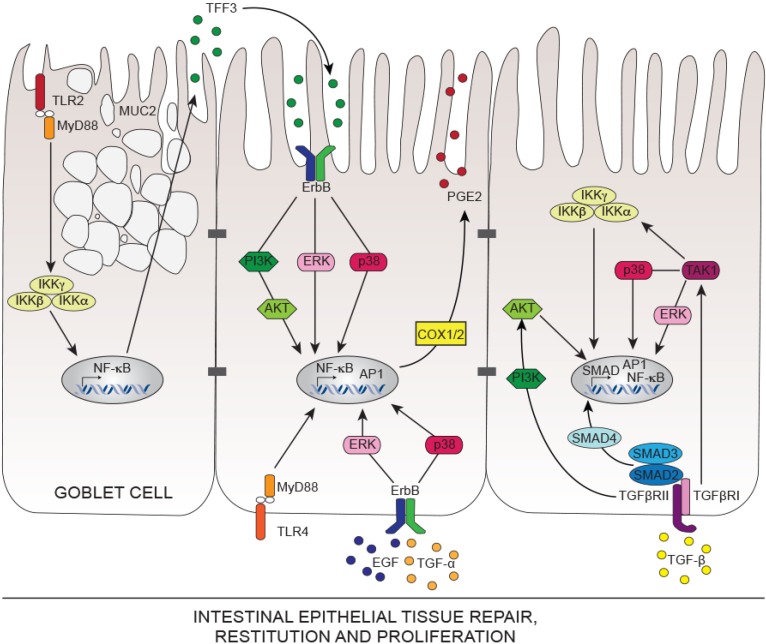
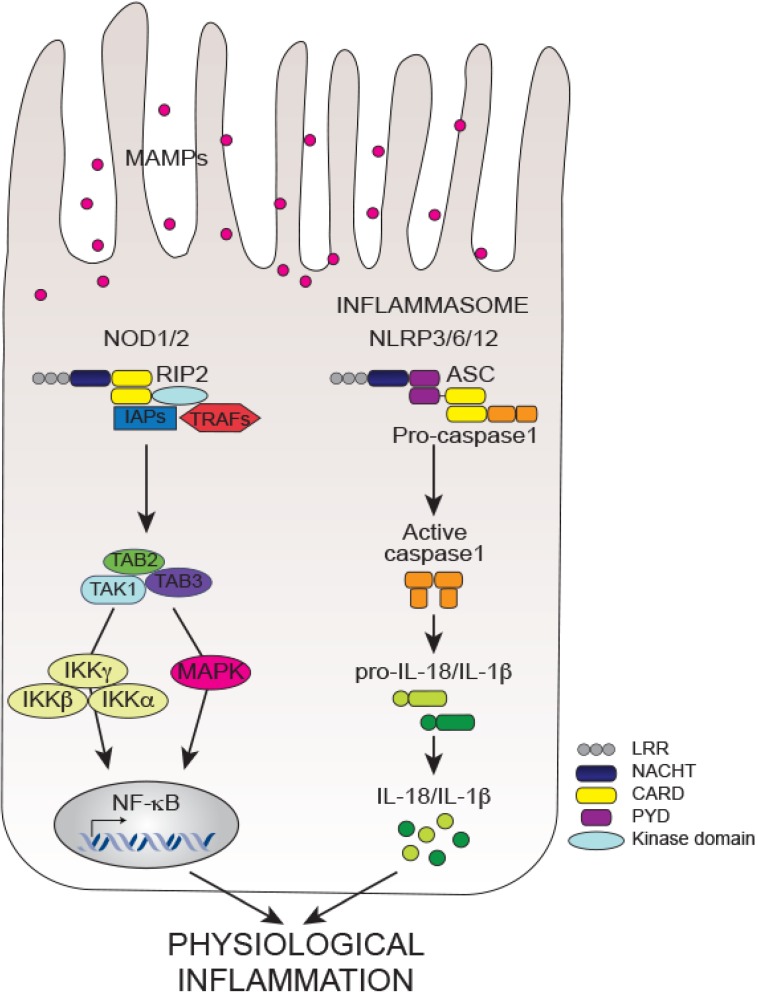
The intestinal epithelium constitutes a dynamic physical barrier segregating the luminal content from the underlying mucosal tissue. Following injury, the epithelial integrity is restored by rapid migration of intestinal epithelial cells (IECs) across the denuded area in a process known as wound healing. Hence, through a sequence of events involving restitution, proliferation and differentiation of IECs the gap is resealed and homeostasis reestablished. Relapsing damage followed by healing of the inflamed mucosa is a hallmark of several intestinal disorders including inflammatory bowel diseases (IBD). While several regulatory peptides, growth factors and cytokines stimulate restitution of the epithelial layer after injury, recent evidence in the field underscores the contribution of innate immunity in controlling this process. In particular, nucleotide-binding and oligomerization domain-like receptors (NLRs) play critical roles in sensing the commensal microbiota, maintaining homeostasis, and regulating intestinal inflammation. Here, we review the process of intestinal epithelial tissue repair and we specifically focus on the impact of NLR-mediated signaling mechanisms involved in governing epithelial wound healing during disease.
Overview
The claims and statistics of this paper haven’t been checked yet.
Run the check — free, no account needed. It reads the open-access text and checks the sources it cites.
Integrity signals
Registry
Cites
Statistics
Figures
Verification
Claims the paper makes
The claims and statistics of this paper haven’t been checked yet.
Run the check — free, no account needed. It reads the open-access text and checks the sources it cites.
Claims other papers make about this one
Each is checked against this paper’s own text: does it say what the citing paper says it does?
In the citing paper
“NLRs proteins are also responsible for maintaining gut barrier integrity by sensing the presence of commensal microbiota and the regulation of intestinal inflammation.172,173”
From Regulation of Intestinal Barrier Function by Microbial Metabolites (2021) · cites this paper as [172]
Self-check
Percentages, sums and reported differences re-computed from the paper’s own numbers.
The self-check needs the paper’s full text.
Citations
Cites
Diversity of the Human Intestinal Microbial Flora
Eckburg, P. B., Bik, E. M., Bernstein, C. N., Purdom, E., Dethlefsen, L., Sargent, M., Gill, S. R., Nelson, K. E., & Relman, D. A. (2005) · Science · doi:10.1126/science.1110591 · Cited by 7,913
Human gut microbiome viewed across age and geography
Yatsunenko, T., Rey, F. E., Manary, M. J., Trehan, I., Dominguez-Bello, M. G., Contreras, M., Magris, M., Hidalgo, G., Baldassano, R. N., Anokhin, A. P., et al. (2012) · Nature · doi:10.1038/nature11053 · Cited by 7,815
Single Lgr5 stem cells build crypt-villus structures in vitro without a mesenchymal niche
Sato, T., Vries, R. G., Snippert, H. J., van de Wetering, M., Barker, N., Stange, D. E., van Es, J. H., Abo, A., Kujala, P., Peters, P. J., et al. (2009) · Nature · doi:10.1038/nature07935 · Cited by 7,204
Martinon, F., Burns, K., & Tschopp, J. (2002) · Molecular Cell · doi:10.1016/s1097-2765(02)00599-3 · Cited by 6,066
Identification of stem cells in small intestine and colon by marker gene Lgr5
Barker, N., van Es, J. H., Kuipers, J., Kujala, P., van den Born, M., Cozijnsen, M., Haegebarth, A., Korving, J., Begthel, H., Peters, P. J., et al. (2007) · Nature · doi:10.1038/nature06196 · Cited by 5,687
Association of NOD2 leucine-rich repeat variants with susceptibility to Crohn's disease
Hugot, J.-P., Chamaillard, M., Zouali, H., Lesage, S., Cézard, J.-P., Belaiche, J., Almer, S., Tysk, C., O'Morain, C. A., Gassull, M., et al. (2001) · Nature · doi:10.1038/35079107 · Cited by 5,591
Diversity, stability and resilience of the human gut microbiota
Lozupone, C. A., Stombaugh, J. I., Gordon, J. I., Jansson, J. K., & Knight, R. (2012) · Nature · doi:10.1038/nature11550 · Cited by 5,533
Smad-dependent and Smad-independent pathways in TGF-β family signalling
Derynck, R., & Zhang, Y. E. (2003) · Nature · doi:10.1038/nature02006 · Cited by 5,498
Schroder, K., & Tschopp, J. (2010) · Cell · doi:10.1016/j.cell.2010.01.040 · Cited by 5,475
A frameshift mutation in NOD2 associated with susceptibility to Crohn's disease
Ogura, Y., Bonen, D. K., Inohara, N., Nicolae, D. L., Chen, F. F., Ramos, R., Britton, H., Moran, T., Karaliuskas, R., Duerr, R. H., et al. (2001) · Nature · doi:10.1038/35079114 · Cited by 5,030
Cited by
Sorted by citations
Regulation of Intestinal Barrier Function by Microbial Metabolites
Ghosh, S., Whitley, C. S., Haribabu, B., & Jala, V. R. (2021) · Cellular and Molecular Gastroenterology and Hepatology · doi:10.1016/j.jcmgh.2021.02.007 · Cited by 835
Human Gut Microbiota and Gastrointestinal Cancer
Meng, C., Bai, C., Brown, T. D., Hood, L., & Tian, Q. (2018) · Genomics Proteomics & Bioinformatics · doi:10.1016/j.gpb.2017.06.002 · Cited by 482
NLRP3 inflammasome activation in inflammaging
Latz, E., & Duewell, P. (2018) · Seminars in Immunology · doi:10.1016/j.smim.2018.09.001 · Cited by 174
Perturbations of gut microbiome genes in infants with atopic dermatitis according to feeding type
Lee, M.-J., Kang, M., Lee, S., Lee, E. M., Kim, K., Won, S., Suh, D. I., Kim, K. W., Sheen, Y. H., Ahn, K., et al. (2018) · Journal of Allergy and Clinical Immunology · doi:10.1016/j.jaci.2017.11.045 · Cited by 163
Ratsimandresy, R. A., Indramohan, M., Dorfleutner, A., & Stehlik, C. (2017) · Cellular & Molecular Immunology · doi:10.1038/cmi.2016.35 · Cited by 161
Metadata
- Authors
- Parlato, M., & Yeretssian, G.
- Affiliations
- Icahn School of Medicine at Mount Sinai (US)
- Tisch Cancer Institute (US)
- Corresponding author
- Yeretssian, Garabet
- Venue
- International Journal of Molecular Sciences
- Publisher
- MDPI AG
- Published
- 2014-05-30
- Volume
- 15
- Issue
- 6
- Pages
- 9594-9627
- ISSN
- 1422-0067 (ISSN-L)
- PMC
- PMC4100112
- OpenAlex
- W2061048240
- Cited by
- 79
- References
- 297
- Citations by year
- 2026: 3 · 2025: 6 · 2024: 4 · 2023: 7 · 2022: 6 · 2021: 8 · 2020: 4 · 2019: 8 · 2018: 13 · 2017: 6 · 2016: 7 · 2015: 5 · 2014: 2
- FWCI
- 0.88
- Type
- journal article
- Language
- en
- Open access
- gold
- doi.org
- Licence
- Locations
- International Journal of Molecular Sciences (publishedVersion, cc-by)
- PubMed Central (publishedVersion, cc-by)
- PubMed (publishedVersion)
- DOAJ (DOAJ: Directory of Open Access Journals) (submittedVersion, cc-by-sa)
- Funders
- Leona M. and Harry B. Helmsley Charitable Trust
- Topics
- Health Sciences › Medicine › Gastroenterology › Inflammatory Bowel Disease
- Life Sciences › Immunology and Microbiology › Immunology › Immune Response and Inflammation
- Life Sciences › Biochemistry, Genetics and Molecular Biology › Molecular Biology › Inflammasome and immune disorders
- Keywords
- NOD-like receptors, intestinal epithelium, intestinal homeostasis, epithelial repair, tissue repair, intestinal inflammation, inflammatory bowel disease, innate immunity, commensal microbiota, epithelial restitution, intestinal epithelial cells
- MeSH terms
- Animals, Homeostasis, Humans, Immunity, Innate, Intestinal Mucosa, Wound Healing, Inflammatory Bowel Diseases, Toll-Like Receptors, Nod Signaling Adaptor Proteins, Inflammasomes
About these checks
Registry, retraction, Cites and statistics results are computed, not judged, with one exception: a printed reference that no index lists is read once by a model before it counts as a citation error. Claims are extracted by a model and kept only when their quote appears verbatim in the text; each cited source is then checked, with a model’s help, for whether it says what the claim relies on. Those verdicts can be wrong — read the claim’s quote and the cited source before relying on one.
Statistics and arithmetic are recomputed, not judged.
Confidence bands are shown only for fields calibrated on our annotated test set. None is calibrated yet, so no band is shown.
What counts as a claim ›How we measure confidence ›How we check this ›
Are you an author, or do you see a problem with this page? Request a review
