

The DOI matches its Crossref record; 187 of the 188 references it cites were found in a registry or an index.
Dietary Strategies Implicated in the Prevention and Treatment of Metabolic Syndrome
Open accessAbstract
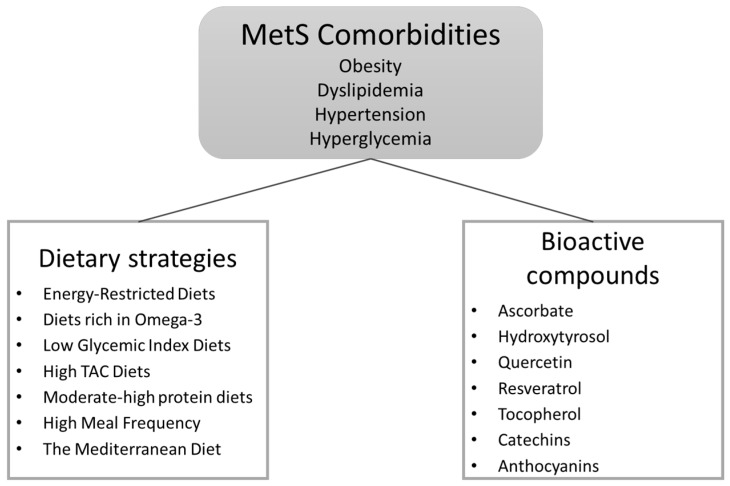
Metabolic syndrome (MetS) is established as the combination of central obesity and different metabolic disturbances, such as insulin resistance, hypertension and dyslipidemia. This cluster of factors affects approximately 10%-50% of adults worldwide and the prevalence has been increasing in epidemic proportions over the last years. Thus, dietary strategies to treat this heterogenic disease are under continuous study. In this sense, diets based on negative-energy-balance, the Mediterranean dietary pattern, n-3 fatty acids, total antioxidant capacity and meal frequency have been suggested as effective approaches to treat MetS. Furthermore, the type and percentage of carbohydrates, the glycemic index or glycemic load, and dietary fiber content are some of the most relevant aspects related to insulin resistance and impaired glucose tolerance, which are important co-morbidities of MetS. Finally, new studies focused on the molecular action of specific nutritional bioactive compounds with positive effects on the MetS are currently an objective of scientific research worldwide. The present review summarizes some of the most relevant dietary approaches and bioactive compounds employed in the treatment of the MetS to date.
Overview
The claims and statistics of this paper haven’t been checked yet.
Run the check — free, no account needed. It reads the open-access text and checks the sources it cites.
Integrity signals
Registry
Cites
Statistics
Figures
Verification
Claims the paper makes
The claims and statistics of this paper haven’t been checked yet.
Run the check — free, no account needed. It reads the open-access text and checks the sources it cites.
Claims other papers make about this one
Each is checked against this paper’s own text: does it say what the citing paper says it does?
The cited source says what the claim attributes to it.
In the citing paper
“Generally, energy-restricting diets are aimed at inducing a state of negative energy balance so that stored lipids inside adipocytes are used as alternative substrates (233).”
From Metabolic Flexibility as an Adaptation to Energy Resources and Requirements in Health and Disease (2018) · cites this paper as [233]
Self-check
Percentages, sums and reported differences re-computed from the paper’s own numbers.
The self-check needs the paper’s full text.
Citations
Cites
3 retracted
RETRACTED: Primary Prevention of Cardiovascular Disease with a Mediterranean Diet
Estruch, R., Ros, E., Salas-Salvadó, J., Covas, M.-I., Corella, D., Arós, F., Gómez-Gracia, E., Ruiz-Gutiérrez, V., Fiol, M., Lapetra, J., et al. (2013) · New England Journal of Medicine · doi:10.1056/nejmoa1200303 · Cited by 4,257
Self-citationRetractedEstruch, R., Ros, E., Salas-Salvadó, J., Covas, M.-I., Corella, D., Arós, F., Gómez-Gracia, E., Ruiz-Gutiérrez, V., Fiol, M., Lapetra, J., et al. (2018) · New England Journal of Medicine · doi:10.1056/nejmc1806491 · Cited by 1,008
Self-citationRetractedRETRACTED: Quercetin: A flavonol with multifaceted therapeutic applications?
D’Andrea, G. (2015) · Fitoterapia · doi:10.1016/j.fitote.2015.09.018 · Cited by 743
RetractedToprak, Ö., Kurt, H., Sarı, Y., Şarkış, C., Us, H., & Kırık, A. (2017) · Kidney & Blood Pressure Research · doi:10.1159/000468530 · Cited by 29,772
Grundy, S. M., Bilheimer, D. W., Chait, A., Clark, L. T., Denke, M. A., Havel, R. J., Hazzard, W. R., Hulley, S. B., Hunninghake, D. B., Kreisberg, R. A., et al. (1993) · JAMA · doi:10.1001/jama.269.23.3015 · Cited by 27,944
Expert Panel on Detection, E. (2001) · JAMA: The Journal of the American Medical Association · doi:10.1001/jama.285.19.2486 · Cited by 26,011
Alberti, K. G. M. M., Eckel, R. H., Grundy, S. M., Zimmet, P. Z., Cleeman, J. I., Donato, K. A., Fruchart, J.-C., James, W. P. T., Loria, C. M., & Smith, S. C. (2009) · Circulation · doi:10.1161/circulationaha.109.192644 · Cited by 14,860
(2000) · PubMed · Cited by 13,173
Grundy, S. M., Cleeman, J. I., Daniels, S. R., Donato, K. A., Eckel, R. H., Franklin, B. A., Gordon, D. J., Krauss, R. M., Savage, P. J., Smith, S. C., et al. (2005) · Circulation · doi:10.1161/circulationaha.105.169404 · Cited by 11,961
The metabolic syndrome—a new worldwide definition
Alberti, K. G. M., Zimmet, P., & Shaw, J. (2005) · The Lancet · doi:10.1016/s0140-6736(05)67402-8 · Cited by 9,352
Research works printed but not linked: 3
- Black, H.R., and Elliott, W.J. (2013). Hypertension: A Companion to Braunwald’s Heart Disease, Elsevier.
- Oresic, M., and Vidal-Puig, A. (2014). A Systems Biology Approach to Study Metabolic Syndrome, Springer. · DOI
- Quinn, P.J., and Kagan, V.E. Fat-Soluble Vitamins, Springer.
Cited by
Sorted by citations
González‐Muniesa, P., Martínez‐González, M. Á., Hu, F. B., Després, J., Matsuzawa, Y., Loos, R. J. F., Moreno, L. A., Bray, G. A., & Martínez, J. A. (2017) · Nature Reviews Disease Primers · doi:10.1038/nrdp.2017.34 · Cited by 1,184
Metabolic Flexibility as an Adaptation to Energy Resources and Requirements in Health and Disease
Smith, R. L., Soeters, M. R., Wüst, R. C. I., & Houtkooper, R. H. (2018) · Endocrine Reviews · doi:10.1210/er.2017-00211 · Cited by 787
Dietary Strategies for Metabolic Syndrome: A Comprehensive Review
Castro‐Barquero, S., Ruiz-León, A. M., Sierra-Pérez, M., Estruch, R., & Casas, R. M. (2020) · Nutrients · doi:10.3390/nu12102983 · Cited by 530
Metabolic syndrome: risk factors, diagnosis, pathogenesis, and management with natural approaches
Mohamed, S. M., Shalaby, M. A., El‐Shiekh, R. A., El-Banna, H. A., Emam, S. R., & Bakr, A. F. (2023) · Food Chemistry Advances · doi:10.1016/j.focha.2023.100335 · Cited by 288
Hu, S. C., & Lan, C.-C. E. (2017) · International Journal of Molecular Sciences · doi:10.3390/ijms18102211 · Cited by 199
Metadata
- Authors
- De la Iglesia, R., Loria-Kohen, V., Zulet, M., Martinez, J., Reglero, G., & Ramirez de Molina, A.
- Affiliations
- GENYAL Platform on Nutrition and Health, IMDEA Food Institute, CEI UAM + CSIC, 28049 Madrid, Spain
- Spanish Biomedical Research Centre in Physiopathology of Obesity and Nutrition (ES)
- Department of Nutrition, Food Science and Physiology, University of Navarra, 31008 Pamplona, Spain
- Madrid Institute for Advanced Studies (ES)
- Venue
- International Journal of Molecular Sciences
- Publisher
- MDPI AG
- Published
- 2016-11-10
- Volume
- 17
- Issue
- 11
- Pages
- 1877
- ISSN
- 1422-0067 (ISSN-L)
- PMC
- PMC5133877
- OpenAlex
- W2553075863
- Cited by
- 168
- References
- 188
- Citations by year
- 2026: 4 · 2025: 12 · 2024: 13 · 2023: 18 · 2022: 25 · 2021: 25 · 2020: 19 · 2019: 16 · 2018: 25 · 2017: 11
- FWCI
- 2.59
- Type
- journal article
- Language
- en
- Open access
- gold
- doi.org
- Licence
- Locations
- International Journal of Molecular Sciences (publishedVersion, cc-by)
- PubMed Central (publishedVersion, cc-by)
- PubMed (publishedVersion)
- DIGITAL.CSIC (Spanish National Research Council (CSIC)) (submittedVersion, cc-by)
- DOAJ (DOAJ: Directory of Open Access Journals) (submittedVersion, cc-by-sa)
- Topics
- Health Sciences › Medicine › Public Health, Environmental and Occupational Health › Nutritional Studies and Diet
- Health Sciences › Medicine › Endocrinology, Diabetes and Metabolism › Diet, Metabolism, and Disease
- Health Sciences › Medicine › Endocrinology, Diabetes and Metabolism › Diabetes, Cardiovascular Risks, and Lipoproteins
- Keywords
- metabolic syndrome, dietary intervention, Mediterranean diet, omega-3 fatty acids, negative energy balance, meal frequency, total antioxidant capacity, insulin resistance, impaired glucose tolerance, glycemic index, glycemic load, dietary fiber, carbohydrate quality, abdominal obesity, dyslipidemia, hypertension
- MeSH terms
- Diet, Dietary Fiber, Energy Metabolism, Feeding Behavior, Humans, Nutritional Physiological Phenomena, Fatty Acids, Omega-3, Metabolic Syndrome, Glycemic Index, Diet, Mediterranean
About these checks
Registry, retraction, Cites and statistics results are computed, not judged, with one exception: a printed reference that no index lists is read once by a model before it counts as a citation error. Claims are extracted by a model and kept only when their quote appears verbatim in the text; each cited source is then checked, with a model’s help, for whether it says what the claim relies on. Those verdicts can be wrong — read the claim’s quote and the cited source before relying on one.
Statistics and arithmetic are recomputed, not judged.
Confidence bands are shown only for fields calibrated on our annotated test set. None is calibrated yet, so no band is shown.
What counts as a claim ›How we measure confidence ›How we check this ›
Are you an author, or do you see a problem with this page? Request a review
