

Chitosan inhibits the rehabilitation of damaged microbes induced by photodynamic inactivation.
Open accessThe DOI matches its Crossref record; 47 of the 48 references it cites were found in a registry or an index, and 1 are not checked yet.
Abstract
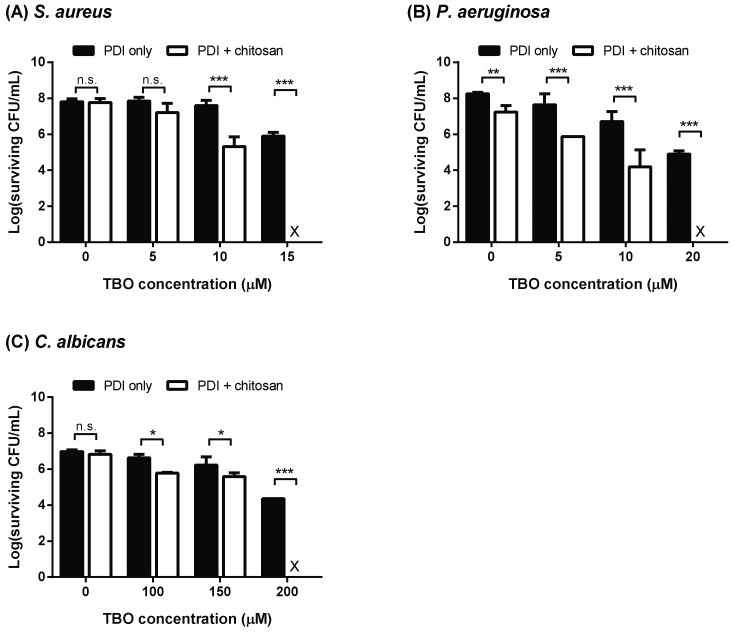
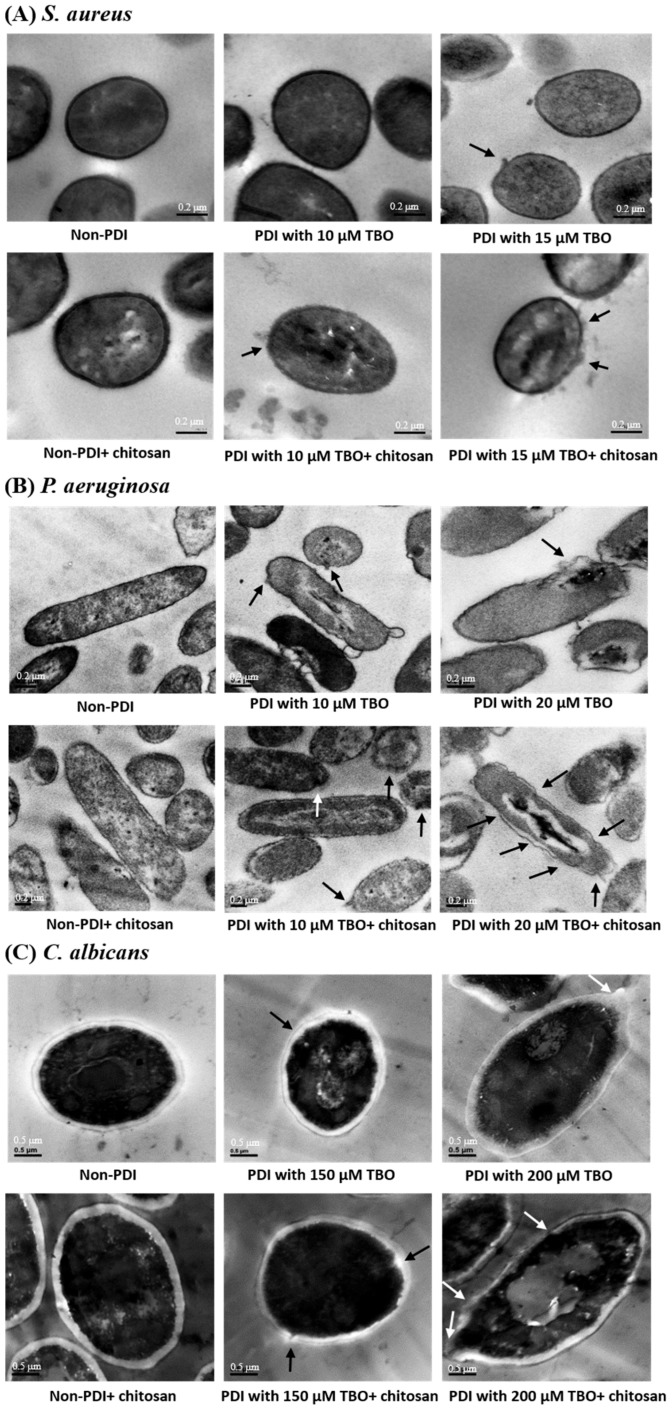
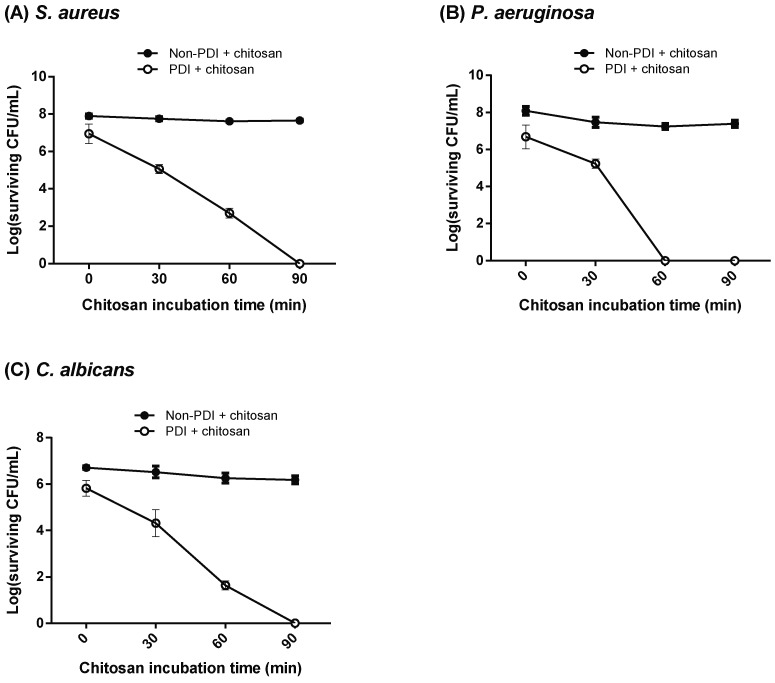
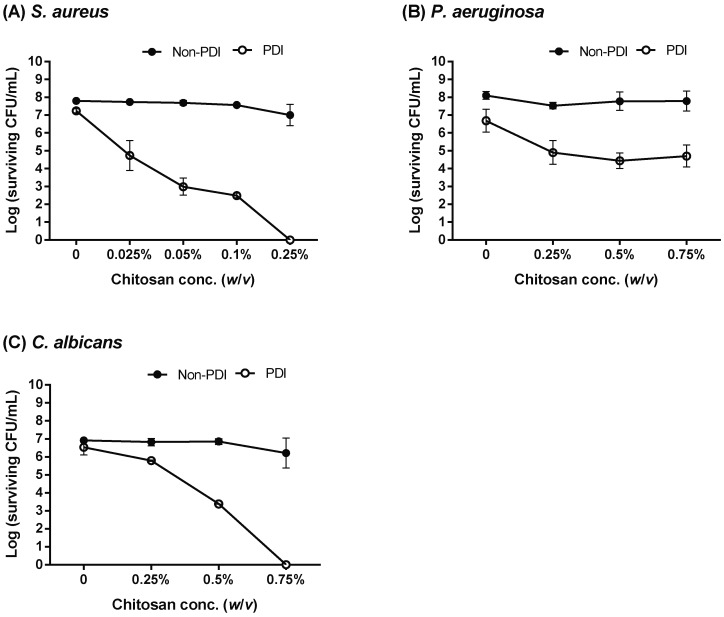
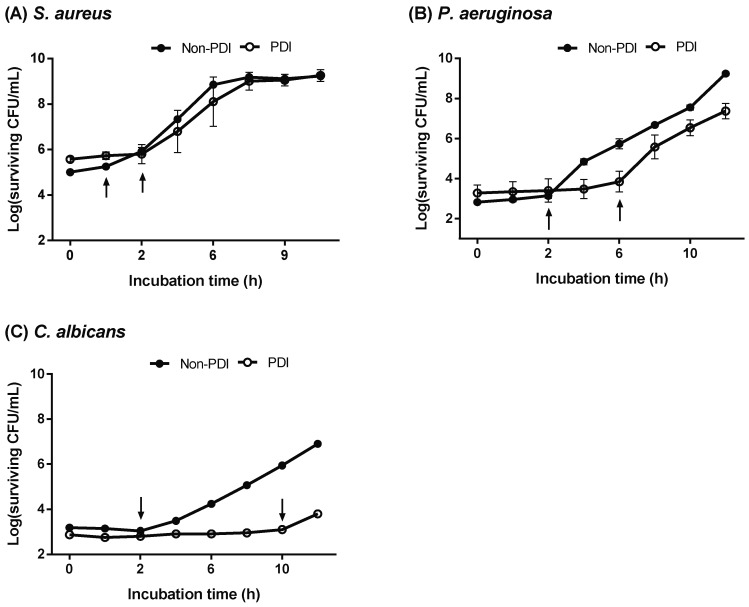
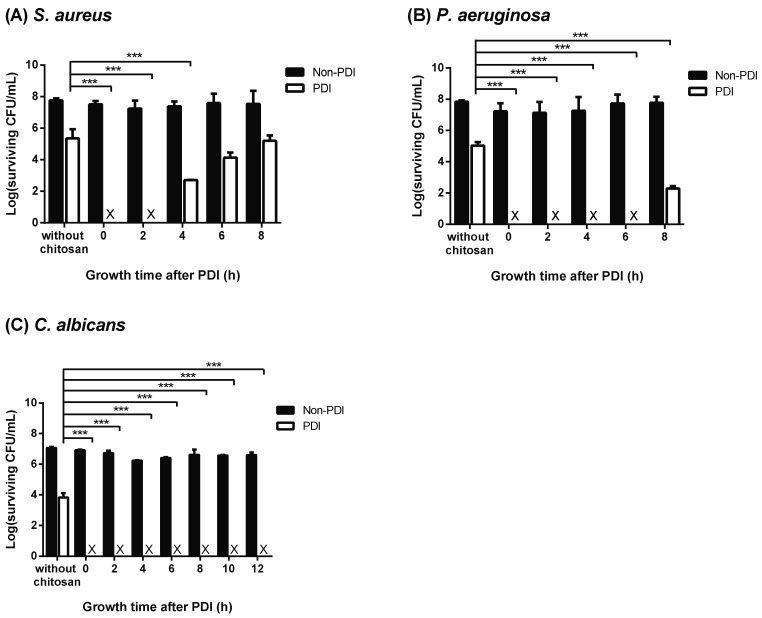
Photodynamic inactivation (PDI) combines the nontoxic photosensitizer (PS) and visible light to generate reactive oxygen species (ROS), which can cause oxidative damages in (on) microbial organisms. Previously, we have shown that chitosan can augment the bactericidal efficacy mediated by PDI against bacteria and Candida. In this study, we showed that the antimicrobial action of chitosan to augment PDI relates to the enlargement of cell surface destruction. The microbial cell surfaces exhibit severe irregular shapes after PDI in the presence of chitosan. Furthermore, increase in the concentrations or incubation time of chitosan significantly reduce the amounts of photosensitizers TBO required, indicating that chitosan could be a synergistic agent with PDI against human pathogens. A prolonged lag phase was found in PDI surviving microbial cells, in which chitosan can act to synergistically eradicate the cells. Once the impaired cells rebuild their cellular functions from PDI-induced damage, the increased cytotoxic effect of chitosan disappeared. Together, our results suggest that chitosan with an augmented bactericidal activity after PDI is to inhibit the rehabilitation of PDI surviving cells, leading to microbial death.
Overview
The claims and statistics of this paper haven’t been checked yet.
Free: it reads the open-access text and checks the first 5 claims that cite a source we can check. Create a free account to check every claim.
Integrity signals
Registry
Cites
Statistics
Figures
Verification
Claims the paper makes
The claims and statistics of this paper haven’t been checked yet.
Free: it reads the open-access text and checks the first 5 claims that cite a source we can check. Create a free account to check every claim.
Claims other papers make about this one
Each is checked against this paper’s own text: does it say what the citing paper says it does?
The cited source says what the claim attributes to it.
In the citing paper
“Indeed, the antifungal activity mediated by chitosan is enhanced after photodynamic inactivation (PDI) treatment (Lin et al., 2018).”
From A Potential Antifungal Effect of Chitosan Against Candida albicans Is Mediated via the Inhibition of SAGA Complex Component Expression and the Subsequent Alteration of Cell Surface Integrity (2019) · cites this paper as Lin et al., 2018
Self-check
Percentages, sums and reported differences re-computed from the paper’s own numbers.
The self-check needs the paper’s full text.
Citations
Cites
International Journal of Molecular Sciences
(2024) · International Journal of Molecular Sciences · doi:10.3390/ijms · Cited by 10,111
Photodynamic therapy for cancer
Dolmans, D. E. J. G. J., Fukumura, D., & Jain, R. K. (2003) · Nature Reviews Cancer · doi:10.1038/nrc1071 · Cited by 6,758 · cited 1×
“Photodynamic therapy (PDT) is an approved therapeutic modality for the treatment of cancers and noncancerous diseases[8, 9].”
BackgroundEpidemiology of Invasive Candidiasis: a Persistent Public Health Problem
Pfaller, M. A., & Diekema, D. J. (2007) · Clinical Microbiology Reviews · doi:10.1128/cmr.00029-06 · Cited by 4,174 · cited 1×
“Indeed, many antibiotic and antifungal agent-resistant pathogens have been found that lead to critical issues in public health, such as methicillin-resistant Staphylococcus aureus (MRSA) [4], multidrug-resistant Pseudomonas aeruginosa [3,5,6], and pathogenic fungi [3,5,6].”
BackgroundChitosan as antimicrobial agent: applications and mode of action.
Rabea, E. I., Badawy, M. E.-T., Stevens, C. V., Smagghe, G., & Steurbaut, W. (2003) · Biomacromolecules · doi:10.1021/bm034130m · Cited by 3,123
Antimicrobial properties of chitosan and mode of action: a state of the art review
Kong, M., Chen, X. G., Xing, K., & Park, H. J. (2010) · International Journal of Food Microbiology · doi:10.1016/j.ijfoodmicro.2010.09.012 · Cited by 3,037 · cited 2×
“Although the antimicrobial properties of chitosan hav been documented in several reviews, the mechanism of chitosan in antimicrobial ac ivity has not yet been fully elucidated [31,35].”
BackgroundChitin and Chitosan Preparation from Marine Sources. Structure, Properties and Applications
Younes, I., & Rinaudo, M. (2015) · Marine Drugs · doi:10.3390/md13031133 · Cited by 2,562 · cited 1×
“Chitosan [poly-(β-1/4)-2-amino-2-deoxy-D-glucopyranose] is a linear polysaccharide, which can be obtained by chitin deacetylation mediated by enzymatic hydrolysis of chitin deacetylase or NaOH alkaline conditions [22-24].”
BackgroundAntimicrobial agents and chemotherapy—1969
Parker, R. H. (1971) · Journal of Chronic Diseases · doi:10.1016/0021-9681(71)90113-5 · Cited by 2,504
Cabello, F. C. (2006) · Environmental Microbiology · doi:10.1111/j.1462-2920.2006.01054.x · Cited by 2,329 · cited 1×
“Due to the emergence of resistance among human pathogens, conventional antimicrobial therapies have become less effective [1-3].”
BackgroundInternational Journal of Food Microbiology
(2015) · Food Microbiology · doi:10.1016/s0740-0020(14)00320-7 · Cited by 2,038
Chitin and chitosan in selected biomedical applications
Anitha, A., Sowmya, S., Kumar, P. T. S., Deepthi, S., Chennazhi, K. P., Ehrlich, H., Tsurkan, M., & Jayakumar, R. (2014) · Progress in Polymer Science · doi:10.1016/j.progpolymsci.2014.02.008 · Cited by 931 · cited 1×
“Due to its biodegradability, biocompatibility and nontoxicity properties, chitosan displays its various important pharmacological applications in biomedical uses, dietary supplement food, agriculture, cosmetics industries and drug delivery[24-27].”
Background
Cited by
Copper sulfide with morphology-dependent photodynamic and photothermal antibacterial activities
Mutalik, C., Okoro, G., Krisnawati, D. I., Jazidie, A., Rahmawati, E. Q., Rahayu, D., Hsu, W.-T., & Kuo, T.-R. (2022) · Journal of Colloid and Interface Science · doi:10.1016/j.jcis.2021.10.019 · Cited by 189
Shih, P.-Y., Liao, Y.-T., Tseng, Y.-K., Deng, F.-S., & Lin, C.-H. (2019) · Frontiers in Microbiology · doi:10.3389/fmicb.2019.00602 · Cited by 156
“Growth curves were measured with a Biowave density meter as previously described (Deng and Lin, 2018).”
MethodMaldonado-Carmona, N., Ouk, T., Calvete, M. J. F., Pereira, M. M., Villandier, N., & Leroy‐Lhez, S. (2020) · Photochemical & Photobiological Sciences · doi:10.1039/c9pp00398c · Cited by 99
Zhang, R., Li, Y., Zhou, M., Wang, C., Feng, P., Miao, W., & Huang, H. (2019) · ACS Applied Materials & Interfaces · doi:10.1021/acsami.9b09020 · Cited by 93
Lo, W.-H., Deng, F.-S., Chang, C., & Lin, C. (2020) · Molecules · doi:10.3390/molecules25215114 · Cited by 98
Wiench, R., Skaba, D. R., Matys, J., & Grzech‐Leśniak, K. (2021) · Antibiotics · doi:10.3390/antibiotics10040349 · Cited by 71
“Two of them were mixed with a photosensitizer: gold nanoparticles [61] and killer decapeptide [63], and chitosan was added after aPDT [66,67].”
BackgroundMethodInfluentialNew Applications of Photodynamic Therapy in the Management of Candidiasis
Rodríguez-Cerdeira, C., Martínez-Herrera, E., Fabbrocini, G., Sanchez-Blanco, B., López-Barcenas, A., EL-Samahy, M., Juárez-Durán, E. R., & González-Cespón, J. L. (2021) · Journal of Fungi · doi:10.3390/jof7121025 · Cited by 48
Efficacy of Curcumin-Mediated Antimicrobial Photodynamic Therapy on Candida spp.—A Systematic Review
Kubizna, M., Dawiec, G., & Wiench, R. (2024) · International Journal of Molecular Sciences · doi:10.3390/ijms25158136 · Cited by 36
“…size of yeast cells (approximately 25–50 times larger than bacteria) and the more complex cell structure (thick cell wall and the presence of a cell nucleus separated from the cytoplasm by a nuclear membrane), a higher concentration of curcumin is required than for the elimination of bacteria [59].”
BackgroundLuo, H., Xu, H., Zhang, H., Li, X., Wu, Q., & Gao, T. (2024) · Carbohydrate Polymers · doi:10.1016/j.carbpol.2024.123147 · Cited by 21
Wiench, R., Nowicka, J., Pajączkowska, M., Kuropka, P., Skaba, D. R., Kruczek-Kazibudzka, A., Kuśka-Kiełbratowska, A., & Grzech‐Leśniak, K. (2021) · International Journal of Molecular Sciences · doi:10.3390/ijms222010971 · Cited by 24
Dadi, N. C. T., Dohál, M., Medvecká, V., Bujdák, J., Koči, K., Zahoranová, A., & Bujdáková, H. (2021) · Molecules · doi:10.3390/molecules26020325 · Cited by 16
Lin, C.-N., Ding, S., & Chen, C. (2021) · Pharmaceuticals · doi:10.3390/ph14040346 · Cited by 12
“It has been reported that due to the interaction between the cationic chain of chitosan and the negatively charged residues on the bacterial surface, the broad antibacterial spectrum of chitosan is effective against Gram-positive and Gram-negative bacteria and fungi [36,37].”
BackgroundPhotodynamic Therapy by Diaryl-Porphyrins to Control the Growth of Candida albicans
Orlandi, V. T., Martegani, E., Bolognese, F., Trivellin, N., Maťátková, O., Paldrychová, M., Baj, A., & Caruso, E. (2020) · Cosmetics · doi:10.3390/cosmetics7020031 · Cited by 11
“Sublethal aPDT causes temporary cell growth arrest and a prolonged lag phase (fungistatic effect) [20], damage to mitochondria [19,21], increased susceptibility to drugs, compromised cell wall functions (permeability), and an ability to form hyphae [14,22].”
BackgroundIsmiyatin, K., Mudjiono, M., Kunarti, S., Santoso, M. L., Hakiki, D., & Irsya, W. (2021) · Research Journal of Pharmacy and Technology · doi:10.52711/0974-360x.2021.00671 · Cited by 7
Fontgalland-Ferreira, G., Figueiredo, S. M., Matos, K., Roncolato, V. L., Kassa, C. T., Pigozzi-Portugal, M. V., Kato, I. T., & Prates, R. A. (2026) · Lasers in Medical Science · doi:10.1007/s10103-026-05001-4
Metadata
- Authors
- Lin, C.-H., Chien, H.-F., Lin, M.-H., Chen, C.-P., Shen, M., & Chen, C.-T.
- Affiliations
- National Taiwan University (TW)
- Taipei Medical University Hospital (TW)
- Corresponding author
- Chen, Chin-Tin
- Venue
- International Journal of Molecular Sciences
- Publisher
- MDPI AG
- Published
- 2018-09-01
- Volume
- 19
- Issue
- 9
- Pages
- 2598
- ISSN
- 1422-0067 (ISSN-L)
- PMC
- PMC6164787
- OpenAlex
- W2807591421
- Cited by
- 16
- References
- 47
- Citations by year
- 2026: 1 · 2024: 2 · 2021: 7 · 2020: 3 · 2019: 2 · 2018: 1
- FWCI
- 2.45
- Type
- journal article
- Language
- en
- Open access
- gold
- dx.doi.org
- Licence
- Locations
- International Journal of Molecular Sciences (publishedVersion, cc-by)
- Preprints.org (acceptedVersion, cc-by)
- Europe PMC (PubMed Central) (publishedVersion, other-oa)
- PubMed Central (publishedVersion, cc-by)
- PubMed (publishedVersion)
- DOAJ (DOAJ: Directory of Open Access Journals) (submittedVersion, cc-by-sa)
- Funders
- Ministry of Science and Technology, Taiwan (MOST105-2628-B002-018-MY3, MOST103-2320-B038-009, MOST-103)
- National Taiwan University
- Topics
- Life Sciences › Biochemistry, Genetics and Molecular Biology › Cancer Research › Photodynamic Therapy Research Studies
- Life Sciences › Immunology and Microbiology › Applied Microbiology and Biotechnology › Antimicrobial agents and applications
- Life Sciences › Biochemistry, Genetics and Molecular Biology › Molecular Biology › Bacterial biofilms and quorum sensing
- Keywords
- chitosan, photodynamic inactivation, antimicrobial photodynamic therapy, photosensitizers, toluidine blue, Staphylococcus aureus, Pseudomonas aeruginosa, Candida albicans, biocidal efficacy, antimicrobial agents
- MeSH terms
- Anti-Infective Agents, Candida albicans, Cell Survival, Cell Wall, Dose-Response Relationship, Drug, Pseudomonas aeruginosa, Staphylococcus aureus, Time Factors, Tolonium Chloride, Colony Count, Microbial, Photosensitizing Agents, Biofilms, Chitosan
About these checks
Registry, retraction, Cites and statistics results are computed, not judged, with one exception: a printed reference that no index lists is read once by a model before it counts as a citation error. Claims are extracted by a model and kept only when their quote appears verbatim in the text; each cited source is then checked, with a model’s help, for whether it says what the claim relies on. Those verdicts can be wrong — read the claim’s quote and the cited source before relying on one.
Statistics and arithmetic are recomputed, not judged.
Confidence bands are shown only for fields calibrated on our annotated test set. None is calibrated yet, so no band is shown.
What counts as a claim ›How we measure confidence ›How we check this ›
Are you an author, or do you see a problem with this page? Request a review
Data sources
Bibliographic data: Semantic Scholar, OpenAlex, Crossref.
Contains information from the Semantic Scholar Academic Graph Datasets, made available under the ODC Attribution License (ODC-BY 1.0).
Semantic Scholar’s data is described in: Kinney, R., et al. (2023). The Semantic Scholar Open Data Platform. arXiv:2301.10140.
