

The DOI matches its Crossref record; 123 of the 123 references it cites were found in a registry or an index.
Danger-Associated Molecular Patterns (DAMPs): Molecular Triggers for Sterile Inflammation in the Liver
Open accessAbstract
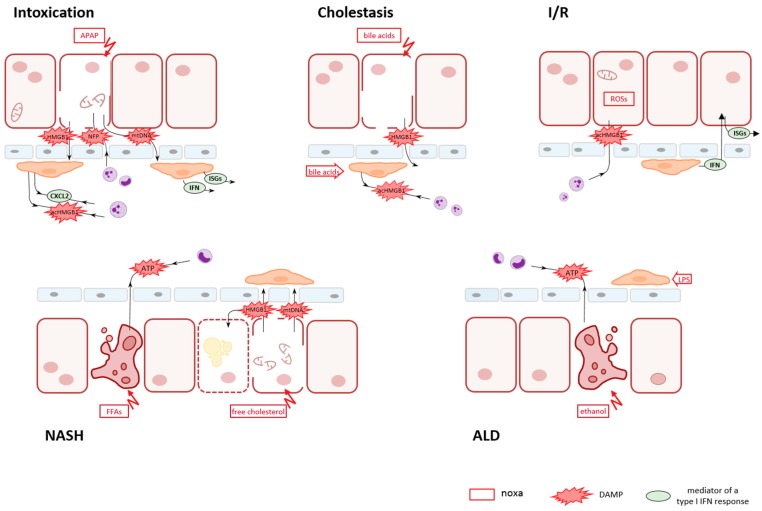
Inflammatory liver diseases in the absence of pathogens such as intoxication by xenobiotics, cholestatic liver injury, hepatic ischemia-reperfusion injury (I/R), non-alcoholic steatohepatitis (NASH), or alcoholic liver disease (ALD) remain threatening conditions demanding specific therapeutic options. Caused by various different noxae, all these conditions have been recognized to be triggered by danger- or death-associated molecular patterns (DAMPs), discompartmentalized self-structures released by dying cells. These endogenous, ectopic molecules comprise proteins, nucleic acids, adenosine triphosphate (ATP), or mitochondrial compounds, among others. This review resumes the respective modes of their release—passively by necrotic hepatocytes or actively by viable or apoptotic parenchymal cells—and their particular roles in sterile liver pathology. It addresses their sensors and the initial inflammatory responses they provoke. It further addresses a resulting second wave of parenchymal death that might be of different mode, boosting the release of additional, second-line DAMPs. Thus, triggering a more complex and pronounced response. Initial and secondary inflammatory responses comprise the activation of Kupffer cells (KCs), the attraction and activation of monocytes and neutrophil granulocytes, and the induction of type I interferons (IFNs) and their effectors. A thorough understanding of pathophysiology is a prerequisite for identifying rational therapeutic targets.
Overview
The claims and statistics of this paper haven’t been checked yet.
Run the check — free, no account needed. It reads the open-access text and checks the sources it cites.
Integrity signals
Registry
Cites
Statistics
Figures
Verification
Claims the paper makes
The claims and statistics of this paper haven’t been checked yet.
Run the check — free, no account needed. It reads the open-access text and checks the sources it cites.
Claims other papers make about this one
Each is checked against this paper’s own text: does it say what the citing paper says it does?
The source backs part of the claim, not all of it — or backs it for a different population, condition or comparison.
In the citing paper
“Damage-associated molecular patterns (DAMPs), like high-mobility group box 1 (HMGB1) or fragmented DNA, are released from hepatocytes. Endogenous danger stimuli bind to Toll-like receptor 4(TRL4) with the MyD88 adaptor protein in Kupffer cells. TLR4/MyD88, prompts the protein NF-κB to lead to the generation of pro-inflammatory and pro-fibrotic mediators associated with the disease—such as TGF-β1”
From From signaling pathways to clinical trials: mesenchymal stem cells as multimodal regenerative architects in liver cirrhosis therapy (2025) · cites this paper as [33]
Experimental — accuracy not yet measuredThe check wasn’t confident either way, so it gives no verdict — never disputed.
In the citing paper
“Pro-inflammatory cytokines TNF-α and IL-1β (secreted by M1 macrophages) activate NF-κB within HSCs, inducing pro-fibrotic gene expression and inhibiting HSC apoptosis.”
From From signaling pathways to clinical trials: mesenchymal stem cells as multimodal regenerative architects in liver cirrhosis therapy (2025) · cites this paper as [33]
Experimental — accuracy not yet measuredThe check wasn’t confident either way, so it gives no verdict — never disputed.
In the citing paper
“TGF-β1 (released by Kupffer cells, platelets, and injured hepatocytes) binds to TβRII receptors on HSCs, leading to phosphorylation of Smad2/3. The phospho-Smad2/3-Smad4 complex translocates to the nucleus, activating genes encoding α-smooth muscle actin (α-SMA), collagen I and III, and tissue inhibitor of metalloproteinase-1 (TIMP-1) while suppressing matrix metalloproteinases (MMPs).”
From From signaling pathways to clinical trials: mesenchymal stem cells as multimodal regenerative architects in liver cirrhosis therapy (2025) · cites this paper as [33]
Experimental — accuracy not yet measuredThe check wasn’t confident either way, so it gives no verdict — never disputed.
In the citing paper
“Chemokines such as CCL2 and CXCL8 recruit monocytes, perpetuating the inflammatory response and fibrosis [33, 34].”
From From signaling pathways to clinical trials: mesenchymal stem cells as multimodal regenerative architects in liver cirrhosis therapy (2025) · cites this paper as [33]
Experimental — accuracy not yet measured
Self-check
Percentages, sums and reported differences re-computed from the paper’s own numbers.
The self-check needs the paper’s full text.
Citations
Cites
1 retracted
Antoine, D. J., Jenkins, R. E., Dear, J. W., Williams, D. P., McGill, M. R., Sharpe, M. R., Craig, D. G. N., Simpson, K. J., Jaeschke, H., & Park, B. K. (2012) · Journal of Hepatology · doi:10.1016/j.jhep.2011.12.019 · Cited by 307
RetractedYounossi, Z. M., Koenig, A. B., Abdelatif, D., Fazel, Y., Henry, L., & Wymer, M. (2016) · Hepatology · doi:10.1002/hep.28431 · Cited by 10,781
Mizgerd, J. P., Kubo, H., Kutkoski, G. J., Bhagwan, S. D., Scharffetter-Kochanek, K., Beaudet, A. L., & Doerschuk, C. M. (1997) · The Journal of Experimental Medicine · doi:10.1084/jem.186.8.1357 · Cited by 7,332
Changes of Intestinal Functions in Liver Cirrhosis
Fukui, H., & Wiest, R. (2016) · Inflammatory Intestinal Diseases · doi:10.1159/000444436 · Cited by 6,820
Tolerance, Danger, and the Extended Family
Matzinger, P. (1994) · Annual Review of Immunology · doi:10.1146/annurev.iy.12.040194.005015 · Cited by 4,848
Release of chromatin protein HMGB1 by necrotic cells triggers inflammation
Scaffidi, P., Misteli, T., & Bianchi, M. E. (2002) · Nature · doi:10.1038/nature00858 · Cited by 4,221
The Danger Model: A Renewed Sense of Self
Matzinger, P. (2002) · Science · doi:10.1126/science.1071059 · Cited by 4,205
Interferon-stimulated genes: A complex web of host defenses
Schneider, W. M., Chevillotte, M. D., & Rice, C. M. (2014) · Annual Review of Immunology · doi:10.1146/annurev-immunol-032713-120231 · Cited by 3,067
Nakahira, K., Haspel, J. A., Rathinam, V. A. K., Lee, S.-J., Dolinay, T., Lam, H. C., Englert, J. A., Rabinovitch, M., Cernadas, M., Kim, H. P., et al. (2011) · Nature Immunology · doi:10.1038/ni.1980 · Cited by 3,049
High-mobility group box 1 protein (HMGB1): nuclear weapon in the immune arsenal
Lotze, M. T., & Tracey, K. J. (2005) · Nature reviews. Immunology · doi:10.1038/nri1594 · Cited by 2,490
Cited by
Sorted by citations
Items 201–234 of 234
Faculty Opinions recommendation of Hepatic macrophages in liver injury.
Lee, W. M. (2020) · Faculty Opinions – Post-Publication Peer Review of the Biomedical Literature · doi:10.3410/f.737892596.793574748
Cells, cytokines, and factors involved in profibrogenic pathways
Muriel, P. (2022) · Elsevier eBooks · doi:10.1016/b978-0-323-99764-5.00014-7
Fundamental science and medicine at the crossroads of life concept
Кимович, Б. А. (2022) · Obstetrics Gynecology and Reproduction · doi:10.17749/2313-7347/ob.gyn.rep.2022.325
States of Ill Health: The Ground of Clinical Presentations
Smith, F. (2022) · Springer eBooks · doi:10.1007/978-3-031-13388-6_7
Kousar, A., Damani, S., Anvekar, P., Rajotia, A., Gopalakrishnan, K., Baraskar, B., Modi, V. K., Aedma, K., Agarwal, J., Voruganti, H. V., et al. (2022) · IEEE International Conference on Bioinformatics and Biomedicine (BIBM) · doi:10.1109/bibm55620.2022.9995460
Mohammed, S., Thadathil, N., Ohene-Marfo, P., Tran, A. L., Veldt, M. V. D., Georgescu, C., Oh, S., Nicklas, E. H., Wang, D., Haritha, N. H., et al. (2023) · doi:10.1158/1541-7786.c.6695932
Mohammed, S., Thadathil, N., Ohene-Marfo, P., Tran, A. L., Veldt, M. V. D., Georgescu, C., Oh, S., Nicklas, E. H., Wang, D., Haritha, N. H., et al. (2023) · doi:10.1158/1541-7786.c.6695932.v2
Кимович, Б. А. (2023) · EXPERIMENTAL & CLINICAL MEDICINE GEORGIA · doi:10.52340/jecm.2023.05.39
Haidai, O. S., Dzevulska, І. V., Samborska, I., & Shvager, O. V. (2025) · Reports of Morphology · doi:10.31393/morphology-journal-2025-31(3)-08
Perumalsamy, H., Park, S., Kim, J. E., Xiao, X., Kim, H. Y., Jun, D. W., & Yoon, T. H. (2025) · MedComm · doi:10.1002/mco2.70448
Moon, S., Hong, J., Lee, D. H., Kim, H. S., Nam, K. N., Jeon, Y. D., & Kim, W. (2025) · British Journal of Clinical Pharmacology · doi:10.1002/bcp.70368
Interplay Between ROS and Inflammation in Alcoholic Fatty Liver Disease
Thakur, V., Mishra, S., Kumar, V., Sharma, A., Sharma, S., & Sharma, C. (2026) · Springer eBooks · doi:10.1007/978-3-032-11752-6_6
Slippery dopamine–fluoropolymer hybrid surface for improving biliary stent longevity
Kim, T. Y., Lee, W.-J., Lee, Y., Kim, S. J., Min, S., Chung, S., Kim, S. A., Yook, K.-Y., Moon, C.-H., Lee, Y., et al. (2026) · Bioactive Materials · doi:10.1016/j.bioactmat.2026.02.003
Felli, É. (2020) · theses.fr (ABES) · doi:10.70675/53f9f7aezc424z40ffz9ccbz688ca114cc92
Rôle des cellules de Kupffer dans la physiopathologie des hépatites aiguës
Chabat-Courrède, C. (2024) · theses.fr (ABES) · doi:10.70675/68752933z5f36z44e9z866az70f7363a7e98
Prudêncio, R. D. S., de Sousa, A. K., da Costa, A. C. C., Holanda, D. M. L., Rodrigues, V. O., Oliveira, A. S. D. S., Santos, G. D. C., Muniz, L. D. C., Magalhães, D. D. A., Sousa, J. J. D. S., et al. (2026) · Medical Hypotheses · doi:10.1016/j.mehy.2026.112011
Wen, X., Xue, T.-Y., Yang, Y.-H., Mai, Y.-P., Wang, Q.-S., Wang, X.-X., Chen, D.-B., Chen, H., & Wang, Z.-X. (2026) · World Journal of Hepatology · doi:10.4254/wjh.119664
Zou, X., Zhang, T., Wang, N., Li, Y., Jiang, X., & zhong, X. (2026) · Biomolecules · doi:10.3390/biom16070941
Exercise-Induced Hepatic Mitochondrial Reprogramming Across Muscle–Gut–Thyroid Axes in MASLD/MASH
McCaffrey, J. M., & Ibdah, J. A. (2026) · International Journal of Molecular Sciences · doi:10.3390/ijms27146112
Zhang, J., Lu, S., Huang, R., Ge, W., Liu, S., Wang, M., & Chen, Z. (2026) · Food Reviews International · doi:10.1080/87559129.2026.2711909
Adaptive Immunity in Marsupials
Jol, C. L., Stannard, H. J., & Old, J. M. (2026) · Journal of Experimental Zoology Part A Ecological and Integrative Physiology · doi:10.1002/jez.70123
Li, J., Zeng, W., & Yang, J. (2026) · Frontiers in Molecular Biosciences · doi:10.3389/fmolb.2026.1901963
Acute-on-chronic liver failure: A comprehensive review
Karur, A. K., GURURAMALINGAM, G., Kaur, K., Alamgir, M., Singh, C. M., & Sohal, A. (2026) · World Journal of Critical Care Medicine · doi:10.5492/wjccm.124862
Liu, Q., Wang, J., Zong, H., Ma, H., Li, M., Wang, M., Wu, D., Zheng, S., Wang, H., & Long, Q. (2026) · Cells · doi:10.3390/cells15171562
Tabatabaei, A., Tabatabaei, N., Mehrzad, B., Achterberg, M., & Mehrzad, J. (2026) · Toxicology in Vitro · doi:10.1016/j.tiv.2026.106305
Liu, D., Li, Q., Che, F., Wang, Q., Zhang, T., Ren, W., Deng, L., Song, B., Wei, Y., Tang, H., et al. (2026) · Cancers · doi:10.3390/cancers18182978
Liang, H., Lu, J., Pan, H., Tian, H., Chen, Y., Zhang, W., Liu, S., Wang, Z., Hou, W., & Shen, Z. (2026) · International Immunopharmacology · doi:10.1016/j.intimp.2026.117442
Zhang, Y., Zhu, J., 崔力凡, Chen, S., Li, X., Gao, L., Chen, X., Wen, K., Zeng, B., & Qian, Y. (2026) · Biogerontology · doi:10.1007/s10522-026-10515-z
Xie, S., Yan, W., Wu, Y., Zhou, C., Ming, Y., Ye, Q., Niu, Y., & Zhang, P. (2026) · Research Square · doi:10.21203/rs.3.rs-11087849/v1
Anand, G. S., & Lahariya, R. (2026) · Wiener Medizinische Wochenschrift · doi:10.1007/s10354-026-01198-9
Yao, X., Zhang, R., Wang, Y., & Xiang, Y. (2026) · Frontiers in Immunology · doi:10.3389/fimmu.2026.1988758
Disrupted Resolution Mechanisms in the Onset and Progression of Chronic Liver Disease
Clãria, J., Romero-Grimaldo, B., Contreras, B. J., Sánchez-Rodríguez, M. B., Rojano, C., Titos, E., & López‐Vicario, C. (2026) · Current topics in microbiology and immunology · doi:10.1007/82_2026_365
Metadata
- Authors
- Mihm, S.
- Affiliations
- Universitätsmedizin Göttingen (DE)
- Corresponding author
- Mihm, Sabine
- ORCID
- Mihm, Sabine
- Venue
- International Journal of Molecular Sciences
- Publisher
- MDPI AG
- Published
- 2018-10-10
- Volume
- 19
- Issue
- 10
- Pages
- 3104
- ISSN
- 1422-0067 (ISSN-L)
- PMC
- PMC6213769
- OpenAlex
- W2896394478
- Cited by
- 232
- References
- 123
- Citations by year
- 2026: 27 · 2025: 30 · 2024: 32 · 2023: 35 · 2022: 34 · 2021: 25 · 2020: 32 · 2019: 16 · 2018: 1
- FWCI
- 1.87
- Type
- journal article
- Language
- en
- Open access
- gold
- dx.doi.org
- Licence
- Locations
- International Journal of Molecular Sciences (publishedVersion, cc-by)
- Europe PMC (PubMed Central) (publishedVersion, other-oa)
- PubMed Central (publishedVersion, cc-by)
- PubMed (publishedVersion)
- DOAJ (DOAJ: Directory of Open Access Journals) (submittedVersion, cc-by-sa)
- GoeScholar The Publication Server of the Georg-August-Universität Göttingen (Georg-August-Universität Göttingen) (submittedVersion, cc-by)
- Topics
- Life Sciences › Immunology and Microbiology › Immunology › Immune Response and Inflammation
- Life Sciences › Biochemistry, Genetics and Molecular Biology › Molecular Biology › Cell death mechanisms and regulation
- Life Sciences › Biochemistry, Genetics and Molecular Biology › Molecular Biology › Inflammasome and immune disorders
- Keywords
- damage-associated molecular patterns, sterile inflammation, liver inflammation, liver necrosis, apoptosis, Kupffer cells, monocytes, neutrophils, type I interferon, nonalcoholic steatohepatitis, alcoholic liver disease, cholestatic liver injury, hepatic ischemia-reperfusion injury, innate immune recognition
- MeSH terms
- Alarmins, Pathogen-Associated Molecular Pattern Molecules, Adenosine Triphosphate, Animals, Hepatitis, Humans, Keratins, Mitochondria, Liver, Biomarkers, HMGB1 Protein
About these checks
Registry, retraction, Cites and statistics results are computed, not judged, with one exception: a printed reference that no index lists is read once by a model before it counts as a citation error. Claims are extracted by a model and kept only when their quote appears verbatim in the text; each cited source is then checked, with a model’s help, for whether it says what the claim relies on. Those verdicts can be wrong — read the claim’s quote and the cited source before relying on one.
Statistics and arithmetic are recomputed, not judged.
Confidence bands are shown only for fields calibrated on our annotated test set. None is calibrated yet, so no band is shown.
What counts as a claim ›How we measure confidence ›How we check this ›
Are you an author, or do you see a problem with this page? Request a review
