

The DOI matches its Crossref record; 123 of the 123 references it cites were found in a registry or an index.
Danger-Associated Molecular Patterns (DAMPs): Molecular Triggers for Sterile Inflammation in the Liver
Open accessAbstract
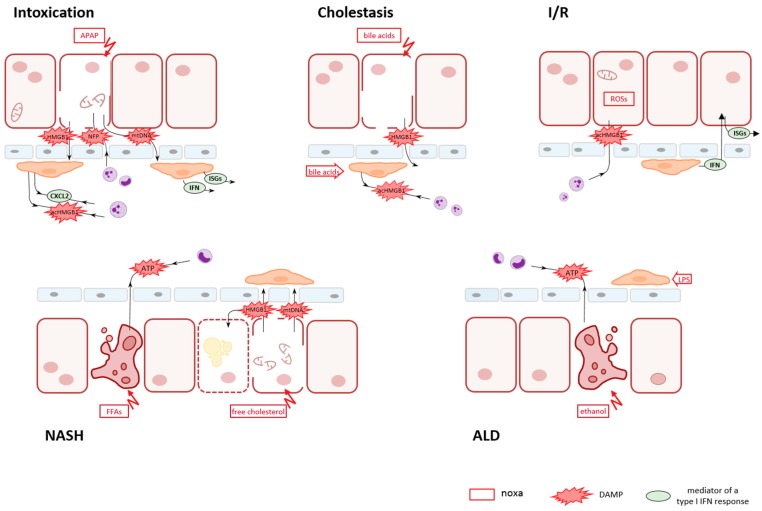
Inflammatory liver diseases in the absence of pathogens such as intoxication by xenobiotics, cholestatic liver injury, hepatic ischemia-reperfusion injury (I/R), non-alcoholic steatohepatitis (NASH), or alcoholic liver disease (ALD) remain threatening conditions demanding specific therapeutic options. Caused by various different noxae, all these conditions have been recognized to be triggered by danger- or death-associated molecular patterns (DAMPs), discompartmentalized self-structures released by dying cells. These endogenous, ectopic molecules comprise proteins, nucleic acids, adenosine triphosphate (ATP), or mitochondrial compounds, among others. This review resumes the respective modes of their release—passively by necrotic hepatocytes or actively by viable or apoptotic parenchymal cells—and their particular roles in sterile liver pathology. It addresses their sensors and the initial inflammatory responses they provoke. It further addresses a resulting second wave of parenchymal death that might be of different mode, boosting the release of additional, second-line DAMPs. Thus, triggering a more complex and pronounced response. Initial and secondary inflammatory responses comprise the activation of Kupffer cells (KCs), the attraction and activation of monocytes and neutrophil granulocytes, and the induction of type I interferons (IFNs) and their effectors. A thorough understanding of pathophysiology is a prerequisite for identifying rational therapeutic targets.
Overview
The claims and statistics of this paper haven’t been checked yet.
Run the check — free, no account needed. It reads the open-access text and checks the sources it cites.
Integrity signals
Registry
Cites
Statistics
Figures
Verification
Claims the paper makes
The claims and statistics of this paper haven’t been checked yet.
Run the check — free, no account needed. It reads the open-access text and checks the sources it cites.
Claims other papers make about this one
Each is checked against this paper’s own text: does it say what the citing paper says it does?
The source backs part of the claim, not all of it — or backs it for a different population, condition or comparison.
In the citing paper
“Damage-associated molecular patterns (DAMPs), like high-mobility group box 1 (HMGB1) or fragmented DNA, are released from hepatocytes. Endogenous danger stimuli bind to Toll-like receptor 4(TRL4) with the MyD88 adaptor protein in Kupffer cells. TLR4/MyD88, prompts the protein NF-κB to lead to the generation of pro-inflammatory and pro-fibrotic mediators associated with the disease—such as TGF-β1”
From From signaling pathways to clinical trials: mesenchymal stem cells as multimodal regenerative architects in liver cirrhosis therapy (2025) · cites this paper as [33]
Experimental — accuracy not yet measuredThe check wasn’t confident either way, so it gives no verdict — never disputed.
In the citing paper
“Pro-inflammatory cytokines TNF-α and IL-1β (secreted by M1 macrophages) activate NF-κB within HSCs, inducing pro-fibrotic gene expression and inhibiting HSC apoptosis.”
From From signaling pathways to clinical trials: mesenchymal stem cells as multimodal regenerative architects in liver cirrhosis therapy (2025) · cites this paper as [33]
Experimental — accuracy not yet measuredThe check wasn’t confident either way, so it gives no verdict — never disputed.
In the citing paper
“TGF-β1 (released by Kupffer cells, platelets, and injured hepatocytes) binds to TβRII receptors on HSCs, leading to phosphorylation of Smad2/3. The phospho-Smad2/3-Smad4 complex translocates to the nucleus, activating genes encoding α-smooth muscle actin (α-SMA), collagen I and III, and tissue inhibitor of metalloproteinase-1 (TIMP-1) while suppressing matrix metalloproteinases (MMPs).”
From From signaling pathways to clinical trials: mesenchymal stem cells as multimodal regenerative architects in liver cirrhosis therapy (2025) · cites this paper as [33]
Experimental — accuracy not yet measuredThe check wasn’t confident either way, so it gives no verdict — never disputed.
In the citing paper
“Chemokines such as CCL2 and CXCL8 recruit monocytes, perpetuating the inflammatory response and fibrosis [33, 34].”
From From signaling pathways to clinical trials: mesenchymal stem cells as multimodal regenerative architects in liver cirrhosis therapy (2025) · cites this paper as [33]
Experimental — accuracy not yet measured
Self-check
Percentages, sums and reported differences re-computed from the paper’s own numbers.
The self-check needs the paper’s full text.
Citations
Cites
1 retracted
Antoine, D. J., Jenkins, R. E., Dear, J. W., Williams, D. P., McGill, M. R., Sharpe, M. R., Craig, D. G. N., Simpson, K. J., Jaeschke, H., & Park, B. K. (2012) · Journal of Hepatology · doi:10.1016/j.jhep.2011.12.019 · Cited by 307
RetractedYounossi, Z. M., Koenig, A. B., Abdelatif, D., Fazel, Y., Henry, L., & Wymer, M. (2016) · Hepatology · doi:10.1002/hep.28431 · Cited by 10,781
Mizgerd, J. P., Kubo, H., Kutkoski, G. J., Bhagwan, S. D., Scharffetter-Kochanek, K., Beaudet, A. L., & Doerschuk, C. M. (1997) · The Journal of Experimental Medicine · doi:10.1084/jem.186.8.1357 · Cited by 7,332
Changes of Intestinal Functions in Liver Cirrhosis
Fukui, H., & Wiest, R. (2016) · Inflammatory Intestinal Diseases · doi:10.1159/000444436 · Cited by 6,820
Tolerance, Danger, and the Extended Family
Matzinger, P. (1994) · Annual Review of Immunology · doi:10.1146/annurev.iy.12.040194.005015 · Cited by 4,848
Release of chromatin protein HMGB1 by necrotic cells triggers inflammation
Scaffidi, P., Misteli, T., & Bianchi, M. E. (2002) · Nature · doi:10.1038/nature00858 · Cited by 4,221
The Danger Model: A Renewed Sense of Self
Matzinger, P. (2002) · Science · doi:10.1126/science.1071059 · Cited by 4,205
Interferon-stimulated genes: A complex web of host defenses
Schneider, W. M., Chevillotte, M. D., & Rice, C. M. (2014) · Annual Review of Immunology · doi:10.1146/annurev-immunol-032713-120231 · Cited by 3,067
Nakahira, K., Haspel, J. A., Rathinam, V. A. K., Lee, S.-J., Dolinay, T., Lam, H. C., Englert, J. A., Rabinovitch, M., Cernadas, M., Kim, H. P., et al. (2011) · Nature Immunology · doi:10.1038/ni.1980 · Cited by 3,049
High-mobility group box 1 protein (HMGB1): nuclear weapon in the immune arsenal
Lotze, M. T., & Tracey, K. J. (2005) · Nature reviews. Immunology · doi:10.1038/nri1594 · Cited by 2,490
Nonalcoholic Fatty Liver Disease
Rinella, M. E. (2015) · JAMA · doi:10.1001/jama.2015.5370 · Cited by 2,320
Ostapowicz, G., Fontana, R. J., Schiødt, F. V., Larson, A., Davern, T. J., Han, S. H. B., McCashland, T. M., Shakil, A. O., Hay, J. E., Hynan, L., et al. (2002) · Annals of Internal Medicine · doi:10.7326/0003-4819-137-12-200212170-00007 · Cited by 2,227
Gray, M. W., Burger, G., & Lang, B. F. (1999) · Science · doi:10.1126/science.283.5407.1476 · Cited by 1,765
Nucleotides released by apoptotic cells act as a find-me signal to promote phagocytic clearance
Elliott, M. R., Chekeni, F. B., Trampont, P. C., Lazarowski, E. R., Kadl, A., Walk, S. F., Park, D., Woodson, R. I., Ostankovich, M., Sharma, P., et al. (2009) · Nature · doi:10.1038/nature08296 · Cited by 1,654
The JAK-STAT Pathway at Twenty
Stark, G. R., & Darnell, J. E., Jr. (2012) · Immunity · doi:10.1016/j.immuni.2012.03.013 · Cited by 1,577
Tian, J., Avalos, A. M., Mao, S.-Y., Chen, B., Senthil, K., Wu, H., Parroche, P., Drabic, S., Golenbock, D., Sirois, C., et al. (2007) · Nature Immunology · doi:10.1038/ni1457 · Cited by 1,372
A lipidomic analysis of nonalcoholic fatty liver disease
Puri, P., Baillie, R. A., Wiest, M. M., Mirshahi, F., Choudhury, J., Cheung, O., Sargeant, C., Contos, M. J., & Sanyal, A. J. (2007) · Hepatology · doi:10.1002/hep.21763 · Cited by 1,338
Monocytic cells hyperacetylate chromatin protein HMGB1 to redirect it towards secretion
Bonaldi, T., Talamo, F., Scaffidi, P., Ferrera, D., Porto, A., Bachi, A., Rubartelli, A., Agresti, A., & Bianchi, M. E. (2003) · The EMBO Journal · doi:10.1093/emboj/cdg516 · Cited by 1,252
Intravascular Danger Signals Guide Neutrophils to Sites of Sterile Inflammation
McDonald, B., Pittman, K., Menezes, G. B., Hirota, S. A., Slaba, I., Waterhouse, C. C. M., Beck, P. L., Muruve, D. A., & Kubes, P. (2010) · Science · doi:10.1126/science.1195491 · Cited by 1,210
MOFRAD, P., Contos, M. J., Haque, M., Sargeant, C., Fisher, R. A., Luketic, V. A., Sterling, R. K., Shiffman, M. L., Stravitz, R. T., & Sanyal, A. J. (2003) · Hepatology · doi:10.1053/jhep.2003.50229 · Cited by 1,199
Pannexin 1 channels mediate ‘find-me’ signal release and membrane permeability during apoptosis
Chekeni, F. B., Elliott, M. R., Sandilos, J. K., Walk, S. F., Kinchen, J. M., Lazarowski, E. R., Armstrong, A. J., Penuela, S., Laird, D. W., Salvesen, G. S., et al. (2010) · Nature · doi:10.1038/nature09413 · Cited by 1,120
Mitochondrial DNA in innate immune responses and inflammatory pathology
West, A. P., & Shadel, G. S. (2017) · Nature Reviews Immunology · doi:10.1038/nri.2017.21 · Cited by 1,115
The nuclear factor HMGB1 mediates hepatic injury after murine liver ischemia-reperfusion
Tsung, A., Sahai, R., Tanaka, H., Nakao, A., Fink, M. P., Lotze, M. T., Yang, H., Li, J., Tracey, K. J., Geller, D. A., et al. (2005) · The Journal of Experimental Medicine · doi:10.1084/jem.20042614 · Cited by 1,113
Hepatocyte apoptosis and fas expression are prominent features of human nonalcoholic steatohepatitis
Feldstein, A. E., Canbay, A., Angulo, P., Taniai, M., Burgart, L. J., Lindor, K. D., & Gores, G. J. (2003) · Gastroenterology · doi:10.1016/s0016-5085(03)00907-7 · Cited by 1,085
Neuschwander‐Tetri, B. A. (2010) · Hepatology · doi:10.1002/hep.23719 · Cited by 1,077
Koliaki, C., Szendroedi, J., Kaul, K., Jelenik, T., Nowotny, P., Jankowiak, F., Herder, C., Carstensen, M., Krausch, M., Knoefel, W. T., et al. (2015) · Cell Metabolism · doi:10.1016/j.cmet.2015.04.004 · Cited by 1,032
Mechanisms of Acetaminophen-Induced Liver Necrosis
Hinson, J. A., Roberts, D. W., & James, L. P. (2010) · Handbook of Experimental Pharmacology · doi:10.1007/978-3-642-00663-0_12 · Cited by 1,006
Apoptotic Caspases Suppress mtDNA-Induced STING-Mediated Type I IFN Production
White, M. J., McArthur, K., Metcalf, D., Lane, R. M., Cambier, J. C., Herold, M. J., van Delft, M. F., Bedoui, S., Lessene, G., Ritchie, M. E., et al. (2014) · Cell · doi:10.1016/j.cell.2014.11.036 · Cited by 983 · cited 1×
“This pathway; however, was demonstrated to be suppressed by caspases in the apoptotic cell, thus rendering mitochondrial apoptosis immunological silent [91,92].”
BackgroundGardella, S., Andrei, C., Ferrera, D., Lotti, L. V., Torrisi, M. R., Bianchi, M. E., & Rubartelli, A. (2002) · EMBO Reports · doi:10.1093/embo-reports/kvf198 · Cited by 926
Apoptotic Caspases Prevent the Induction of Type I Interferons by Mitochondrial DNA
Rongvaux, A., Jackson, R., Harman, C. C. D., Li, T., West, A. P., de Zoete, M. R., Wu, Y., Yordy, B., Lakhani, S. A., Kuan, C.-Y., et al. (2014) · Cell · doi:10.1016/j.cell.2014.11.037 · Cited by 847
Cell Death and Cell Death Responses in Liver Disease: Mechanisms and Clinical Relevance
Luedde, T., Kaplowitz, N., & Schwabe, R. F. (2014) · Gastroenterology · doi:10.1053/j.gastro.2014.07.018 · Cited by 785
Novel role of PKR in inflammasome activation and HMGB1 release
Lü, B., Nakamura, T., Inouye, K., Li, J., Tang, Y., Lundbäck, P., Valdés‐Ferrer, S. I., Olofsson, P. S., Kalb, T. H., Roth, J., et al. (2012) · Nature · doi:10.1038/nature11290 · Cited by 772
McGill, M. R., Sharpe, M. R., Williams, C. D., Taha, M., Curry, S. C., & Jaeschke, H. (2012) · Journal of Clinical Investigation · doi:10.1172/jci59755 · Cited by 764
Gut–Liver Axis in Alcoholic Liver Disease
Szabo, G. (2015) · Gastroenterology · doi:10.1053/j.gastro.2014.10.042 · Cited by 754
Mutually exclusive redox forms of HMGB1 promote cell recruitment or proinflammatory cytokine release
Venereau, E., Casalgrandi, M., Schiraldi, M., Antoine, D. J., Cattaneo, A., De Marchis, F., Liu, J., Antonelli, A., Preti, A., Raeli, L., et al. (2012) · Journal of Experimental Medicine · doi:10.1084/jem.20120189 · Cited by 720 · cited 2×
“Full oxidation of HMGB1 abrogates its chemokine and cytokine activities and associates with resolution of inflammation [23,25].”
BackgroundParlesak, A., Schäfer, C., Schütz, T., Bode, J. C., & Bode, C. (2000) · Journal of Hepatology · doi:10.1016/s0168-8278(00)80242-1 · Cited by 647
Csak, T., Ganz, M., Pespisa, J., Kodys, K., Dolganiuc, A., & Szabo, G. (2011) · Hepatology · doi:10.1002/hep.24341 · Cited by 645
Mitochondrial adaptations and dysfunctions in nonalcoholic fatty liver disease
Begriche, K., Massart, J., Robin, M.-A., Bonnet, F., & Fromenty, B. (2013) · Hepatology · doi:10.1002/hep.26226 · Cited by 628
Tsung, A., Klune, J. R., Zhang, X., Jeyabalan, G., Cao, Z., Peng, X., Stolz, D. B., Geller, D. A., Rosengart, M. R., & Billiar, T. R. (2007) · The Journal of Experimental Medicine · doi:10.1084/jem.20070247 · Cited by 622
Hyeon, C. K., Chung, M. N., Jee, S. H., Kwang, H. H., Oh, D. K., & Suh, I. (2004) · BMJ · doi:10.1136/bmj.38050.593634.63 · Cited by 593
The Role of Cholesterol in the Pathogenesis of NASH
Ioannou, G. N. (2016) · Trends in Endocrinology & Metabolism · doi:10.1016/j.tem.2015.11.008 · Cited by 498
Hepatocyte mitochondrial DNA drives nonalcoholic steatohepatitis by activation of TLR9
Garcia-Martinez, I., Santoro, N., Chen, Y., Hoque, R., Ouyang, X., Caprio, S., Shlomchik, M. J., Coffman, R. L., Candia, A., & Mehal, W. Z. (2016) · Journal of Clinical Investigation · doi:10.1172/jci83885 · Cited by 498
Intermediate Filament Proteins and Their Associated Diseases
Omary, M. B., Coulombe, P. A., & McLean, W. H. I. (2004) · New England Journal of Medicine · doi:10.1056/nejmra040319 · Cited by 497
NLRP3 inflammasome activation is required for fibrosis development in NAFLD
Wree, A., McGeough, M. D., Peña, C. A., Schlattjan, M., Li, H., Inzaugarat, M. E., Messer, K., Canbay, A., Hoffman, H. M., & Feldstein, A. E. (2014) · Journal of Molecular Medicine · doi:10.1007/s00109-014-1170-1 · Cited by 486
Inflammasome-Dependent Release of the Alarmin HMGB1 in Endotoxemia
Lamkanfi, M., Sarkar, A., Walle, L. V., Vitari, A. C., Amer, A. O., Wewers, M. D., Tracey, K. J., Kanneganti, T., & Dixit, V. M. (2010) · The Journal of Immunology · doi:10.4049/jimmunol.1000803 · Cited by 482
Endotoxemia and gut barrier dysfunction in alcoholic liver disease†
Rao, R. (2009) · Hepatology · doi:10.1002/hep.23009 · Cited by 476
Neutrophil P2X7 receptors mediate NLRP3 inflammasome-dependent IL-1β secretion in response to ATP
Karmakar, M., Katsnelson, M. A., Dubyak, G. R., & Pearlman, E. (2016) · Nature Communications · doi:10.1038/ncomms10555 · Cited by 450
Petrasek, J., Iracheta‐Vellve, A., Csák, T., Satishchandran, A., Kodys, K., Kurt‐Jones, E. A., Fitzgerald, K. A., & Szabó, G. (2013) · Proceedings of the National Academy of Sciences · doi:10.1073/pnas.1308331110 · Cited by 449
Activation of Autophagy Protects Against Acetaminophen–Induced Hepatotoxicity
Ni, H., Bockus, A. B., Boggess, N., Jaeschke, H., & Ding, W. (2011) · Hepatology · doi:10.1002/hep.24690 · Cited by 429
Mitochondrial Damage-Associated Molecular Patterns: From Inflammatory Signaling to Human Diseases
Grazioli, S., & Pugin, J. (2018) · Frontiers in Immunology · doi:10.3389/fimmu.2018.00832 · Cited by 429
Antoine, D. J., Dear, J. W., Lewis, P. J. S., Platt, V., Coyle, J., Masson, M., Thanacoody, R. H. K., Gray, A. J., Webb, D. J., Moggs, J. G., et al. (2013) · Hepatology · doi:10.1002/hep.26294 · Cited by 427
Bianchi, M. E. (2009) · Journal of Leukocyte Biology · doi:10.1189/jlb.1008585 · Cited by 419
Role of the inflammasome in acetaminophen-induced liver injury and acute liver failure
Woolbright, B. L., & Jaeschke, H. (2016) · Journal of Hepatology · doi:10.1016/j.jhep.2016.11.017 · Cited by 397
MD-2 is required for disulfide HMGB1–dependent TLR4 signaling
Yang, H., Wang, H., Ju, Z., Ragab, A. A. Y., Lundbäck, P., Long, W., Valdés‐Ferrer, S. I., He, M., Pribis, J. P., Li, J., et al. (2015) · The Journal of Experimental Medicine · doi:10.1084/jem.20141318 · Cited by 379
Enhanced free cholesterol, SREBP-2 and StAR expression in human NASH
Caballero, F., Fernández, A., De Lacy, A. M., Fernández-Checa, J. C., Caballería, J., & García-Ruiz, C. (2009) · Journal of Hepatology · doi:10.1016/j.jhep.2008.12.016 · Cited by 368
High Mobility Group Box Protein 1 (HMGB1): The Prototypical Endogenous Danger Molecule
Yang, H., Wang, H., Chavan, S. S., & Andersson, U. (2015) · Molecular Medicine · doi:10.2119/molmed.2015.00087 · Cited by 366
Ruhl, C. E., & Everhart, J. E. (2008) · Gastroenterology · doi:10.1053/j.gastro.2008.10.052 · Cited by 357
The HMGB1/RAGE axis triggers neutrophil-mediated injury amplification following necrosis
Huebener, P., Pradère, J., Hernandez, C., Gwak, G., Caviglia, J. M., Mu, X., Loike, J. D., Jenkins, R. E., Antoine, D. J., & Schwabe, R. F. (2014) · Journal of Clinical Investigation · doi:10.1172/jci76887 · Cited by 355
Marques, P. E., Amaral, S. S., Pires, D. A., Nogueira, L. L., Soriani, F. M., Lima, B. H. F., Lopes, G. A. O., Russo, R. C., Ávila, T. V., Melgaço, J. G., et al. (2012) · Hepatology · doi:10.1002/hep.25801 · Cited by 332
High-mobility group box 1 protein (HMGB1) operates as an alarmin outside as well as inside cells
Andersson, U., Yang, H., & Harris, H. (2018) · Seminars in Immunology · doi:10.1016/j.smim.2018.02.011 · Cited by 309
The HMGB1/RAGE axis triggers neutrophil-mediated injury amplification following necrosis
Huebener, P., Pradère, J., Hernandez, C., Gwak, G., Caviglia, J. M., Mu, X., Loike, J. D., Jenkins, R. E., Antoine, D. J., & Schwabe, R. F. (2019) · Journal of Clinical Investigation · doi:10.1172/jci126975 · Cited by 301
The ascending pathophysiology of cholestatic liver disease
Jansen, P. L. M., Ghallab, A., Vartak, N., Reif, R., Schaap, F. G., Hampe, J., & Hengstler, J. G. (2017) · Hepatology · doi:10.1002/hep.28965 · Cited by 301
Regulation of immunity and oncogenesis by the IRF transcription factor family
Savitsky, D., Tamura, T., Yanai, H., & Taniguchi, T. (2010) · Cancer Immunology, Immunotherapy · doi:10.1007/s00262-009-0804-6 · Cited by 298
Mechanisms of bile acid mediated inflammation in the liver
Li, M., Cai, S., & Boyer, J. L. (2017) · Molecular Aspects of Medicine · doi:10.1016/j.mam.2017.06.001 · Cited by 275
Toward unraveling the complexity of simple epithelial keratins in human disease
Omary, M. B., Ku, N., Strnad, P., & Hanada, S. (2009) · Journal of Clinical Investigation · doi:10.1172/jci37762 · Cited by 267
Apoptosis in nonalcoholic fatty liver disease: diagnostic and therapeutic implications
Alkhouri, N., Carter-Kent, C. A., & Feldstein, A. E. (2011) · Expert Review of Gastroenterology & Hepatology · doi:10.1586/egh.11.6 · Cited by 259
PTEN functions to 'prioritize' chemotactic cues and prevent 'distraction' in migrating neutrophils
Heit, B., Robbins, S. M., Downey, C. M., Guan, Z., Colarusso, P., Miller, B. J., Jirik, F. R., & Kubes, P. (2008) · Nature Immunology · doi:10.1038/ni.1623 · Cited by 254
Li, L., Chen, L., Hu, L., Liu, Y., Sun, H., Tang, J. P., Hou, Y.-J., Chang, Y., Tu, Q., Feng, G., et al. (2011) · Hepatology · doi:10.1002/hep.24552 · Cited by 244
Evankovich, J. W., Cho, S. W., Zhang, R., Cardinal, J. S., Dhupar, R., Zhang, L., Klune, J. R., Zlotnicki, J. P., Billiar, T. R., & Tsung, A. (2010) · Journal of Biological Chemistry · doi:10.1074/jbc.m110.128348 · Cited by 242
Biomarkers of liver cell death
Eguchi, A., Wree, A., & Feldstein, A. E. (2014) · Journal of Hepatology · doi:10.1016/j.jhep.2013.12.026 · Cited by 220
Serum aminotransferase activity and mortality risk in a United States community
Lee, T. H., Kim, W. R., Benson, J. T., Therneau, T. M., & Melton, J. L. (2008) · Hepatology · doi:10.1002/hep.22090 · Cited by 208
Gan, L. T., Rooyen, D. M. V., Koina, M. E., McCuskey, R. S., Teoh, N., & Farrell, G. C. (2014) · Journal of Hepatology · doi:10.1016/j.jhep.2014.07.024 · Cited by 199
Liver autophagy: much more than just taking out the trash
Schneider, J. L., & Cuervo, A. M. (2013) · Nature Reviews Gastroenterology & Hepatology · doi:10.1038/nrgastro.2013.211 · Cited by 198
Bile acid-induced necrosis in primary human hepatocytes and in patients with obstructive cholestasis
Woolbright, B. L., Dorko, K., Antoine, D. J., Clarke, J. I., Gholami, P., Li, F., Kumer, S. C., Schmitt, T. M., Forster, J., Fan, F., et al. (2015) · Toxicology and Applied Pharmacology · doi:10.1016/j.taap.2015.01.015 · Cited by 190
New Aspects of Lipotoxicity in Nonalcoholic Steatohepatitis
Méndez‐Sánchez, N., Cruz-Ramón, V., Ramírez-Pérez, O., Hwang, J. P., Barranco-Fragoso, B., & Córdova‐Gallardo, J. (2018) · International Journal of Molecular Sciences · doi:10.3390/ijms19072034 · Cited by 177
Kunutsor, S. K., Apekey, T. A., Seddoh, D., & Walley, J. D. (2014) · International Journal of Epidemiology · doi:10.1093/ije/dyt192 · Cited by 174
Haselow, K., Bode, J. G., Wammers, M., Ehlting, C., Keitel, V., Kleinebrecht, L., Schupp, A.-K., Häussinger, D., & Graf, D. (2013) · Journal of Leukocyte Biology · doi:10.1189/jlb.0812396 · Cited by 164
MacFarlane, M., Merrison, W., Dinsdale, D. D., & Cohen, G. M. (2000) · The Journal of Cell Biology · doi:10.1083/jcb.148.6.1239 · Cited by 157
Positive feedback regulation of type I interferon by the interferon‐stimulated gene STING
Ma, F., Li, B., Yu, Y., Iyer, S. S., Sun, M., & Cheng, G. (2015) · EMBO Reports · doi:10.15252/embr.201439366 · Cited by 155
High mobility group box 1 orchestrates tissue regeneration via CXCR4
Tirone, M., Tran, N. L., Ceriotti, C., Gorzanelli, A., Canepari, M., Bottinelli, R., Raucci, A., Maggio, S. D., Santiago, C. A., Mellado, M., et al. (2017) · The Journal of Experimental Medicine · doi:10.1084/jem.20160217 · Cited by 153
Extracellular nucleosides and nucleotides as immunomodulators
Kepp, O., Loos, F., Liu, P., & Kroemer, G. (2017) · Immunological Reviews · doi:10.1111/imr.12571 · Cited by 149
TLRs/NLRs: Shaping the landscape of host immunity
Dolasia, K., Bisht, M. K., Pradhan, G., Udgata, A., & Mukhopadhyay, S. (2017) · International Reviews of Immunology · doi:10.1080/08830185.2017.1397656 · Cited by 149
Huang, H., Nace, G., McDonald, K.-A., Tai, S., Klune, J. R., Rosborough, B. R., Ding, Q., Loughran, P., Zhu, X., Beer–Stolz, D., et al. (2013) · Hepatology · doi:10.1002/hep.26976 · Cited by 148
McGill, M. R., Staggs, V. S., Sharpe, M. R., Lee, W. M., & Jaeschke, H. (2014) · Hepatology · doi:10.1002/hep.27265 · Cited by 148
Kano, A., Haruyama, T., Akaike, T., & Watanabe, Y. (1999) · Biochemical and Biophysical Research Communications · doi:10.1006/bbrc.1999.0276 · Cited by 137
Keratins: Biomarkers and modulators of apoptotic and necrotic cell death in the liver
Ku, N., Strnad, P., Bantel, H., & Omary, M. B. (2016) · Hepatology · doi:10.1002/hep.28493 · Cited by 130
Dear, J. W., Clarke, J. I., Francis, B., Allen, L., Wraight, J., Shen, J., Dargan, P. I., Wood, D., Cooper, J., Thomas, S. H. L., et al. (2018) · The Lancet Gastroenterology & Hepatology · doi:10.1016/s2468-1253(17)30266-2 · Cited by 123
Pathogenesis of Kupffer Cells in Cholestatic Liver Injury
Sato, K., Hall, C. M., Glaser, S. S., Francis, H., Meng, F., & Alpini, G. D. (2016) · American Journal Of Pathology · doi:10.1016/j.ajpath.2016.06.003 · Cited by 122
cGAS-mediated autophagy protects the liver from ischemia-reperfusion injury independently of STING
Lei, Z., Deng, M., Yi, Z., Sun, Q., Shapiro, R. A., Xu, H., Li, T., Loughran, P., Griepentrog, J. E., Huang, H., et al. (2018) · American Journal of Physiology-Gastrointestinal and Liver Physiology · doi:10.1152/ajpgi.00326.2017 · Cited by 122
A prospective study of the utility of plasma biomarkers to diagnose alcoholic hepatitis
Bissonnette, J., Altamirano, J., Devue, C., Roux, O., Payancé, A., Lebrec, D., Bédossa, P., Valla, D. C., Durand, F., Ait‐Oufella, H., et al. (2017) · Hepatology · doi:10.1002/hep.29080 · Cited by 118
NMI and IFP35 serve as proinflammatory DAMPs during cellular infection and injury
Xiahou, Z., Wang, X., Shen, J., Zhu, X., Feng, X., Hu, R., Guo, D., Li, H., Tian, Y., Liu, Y., et al. (2017) · Nature Communications · doi:10.1038/s41467-017-00930-9 · Cited by 116
A Janus Tale of Two Active High Mobility Group Box 1 (HMGB1) Redox States
Tang, D., Billiar, T. R., & Lotze, M. T. (2012) · Molecular Medicine · doi:10.2119/molmed.2012.00314 · Cited by 112
Ghallab, A., Hofmann, U., Sezgin, S., Vartak, N., Hassan, R., Zaza, A., Godoy, P., Schneider, K. M., Guenther, G., Ahmed, Y. A., et al. (2019) · Hepatology · doi:10.1002/hep.30213 · Cited by 101
Penzo, M., Molteni, R., Suda, T., Samaniego, S., Raucci, A., Habiel, D. M., Miller, F. W., Jiang, H.-P., Li, J., Pardi, R., et al. (2010) · The Journal of Immunology · doi:10.4049/jimmunol.0903131 · Cited by 101
Cell death markers in patients with cirrhosis and acute decompensation
Macdonald, S., Andreola, F., Bächtiger, P., Amorós, À., Pavesi, M., Mookerjee, R. P., Zheng, Y. B., Grønbæk, H., Gerbes, A. L., Solà, E., et al. (2017) · Hepatology · doi:10.1002/hep.29581 · Cited by 99
Zhai, Y., Qiao, B., GAO, F. G., Shen, X., Vardanian, A. J., Busuttil, R. W., & Kupiec‐Weglinski, J. W. (2007) · Hepatology · doi:10.1002/hep.21970 · Cited by 97
Woolbright, B. L., Antoine, D. J., Jenkins, R. E., Bajt, M. L., Park, B. K., & Jaeschke, H. (2013) · Toxicology and Applied Pharmacology · doi:10.1016/j.taap.2013.09.023 · Cited by 92
Dhupar, R., Klune, J. R., Evankovich, J. W., Cardinal, J. S., Zhang, M. M., Ross, M., Murase, N., Geller, D. A., Billiar, T. R., & Tsung, A. (2010) · Shock · doi:10.1097/shk.0b013e3181f6aab0 · Cited by 87
Autophagy and acetaminophen-induced hepatotoxicity
Shan, S., Shen, Z., & Song, F. (2018) · Archives of Toxicology · doi:10.1007/s00204-018-2237-5 · Cited by 81
Biological Role of the N-Formyl Peptide Receptors
Panaro, M. A., Acquafredda, A., Sisto, M., Lisi, S., Maffione, A. B., & Mitolo, V. (2006) · Immunopharmacology and Immunotoxicology · doi:10.1080/08923970600625975 · Cited by 79
Interferon regulatory factor 9 is a key mediator of hepatic ischemia/reperfusion injury
Wang, P., Zhang, R., Huang, L., Zhu, L., Jiang, D.-S., Chen, H., Zhang, Y., Tian, S., Zhang, X., Zhang, X.-D., et al. (2014) · Journal of Hepatology · doi:10.1016/j.jhep.2014.08.022 · Cited by 77
Castellaneta, A., Yoshida, O., Kimura, S., Yokota, S., Geller, D. A., Murase, N., & Thomson, A. W. (2014) · Hepatology · doi:10.1002/hep.27037 · Cited by 69
Calmus, Y., & Poupon, R. (2014) · Clinics and Research in Hepatology and Gastroenterology · doi:10.1016/j.clinre.2014.07.007 · Cited by 69
Yang, M., Du, Q., Goswami, J., Varley, P. R., Chen, B., Wang, R., Morelli, A. E., Stolz, D. B., Billiar, T. R., Li, J., et al. (2017) · Hepatology · doi:10.1002/hep.29605 · Cited by 68
Xiao, F., Waldrop, S. L., Khimji, A.-K., & Kilic, G. (2012) · American Journal of Physiology-Cell Physiology · doi:10.1152/ajpcell.00175.2012 · Cited by 65
Ueki, S., Dhupar, R., Cardinal, J. S., Tsung, A., Yoshida, J., Ozaki¹, K. S., Klune, J. R., Murase, N., & Geller, D. A. (2009) · Hepatology · doi:10.1002/hep.23501 · Cited by 63
Therapeutic targets for cholestatic liver injury
Woolbright, B. L., & Jaeschke, H. (2015) · Expert Opinion on Therapeutic Targets · doi:10.1517/14728222.2016.1103735 · Cited by 54
Cell Death and Prognosis of Mortality in Alcoholic Hepatitis Patients Using Plasma Keratin-18
Woolbright, B. L., Bridges, B., Dunn, W., Olson, J. C., Weinman, S. A., & Jaeschke, H. (2017) · Gene Expression · doi:10.3727/105221617x15016197658871 · Cited by 48
IRF-1 Promotes Liver Transplant Ischemia/Reperfusion Injury via Hepatocyte IL-15/IL-15Rα Production
Yokota, S., Yoshida, O., Dou, L., Spadaro, A. V., Isse, K., Ross, M. A., Stolz, D. B., Kimura, S., Du, Q., Demetris, A. J., et al. (2015) · The Journal of Immunology · doi:10.4049/jimmunol.1402505 · Cited by 46
The Role of Dendritic Cells in Fibrosis Progression in Nonalcoholic Fatty Liver Disease
Almeda‐Valdés, P., Olivos, N. E. A., Barranco-Fragoso, B., Uribe, M., & Méndez‐Sánchez, N. (2015) · BioMed Research International · doi:10.1155/2015/768071 · Cited by 41
Sterile inflammation in acute liver injury: myth or mystery?
Woolbright, B. L., & Jaeschke, H. (2015) · Expert Review of Gastroenterology & Hepatology · doi:10.1586/17474124.2015.1060855 · Cited by 41
Interferon regulatory factor-2 is protective against hepatic ischemia-reperfusion injury
Klune, J. R., Dhupar, R., Kimura, S., Ueki, S., Cardinal, J. S., Nakao, A., Nace, G., Evankovich, J. W., Murase, N., Tsung, A., et al. (2012) · American Journal of Physiology-Gastrointestinal and Liver Physiology · doi:10.1152/ajpgi.00050.2012 · Cited by 38
de Araujo, A., Antunes, M. M., Mattos, M. S., Diniz, A. B., Alvarenga, D. M., Nakagaki, B. N., de Carvalho, É., Lacerda, V. A. D. S., Carvalho-Gontijo, R., Goulart, J. L. D. J., et al. (2018) · Cells · doi:10.3390/cells7080088 · Cited by 36
Weerasinghe, S. V. W., Ku, N., Altshuler, P. J., Kwan, R., & Omary, M. B. (2014) · Journal of Cell Science · doi:10.1242/jcs.138479 · Cited by 35
Xiao, F., Waldrop, S. L., Bronk, S. F., Gores, G. J., Davis, L. S., & Kilic, G. (2015) · Purinergic Signalling · doi:10.1007/s11302-015-9456-5 · Cited by 34
Yu, Y., Li, S., Wang, Z., He, J., Ding, Y., Zhang, H., Yu, W., Shi, Y., Cui, Z., Wang, X., et al. (2017) · Scientific Reports · doi:10.1038/srep43684 · Cited by 32
Mitochondrial DNA from hepatocytes as a ligand for TLR9: Drivers of nonalcoholic steatohepatitis?
Handa, P., Vemulakonda, L. A., Kowdley, K. V., Uribe, M., & Méndez‐Sánchez, N. (2016) · World Journal of Gastroenterology · doi:10.3748/wjg.v22.i31.6965 · Cited by 30
Cui, Z., Li, S., Liu, Z., Zhang, Y., & Zhang, H. (2018) · Cellular Physiology and Biochemistry · doi:10.1159/000491732 · Cited by 28
Gabl, M., Sundqvist, M., Holdfeldt, A., Lind, S., Mårtensson, J., Christenson, K., Marutani, T., Dahlgren, C., Mukai, H., & Forsman, H. F. (2018) · The Journal of Immunology · doi:10.4049/jimmunol.1701719 · Cited by 26
Inzaugarat, M. E., Wree, A., & Feldstein, A. E. (2016) · Hepatology · doi:10.1002/hep.28666 · Cited by 25
Type I and type II interferon responses in two human liver cell lines (Huh-7 and HuH6)
Grünvogel, O., Esser‐Nobis, K., Windisch, M. P., Frese, M., Trippler, M., Bartenschlager, R. F. W., Lohmann, V., & Binder, M. (2015) · Genomics Data · doi:10.1016/j.gdata.2015.12.017 · Cited by 11
HMGB1 and injury amplification
Huebener, P., Hernandez, C., & Schwabe, R. F. (2015) · Oncotarget · doi:10.18632/oncotarget.5243 · Cited by 9
Is Keratin-18 only a marker of cell death in acute-on-chronic liver failure?
Woolbright, B. L., & Jaeschke, H. (2018) · Journal of Laboratory and Precision Medicine · doi:10.21037/jlpm.2018.03.07 · Cited by 2
Cited by
Sorted by citations
Liver Fibrosis: Mechanistic Concepts and Therapeutic Perspectives
Roehlen, N., Crouchet, E., & Baumert, T. F. (2020) · Cells · doi:10.3390/cells9040875 · Cited by 1,237
Denning, N., Aziz, M., Gurien, S. D., & Wang, P. (2019) · Frontiers in Immunology · doi:10.3389/fimmu.2019.02536 · Cited by 651
Heyens, L. J. M., Busschots, D., Koek, G. H., Robaeys, G., & Francque, S. (2021) · Frontiers in Medicine · doi:10.3389/fmed.2021.615978 · Cited by 258
Harjumäki, R., Pridgeon, C. S., & Ingelman‐Sundberg, M. (2021) · International Journal of Molecular Sciences · doi:10.3390/ijms22158221 · Cited by 248
Liver Fibrosis: Therapeutic Targets and Advances in Drug Therapy
Tan, Z., Sun, H., Xue, T., Gan, C., Liu, H., Xie, Y., Yao, Y., & Ye, T. (2021) · Frontiers in Cell and Developmental Biology · doi:10.3389/fcell.2021.730176 · Cited by 223
Metadata
- Authors
- Mihm, S.
- Affiliations
- Universitätsmedizin Göttingen (DE)
- Corresponding author
- Mihm, Sabine
- ORCID
- Mihm, Sabine
- Venue
- International Journal of Molecular Sciences
- Publisher
- MDPI AG
- Published
- 2018-10-10
- Volume
- 19
- Issue
- 10
- Pages
- 3104
- ISSN
- 1422-0067 (ISSN-L)
- PMC
- PMC6213769
- OpenAlex
- W2896394478
- Cited by
- 232
- References
- 123
- Citations by year
- 2026: 27 · 2025: 30 · 2024: 32 · 2023: 35 · 2022: 34 · 2021: 25 · 2020: 32 · 2019: 16 · 2018: 1
- FWCI
- 1.87
- Type
- journal article
- Language
- en
- Open access
- gold
- dx.doi.org
- Licence
- Locations
- International Journal of Molecular Sciences (publishedVersion, cc-by)
- Europe PMC (PubMed Central) (publishedVersion, other-oa)
- PubMed Central (publishedVersion, cc-by)
- PubMed (publishedVersion)
- DOAJ (DOAJ: Directory of Open Access Journals) (submittedVersion, cc-by-sa)
- GoeScholar The Publication Server of the Georg-August-Universität Göttingen (Georg-August-Universität Göttingen) (submittedVersion, cc-by)
- Topics
- Life Sciences › Immunology and Microbiology › Immunology › Immune Response and Inflammation
- Life Sciences › Biochemistry, Genetics and Molecular Biology › Molecular Biology › Cell death mechanisms and regulation
- Life Sciences › Biochemistry, Genetics and Molecular Biology › Molecular Biology › Inflammasome and immune disorders
- Keywords
- damage-associated molecular patterns, sterile inflammation, liver inflammation, liver necrosis, apoptosis, Kupffer cells, monocytes, neutrophils, type I interferon, nonalcoholic steatohepatitis, alcoholic liver disease, cholestatic liver injury, hepatic ischemia-reperfusion injury, innate immune recognition
- MeSH terms
- Alarmins, Pathogen-Associated Molecular Pattern Molecules, Adenosine Triphosphate, Animals, Hepatitis, Humans, Keratins, Mitochondria, Liver, Biomarkers, HMGB1 Protein
About these checks
Registry, retraction, Cites and statistics results are computed, not judged, with one exception: a printed reference that no index lists is read once by a model before it counts as a citation error. Claims are extracted by a model and kept only when their quote appears verbatim in the text; each cited source is then checked, with a model’s help, for whether it says what the claim relies on. Those verdicts can be wrong — read the claim’s quote and the cited source before relying on one.
Statistics and arithmetic are recomputed, not judged.
Confidence bands are shown only for fields calibrated on our annotated test set. None is calibrated yet, so no band is shown.
What counts as a claim ›How we measure confidence ›How we check this ›
Are you an author, or do you see a problem with this page? Request a review
