

Efficacy of Anamorelin, a Novel Non-Peptide Ghrelin Analogue, in Patients with Advanced Non-Small Cell Lung Cancer (NSCLC) and Cachexia—Review and Expert Opinion
Open accessThe DOI matches its Crossref record; 91 of the 92 references it cites were found in a registry or an index.
Abstract
Cancer cachexia is a multilayered syndrome consisting of the interaction between tumor cells and the host, at times modulated by the pharmacologic treatments used for tumor control. Key cellular and soluble mediators, activated because of this interaction, induce metabolic and nutritional alterations. This results in mass and functional changes systemically, and can lead to increased morbidity and reduced length and quality of life. For most solid malignancies, a cure remains an unrealistic goal, and targeting the key mediators is ineffective because of their heterogeneity/redundancy. The most beneficial approach is to target underlying systemic mechanisms, an approach where the novel non-peptide ghrelin analogue anamorelin has the advantage of stimulating appetite and possibly food intake, as well as promoting anabolism and significant muscle mass gain. In the ROMANA studies, compared with placebo, anamorelin significantly increased lean body mass in non-small cell lung cancer (NSCLC) patients. Body composition analysis suggested that anamorelin is an active anabolic agent in patients with NSCLC, without the side effects of other anabolic drugs. Anamorelin also induced a significant and meaningful improvement of anorexia/cachexia symptoms. The ROMANA trials have provided unprecedented knowledge, highlighting the therapeutic effects of anamorelin as an initial, but significant, step toward directly managing cancer cachexia.
Overview
The claims and statistics of this paper haven’t been checked yet.
Free: it reads the open-access text and checks the first 5 claims that cite a source we can check. Create a free account to check every claim.
Integrity signals
Registry
Cites
Statistics
Figures
Verification
Claims the paper makes
The claims and statistics of this paper haven’t been checked yet.
Free: it reads the open-access text and checks the first 5 claims that cite a source we can check. Create a free account to check every claim.
Claims other papers make about this one
Each is checked against this paper’s own text: does it say what the citing paper says it does?
The cited source says what the claim attributes to it.
In the citing paper
“This oral ghrelin analogue has mostly been studied in cancer217–219 and has anti-inflammatory and anabolic properties.”
From Sarcopenic obesity in older adults: a clinical overview (2024) · cites this paper as [217]
Self-check
Percentages, sums and reported differences re-computed from the paper’s own numbers.
The self-check needs the paper’s full text.
Citations
Cites
Garber, C. E., Blissmer, B., Deschenes, M. R., Franklin, B. A., Lamonte, M. J., Lee, I.-M., Nieman, D. C., & Swain, D. P. (2011) · Medicine & Science in Sports & Exercise · doi:10.1249/mss.0b013e318213fefb · Cited by 9,319
The functional assessment of cancer therapy scale: development and validation of the general measure
Cella, D. F., Tulsky, D. S., Gray, G., Sarafian, B., Linn, E., Bonomi, A., Silberman, M., Yellen, S. B., Winicour, P., & Brannon, J. (1993) · Journal of Clinical Oncology · doi:10.1200/jco.1993.11.3.570 · Cited by 6,020 · cited 5×
“The Functional Assessment of Cancer Therapy-General (FACT-G) [90] is the core instrument, and contains four domains: physical, functional, emotional, and social well-being.”
InfluentialSelf-citationDefinition and classification of cancer cachexia: an international consensus
Fearon, K., Strasser, F., Anker, S. D., Bosaeus, I., Bruera, E., Fainsinger, R. L., Jatoi, A., Loprinzi, C., MacDonald, N., Mantovani, G., et al. (2011) · The Lancet Oncology · doi:10.1016/s1470-2045(10)70218-7 · Cited by 5,767 · cited 4×
“This threshold was chosen on the basis of the consideration that an unintended weight loss of ≥5% represents one of the diagnostic criteria for cancer anorexia/cachexia [1].”
BackgroundInfluentialSelf-citationESPEN guidelines on nutrition in cancer patients
Arends, J., Bachmann, P., Baracos, V., Barthelemy, N., Bertz, H., Bozzetti, F., Fearon, K., Hütterer, E., Isenring, E., Kaasa, S., et al. (2017) · Clinical Nutrition · doi:10.1016/j.clnu.2016.07.015 · Cited by 3,114 · cited 5×
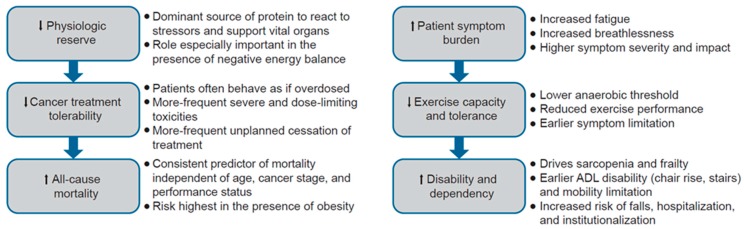
“Across multiple cohort studies, patients with low LBM experience more severe or dose-limiting toxicities and earlier cessation of chemotherapy compared with those with relatively higher LBM [22].”
BackgroundInfluentialSelf-citationMartin, L., Birdsell, L., MacDonald, N., Reiman, T., Clandinin, M. T., McCargar, L. J., Murphy, R., Ghosh, S., Sawyer, M. B., & Baracos, V. E. (2013) · Journal of Clinical Oncology · doi:10.1200/jco.2012.45.2722 · Cited by 2,680 · cited 1×
“Patients with severe weight loss are an at-risk population [44] that is extremely difficult to treat [45].”
BackgroundMourtzakis, M., Prado, C. M. M., Lieffers, J. R., Reiman, T., McCargar, L. J., & Baracos, V. E. (2008) · Applied Physiology, Nutrition, and Metabolism · doi:10.1139/h08-075 · Cited by 2,224 · cited 1×
“An assessment approach that considers body composition is important for patients with lung cancer and cachexia, as neither body weight [46,47] nor BMI [48] are strongly correlated with LBM or skeletal muscle.”
BackgroundMuscaritoli, M., Anker, S. D., Argilés, J., Aversa, Z., Bauer, J. M., Biolo, G., Boirie, Y., Bosaeus, I., Cederholm, T., Costelli, P., et al. (2010) · Clinical Nutrition · doi:10.1016/j.clnu.2009.12.004 · Cited by 1,732 · cited 1×
“The FAACT questionnaire contains the 12-item A/CS domain that specifically addresses anorexia/cachexia (Table 2), and is the ideal tool to measure the complex phenomenon of appetite/eating [92], as the questions not only evaluate cancer anorexia/cachexia symptoms and concerns including appetite, early satiety, and oth…”
MethodSelf-citationESPEN expert group recommendations for action against cancer-related malnutrition
Arends, J., Baracos, V., Bertz, H., Bozzetti, F., Calder, P. C., Deutz, N. E. P., Erickson, N., Laviano, A., Lisanti, M. P., Lobo, D. N., et al. (2017) · Clinical Nutrition · doi:10.1016/j.clnu.2017.06.017 · Cited by 1,305 · cited 1×
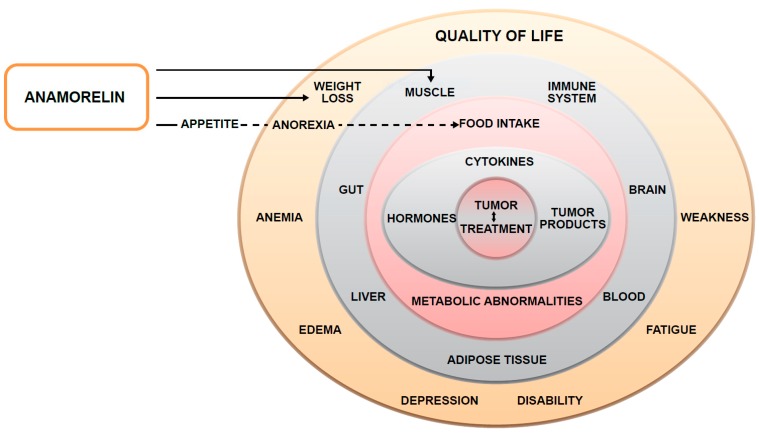
“The etiology of cancer cachexia is not yet fully clarified; central features comprise anorexia, reduced food intake, and increased systemic inflammation (C-reactive protein levels above upper limits of normal) [2,3].”
BackgroundSelf-citationAge-related and disease-related muscle loss: The effect of diabetes, obesity, and other diseases
Kalyani, R. R., Corriere, M., & Ferrucci, L. (2014) · The Lancet Diabetes & Endocrinology · doi:10.1016/s2213-8587(14)70034-8 · Cited by 1,102 · cited 1×
“A decline in LBM is observed as a natural feature of aging, with LBM reported to decrease from 50% of total body weight in healthy young adults to about 25% by the age of 75–80 years [49,50].”
BackgroundPrevalence of Malnutrition and Current Use of Nutrition Support in Patients With Cancer
Hébuterne, X., Lemarié, E., Michallet, M., de Montreuil, C. B., Schneider, S. M., & Goldwasser, F. (2014) · Journal of Parenteral and Enteral Nutrition · doi:10.1177/0148607113502674 · Cited by 823 · cited 1×
“By definition, nutritional therapy alone cannot reverse the effects of cancer cachexia [22,78].”
Background
Research works printed but not linked: 4
- Currow D. Temel J. Abernethy A. Friend J. Giorgino R. Fearon K.C. Pooled efficacy data from ROMANA 1 and ROMANA 2, two phase 3 trials of anamorelin in advanced non-small cell lung cancer (NSCLC) patients with cachexia Support. Care Cancer 2016 24 S23 PS006
- Crawford J.C. Johnston M.A. Hancock M.L. Small S.G. Taylor R.P. Dalton J.P. Steiner M.S. Enobosarm, a selective androgen receptor modulator (SARM), increases lean body mass (LBM) in advanced NSCLC patients; updated results of two pivotal, international Phase 3 trials Proceedings of the MASCC/ISOO International Symposium on Supportive Care in Cancer Miami, FL, USA 26–28 June 2014 MASCC-0546
- Cella D.F. Bonomi A.E. Leslie W.T. Von Roenn J. Tchekmedyian N.S. Quality of life and nutritional well-being: Measurement and relationship Oncology 1993 7 S105 S111
- Gelhorn H.L. Gries K.S. Duus E.M. Bourne R.K. Friend J.E. Speck R.M. Leidy N.K. Cella D. Psychometric properties of the FAACT Additional Concerns Subscale (A/CS) for measurement of anorexia in patients with non-small cell lung cancer Proceedings of the International Society for Quality of Life Research 23rd Annual Conference Copenhagen, Denmark 19–22 October 2016 Poster 1005
Cited by
Sarcopenic obesity in older adults: a clinical overview
Prado, C. M., Batsis, J. A., Donini, L. M., Gonzalez, M. C., & Siervo, M. (2024) · Nature Reviews Endocrinology · doi:10.1038/s41574-023-00943-z · Cited by 355
Cancer Cachexia: Definition, Staging, and Emerging Treatments
Ni, J., & Zhang, L. (2020) · Cancer Management and Research · doi:10.2147/cmar.s261585 · Cited by 290
Muscle Wasting and Sarcopenia in Heart Failure—The Current State of Science
Lena, A., Anker, M. S., & Springer, J. (2020) · International Journal of Molecular Sciences · doi:10.3390/ijms21186549 · Cited by 159
Osteosarcopenia: A Narrative Review on Clinical Studies
Polito, A., Barnaba, L., Ciarapica, D., & Azzini, E. (2022) · International Journal of Molecular Sciences · doi:10.3390/ijms23105591 · Cited by 138
“Ghrelin agonists can determine the improvement of malnutrition and increase muscle mass or strength [85].”
BackgroundZhu, X., Callahan, M. F., Gruber, K. A., Szumowski, M., & Marks, D. L. (2020) · Journal of Clinical Investigation · doi:10.1172/jci138392 · Cited by 60
“Some of these agents have found their way into clinical trials in patients with cachexia (32, 35, 36).”
BackgroundBallarò, R., Lopalco, P., Audrito, V., Beltrà, M., Pin, F., Angelini, R., Costelli, P., Corcelli, A., Bonetto, A., Szeto, H. H., et al. (2021) · Cancers · doi:10.3390/cancers13040850 · Cited by 69
“Consistently, the ROMANA trials, among the largest phase 3 clinical trials in cancer cachexia testing the effect of a ghrelin analog, showed beneficial effects of the drug in gaining lean body mass, without improving muscle strength [34].”
BackgroundSingh, N., Decroly, É., Khatib, A., & Villoutreix, B. O. (2020) · European Journal of Pharmaceutical Sciences · doi:10.1016/j.ejps.2020.105495 · Cited by 52
“, anamorelin (Currow et al., 2018)) and were also flagged as putative superficial binder with our”
Anorexia and the Cancer Patient
Johannes, C. M., & Musser, M. L. (2019) · Veterinary Clinics of North America Small Animal Practice · doi:10.1016/j.cvsm.2019.04.008 · Cited by 50
Nakano, O., Kawai, H., Kobayashi, T., Kohisa, J., Ikarashi, S., Hayashi, K., Yokoyama, J., & Terai, S. (2021) · Cancer Medicine · doi:10.1002/cam4.3964 · Cited by 32
Ghrelin and Cancer: Examining the Roles of the Ghrelin Axis in Tumor Growth and Progression
Kotta, A. S., Kelling, A. S., Corleto, K. A., Sun, Y., & Giles, E. D. (2022) · Biomolecules · doi:10.3390/biom12040483 · Cited by 25
“Additional studies have similarly reported significant increases in lean body mass with administration of anamorelin [74,76,77].”
BackgroundFood, Nutrition, Physical Activity and Microbiota: Which Impact on Lung Cancer?
Nigro, E., Perrotta, F., Scialò, F., D’Agnano, V., Mallardo, M., Bianco, A., & Daniele, A. (2021) · International Journal of Environmental Research and Public Health · doi:10.3390/ijerph18052399 · Cited by 28
“…and cognitive function, no difference in handgrip strength, higher physical activity level 40 patients with stage III NSCLC Temel et al., 2016 [64] Currow et al., 2018 [65] Anamorelin 100 mg orally once daily for 12 weeks Improvements in body weight and anorexia-cachexia symptoms. no difference…”
BackgroundMolfino, A., Amabile, M. I., Giorgi, A., Monti, M., D’Andrea, V., & Muscaritoli, M. (2019) · Expert Opinion on Investigational Drugs · doi:10.1080/13543784.2019.1646727 · Cited by 25
Self-citationMorimoto, M., Yamaoka, M., & Hara, T. (2020) · Pharmacology Research & Perspectives · doi:10.1002/prp2.563 · Cited by 24
Gameli, P. S., Taoussi, O., Basile, G., Carlier, J., & Busardò, F. P. (2023) · Metabolites · doi:10.3390/metabo13080949 · Cited by 10
“Imbalances in ghrelin and leptin is a prominent feature and intravenously administered ghrelin was recommended, although ghrelin is characterized by a short half-life of approximately 30 min [9].”
BackgroundGrowth Hormone Secretagogues and the Regulation of Calcium Signaling in Muscle
Bresciani, E., Rizzi, L., Coco, S., Molteni, L., Meanti, R., Locatelli, V., & Torsello, A. (2019) · International Journal of Molecular Sciences · doi:10.3390/ijms20184361 · Cited by 9
“Phase 3 clinical studies in patients with advanced non–small cell lung cancer and cachexia reported that anamorelin administration for 12 weeks increased lean body mass (LBM) and body weight, improving some symptoms of anorexia/cachexia [36].”
BackgroundHowick, K., Chruścicka, B., Felice, D., Ramírez, V. T., van Leuven, L., Pietra, C., Cryan, J. F., Griffin, B. T., & Schellekens, H. (2020) · Neuropharmacology · doi:10.1016/j.neuropharm.2020.108011 · Cited by 10
Pancreatic cancer cachexia: A systemic consequence of multi-organ interactions
Xiao, A., Feng, Y., Yin, B., Zhang, J., Cao, Z., Liu, X., Liang, Y., & Wu, W. (2025) · hLife · doi:10.1016/j.hlife.2025.05.002 · Cited by 6
Therapeutic potential of ghrelin/GOAT/GHSR system in gastrointestinal disorders
Ma, Y., Yan, Q., Wang, P., Guo, W., & Yu, L. (2024) · Frontiers in Nutrition · doi:10.3389/fnut.2024.1422431 · Cited by 7
Pharmacologic Treatments to Preserve Bone and Muscle Mass in Osteosarcopenia
Klein, G. L. (2020) · Current Osteoporosis Reports · doi:10.1007/s11914-020-00576-5 · Cited by 6
Uzun, H., Uysal, P., Afsar, C., Sözer, V., İnanç, B., Ağaoğlu, F., Güral, Z., Fazlıoğlu, N., & Çuhadaroğlu, Ç. (2020) · Journal of Cancer Research and Therapeutics · doi:10.4103/jcrt.jcrt_10_19 · Cited by 5
An immunological panacea for cancer-related cachexia
Xue, J., Lu, T., Yang, K., Birbrair, A., & Zhou, S. (2026) · Trends in cancer · doi:10.1016/j.trecan.2026.06.005 · Cited by 3
Willbanks, A. R., Seals, M., Karmali, R., & Roy, I. (2024) · Cancers · doi:10.3390/cancers16020360 · Cited by 4
“The failure of individual agents to treat cancer cachexia may be tied to the heterogeneity of biological cachexia presentation between patients and over time [142].”
BackgroundDuan, B., Zhang, Y., Wang, X., Zhang, Y., Hou, Y., Bai, J., Liu, L., Chen, Y. S., Zhang, R., Jin, R., et al. (2021) · Frontiers in Nutrition · doi:10.3389/fnut.2021.654194 · Cited by 3
“Anamorelin has the advantage of stimulating appetite and possibly food intake, as well as promoting anabolism and significant muscle mass gain; however, the availability of drug limits its use (10).”
BackgroundWang, J., Jia, W., Li, D., Song, Y., Sun, N., Yang, K., Li, H., & Yin, C. (2022) · PubMed Central · doi:10.3779/j.issn.1009-3419.2022.101.21 · Cited by 4
Amano, K., Okamura, S., Mori, N., Sakaguchi, T., Miura, T., Uneno, Y., Ishiki, H., Hiratsuka, Y., Yokomichi, N., Hamano, J., et al. (2025) · Nutrition · doi:10.1016/j.nut.2025.112818 · Cited by 2
Low-Dose Metformin as a Monotherapy Does Not Reduce Non-Small-Cell Lung Cancer Tumor Burden in Mice
Stott, N. L., Dréau, D., Marriott, I., Bennett, J. M., Turner, M. J., Arthur, S. T., & Marino, J. S. (2021) · Biomedicines · doi:10.3390/biomedicines9111685 · Cited by 1
“Cachexia occurs in more than 50% of lung cancer patients undergoing chemotherapy, radiotherapy, or a combination of both [22,23], and more than 60% of patients with advanced NSCLC present respiratory complications and increased rates of cachexia [24].”
BackgroundSullivan, E. S., Schellekens, H., Griffin, B. T., Cushen, S. J., Howick, K., Cryan, J. F., Dahly, D. L., Noronha, N., & Ryan, A. M. (2025) · Food & Function · doi:10.1039/d4fo06083k
選択的アンドロゲン受容体モジュレーターのアンドロゲン低下型サルコペニアおよび悪液質モデルへの効果に関する研究
MORIMOTO, M. (2022) · Institutional Repositories DataBase (IRDB) · doi:10.15068/0002005701
Metadata
- Authors
- Currow, D. C., Maddocks, M., Cella, D., & Muscaritoli, M.
- Affiliations
- University of Technology Sydney (AU)
- King's College London (GB)
- Northwestern University (US)
- Sapienza University of Rome (IT)
- Corresponding author
- Muscaritoli, Maurizio
- Venue
- International Journal of Molecular Sciences
- Publisher
- MDPI AG
- Published
- 2018-11-05
- Volume
- 19
- Issue
- 11
- Pages
- 3471
- ISSN
- 1422-0067 (ISSN-L)
- PMC
- PMC6275064
- OpenAlex
- W2900369002
- Cited by
- 27
- References
- 92
- Citations by year
- 2026: 1 · 2025: 3 · 2024: 3 · 2023: 1 · 2022: 3 · 2021: 5 · 2020: 8 · 2019: 3
- FWCI
- 0.53
- Type
- journal article
- Language
- en
- Open access
- gold
- dx.doi.org
- Licence
- Locations
- International Journal of Molecular Sciences (publishedVersion, cc-by)
- Europe PMC (PubMed Central) (publishedVersion, cc-by)
- PubMed Central (publishedVersion, cc-by)
- PubMed (publishedVersion)
- DOAJ (DOAJ: Directory of Open Access Journals) (submittedVersion, cc-by-sa)
- IRIS Research product catalog (Sapienza University of Rome) (submittedVersion)
- UTS ePRESS (University of Technology Sydney) (submittedVersion)
- Funders
- Helsinn Healthcare SA (NA)
- Topics
- Health Sciences › Medicine › Physiology (medical) › Nutrition and Health in Aging
- Life Sciences › Neuroscience › Endocrine and Autonomic Systems › Regulation of Appetite and Obesity
- Life Sciences › Biochemistry, Genetics and Molecular Biology › Molecular Biology › Muscle Physiology and Disorders
- Keywords
- anamorelin, cancer cachexia, non-small cell lung cancer, appetite stimulation, lean body mass, anabolic therapy, muscle mass gain, anorexia, body composition
- MeSH terms
- Body Weight, Cachexia, Carcinoma, Non-Small-Cell Lung, Humans, Hydrazines, Oligopeptides, Hand Strength, Ghrelin
About these checks
Registry, retraction, Cites and statistics results are computed, not judged, with one exception: a printed reference that no index lists is read once by a model before it counts as a citation error. Claims are extracted by a model and kept only when their quote appears verbatim in the text; each cited source is then checked, with a model’s help, for whether it says what the claim relies on. Those verdicts can be wrong — read the claim’s quote and the cited source before relying on one.
Statistics and arithmetic are recomputed, not judged.
Confidence bands are shown only for fields calibrated on our annotated test set. None is calibrated yet, so no band is shown.
What counts as a claim ›How we measure confidence ›How we check this ›
Are you an author, or do you see a problem with this page? Request a review
Data sources
Bibliographic data: Semantic Scholar, OpenAlex, Crossref.
Contains information from the Semantic Scholar Academic Graph Datasets, made available under the ODC Attribution License (ODC-BY 1.0).
Semantic Scholar’s data is described in: Kinney, R., et al. (2023). The Semantic Scholar Open Data Platform. arXiv:2301.10140.
