

miR-34a-5p Increases Hepatic Triglycerides and Total Cholesterol Levels by Regulating ACSL1 Protein Expression in Laying Hens
Open accessThe DOI matches its Crossref record; 49 of the 49 references it cites were found in a registry or an index.
Abstract
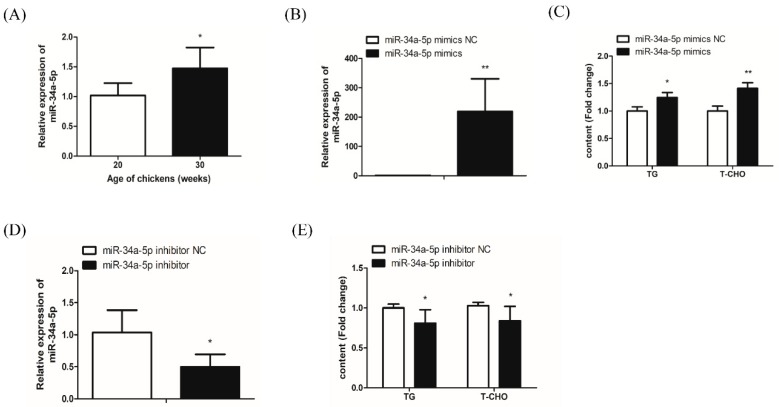
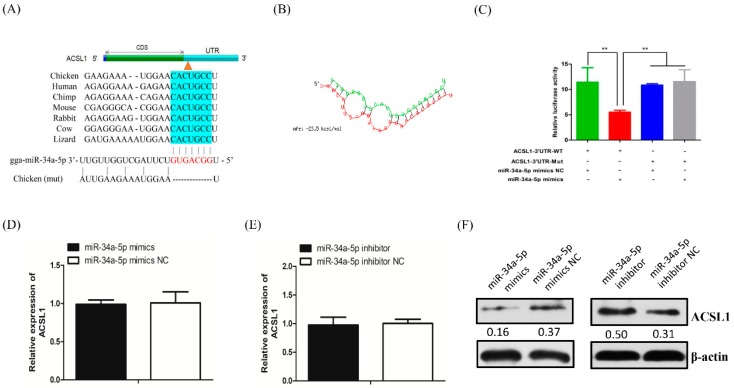
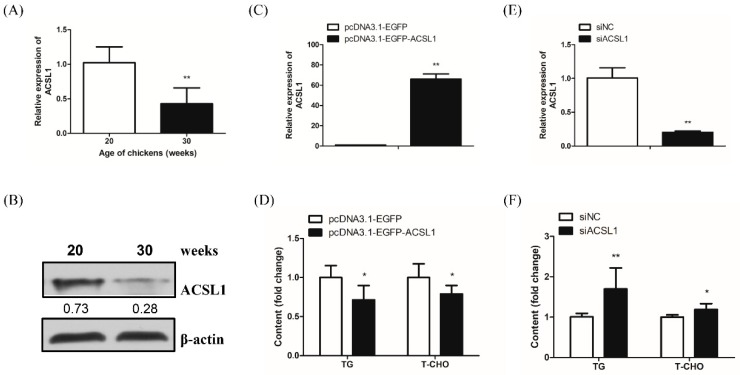
Accumulating evidence has shown that miR-34a serves as a posttranscriptional regulatory molecule of lipid metabolism in mammals. However, little studies about miR-34a on lipid metabolism in poultry have been reported until now. To gain insight into the biological functions and action mechanisms of miR-34a on hepatic lipid metabolism in poultry, we firstly investigated the expression pattern of miR-34a-5p, a member of miR-34a family, in liver of chicken, and determined its function in hepatocyte lipid metabolism by miR-34a-5p overexpression and inhibition, respectively. We then validated the interaction between miR-34a-5p and its target using dual-luciferase reporter assay, and explored the action mechanism of miR-34a-5p on its target by qPCR and Western blotting. Additionally, we looked into the function of the target gene on hepatocyte lipid metabolism by gain- and loss-of-function experiments. Our results indicated that miR-34a-5p showed a significantly higher expression level in livers in peak-laying hens than that in pre-laying hens. miR-34a-5p could increase the intracellular levels of triglycerides and total cholesterol in hepatocyte. Furthermore, miR-34a-5p functioned by inhibiting the translation of its target gene, long-chain acyl-CoA synthetase 1 (ACSL1), which negatively regulates hepatocyte lipid content. In conclusion, miR-34a-5p could increase intracellular lipid content by reducing the protein level, without influencing mRNA stability of the ACSL1 gene in chickens.
Overview
The claims and statistics of this paper haven’t been checked yet.
Free: it reads the open-access text and checks the first 5 claims that cite a source we can check. Create a free account to check every claim.
Integrity signals
Registry
Cites
Statistics
Figures
Verification
Claims the paper makes
The claims and statistics of this paper haven’t been checked yet.
Free: it reads the open-access text and checks the first 5 claims that cite a source we can check. Create a free account to check every claim.
Claims other papers make about this one
Each is checked against this paper’s own text: does it say what the citing paper says it does?
In the citing paper
“The liver is an estrogen-targeted organ [61], and estradiol has been shown to inhibit hepatic stellate cell proliferation and fibrogenesis in animal models [62].”
From Emerging role of liver-bone axis in osteoporosis (2024) · cites this paper as [61]
Self-check
Percentages, sums and reported differences re-computed from the paper’s own numbers.
The self-check needs the paper’s full text.
Citations
Cites
Bartel (2004) · doi:10.1016/s0092-8674(04)00045-5 · Cited by 34,714
The functions of animal microRNAs
Ambros, V. (2004) · Nature · doi:10.1038/nature02871 · Cited by 10,728
Wightman, B., Ha, I., & Ruvkun, G. (1993) · Cell · doi:10.1016/0092-8674(93)90530-4 · Cited by 4,292 · cited 1×
“miRNA, lin4, was proven to complementarily bind to the lin14 3′ UTR and negatively regulate lin14 protein expression without changing lin14 mRNA levels [41] as a result of the following two possible mechanisms: impaired ribosome assembly on the mRNA and degradation of the newly synthesized polypeptide [42].”
BackgroundNon-coding RNAs and cancer: microRNAs and beyond
Raia, R. M., & Calin, G. A. (2011) · Journal of Nucleic Acids Investigation · doi:10.4081/jnai.2011.e5 · Cited by 3,382
Fast and effective prediction of microRNA/target duplexes
REHMSMEIER, M., STEFFEN, P., HÖCHSMANN, M., & GIEGERICH, R. (2004) · RNA · doi:10.1261/rna.5248604 · Cited by 2,560
c-Myc-regulated microRNAs modulate E2F1 expression
O'Donnell, K. A., Wentzel, E. A., Zeller, K. I., Dang, C. V., & Mendell, J. T. (2005) · Nature · doi:10.1038/nature03677 · Cited by 2,347 · cited 1×
“miR-17-5p and miR-20a have been reported to suppress the protein translation of the E2F1 gene, a target of the two miRNAs, without altering E2F1 mRNA levels in HeLa cell [43].”
BackgroundOlsen, P. H., & Ambros, V. (1999) · Developmental Biology · doi:10.1006/dbio.1999.9523 · Cited by 1,234 · cited 1×
“miRNA, lin4, was proven to complementarily bind to the lin14 3′ UTR and negatively regulate lin14 protein expression without changing lin14 mRNA levels [41] as a result of the following two possible mechanisms: impaired ribosome assembly on the mRNA and degradation of the newly synthesized polypeptide [42].”
BackgroundRepression of protein synthesis by miRNAs: how many mechanisms?
Pillai, R. S., Bhattacharyya, S. N., & Filipowicz, W. (2007) · Trends in Cell Biology · doi:10.1016/j.tcb.2006.12.007 · Cited by 1,108 · cited 1×
“The pathway through which miRNAs silence genes depends on the complementarity of the miRNA and target mRNA [37,38].”
BackgroundThe mechanics of miRNA-mediated gene silencing: a look under the hood of miRISC
Fabian, M. R., & Sonenberg, N. (2012) · Nature Structural & Molecular Biology · doi:10.1038/nsmb.2296 · Cited by 1,025 · cited 1×
“However, when a miRNA binds to a target with imperfect complementarity, the miRNA obstructs the translation of the gene due to miRISC blocking the formation of the translation initiation complex, resulting in mRNA deadenylation, preventing the assembly of a productive ribosome at the translation initiation stage, or i…”
BackgroundMicroRNAs: History, Biogenesis, and Their Evolving Role in Animal Development and Disease
Bhaskaran, M., & Mohan, M. (2014) · Veterinary Pathology · doi:10.1177/0300985813502820 · Cited by 605 · cited 1×
“It has been successively demonstrated that miRNAs exert crucial functions in various biological processes, such as animal growth and development, immune response, metabolic activity, and diseases [18,19].”
Background
Cited by
Molecular Regulation of Lipogenesis, Adipogenesis and Fat Deposition in Chicken
Nematbakhsh, S., Chong, P. P., Selamat, J., Nordin, N., Idris, L. H., & Razis, A. F. A. (2021) · Genes · doi:10.3390/genes12030414 · Cited by 139
“Long-chain acyl-CoA synthetase (ACSL) is a candidate gene for the regulation of skeletal muscle fatty acid composition [15] and catalyzes the conversion of long-chain fatty acids into acyl-CoA [46].”
BackgroundThe potential role and mechanism of circRNA/miRNA axis in cholesterol synthesis
Chen, W., Xu, J., Wu, Y., Liang, B., Yan, M., Sun, C., Wang, D., Hu, X., Liu, L.-Z., Hu, W., et al. (2023) · International Journal of Biological Sciences · doi:10.7150/ijbs.84994 · Cited by 122
“circOgdh miR-34a-5p/ACSL1 axis [175, 176] circMED12L miR-34a-5p/ACSL1 axis [175, 180] circ_FURIN miR-34a-5p/ACSL1 axis [175, 181]”
BackgroundInfluentialEmerging role of liver-bone axis in osteoporosis
Gao, H., Peng, X., Li, N., Gou, L., Xu, T., Wang, Y., Qin, J., Liang, H., Ma, P., Li, S., et al. (2024) · Journal of Orthopaedic Translation · doi:10.1016/j.jot.2024.07.008 · Cited by 36
“The liver is an estrogen-targeted organ [61], and estradiol has been shown to inhibit hepatic stellate cell proliferation and fibrogenesis in animal models [62].”
BackgroundZhang, D., Wang, D., Wang, Z., Wang, Y., Li, G., Sun, G., Tian, Y., Han, R., Li, Z., Jiang, R., et al. (2020) · International Journal of Molecular Sciences · doi:10.3390/ijms21051624 · Cited by 36
“In chicken liver, miR-34a-5p promotes the accumulation of TG by regulating the expression of long-chain acyl-CoA synthetase 1 (ACSL1), and it has a function similar to that of human and mouse hepatocytes, thus achieving the positive regulation of fatty acid synthesis [65].”
BackgroundSelf-citationEmerging Roles of Non-Coding RNAs in the Feed Efficiency of Livestock Species
Hu, G., Do, D. N., Davoudi, P., & Miar, Y. (2022) · Genes · doi:10.3390/genes13020297 · Cited by 24
Jiang, K., Ma, Z., Wang, Z., Li, H., Wang, Y., Tian, Y., Li, D., & Liu, X. (2021) · Frontiers in Genetics · doi:10.3389/fgene.2020.587546 · Cited by 24
“A same rising trend of cholesterol levels was previously found in laying hens (Tian et al., 2019).”
BackgroundSelf-citationShan, B., Yan, M., Yang, K., Lin, W., Yan, J., Wei, S., Wei, W., Chen, J., & Zhang, L. (2022) · Genes · doi:10.3390/genes13020260 · Cited by 22
“For example, miR-205 influences abnormal lipid metabolism in hepatoma cells [15], miR-181a affects the biosynthesis of milk fat in bovine mammary epithelial cells [16], and miR-34-5p enhances hepatic lipid content in chickens [17].”
BackgroundTian, W., Wang, D., Wang, Z., Jiang, K., Li, Z., Tian, Y., Kang, X., Liu, X., & Li, H. (2020) · Gene · doi:10.1016/j.gene.2020.145094 · Cited by 19
Self-citationGuo, Y., Tian, W., Wang, D., Yang, L., Wang, Z., Wu, X., Zhi, Y., Zhang, K., Wang, Y., Li, Z., et al. (2023) · International Journal of Biological Macromolecules · doi:10.1016/j.ijbiomac.2023.127061 · Cited by 22
Self-citationXie, Y., Liu, Z., Guo, J., Su, X., Zhao, C., Zhang, C., Qin, Q., Dai, D., Zhao, Y., Wang, Z., et al. (2021) · Frontiers in Genetics · doi:10.3389/fgene.2021.649015 · Cited by 19
“In addition, miR-34a-5p can increase intracellular lipid content by reducing theACSL1 protein level (Tian et al., 2019). miR-126-3 might be involved in lipid metabolism in the mammary gland (Chu et al., 2017).”
BackgroundSelf-citationZhu, L., Liao, R., Huang, J., Yan, H., Xiao, C., Yang, Y., Wang, H., & Yang, C. (2022) · Frontiers in Veterinary Science · doi:10.3389/fvets.2022.913841 · Cited by 14
“Moreover, overexpression of miR-34a-5p, which targets acyl-CoA synthetase long-chain family member 1, promotes hepatic TG deposition and increased cholesterol production (12).”
BackgroundZhai, B., Zhao, Y., Li, H., Li, S., Gu, J., Zhang, H., Zhang, Y., Li, H., Tian, Y., Li, G., et al. (2023) · BMC Genomics · doi:10.1186/s12864-023-09685-8 · Cited by 12
“It is known that miR-34a-5p increases intracellular triglyceride and total cholesterol levels in chicken liver by inhibiting the ACSL1 gene [51].”
BackgroundSelf-citationGuo, Y., Geng, W., Chen, Z., Zhi, Y., Zhang, K., Li, Z., Li, G., Kang, X., Tian, W., Li, H., et al. (2024) · International Journal of Biological Macromolecules · doi:10.1016/j.ijbiomac.2024.131049 · Cited by 13
Self-citationLi, H., Zhang, H., Dai, Y., Li, S., Gu, J., Wu, R., Jia, J., Shen, J., Zhang, Y., Li, H., et al. (2024) · International Journal of Biological Macromolecules · doi:10.1016/j.ijbiomac.2024.137608 · Cited by 16
Self-citationWang, Z., Wang, D., Jiang, K., Guo, Y., Li, Z., Jiang, R., Han, R., Li, G., Tian, Y., Li, H., et al. (2021) · Frontiers in Veterinary Science · doi:10.3389/fvets.2021.700669 · Cited by 11
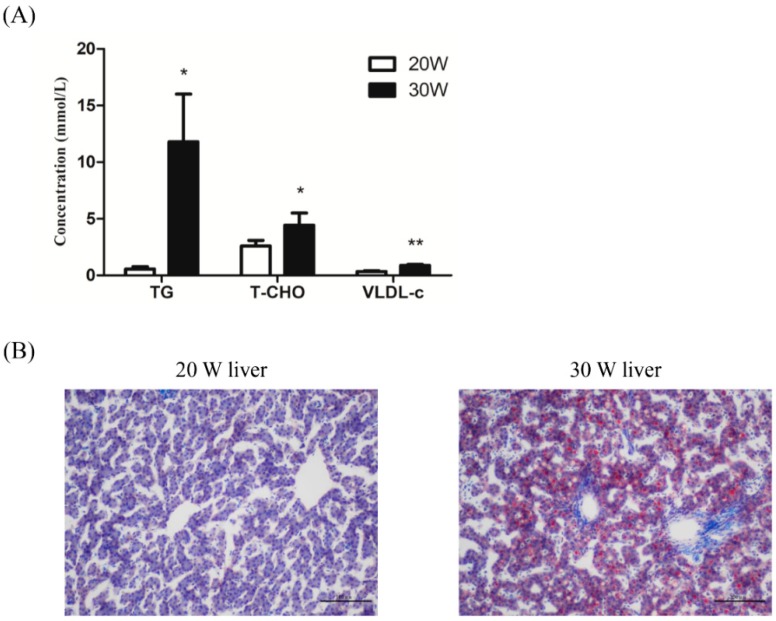
“Animals and Sampling Our previous study had shown that the lipid content was significantly higher in peak-laying hens at 30w than that in prelaying hens at 20w (36).”
BackgroundSelf-citationZhao, J., Ya-mei, W. U., ZHANG, Y., Shu-yue, T. A. N. G., Han, S., Can, C. U. I., Bo, T. A. N., Yu, J., Kang, H., Guang-deng, C. H. E. N., et al. (2023) · Journal of Integrative Agriculture · doi:10.1016/j.jia.2023.04.010 · Cited by 10
Hicks, J. A., & Liu, H. (2020) · Poultry Science · doi:10.1016/j.psj.2020.11.033 · Cited by 9
Du, Y., Chen, X., Han, Y., Sun, L., Wei, C., Yang, W., Zhao, Y., Liu, Z., & Geng, Z. (2022) · Animals · doi:10.3390/ani12070874 · Cited by 7
“The lipids were synthesized in the liver with the stimulation of E2 for promoting the development of follicles at the early laying period [11].”
BackgroundBai, Y., Li, J., Wei, Y., Chen, Z., Liu, Z., Guo, D., Jia, X., Niu, Y., Shi, B., Zhang, X., et al. (2024) · Antioxidants · doi:10.3390/antiox13060641 · Cited by 5
“…fat deposition or FA metabolism primarily focus on individual genes or related signaling axes, with a relatively limited emphasis on proteomics [24–26]. bovine fat deposition or FA metabolism primarily focus on individual genes or axes, with a relatively limited emphasis on proteomics [24–26].”
BackgroundSelf-citationGeng, W., Guo, Y., Chen, B., Cheng, X., Li, S., Challioui, M. K., Tian, W., Li, H., Zhang, Y., Li, Z., et al. (2024) · Poultry Science · doi:10.1016/j.psj.2024.104258 · Cited by 9
“The resulting supernatants were collected for the dual-luciferase reporter assay system, following the protocol described in the previous study (Tian et al., 2019).”
MethodSelf-citationSun, M., Wang, H., Zhu, X., Zhang, X., Min, Y., Ge, M., Jiang, X., & Yu, W. (2025) · Poultry Science · doi:10.1016/j.psj.2025.105125 · Cited by 6
“Total cholesterol is a crucial precursor for steroid hormone synthesis, as it is essential for the production of sex hormones, such as estrogen, in the ovaries of laying hens (Tian, et al., 2019).”
Ameliorative effects of Bacillus subtilis C10 on alcoholic liver injury in mice
Wang, Q., Wang, M., Chen, J., Zhang, W., & Lv, X. (2024) · Journal of Food Science · doi:10.1111/1750-3841.17539 · Cited by 4
Li, X., Bai, Y., Li, J., Chen, Z., Ma, Y., Shi, B., Han, X., Luo, Y., Hu, J., Wang, J., et al. (2022) · Frontiers in Genetics · doi:10.3389/fgene.2022.994806 · Cited by 4
Self-citationMiRNAs in Poultry Health and Production: Progress and Challenges
Nguyen, T. V., Tat, T. H., & Do, D. N. (2025) · Animals · doi:10.3390/ani15223230 · Cited by 4
“Tian et al. showed that miR-34a-5p targeted Acyl-CoA Synthetase Long Chain Family Member 1 (ACSL1) protein expression to increase hepatic triglycerides and total cholesterol levels in laying hens [48].”
Song, J., Shi, X., Li, X., Liang, Q., Zeng, L., Li, G., Yan, Y., Xu, G., & Zheng, J. (2022) · Frontiers in Veterinary Science · doi:10.3389/fvets.2022.868602 · Cited by 4
Luo, X., Zhang, J., Guo, J., Zhao, W., Tian, Y., Xiang, H., Kang, H., Ye, F., Chen, S., Li, H., et al. (2024) · Animals · doi:10.3390/ani14142132 · Cited by 3
“This activity is particularly heightened during the egg-laying period due to the increased demand for lipid synthesis required for egg formation, underscoring the liver’s critical role [6].”
BackgroundSelf-citationYuan, W., Gou, W., Liu, Y., Fu, J., Si, Q., Liu, M., Zhang, N., & Shang, H. (2025) · British Poultry Science · doi:10.1080/00071668.2025.2526157 · Cited by 2
Kochetova, O. V., Korytina, G. F., Timasheva, Y., Gilyazova, I. B., Akhmetshin, A. G., Abdeeva, G., Karunas, A. S., Хуснутдинова, Э. К., & Gusev, O. (2026) · Animals · doi:10.3390/ani16020260 · Cited by 6
“…include miR-34a-5p, which increases intracellular triglyceride and total cholesterol levels by suppressing translation of its hepatic target ACSL1 [123], and miR-218-5p, which modulates ELOVL5 and FADS1, essential enzymes in the biosynthesis of long-chain polyunsaturated fatty acids [121,124]…”
Lü, Y., Wang, Y., Bao, X., Lv, X., & Huang, Y. (2025) · Ecotoxicology and Environmental Safety · doi:10.1016/j.ecoenv.2025.118152 · Cited by 3
Zhang, K., Gu, Z., Li, S., Cheng, X. R., Wang, Y., Wei, H., Cheng, Z., Zhi, Y., Challioui, M. K., Guo, Y., et al. (2025) · Food Chemistry Molecular Sciences · doi:10.1016/j.fochms.2025.100339 · Cited by 2
“The miR-34 family has been implicated in lipid metabolism and SM development (Chen et al., 2019; Lyu et al., 2022; Ouyang et al., 2015; Tian et al., 2019; Wei et al., 2024). miR-34b-5p regulates chicken myoblast proliferation by targeting the IGFBP2 gene (Wang et al., 2019).”
Self-citationStrategies to reduce cholesterol content in poultry eggs: an overview
Balhara, N., Dimple, D., Ruby, R., Magnuson, A. D., Giri, A., & Mukesh, M. (2026) · Tropical Animal Health and Production · doi:10.1007/s11250-026-04954-6 · Cited by 1
“…of miR-34a in chickens inhibited hepatocyte lipid metabolism after the overexpression of miR-34a-5p in the liver. miR-34a-5p inhibits long-chain acyl-CoA synthetase 1 ( ACSL1 ) activity, which is responsible for the negative regulation of hepatocyte lipid content (Tian et al. 2019 ) (Fig.”
Non-coding RNAs Related to Lipid Metabolism and Non-alcoholic Fatty Liver Disease
Holvoet, P. (2021) · Springer eBooks · doi:10.1007/978-3-030-68844-8_4 · Cited by 1
Zhai, B., Zhao, Y., Li, H., Li, S., Gu, J., Zhang, H., Zhang, Y., Li, H., Tian, Y., Li, G. X., et al. (2024) · Figshare · doi:10.6084/m9.figshare.24266060
Self-citationZhai, B., Zhao, Y., Li, H., Li, S., Gu, J., Zhang, H., Zhang, Y., Li, H., Tian, Y., Li, G. X., et al. (2023) · Figshare · doi:10.6084/m9.figshare.24266034
Self-citationIdentification and functional analysis of miR-34c-5p target genes during chicken myogenesis
Li, S., Zhang, K., Tian, Y., Guo, M., Wang, X., Ding, P., Guo, Y., Li, H., Li, Z., Tian, Y., et al. (2026) · Genomics · doi:10.1016/j.ygeno.2026.111221
Self-citation
Metadata
- Authors
- Tian, W.-H., Wang, Z., Yue, Y.-X., Li, H., Li, Z.-J., Han, R.-L., Tian, Y.-D., Kang, X.-T., & Liu, X.-J.
- Affiliations
- College of Animal Science and Veterinary Medicine, Henan Agricultural University, Zhengzhou 450002, China
- Henan Agricultural University (CN)
- Venue
- International Journal of Molecular Sciences
- Publisher
- MDPI AG
- Published
- 2019-09-08
- Volume
- 20
- Issue
- 18
- Pages
- 4420
- ISSN
- 1422-0067 (ISSN-L)
- PMC
- PMC6770783
- OpenAlex
- W2972120896
- Cited by
- 35
- References
- 49
- Citations by year
- 2026: 3 · 2025: 5 · 2024: 8 · 2023: 5 · 2022: 6 · 2021: 5 · 2020: 3
- FWCI
- 1.10
- Type
- journal article
- Language
- en
- Open access
- gold
- dx.doi.org
- Licence
- Locations
- International Journal of Molecular Sciences (publishedVersion, cc-by)
- Europe PMC (PubMed Central) (publishedVersion, cc-by)
- PubMed Central (publishedVersion, cc-by)
- PubMed (publishedVersion)
- DOAJ (DOAJ: Directory of Open Access Journals) (submittedVersion, cc-by-sa)
- Funders
- Key Project of NSFC-Henan Province Joint Fund (U1704233)
- China Agriculture Research System (CARS-40-K04)
- China Postdoctoral Science Foundation (2017M520301)
- Topics
- Life Sciences › Biochemistry, Genetics and Molecular Biology › Cancer Research › MicroRNA in disease regulation
- Life Sciences › Biochemistry, Genetics and Molecular Biology › Biochemistry › Lipid metabolism and biosynthesis
- Life Sciences › Biochemistry, Genetics and Molecular Biology › Biochemistry › Cholesterol and Lipid Metabolism
- Keywords
- miR-34a-5p, ACSL1, hepatic lipid metabolism, triglycerides, total cholesterol, laying hens, chicken liver, microRNA target regulation, translation repression, mRNA stability
- MeSH terms
- Animals, Base Sequence, Cell Line, Chickens, Cholesterol, Coenzyme A Ligases, Liver, Triglycerides, Gene Expression, MicroRNAs, Lipid Metabolism
About these checks
Registry, retraction, Cites and statistics results are computed, not judged, with one exception: a printed reference that no index lists is read once by a model before it counts as a citation error. Claims are extracted by a model and kept only when their quote appears verbatim in the text; each cited source is then checked, with a model’s help, for whether it says what the claim relies on. Those verdicts can be wrong — read the claim’s quote and the cited source before relying on one.
Statistics and arithmetic are recomputed, not judged.
Confidence bands are shown only for fields calibrated on our annotated test set. None is calibrated yet, so no band is shown.
What counts as a claim ›How we measure confidence ›How we check this ›
Are you an author, or do you see a problem with this page? Request a review
Data sources
Bibliographic data: Semantic Scholar, OpenAlex, Crossref.
Contains information from the Semantic Scholar Academic Graph Datasets, made available under the ODC Attribution License (ODC-BY 1.0).
Semantic Scholar’s data is described in: Kinney, R., et al. (2023). The Semantic Scholar Open Data Platform. arXiv:2301.10140.
