

The DOI matches its Crossref record; 122 of the 126 references it cites were found in a registry or an index.
Adipokines and Obesity. Potential Link to Metabolic Disorders and Chronic Complications
Open accessAbstract
The World Health Organization (WHO) has recognized obesity as one of the top ten threats to human health. It is estimated that the number of obese and overweight people worldwide exceeds the number of those who are undernourished. Obesity is not only a state of abnormally increased adipose tissue in the body, but also of increased release of biologically active adipokines. Adipokines released into the circulating blood, due to their specific receptors on the surface of target cells, act as classic hormones affecting the metabolism of tissues and organs. What is more, adipokines and cytokines may decrease the insulin sensitivity of tissues and induce inflammation and development of chronic complications. Certainly, it can be stated that in an era of a global obesity pandemic, adipokines may gain more and more importance as regards their use in the diagnostic evaluation and treatment of diseases. An extensive search for materials on the role of white, brown and perivascular fatty tissue and obesity-related metabolic and chronic complications was conducted online using PubMed, the Cochrane database and Embase.
Overview
The claims and statistics of this paper haven’t been checked yet.
Run the check — free, no account needed. It reads the open-access text and checks the sources it cites.
Integrity signals
Registry
Cites
Statistics
Figures
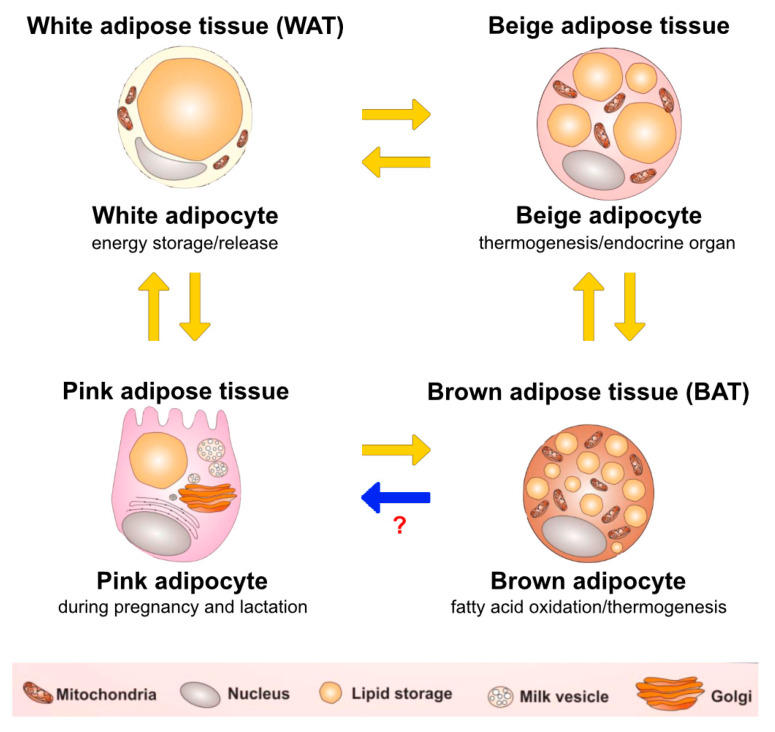
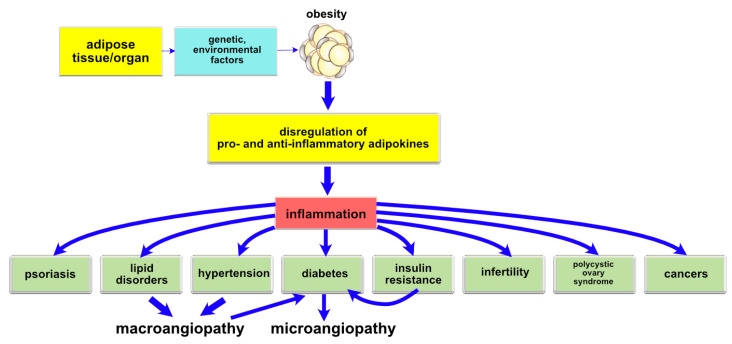
Verification
Claims the paper makes
The claims and statistics of this paper haven’t been checked yet.
Run the check — free, no account needed. It reads the open-access text and checks the sources it cites.
Claims other papers make about this one
Each is checked against this paper’s own text: does it say what the citing paper says it does?
In the citing paper
“It is well understood that the bone, 165 muscle 236 and adipose tissues 237 secrete numerous cytokines, some of which represent an unexamined source of potential novel therapeutic targets.”
From The role of the androgen receptor in the pathogenesis of obesity and its utility as a target for obesity treatments (2022) · cites this paper as [237]
Self-check
Percentages, sums and reported differences re-computed from the paper’s own numbers.
The self-check needs the paper’s full text.
Citations
Cites
(2000) · PubMed · Cited by 13,173
Identification and Importance of Brown Adipose Tissue in Adult Humans
Cypess, A. M., Lehman, S., Williams, G., Tal, I., Rodman, D., Goldfine, A. B., Kuo, F. C., Palmer, E. L., Tseng, Y.-H., Doria, A., et al. (2009) · New England Journal of Medicine · doi:10.1056/nejmoa0810780 · Cited by 4,399
Bray, G. A., Kim, K. K., Wilding, J. P. H., & on behalf of the World Obesity Federation (2017) · Obesity Reviews · doi:10.1111/obr.12551 · Cited by 1,612
Angiogenesis and Inflammation in Peritoneal Dialysis: The Role of Adipocytes
Shi, J., Yu, M., & Sheng, M. (2017) · Kidney & Blood Pressure Research · doi:10.1159/000476017 · Cited by 1,406
Resistin Is an Inflammatory Marker of Atherosclerosis in Humans
Reilly, M. P., Lehrke, M., Wolfe, M. L., Rohatgi, A. K., Lazar, M. A., & Rader, D. J. (2005) · Circulation · doi:10.1161/01.cir.0000155620.10387.43 · Cited by 915
Brown adipose tissue as a secretory organ
Villarroya, F., Cereijo, R., Villarroya, J., & Giralt, M. (2016) · Nature Reviews Endocrinology · doi:10.1038/nrendo.2016.136 · Cited by 697
Chen, M., Chung, F., Chang, D., Tsai, J. C. ‐., Huang, H.-F., Shin, S., & Lee, Y. (2006) · The Journal of Clinical Endocrinology & Metabolism · doi:10.1210/jc.2005-1475 · Cited by 660
Kumada, M., Kihara, S., Ouchi, N., Kobayashi, H., Okamoto, Y., Ohashi, K., Maeda, K., Nagaretani, H., Kishida, K., Maeda, N., et al. (2004) · Circulation · doi:10.1161/01.cir.0000127953.98131.ed · Cited by 555
Insulin resistance associated to obesity: the link TNF-alpha
Nieto-Vázquez, I., Fernández‐Veledo, S., Kramer, D., Vila‐Bedmar, R., García‐Guerra, L., & Lorenzo, M. (2008) · Archives of Physiology and Biochemistry · doi:10.1080/13813450802181047 · Cited by 493
The current biology of resistin
Steppan, C. M., & Lazar, M. A. (2004) · Journal of Internal Medicine · doi:10.1111/j.1365-2796.2004.01306.x · Cited by 371
Research works printed but not linked: 2
- Jachimowicz-Duda, O., Wąż, P., and Zorena, K. (2015, January 19–24). Interleukin-34 concentration is dependent on LDL cholesterol, HbA1c, CRP and WHR in patients with type 2 diabetes. Proceedings of the Crossroads of Lipid Metabolism and Diabetes 2015, Copenhagen, Denmark.
- Jachomowicz-Duda, O., Wąż, P., and Zorena, K. (2017, January 28–29). The relationship between interleukin-34 level and selected biochemical and clinical parameters in patients with type 2 diabetes. Proceedings of the Synergy Conference: “Autoimmunity in 2017-Where Are We Now?”, New York, NY, USA.
Cited by
Sorted by citations
The role of adipokines in health and disease
Clemente-Suárez, V. J., Redondo-Flórez, L., Beltrán-Velasco, A. I., Martín-Rodríguez, A., Martínez-Guardado, I., Navarro-Jiménez, E., Laborde-Cárdenas, C. C., & Tornero-Aguilera, J. F. (2023) · Biomedicines · doi:10.3390/biomedicines11051290 · Cited by 463
The role of adipokines in inflammatory mechanisms of obesity
Kirichenko, T. V., Markina, Y. V., Bogatyreva, A. I., Tolstik, T. V., Varaeva, Y. R., & Starodubova, A. V. (2022) · International Journal of Molecular Sciences · doi:10.3390/ijms232314982 · Cited by 289
Iron Metabolism in Obesity and Metabolic Syndrome
González-Domínguez, Á., Visiedo-García, F. M., Domínguez-Riscart, J., González-Domínguez, R., Mateos, R. M., & Lechuga-Sancho, A. M. (2020) · International Journal of Molecular Sciences · doi:10.3390/ijms21155529 · Cited by 227
Varra, F., Varras, M. N., Varra, V., & Theodosis‐Nobelos, P. (2024) · Molecular Medicine Reports · doi:10.3892/mmr.2024.13219 · Cited by 232
Lee, M.-W., Lee, M., & Oh, K. (2019) · Journal of Clinical Medicine · doi:10.3390/jcm8060854 · Cited by 192
Metadata
- Authors
- Zorena, K., Jachimowicz-Duda, O., Ślęzak, D., Robakowska, M., & Mrugacz, M.
- Affiliations
- Gdańsk Medical University (PL)
- Independent Public Specialized Health Care Center in Lębork, Department of Internal Diseases, Węgrzynowicza 13, 84-300 Lębork, Poland
- Medical University of Białystok (PL)
- Corresponding author
- Zorena, Katarzyna
- Venue
- International Journal of Molecular Sciences
- Publisher
- MDPI AG
- Published
- 2020-05-18
- Volume
- 21
- Issue
- 10
- Pages
- 3570
- ISSN
- 1422-0067 (ISSN-L)
- PMC
- PMC7278967
- OpenAlex
- W3024358488
- Cited by
- 411
- References
- 126
- Citations by year
- 2026: 39 · 2025: 61 · 2024: 105 · 2023: 86 · 2022: 73 · 2021: 35 · 2020: 11
- FWCI
- 7.46
- Type
- journal article
- Language
- en
- Open access
- gold
- dx.doi.org
- Licence
- Locations
- International Journal of Molecular Sciences (publishedVersion, cc-by)
- PubMed Central (publishedVersion, cc-by)
- PubMed (publishedVersion)
- DOAJ (DOAJ: Directory of Open Access Journals) (submittedVersion, cc-by-sa)
- Topics
- Health Sciences › Medicine › Endocrinology, Diabetes and Metabolism › Adipokines, Inflammation, and Metabolic Diseases
- Health Sciences › Medicine › Physiology (medical) › Adipose Tissue and Metabolism
- Health Sciences › Medicine › Cardiology and Cardiovascular Medicine › Cardiovascular Disease and Adiposity
- Keywords
- adipokines, obesity, metabolic disorders, chronic complications, insulin resistance, inflammation, cytokines, adipose tissue, brown adipose tissue, perivascular adipose tissue, obesity-related comorbidities
- MeSH terms
- Animals, Humans, Inflammation, Metabolic Diseases, Obesity, Adipokines
About these checks
Registry, retraction, Cites and statistics results are computed, not judged, with one exception: a printed reference that no index lists is read once by a model before it counts as a citation error. Claims are extracted by a model and kept only when their quote appears verbatim in the text; each cited source is then checked, with a model’s help, for whether it says what the claim relies on. Those verdicts can be wrong — read the claim’s quote and the cited source before relying on one.
Statistics and arithmetic are recomputed, not judged.
Confidence bands are shown only for fields calibrated on our annotated test set. None is calibrated yet, so no band is shown.
What counts as a claim ›How we measure confidence ›How we check this ›
Are you an author, or do you see a problem with this page? Request a review
