

The DOI matches its Crossref record; 198 of the 200 references it cites were found in a registry or an index.
Ionizing Radiation as a Source of Oxidative Stress—The Protective Role of Melatonin and Vitamin D
Open accessAbstract
Ionizing radiation (IR) has found widespread application in modern medicine, including medical imaging and radiotherapy. As a result, both patients and healthcare professionals are exposed to various IR doses. To minimize the negative side effects of radiation associated with oxidative imbalance, antioxidant therapy has been considered. In this review, studies on the effects of melatonin and vitamin D on radiation-induced oxidative stress are discussed. According to the research data, both substances meet the conditions for use as agents that protect humans against IR-induced tissue damage. Numerous studies have confirmed that melatonin, a hydro- and lipophilic hormone with strong antioxidant properties, can potentially be used as a radioprotectant in humans. Less is known about the radioprotective effects of vitamin D, but the results to date have been promising. Deficiencies in melatonin and vitamin D are common in modern societies and may contribute to the severity of adverse side effects of medical IR exposure. Hence, supporting supplementation with both substances seems to be of first importance. Interestingly, both melatonin and vitamin D have been found to selectively radiosensitise cancer cells, which makes them promising adjuvants in radiotherapy. More research is needed in this area, especially in humans.
Overview
The claims and statistics of this paper haven’t been checked yet.
Run the check — free, no account needed. It reads the open-access text and checks the sources it cites.
Integrity signals
Registry
Cites
Statistics
Figures
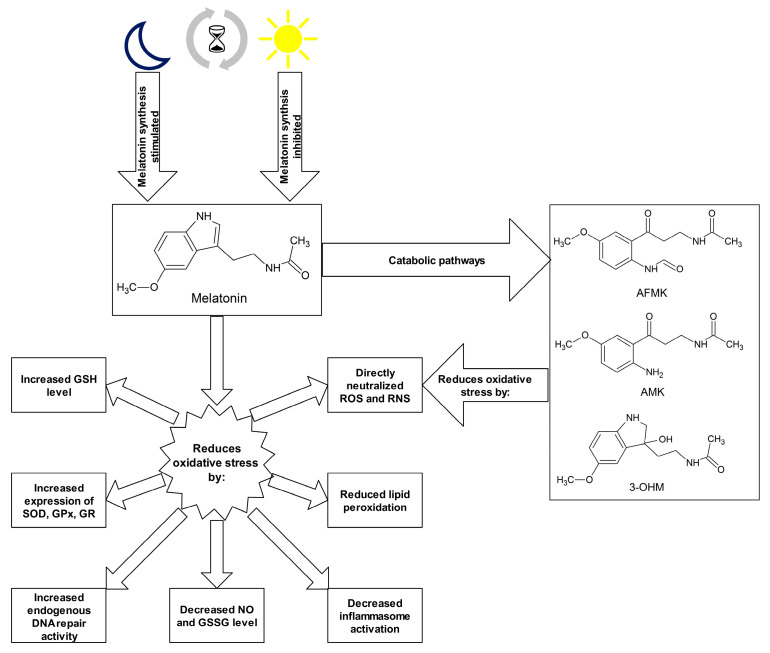
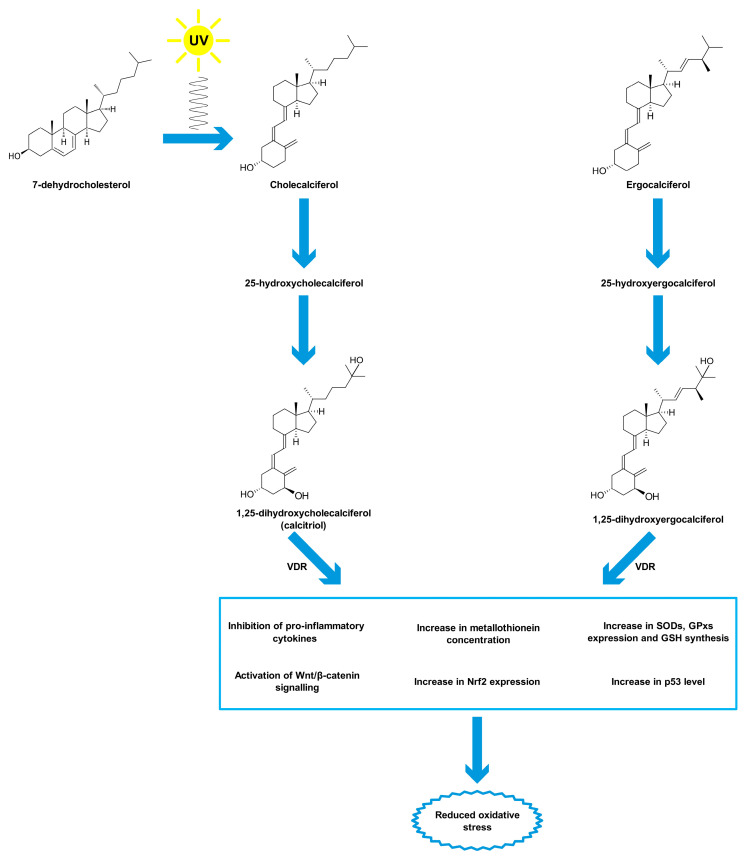
Verification
Claims the paper makes
The claims and statistics of this paper haven’t been checked yet.
Run the check — free, no account needed. It reads the open-access text and checks the sources it cites.
Claims other papers make about this one
Each is checked against this paper’s own text: does it say what the citing paper says it does?
In the citing paper
“Ionizing radiation may cause radiolysis of water, accompanied by the formation of hydroxyl radicals (Nuszkiewicz et al. 2020).”
From Reactive Oxygen Species, Toxicity, Oxidative Stress, and Antioxidants: Chronic Diseases and Aging (2023) · cites this paper as Nuszkiewicz et al. 2020
Self-check
Percentages, sums and reported differences re-computed from the paper’s own numbers.
The self-check needs the paper’s full text.
Citations
Cites
1 retracted
Sepehrmanesh, Z., Kolahdooz, F., Abedi, F., Mazroii, N., Assarian, A., Asemi, Z., & Esmaillzadeh, A. (2016) · The Journal of Nutrition · doi:10.3945/jn.115.218883 · Cited by 143
RetractedOxidative stress: a concept in redox biology and medicine
Sies, H. (2015) · Redox Biology · doi:10.1016/j.redox.2015.01.002 · Cited by 3,208
The role of antioxidants in the chemistry of oxidative stress: A review
Pisoschi, A. M., & Pop, A. (2015) · European Journal of Medicinal Chemistry · doi:10.1016/j.ejmech.2015.04.040 · Cited by 2,963
Oxidative stress and the amyloid beta peptide in Alzheimer’s disease
Cheignon, C., Tomas, M., Bonnefont-Rousselot, D., Faller, P., Hureau, C., & Collin, F. (2018) · Redox Biology · doi:10.1016/j.redox.2017.10.014 · Cited by 2,185
Vitamin D: Metabolism, Molecular Mechanism of Action, and Pleiotropic Effects
Christakos, S., Dhawan, P., Verstuyf, A., Verlinden, L., & Carmeliet, G. (2015) · Physiological Reviews · doi:10.1152/physrev.00014.2015 · Cited by 2,105
Reactive Oxygen Species in Metabolic and Inflammatory Signaling
Forrester, S. J., Kikuchi, D. S., Hernandes, M. S., Xu, Q., & Griendling, K. K. (2018) · Circulation Research · doi:10.1161/circresaha.117.311401 · Cited by 2,081
Melatonin as an antioxidant: under promises but over delivers
Reiter, R. J., Mayo, J. C., Tan, D. X., Sainz, R. M., Alatorre-Jiménez, M. A., & Qin, L. (2016) · Journal of Pineal Research · doi:10.1111/jpi.12360 · Cited by 1,777
ISOLATION OF MELATONIN, THE PINEAL GLAND FACTOR THAT LIGHTENS MELANOCYTES 1
Lerner, A. B., Case, J. D., TAKAHASHI, Y., Lee, T. H., & Mori, W. (1958) · Journal of the American Chemical Society · doi:10.1021/ja01543a060 · Cited by 1,759
Ionizing radiation-induced metabolic oxidative stress and prolonged cell injury
Azzam, E. I., Jay‐Gerin, J., & Pain, D. (2011) · Cancer Letters · doi:10.1016/j.canlet.2011.12.012 · Cited by 1,688
The vitamin D deficiency pandemic: Approaches for diagnosis, treatment and prevention
Holick, M. F. (2017) · Reviews in Endocrine and Metabolic Disorders · doi:10.1007/s11154-017-9424-1 · Cited by 1,641
Cited by
Sorted by citations
Reactive Oxygen Species, Toxicity, Oxidative Stress, and Antioxidants: Chronic Diseases and Aging
Jomova, K., Raptova, R., Alomar, S. Y., Alwasel, S. H., Nepovimova, E., Kuca, K., & Valko, M. (2023) · Archives of Toxicology · doi:10.1007/s00204-023-03562-9 · Cited by 2,638
Liu, R., Bian, Y., Liu, L., Liu, L., Liu, X., & Ma, S. (2022) · International Journal of Molecular Medicine · doi:10.3892/ijmm.2022.5121 · Cited by 125
Miazek, K., Beton-Mysur, K., Śliwińska, A., & Brożek-Płuska, B. (2022) · Biomolecules · doi:10.3390/biom12081087 · Cited by 117
Dual sources of melatonin and evidence for different primary functions
Reiter, R. J., Sharma, R., Tan, D. X., Chuffa, L. G. D. A., da Silva, D. G. H., Slominski, A. T., Steinbrink, K., & Kleszczyński, K. (2024) · Frontiers in Endocrinology · doi:10.3389/fendo.2024.1414463 · Cited by 83
Nuclear and Radiological Emergencies: Biological Effects, Countermeasures and Biodosimetry
Obrador, E., Palmer, R. S., Villaescusa, J. I., Gallego, E., Pellicer, B., Estrela, J. M., & Montoro, A. (2022) · Antioxidants · doi:10.3390/antiox11061098 · Cited by 80
Metadata
- Authors
- Nuszkiewicz, J., Woźniak, A., & Szewczyk-Golec, K.
- Affiliations
- Nicolaus Copernicus University (PL)
- Department of Medical Biology and Biochemistry, Faculty of Medicine, Ludwik Rydygier Collegium Medicum in Bydgoszcz, Nicolaus Copernicus University in Toruń, 24 Karłowicza St, 85-092 Bydgoszcz, Poland
- Corresponding author
- Nuszkiewicz, Jarosław
- Venue
- International Journal of Molecular Sciences
- Publisher
- MDPI AG
- Published
- 2020-08-13
- Volume
- 21
- Issue
- 16
- Pages
- 5804
- ISSN
- 1422-0067 (ISSN-L)
- PMC
- PMC7460937
- OpenAlex
- W3048655647
- Cited by
- 156
- References
- 200
- Citations by year
- 2026: 32 · 2025: 31 · 2024: 34 · 2023: 16 · 2022: 27 · 2021: 13 · 2020: 3
- FWCI
- 2.16
- Type
- journal article
- Language
- en
- Open access
- gold
- doi.org
- Licence
- Locations
- International Journal of Molecular Sciences (publishedVersion, cc-by)
- PubMed Central (publishedVersion, cc-by)
- PubMed (publishedVersion)
- DOAJ (DOAJ: Directory of Open Access Journals) (submittedVersion)
- Topics
- Health Sciences › Medicine › Radiology, Nuclear Medicine and Imaging › Effects of Radiation Exposure
- Life Sciences › Neuroscience › Endocrine and Autonomic Systems › Circadian rhythm and melatonin
- Health Sciences › Medicine › Biochemistry (medical) › Antioxidant Activity and Oxidative Stress
- Keywords
- ionizing radiation, oxidative stress, melatonin, vitamin D, radiation protection, antioxidant therapy, radiation-induced tissue damage, melatonin deficiency, vitamin D deficiency, adjuvant radiotherapy, radiation exposure
- MeSH terms
- Animals, Circadian Rhythm, Humans, Melatonin, Radiation, Ionizing, Vitamin D, Reactive Oxygen Species, Oxidative Stress
About these checks
Registry, retraction, Cites and statistics results are computed, not judged, with one exception: a printed reference that no index lists is read once by a model before it counts as a citation error. Claims are extracted by a model and kept only when their quote appears verbatim in the text; each cited source is then checked, with a model’s help, for whether it says what the claim relies on. Those verdicts can be wrong — read the claim’s quote and the cited source before relying on one.
Statistics and arithmetic are recomputed, not judged.
Confidence bands are shown only for fields calibrated on our annotated test set. None is calibrated yet, so no band is shown.
What counts as a claim ›How we measure confidence ›How we check this ›
Are you an author, or do you see a problem with this page? Request a review
