

The DOI matches its Crossref record; 83 of the 84 references it cites were found in a registry or an index, and 1 are not checked yet.
The Role of HPA Axis and Allopregnanolone on the Neurobiology of Major Depressive Disorders and PTSD
Open accessAbstract
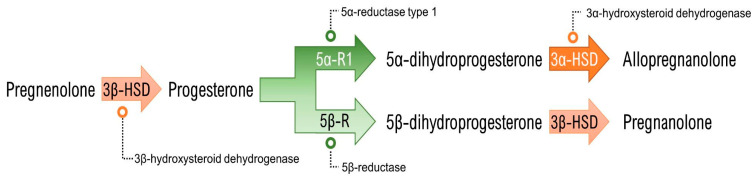
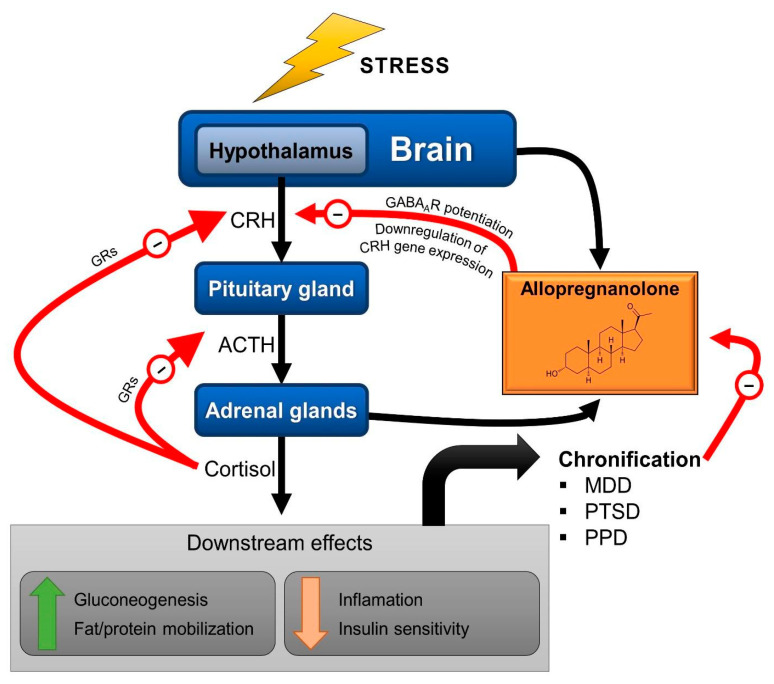
Under stressful conditions, the hypothalamic-pituitary-adrenal (HPA) axis acts to promote transitory physiological adaptations that are often resolved after the stressful stimulus is no longer present. In addition to corticosteroids (e.g., cortisol), the neurosteroid allopregnanolone (3α,5α-tetrahydroprogesterone, 3α-hydroxy-5α-pregnan-20-one) participates in negative feedback mechanisms that restore homeostasis. Chronic, repeated exposure to stress impairs the responsivity of the HPA axis and dampens allopregnanolone levels, participating in the etiopathology of psychiatric disorders, such as major depressive disorder (MDD) and post-traumatic stress disorder (PTSD). MDD and PTSD patients present abnormalities in the HPA axis regulation, such as altered cortisol levels or failure to suppress cortisol release in the dexamethasone suppression test. Herein, we review the neurophysiological role of allopregnanolone both as a potent and positive GABAergic neuromodulator but also in its capacity of inhibiting the HPA axis. The allopregnanolone function in the mechanisms that recapitulate stress-induced pathophysiology, including MDD and PTSD, and its potential as both a treatment target and as a biomarker for these disorders is discussed.
Overview
The claims and statistics of this paper haven’t been checked yet.
Run the check — free, no account needed. It reads the open-access text and checks the sources it cites.
Integrity signals
Registry
Cites
Statistics
Figures
Verification
Claims the paper makes
The claims and statistics of this paper haven’t been checked yet.
Run the check — free, no account needed. It reads the open-access text and checks the sources it cites.
Claims other papers make about this one
Each is checked against this paper’s own text: does it say what the citing paper says it does?
The source backs part of the claim, not all of it — or backs it for a different population, condition or comparison.
In the citing paper
“Allopregnanolone has induced the GABAergic inhibition of HPA axis activation in female rats [93,94] and pregnant women [95].”
From Fibromyalgia pathogenesis explained by a neuroendocrine multistable model (2024) · cites this paper as [94]
Experimental — accuracy not yet measured
Self-check
Percentages, sums and reported differences re-computed from the paper’s own numbers.
The self-check needs the paper’s full text.
Citations
Cites
Slavich, G. M., & Irwin, M. R. (2014) · Psychological Bulletin · doi:10.1037/a0035302 · Cited by 2,206
The impact of stress on body function
Yaribeygi, H., Panahi, Y., Sahraei, H., Johnston, T. P., & Sahebkar, A. (2017) · EXCLI journal · doi:10.17179/excli2017-480 · Cited by 1,356
Stetler, C., & Miller, G. E. (2011) · Psychosomatic Medicine · doi:10.1097/psy.0b013e31820ad12b · Cited by 1,123
Purdy, R. H., Morrow, A. L., Moore, P. H., & Paul, S. M. (1991) · Proceedings of the National Academy of Sciences · doi:10.1073/pnas.88.10.4553 · Cited by 951
Post-traumatic stress disorder.
Yehuda, R., Hoge, C. W., McFarlane, A. C., Vermetten, E., Lanius, R. A., Nievergelt, C. M., Hobfoll, S. E., Koenen, K. C., Neylan, T. C., & Hyman, S. E. (2015) · Nature Reviews Disease Primers · doi:10.1038/nrdp.2015.57 · Cited by 870
Meltzer-Brody, S., Colquhoun, H., Riesenberg, R., Epperson, C. N., Deligiannidis, K. M., Rubinow, D. R., Li, H., Sankoh, A. J., Clemson, C., Schacterle, A., et al. (2018) · The Lancet · doi:10.1016/s0140-6736(18)31551-4 · Cited by 795
Extrasynaptic GABAA Receptors: Their Function in the CNS and Implications for Disease
Brickley, S. G., & Módy, I. (2012) · Neuron · doi:10.1016/j.neuron.2011.12.012 · Cited by 695
Uzunova, V., Sheline, Y. I., Davis, J. M., Rasmusson, A. M., Uzunov, D. P., Costa, E., & Guidotti, A. (1998) · Proceedings of the National Academy of Sciences · doi:10.1073/pnas.95.6.3239 · Cited by 672
The combined dexamethasone/CRH test: A refined laboratory test for psychiatric disorders
Heuser, I., Yassouridis, A., & Holsboer, F. (1994) · Journal of Psychiatric Research · doi:10.1016/0022-3956(94)90017-5 · Cited by 662
The Effects of Psychological Stress on Depression
Yang, L., Zhao, Y., Wang, Y., Liu, L., Zhang, X., Li, B., & Cui, R. (2015) · Current Neuropharmacology · doi:10.2174/1570159x1304150831150507 · Cited by 589
Cited by
Sorted by citations
Immunology of stress: A review article
Alotiby, A. (2024) · Journal of Clinical Medicine · doi:10.3390/jcm13216394 · Cited by 253
Sex Differences in Stress Response: Classical Mechanisms and Beyond
Hodes, G. E., Bangasser, D. A., Sotiropoulos, I., Kokras, N., & Dalla, C. (2023) · Current Neuropharmacology · doi:10.2174/1570159x22666231005090134 · Cited by 103
Shared biological mechanisms of depression and obesity: focus on adipokines and lipokines
Fu, X., Wang, Y., Zhao, F., Cui, R., Xie, W., Liu, Q., & Yang, W. (2023) · Aging · doi:10.18632/aging.204847 · Cited by 86
From bugs to brain: unravelling the GABA signalling networks in the brain–gut–microbiome axis
Belelli, D., Lambert, J. J., Wan, M. L. Y., Monteiro, A. R., Nutt, D., & Swinny, J. D. (2024) · Brain · doi:10.1093/brain/awae413 · Cited by 69
Liu, Y., Song, N., Yao, H. P., Jiang, S., Wang, Y., Zheng, Y., Zhou, Y., Ding, J., Hu, G., & Lu, M. (2022) · Journal of Neuroinflammation · doi:10.1186/s12974-022-02597-6 · Cited by 61
Metadata
- Authors
- Almeida, F. B., Pinna, G., & Barros, H. M. T.
- Affiliations
- Universidade Federal de Ciências da Saúde de Porto Alegre (BR)
- University of Illinois Chicago (US)
- Corresponding author
- Pinna, Graziano
- Venue
- International Journal of Molecular Sciences
- Publisher
- MDPI AG
- Published
- 2021-05-23
- Volume
- 22
- Issue
- 11
- Pages
- 5495
- ISSN
- 1422-0067 (ISSN-L)
- PMC
- PMC8197074
- OpenAlex
- W3164510424
- Cited by
- 130
- References
- 84
- Citations by year
- 2026: 17 · 2025: 39 · 2024: 30 · 2023: 26 · 2022: 16 · 2021: 2
- FWCI
- 2.23
- Type
- journal article
- Language
- en
- Open access
- gold
- doi.org
- Licence
- Locations
- International Journal of Molecular Sciences (publishedVersion, cc-by)
- PubMed Central (publishedVersion, cc-by)
- PubMed (publishedVersion)
- DOAJ (DOAJ: Directory of Open Access Journals) (submittedVersion, cc-by-sa)
- Funders
- Coordenação de Aperfeiçoamento de Pessoal de Nível Superior ((Code 001))
- Conselho Nacional de Desenvolvimento Científico e Tecnológico
- Fundação de Amparo à Pesquisa do Estado do Rio Grande do Sul (19/2551, Code 001)
- Topics
- Life Sciences › Neuroscience › Behavioral Neuroscience › Stress Responses and Cortisol
- Life Sciences › Neuroscience › Cellular and Molecular Neuroscience › Neuroscience and Neuropharmacology Research
- Social Sciences › Psychology › Clinical Psychology › Posttraumatic Stress Disorder Research
- Keywords
- hypothalamic-pituitary-adrenal axis, allopregnanolone, major depressive disorder, post-traumatic stress disorder, neurosteroids, GABAergic modulation, chronic stress, cortisol, dexamethasone suppression test, biomarkers, treatment goals
- MeSH terms
- Adaptation, Physiological, Animals, Antidepressive Agents, Chronic Disease, Corticosterone, Depressive Disorder, Major, Major Depressive Disorder, Female, gamma-Aminobutyric Acid, Humans, Hypothalamo-Hypophyseal System, Male, Models, Biological, Pituitary-Adrenal System, Pregnanolone, Receptors, GABA-A, Sex Characteristics, Stress, Physiological, Stress Disorders, Post-Traumatic, Stress, Psychological, Feedback, Physiological, GABA-A Receptor Agonists
About these checks
Registry, retraction, Cites and statistics results are computed, not judged, with one exception: a printed reference that no index lists is read once by a model before it counts as a citation error. Claims are extracted by a model and kept only when their quote appears verbatim in the text; each cited source is then checked, with a model’s help, for whether it says what the claim relies on. Those verdicts can be wrong — read the claim’s quote and the cited source before relying on one.
Statistics and arithmetic are recomputed, not judged.
Confidence bands are shown only for fields calibrated on our annotated test set. None is calibrated yet, so no band is shown.
What counts as a claim ›How we measure confidence ›How we check this ›
Are you an author, or do you see a problem with this page? Request a review
