

The Cytokine Mediated Molecular Pathophysiology of Psoriasis and Its Clinical Implications
Open accessThe DOI matches its Crossref record; 104 of the 104 references it cites were found in a registry or an index.
Abstract
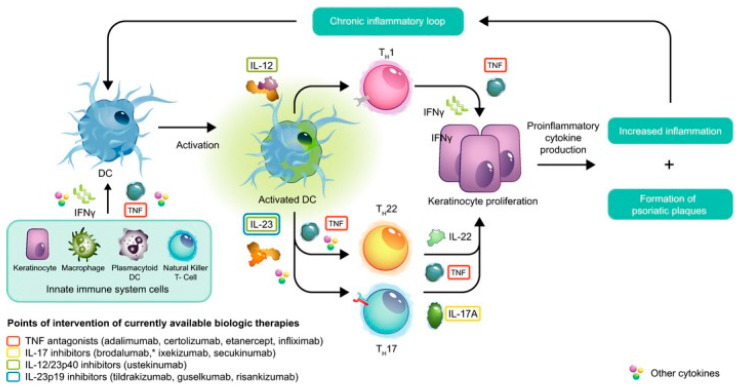
Psoriasis is the result of uncontrolled keratinocyte proliferation, and its pathogenesis involves the dysregulation of the immune system. The interplay among cytokines released by dendritic, Th1, Th2, and Th17 cells leads to the phenotypical manifestations seen in psoriasis. Biological therapies target the cytokine-mediated pathogenesis of psoriasis and have improved patient quality of life. This review will describe the underlying molecular pathophysiology and biologics used to treat psoriasis. A review of the literature was conducted using the PubMed and Google Scholar repositories to investigate the molecular pathogenesis, clinical presentation, and current therapeutics in psoriasis. Plaque psoriasis’, the most prevalent subtype of psoriasis, pathogenesis primarily involves cytokines TNF-α, IL-17, and IL-23. Pustular psoriasis’, an uncommon variant, pathogenesis involves a mutation in IL-36RN. Currently, biological therapeutics targeted at TNF-α, IL-12/IL-23, IL-17, and IL-23/IL-39 are approved for the treatment of moderate to severe psoriasis. More studies need to be performed to elucidate the precise molecular pathology and assess efficacy between biological therapies for psoriasis. Psoriasis is a heterogenous, chronic, systemic inflammatory disease that presents in the skin with multiple types. Recognizing and understanding the underlying molecular pathways and biological therapeutics to treat psoriasis is important in treating this common disease.
Overview
The claims and statistics of this paper haven’t been checked yet.
Free: it reads the open-access text and checks the first 5 claims that cite a source we can check. Create a free account to check every claim.
Integrity signals
Registry
Cites
Statistics
Figures
Verification
Claims the paper makes
The claims and statistics of this paper haven’t been checked yet.
Free: it reads the open-access text and checks the first 5 claims that cite a source we can check. Create a free account to check every claim.
Claims other papers make about this one
Each is checked against this paper’s own text: does it say what the citing paper says it does?
The source backs part of the claim, not all of it — or backs it for a different population, condition or comparison.
In the citing paper
“Early lesions may show less developed psoriasiform hyperplasia and a more prominent superficial perivascular lymphocytic infiltrate, while chronic plaques show the classic combination of regular epidermal hyperplasia, parakeratosis, hypogranulosis, neutrophilic microabscesses, and vascular remodeling.”
From The Cutaneous Immune Microenvironment in Selected Inflammatory Skin Diseases: Linking Histopathology, Mechanisms, and Targeted Therapy (2026) · cites this paper as [21]
Experimental — accuracy not yet measuredThe source backs part of the claim, not all of it — or backs it for a different population, condition or comparison.
In the citing paper
“Disease initiation is thought to begin when environmental triggers such as trauma, infection, stress, or drugs disturb the epidermal barrier and activate keratinocyte proliferation.”
From The Cutaneous Immune Microenvironment in Selected Inflammatory Skin Diseases: Linking Histopathology, Mechanisms, and Targeted Therapy (2026) · cites this paper as [21]
Experimental — accuracy not yet measuredThe source backs part of the claim, not all of it — or backs it for a different population, condition or comparison.
In the citing paper
“Under these triggers, keratinocytes become activated and release antimicrobial peptides, self-nucleic acids, and alarm mediators that are sensed by innate immune cells, particularly the dendritic cells, which act as antigen-presenting cells (APC) [21,22].”
From The Cutaneous Immune Microenvironment in Selected Inflammatory Skin Diseases: Linking Histopathology, Mechanisms, and Targeted Therapy (2026) · cites this paper as [21]
Experimental — accuracy not yet measuredThe source backs part of the claim, not all of it — or backs it for a different population, condition or comparison.
In the citing paper
“The histological pattern closely mirrors activation of the IL-23/Th17 axis, with IL-17- and IL-22-driven keratinocyte hyperproliferation, neutrophil recruitment, and angiogenesis.”
From The Cutaneous Immune Microenvironment in Selected Inflammatory Skin Diseases: Linking Histopathology, Mechanisms, and Targeted Therapy (2026) · cites this paper as [21]
Experimental — accuracy not yet measuredThe source backs part of the claim, not all of it — or backs it for a different population, condition or comparison.
In the citing paper
“Neutrophilic collections represent important diagnostic clues.”
From The Cutaneous Immune Microenvironment in Selected Inflammatory Skin Diseases: Linking Histopathology, Mechanisms, and Targeted Therapy (2026) · cites this paper as [21]
Experimental — accuracy not yet measured
15 more claims about this paper
Create a free account to see every claim other papers make about this one.
Self-check
Percentages, sums and reported differences re-computed from the paper’s own numbers.
The self-check needs the paper’s full text.
Citations
Cites
Pathophysiology, Clinical Presentation, and Treatment of Psoriasis: A Review
Armstrong, A. W., & Read, C. (2020) · JAMA · doi:10.1001/jama.2020.4006 · Cited by 2,335 · cited 10×
“Additionally, extra-cutaneous manifestations, such as cholangitis, epigastric pain, cholestasis, arthritis, acute renal failure, and interstitial pneumonitis, warrant hospitalization [1,2,33,51].”
BackgroundInfluentialPsoriasis Pathogenesis and Treatment
Rendon, A., & Schäkel, K. (2019) · International Journal of Molecular Sciences · doi:10.3390/ijms20061475 · Cited by 2,064 · cited 11×
“Sci. 2021, 22, x FOR PEER REVIEW 3 of 23 secrete TNF-α and IL-23 [1,13].”
BackgroundInfluentialRitchlin, C. T., Colbert, R. A., & Gladman, D. D. (2017) · New England Journal of Medicine · doi:10.1056/nejmra1505557 · Cited by 1,404
National, regional, and worldwide epidemiology of psoriasis: systematic analysis and modelling study
Parisi, R., Iskandar, I. Y. K., Kontopantelis, E., Augustin, M., Griffiths, C. E. M., & Ashcroft, D. M. (2020) · BMJ · doi:10.1136/bmj.m1590 · Cited by 1,187 · cited 1×
“10% in high-income Southern Latin American countries [4].”
BackgroundIL-23 induces spondyloarthropathy by acting on ROR-γt+ CD3+CD4−CD8− entheseal resident T cells
Sherlock, J. P., Joyce-Shaikh, B., Turner, S. P., Chao, C.-C., Sathe, M., Grein, J., Gorman, D. M., Bowman, E. P., McClanahan, T. K., Yearley, J. H., et al. (2012) · Nature Medicine · doi:10.1038/nm.2817 · Cited by 1,060 · cited 1×
“This subsequently promotes osteoproliferation, bone erosion, and inflammation [41,42].”
BackgroundPivotal Role of Dermal IL-17-Producing γδ T Cells in Skin Inflammation
Cai, Y., Shen, X., Ding, C., Qi, C., Li, K., Li, X., Jala, V. R., Zhang, H.-G., Wang, T., Zheng, J., et al. (2011) · Immunity · doi:10.1016/j.immuni.2011.08.001 · Cited by 1,026
Boniface, K., Bernard, F.-X., Garcia, M., Gurney, A. L., Lecron, J.-C., & Morel, F. (2005) · The Journal of Immunology · doi:10.4049/jimmunol.174.6.3695 · Cited by 864 · cited 1×
“In vitro stimulation of ILC NCR+ produces IL-22, which is implicated in the pathogenesis of psoriasis, and increases the production of S100 AMPs [17,18].”
BackgroundGriffiths, C. E. M., Reich, K., Lebwohl, M., van de Kerkhof, P., Paul, C., Menter, A., Cameron, G. S., Erickson, J., Zhang, L., Secrest, R. J., et al. (2015) · The Lancet · doi:10.1016/s0140-6736(15)60125-8 · Cited by 834 · cited 1×
“Two prospective, multi-center phase III, double-blind trials (UNCOVER-2 and UNCOVER-3) evaluated the efficacy of ixekizumab compared to etanercept and placebo in patients with moderate to severe psoriasis [82].”
BackgroundPhase 3 Studies Comparing Brodalumab with Ustekinumab in Psoriasis
Lebwohl, M., Strober, B., Menter, A., Gordon, K., Weglowska, J., Puig, L., Papp, K., Spelman, L., Toth, D., Kerdel, F., et al. (2015) · New England Journal of Medicine · doi:10.1056/nejmoa1503824 · Cited by 828 · cited 1×
“Two replicate, multi-center phase III, randomized, double-blind, placebo and active comparator-controlled trials (AMAGINE-2 and AMAGINE-3), evaluated the efficacy of ustekinumab compared to brodalumab 210 mg in patients with moderate to severe psoriasis [76].”
BackgroundReich, K., Armstrong, A. W., Foley, P., Song, M., Wasfi, Y., Randazzo, B., Li, S., Shen, Y.-K., & Gordon, K. B. (2017) · Journal of the American Academy of Dermatology · doi:10.1016/j.jaad.2016.11.042 · Cited by 761
Research works printed but not linked: 8
- Badri T. Kumar P. Oakley A.M. Plaque Psoriasis StatPearls 2021 19 560 565 28613629
- Tiwari V. Brent L.H. Psoriatic Arthritis StatPearls Publishing Treasure Island, FL, USA 2021 31613490
- Gerriets V. Bansal P. Goyal A. Khaddour K. Tumor Necrosis Factor Inhibitors StatPearls Publishing Treasure Island, FL, USA 2021 29494032
- Fatima R. Bittar K. Aziz M. Infliximab StatPearls Publishing Treasure Island, FL, USA 2021 29763197
- Colquhoun M. Kemp A.K. Ustekinumab StatPearls Publishing Treasure Island, FL, USA 2021 34033407
- Preuss C.V. Quick J. Ixekizumab StatPearls Publishing Treasure Island, FL, USA 2021 28613740
- Aboobacker S. Kurn H. Al Aboud A.M. Secukinumab StatPearls Publishing Treasure Island, FL, USA 2021 30725776
- Golbari N.M. Basehore B.M. Zito P.M. Brodalumab StatPearls Publishing Treasure Island, FL, USA 2021 29261896
Cited by
Oxidative Stress: Signaling Pathways, Biological Functions, and Disease
Liu, S., Liu, J., Wang, Y., Deng, F., & Deng, Z. (2025) · MedComm · doi:10.1002/mco2.70268 · Cited by 359
Inflammation and Psoriasis: A Comprehensive Review
Matei-Man, A.-M., Orăsan, M. S., Hoteiuc, O.-A., Olănescu-Vaida-Voevod, M.-C., & Mocan, T. (2023) · International Journal of Molecular Sciences · doi:10.3390/ijms242216095 · Cited by 160
“%) and murine variable region (25%), binding to both soluble and transmembrane forms of TNF-α and thus disrupting the interaction of TNF-α with its receptors [179,180].”
BackgroundUpdated Perspectives on Keratinocytes and Psoriasis: Keratinocytes are More Than Innocent Bystanders
Ortiz‐López, L. I., Choudhary, V., & Bollag, W. B. (2022) · Psoriasis Targets and Therapy · doi:10.2147/ptt.s327310 · Cited by 109
“Such considerations are important since psoriatic individuals are often dissatisfied with current therapies(115) because some may be ineffective and others, like the biologic agents, can be expensive and exhibit a spectrum of undesirable side effects, for example, increasing the risk of serious infections and possibly…”
BackgroundNanocarrier-Based Transdermal Drug Delivery Systems for Dermatological Therapy
Kang, Y., Zhang, S., Wang, G., Yan, Z., Wu, G., Tang, L., & Wang, W. (2024) · Pharmaceutics · doi:10.3390/pharmaceutics16111384 · Cited by 100
Gasdermin D-mediated keratinocyte pyroptosis as a key step in psoriasis pathogenesis
Lian, N., Chen, Y., Chen, S., Zhang, Y., Chen, H., Yang, Y., Gu, H., Chen, Q., Li, M., & Chen, X. (2023) · Cell Death and Disease · doi:10.1038/s41419-023-06094-3 · Cited by 76
The holistic approach to psoriasis patients with comorbidities: the role of investigational drugs
Camela, E., Potestio, L., Fabbrocini, G., Pallotta, S., & Megna, M. (2023) · Expert Opinion on Investigational Drugs · doi:10.1080/13543784.2023.2219387 · Cited by 46
“The growing investigation in psoriasis syndrome’s pathophysiology has led to the discovery of new key molecules and to the development of novel agents, widening the therapeutic armamentarium [2,3].”
BackgroundAssociation between systemic immune-inflammation index and psoriasis: a population-based study
Zhao, X., Li, J., & Li, X. (2024) · Frontiers in Immunology · doi:10.3389/fimmu.2024.1305701 · Cited by 51
Immune cells in the epithelial immune microenvironment of psoriasis: emerging therapeutic targets
Li, L., Lu, J., Liu, J., Wu, J., Zhang, X., Meng, Y., Wu, X., Tai, Z., Zhu, Q., & Chen, Z. (2024) · Frontiers in Immunology · doi:10.3389/fimmu.2023.1340677 · Cited by 54
Emerging Oral Therapies for the Treatment of Psoriasis: A Review of Pipeline Agents
Drakos, A., Torres, T. R., & Vender, R. B. (2024) · Pharmaceutics · doi:10.3390/pharmaceutics16010111 · Cited by 48
“It is produced by myeloid dendritic cells and macrophages, and upon production drives the differentiation of naïve T helper cells to Th17 lymphocytes, stimulating these cells to secrete proinflammatory cytokines such as IL-12, IL-23, IL-17, and TNF [38–40].”
BackgroundIL-12 family cytokines and autoimmune diseases: A potential therapeutic target?
Cui, X., Liu, W., Jiang, H., Zhao, Q., Hu, Y., Tang, X., Liu, X., Dai, H., Rui, H., & Liu, B. (2024) · Journal of Translational Autoimmunity · doi:10.1016/j.jtauto.2024.100263 · Cited by 48
Circulating inflammatory cytokines and psoriasis risk: A systematic review and meta-analysis
Liu, X.-Q., Zhou, P.-L., Yin, X., Wang, A.-X., Wang, D., Yang, Y. S., & Liu, Q. (2023) · PLoS ONE · doi:10.1371/journal.pone.0293327 · Cited by 42
The Intriguing Links between Psoriasis and Bullous Pemphigoid
Maronese, C. A., Cassano, N., Genovese, G., Foti, C., Vena, G. A., & Marzano, A. V. (2022) · Journal of Clinical Medicine · doi:10.3390/jcm12010328 · Cited by 34
Systemic Psoriasis: From Molecular Mechanisms to Global Management Strategies
Prema, S. S., & Shanmugamprema, D. (2025) · Clinical Reviews in Allergy & Immunology · doi:10.1007/s12016-025-09089-4 · Cited by 43
“Recent molecular studies have shown that guttate lesions share a proinflammatory cytokine profile similar to plaque psoriasis, particularly involving the Th1 and Th17 pathways [150, 151].”
Francesco, M. A. D., & Caruso, A. (2022) · Vaccines · doi:10.3390/vaccines10020244 · Cited by 44
“Other localizations are the retroauricular folds, antecubital fossae, popliteal fossae, abdomen, intergluteal cleft and perineal area [45,46].”
BackgroundLiu, L., Zhang, H., Tang, X., Zhang, M., Wu, Y., Zhao, Y., Lu, C., & Zhao, R. (2024) · International Immunopharmacology · doi:10.1016/j.intimp.2024.112082 · Cited by 29
Lv, Y., Liu, Y., Mao, Z., Zhou, M., Zhu, B., Chen, Y., Ding, Z., Zhou, F., & Ye, Y. (2024) · Phytomedicine · doi:10.1016/j.phymed.2024.155917 · Cited by 33
Zhu, Y. J., Zhou, Y. Q., Ma, X.-N., Duan, Z., Xu, H. H., Li, Y., Kong, Y., Yang, L., & Xin, X. (2025) · Pharmaceutics · doi:10.3390/pharmaceutics17030283 · Cited by 32
Interventions in cytokine signaling: novel horizons for psoriasis treatment
Li, L., Liu, J., Lu, J., Wu, J., Zhang, X., Ma, T., Wu, X., Zhu, Q., Chen, Z., & Tai, Z. (2025) · Frontiers in Immunology · doi:10.3389/fimmu.2025.1573905 · Cited by 39
CD44 targeted indirubin nanocrystal-loaded hyaluronic acid hydrogel for the treatment of psoriasis
Li, L., Liu, C., Fu, J., Wang, Y., Yang, D., Peng, B., Liu, X., Han, X., Meng, Y., Feng, F., et al. (2023) · International Journal of Biological Macromolecules · doi:10.1016/j.ijbiomac.2023.125239 · Cited by 31
A Review of the Clinical Trial Landscape in Psoriasis: An Update for Clinicians
Drakos, A., & Vender, R. B. (2022) · Dermatology and Therapy · doi:10.1007/s13555-022-00840-9 · Cited by 28
How Hormonal Balance Changes Lives in Women with Psoriasis
Cassalia, F., Lunardon, A., Frattin, G., Danese, A., Caroppo, F., & Fortina, A. B. (2025) · Journal of Clinical Medicine · doi:10.3390/jcm14020582 · Cited by 27
“T cells, especially T helper (Th1 and Th17) cells, are known for driving pro-inflammatory responses in psoriasis by releasing cytokines such as IL-17, IL-22, and TNF-α , which stimulate keratinocyte hyperproliferation and sustain the characteristic plaques and scaling of psoriatic skin [18].”
Patel, H. A., Revankar, R. R., Pedroza, S. T., Graham, S., & Feldman, S. R. (2023) · International Journal of Molecular Sciences · doi:10.3390/ijms241512310 · Cited by 22
“There are genes that are strongly associated with a higher risk of developing psoriasis, such as HLA-C*06:02 [1,11].”
BackgroundInfluentialSelf-citationSimancas‐Racines, D., Román-Galeano, N. M., Verde, L., Annunziata, G., Marchetti, M., Matos, A., Campuzano-Donoso, M., Reytor-González, C., Muscogiuri, G., Barrea, L., et al. (2025) · International Journal of Molecular Sciences · doi:10.3390/ijms26072895 · Cited by 24
“Dysregulated cytokine activity plays a key role in the development and progression of psoriasis [29].”
Alkhuder, K. (2023) · Photodiagnosis and Photodynamic Therapy · doi:10.1016/j.pdpdt.2023.103606 · Cited by 21
Cestari, M. D. C. P., Tovo, R. F., & Bueno, D. F. (2025) · International Journal of Dermatology · doi:10.1111/ijd.17982 · Cited by 32
Tu, Z., Wei, W., Xiang, Q., Wang, W., Zhang, S., & Zhou, H. (2023) · Immunity Inflammation and Disease · doi:10.1002/iid3.1104 · Cited by 20
Eichenfield, L. F., Tarabar, S. G., Forman, S. B., García-Bello, A., Feng, G. L., Fetterly, G. J., Mahling, P., Peeva, E., Vincent, M. S., & Chandra, D. E. (2023) · JAMA Dermatology · doi:10.1001/jamadermatol.2023.4990 · Cited by 22
Farì, G., Megna, M., Scacco, S., Ranieri, M., Raele, M. V., Noya, E. C., Macchiarola, D., Bianchi, F. P., Carati, D., Gnoni, A., et al. (2023) · Biology · doi:10.3390/biology12081061 · Cited by 19
“Moreover, the increased serum level of these cytokines in chronic systemic inflammatory diseases such as vasculitis [39], psoriasis [40], and long COVID-19 syndrome [41] is now clear.”
BackgroundJyonouchi, H. (2024) · Frontiers in Psychiatry · doi:10.3389/fpsyt.2024.1333717 · Cited by 22
Kılıç, Ş. B., & Erdal, H. (2025) · Medicine · doi:10.1097/md.0000000000041715 · Cited by 25
“[4] In a normal immune response, white blood cells, particularly T cells, help protect the body against infections and other threats.”
Serum LL‐37 and inflammatory cytokines levels in psoriasis
Lao, J., Xie, Z., Qin, Q., Qin, R., Li, S., & Yuan, Y. (2023) · Immunity Inflammation and Disease · doi:10.1002/iid3.802 · Cited by 20
“At present, biological therapies targeting IL‐12/IL‐23, TNF‐α, and IL‐17 have been approved for moderate to severe PsO treatments.(15,16) In addition, Th2‐induced cytokines, namely IL‐4 and IL‐10, have been reported to be promising targets for PsO.”
BackgroundEtiopathogenesis of Psoriasis: Integration of Proposed Theories
Hernandez-Nicols, B. F., Robledo-Pulido, J. J., & Alvarado‐Navarro, A. (2024) · Immunological Investigations · doi:10.1080/08820139.2024.2302823 · Cited by 20
Pathogenic Gene Spectrum and Clinical Implication in Chinese Patients with Lupus Nephritis
Zhang, C., Han, X., Jin, Y., Chen, X., Gong, C., Peng, J., Wang, Y., Luo, X., Yang, Z., Zhang, Y., et al. (2023) · Clinical Journal of the American Society of Nephrology · doi:10.2215/cjn.0000000000000185 · Cited by 16
The Current Advancement in Psoriasis
Bhagwat, A. P., & Madke, B. (2023) · Cureus · doi:10.7759/cureus.47006 · Cited by 22
“Additionally, transplanting NKT cells causes the development of psoriasis, indicating that they may play a part in the disease's pathophysiology [9].”
BackgroundRisk of Cutaneous T Cell Lymphoma with Psoriasis Biologic Therapies
Davis, M. S., Spencer, R. K., Johnson, C. E., Elhage, K. G., Jin, J. Q., Hakimi, M., Bhutani, T., & Liao, W. J. (2023) · Dermatology and Therapy · doi:10.1007/s13555-023-01074-z · Cited by 15
“These therapies target the cytokine-mediated pathogenesis of psoriasis and are approved for the treatment of moderate-to-severe psoriasis [5].”
BackgroundLncRNA MALAT1 in Keratinocyte function: A review of recent advances
Juárez-Vicuña, Y., Ruiz-Ojeda, D., González-Ramírez, J., Flores-Balderas, X., Springall, R., Sánchez‐Muñoz, F., & Guzmán-Martín, C. A. (2024) · Non-coding RNA Research · doi:10.1016/j.ncrna.2024.01.021 · Cited by 16
“In certain inflammatory skin disorders such as psoriasis, atopic dermatitis, and eczema, dysregulated signaling pathways in keratinocytes contribute to the inflammatory processes [8, 9].”
BackgroundZhou, L., Zhong, Y., Li, C., Zhou, Y., Liu, X., Li, L., Zou, Z., Zhong, Z., & Ye, J. (2024) · Inflammation · doi:10.1007/s10753-024-01994-8 · Cited by 14
“This is evidenced by the presence of elevated levels of inflammatory cytokines such as IL17, TNF-α, IFN-γ, and IL23, which are essential components in initiating and propagating inflammation [7, 8].”
Chen, P., Tseng, H., Wang, Y., Fang, S., Chen, S., Chen, C., Tsai, S., Chang, Y., Tsai, Y., & Hwang, T. (2023) · British Journal of Pharmacology · doi:10.1111/bph.16080 · Cited by 15
“Scientists have developed several therapies involving the use of monoclonal antibodies or inhibitors targeting TNF-α, IL-17, the IL-17 receptor, IL-23, IL-23/IL-39 and IL-23/IL-12 for the treatment of patients with moderate-to-severe plaque psoriasis (Singh et al., 2021).”
Identification of novel immune subtypes and potential hub genes of patients with psoriasis
Li, Y., Li, L., Tian, Y., Luo, J., Huang, J., Zhang, L., Zhang, J., Li, X., & Hu, L. (2023) · Journal of Translational Medicine · doi:10.1186/s12967-023-03923-z · Cited by 13
“To be specific, the uncontrolled immune response is mediated by T lymphocytes and various immune cells, thus leading to the phenotypical manifestations in psoriasis [1, 2].”
BackgroundKulaklı, S. (2023) · SiSli Etfal Hastanesi Tip Bulteni / The Medical Bulletin of Sisli Hospital · doi:10.14744/semb.2023.43569 · Cited by 18
Wu, H., Jmel, M. A., Chai, J., Tian, M., Xu, X., Hui, Y., Nandakumar, K. S., & Kotsyfakis, M. (2024) · Frontiers in Immunology · doi:10.3389/fimmu.2024.1344878 · Cited by 13
“Since the biologics used for psoriasis treatments are mainly immunomodulators (54), tick-derived protease inhibitors can play a pivotal role by targeting the central cytokines involved in the in fl ammatory pathogenesis of the disease (42, 55, 56).”
BackgroundChen, L., Huang, D., Huang, Z., Liu, X., He, M., Luo, M., Tang, Z., Tan, G., Guo, Q., & Xiong, H. (2024) · International Immunopharmacology · doi:10.1016/j.intimp.2024.112033 · Cited by 15
Hasan, A. M., & Gatea, F. K. (2024) · Naunyn-Schmiedeberg s Archives of Pharmacology · doi:10.1007/s00210-024-02947-6 · Cited by 15
“VEGF-A, which causes inflammatory angiogenesis in psoriasis (Abu-Raghif et al., 2015), was inhibited by topical Roquinimex, protecting against IMQ-induced lesions (Singh et al., 2021).”
Cornuside alleviates psoriasis-like skin lesions in mice by relieving inflammatory effects
Yan, F., Wang, L., Zhang, J. J., Liu, Z., Yu, B., Li, W., Guo, Z., Shi, D., Zhang, H., & Xiong, H. (2024) · International Immunopharmacology · doi:10.1016/j.intimp.2024.112183 · Cited by 13
Qu, H., Kao, C., & Hakonarson, H. H. (2024) · Experimental Dermatology · doi:10.1111/exd.15181 · Cited by 17
“87,88 Biologic drugs that specifically inhibit key cytokines, such as IL-17 and IL-23, have shown remarkable efficacy in reducing inflammation and improving clinical outcomes in patients with these conditions.”
Review of bimekizumab in the treatment of psoriasis
Koppu, S., Singh, R., Kaur, K., & Feldman, S. R. (2022) · Human Vaccines & Immunotherapeutics · doi:10.1080/21645515.2022.2119767 · Cited by 11
“5 million people in the United States and most commonly presents in the skin as plaque psoriasis, which comprises 80% of cases.(2) Over the past two decades, increased understanding of the underlying molecular pathogenesis of psoriasis has facilitated the development of targeted systemic treatments, particularly in th…”
BackgroundSelf-citationHe, Y., Jia, H., Yang, Q., Shan, W., Chen, X., Huang, X., Liu, T., & Sun, R. (2023) · Inflammation · doi:10.1007/s10753-023-01805-6 · Cited by 10
Psoriasis and Fibromyalgia: A Systematic Review
D’Onghia, M., Ursini, F., Cinotti, É., Calabrese, L., Tognetti, L., Cartocci, A., Lazzeri, L., Frediani, B., Rubegni, P., & Trovato, E. (2024) · Journal of Personalized Medicine · doi:10.3390/jpm14020165 · Cited by 13
“Interestingly, the distinctive signature of FM includes pro-inflammatory cytokines, which also play a role in the pathogenesis of PsO [51,52].”
BackgroundJiang, W., Li, Q., & Zheng, W. (2025) · Archives of Dermatological Research · doi:10.1007/s00403-025-04174-2 · Cited by 11
“IL-23 binds to its receptor IL-23R, activating the downstream JAK-STAT signaling pathway, which promotes the differentiation and proliferation of Th17 cells [21].”
Ooi, Q. X., Kristoffersson, A., Korell, J., Flack, M., Plan, E. L., & Weber, B. (2023) · CPT Pharmacometrics & Systems Pharmacology · doi:10.1002/psp4.12948 · Cited by 11
“Our aims were to (1) characterize BI 730357 PK properties following oral administration, (2) investigate the relationship between BI 730357 concentration and PASI response, and (3) predict the expected PASI outcome for three BI 730357 dosage regimens.”
BackgroundInfluentialAndrzejczak, K., Sternak, A., Witkowski, W., & Ponikowska, M. (2025) · Cells · doi:10.3390/cells14181442 · Cited by 10
“…IL-23, and TNF-α , can effectively reduce inflammation and limit excessive immune system activation, potentially counteracting inflammageing [63,205–209] A study by Florian TL et al. analysed the relationship between levels of TNF-α , IL-23, IL-17A, and IL-17F and the duration and severity of…”
Gao, W., Lei, Y., Guo, X., Luo, Y., Zhang, Z., Xi, Y., Wang, W., Xia, W., Wang, Z., Niu, X., et al. (2023) · Molecular Immunology · doi:10.1016/j.molimm.2023.10.002 · Cited by 11
Hsieh, C., Yu, S., Lai, K., Chao, W., & Yen, C. (2024) · Biomedicines · doi:10.3390/biomedicines12051115 · Cited by 12
“TNF-α inhibitors could block dendritic cell activation, thereby inhibiting Th1-induced IFN-γ secretion and Th17-induced IL-17 secretion [34].”
BackgroundLi, M., Yu, W., Liu, Z., & Liu, S. (2024) · International Journal of Molecular Sciences · doi:10.3390/ijms25115705 · Cited by 10
“The pathogenesis of psoriasis is orchestrated by the intricate interplay among diverse cell types and inflammatory cytokines [30].”
BackgroundMortato, E., Artosi, F., Borselli, C., Compagnucci, I., Rivieccio, A., Lanna, C., Lambiase, S., Shumak, R. G., Loconsole, F., Bianchi, L., et al. (2025) · Journal of Dermatological Treatment · doi:10.1080/09546634.2024.2432932 · Cited by 10
RNA-Based Antipsoriatic Gene Therapy: An Updated Review Focusing on Evidence from Animal Models
Lin, Z., Hung, C., Aljuffali, I. A., Lin, M., & Fang, J. (2024) · Drug Design Development and Therapy · doi:10.2147/dddt.s447780 · Cited by 15
“24,25 The primary contributors to plaque psoriasis, the most common type of psoriasis, are cytokines such as TNF-α, IL-17, and IL-23, whereas pustular psoriasis, a less frequent form, is linked to an IL-36RN mutation.”
BackgroundCurrent treatment of Psoriasis triggered by Cytokine Storm and future immunomodulation strategies
Braga, G. D. C., Francisco, G. R., & Bagatini, M. D. (2024) · Journal of Molecular Medicine · doi:10.1007/s00109-024-02481-1 · Cited by 10
“The T cell differentiation is executed by the stimuli of the TNF-α, INF-γ, IL-17, IL-23, and IL-12 mediators, leading to the activation of Th1 and Th17 cells [3, 17].”
InfluentialŠabović, E. K. M., Šumenjak, T. K., Mijovski, M. B., & Janić, M. (2025) · Immunologic Research · doi:10.1007/s12026-024-09584-4 · Cited by 12
“In recent years, the pathophysiology of psoriasis has revealed a dysregulation of the immune system consisting of a complex interplay between different cytokines, in particular the Th1 and Th17 cytokine family [1, 2].”
The role of lipidomics in psoriasis
Boboryko, D., Bratborska, A. W., Skórka, P., & Pawlik, A. (2025) · Clinica Chimica Acta · doi:10.1016/j.cca.2025.120515 · Cited by 9
Qin, J., Meng, Z., Min, W., Wang, X., & Zou, Y. (2025) · Clinical Cosmetic and Investigational Dermatology · doi:10.2147/ccid.s574980 · Cited by 9
“8,14 15–19 It is important to note that Th17 cells are not the only source of IL-17.”
Acrodermatitis continua of Hallopeau successfully treated with bimekizumab: A case report
Cirone, K. D., & Lovegrove, F. E. (2023) · SAGE Open Medical Case Reports · doi:10.1177/2050313x231160937 · Cited by 8
Preclinical techniques for drug discovery in psoriasis
Gujarathi, P. P., Korat, R., & Gujarathi, P. S. (2024) · International Immunopharmacology · doi:10.1016/j.intimp.2024.112378 · Cited by 8
Zhang, B., Yan, G., Li, F., Tang, Y., Xu, G., Zhang, Y., & Ze, K. (2024) · Current Pharmaceutical Design · doi:10.2174/0113816128287142240529120346 · Cited by 7
Hard-to-Treat Areas in Psoriasis: An Underevaluated Part of the Disease
Lupulescu, A.-M., Savu, A.-P., Bucur, Ș., Serban, E. D., Popescu, S., & Constantin, M. M. (2025) · Life · doi:10.3390/life15030425 · Cited by 7
“Other cells involved in this complex mechanism of psoriasis’ pathogenesis are represented by neutrophils, cytotoxic cells, Th9, Th22, Th1 with all the cytokines and chemokines they secrete (Figure 1) [7–9].”
Song, Q., Xu, P., Xiao, Q., Zhang, C., & Mao, Y. (2025) · Molecular Medicine Reports · doi:10.3892/mmr.2025.13534 · Cited by 8
“Cytokines such as IL‑12, IL‑23 and tumor necrosis factor‑ α (TNF‑ α ) collectively initiate and sustain these inflammatory circuits (6,7). obesity is recognized as one of the most prevalent comorbid conditions associated with psoriasis.”
Targeting IL-17A for the treatment of pustular psoriasis: a comprehensive review
Rosi, E., Fastame, M. T., Cesare, A. D., & Prignano, F. (2022) · Expert Opinion on Biological Therapy · doi:10.1080/14712598.2022.2116978 · Cited by 8
“Among the many clinical forms, a very peculiar one is PP. PP has long been considered as a clinical form of psoriasis but there is increasing evidence – in particular for GPP – that it is a separate entity with a specific pathogenetic pathway; it is associated with mutations in several genes, including IL36RN, AP1S3,…”
BackgroundThe vicious circle effect: stress as effect and cause in patients with psoriasis
Foks-Ciekalska, A., Jarząb, J., Bożek, A., Hadas, E., Ziółkowska-Banasik, D., Gumieniak, K., & Ciekalski, W. (2022) · Advances in Dermatology and Allergology · doi:10.5114/ada.2022.120452 · Cited by 10
“Moreover, transplantation of NKT cells is known to lead to the induction of psoriasis, suggesting their involvement in its pathogenesis [5].”
InfluentialSingle-cell RNA sequencing in autoimmune diseases: New insights and challenges
Huang, J., Hu, Y., Wang, S., Liu, Y., Sun, X., Wang, X., & Yu, H. (2025) · Pharmacology & Therapeutics · doi:10.1016/j.pharmthera.2025.108807 · Cited by 8
Du, X., Shi, L., Wang, B., & Zhang, G. (2024) · Archives of Dermatological Research · doi:10.1007/s00403-024-03097-8 · Cited by 6
“Furthermore, convincing evidence has shown that the pathologic changes in psoriasis constitute infiltration of the skin by inflammatory cells and uncontrolled keratinocyte proliferation, leading to well-defined erythematous degeneration [13, 35].”
Innovative Approaches to Psoriasis: Small Molecules Targeting Key Signaling Pathways
Gosia, M., Doshi, G., Parab, S. B., & Godad, A. P. (2025) · Immunological Investigations · doi:10.1080/08820139.2025.2449960 · Cited by 7
“The selectivity of BMS-986165 allows targeting for specific cytokine pathways, including IL-12, IL-23, and type I and III IFN, which are implicated in Pso.”
InfluentialHuman dental pulp stem cells ameliorate the imiquimod-induced psoriasis in mice
Wen, K., Li, W., Cheng, C., Weige, X., Jiaqi, C., Shiyu, S., Huang, L., Hongwei, W., & Sijing, X. (2023) · Heliyon · doi:10.1016/j.heliyon.2023.e13337 · Cited by 8
“Although the pathogenesis of psoriasis is not fully elucidated, numerous evidences indicate that T cells, especially helper T cells (Th cells), play an important pathogenic role in the initiation of psoriasis [6,7].”
BackgroundOff-label use of upadacitinib in dermatology: a review
Yu, H., Zhu, J., Ni, X., Yu, K., & Mu, Z. (2025) · Journal of Dermatological Treatment · doi:10.1080/09546634.2025.2560502 · Cited by 5
“Additionally, in the JAK/STAT pathway, IFN-I and IFN-II transduce signals through JAK1 and JAK2, thereby sensitizing keratinocytes and recruiting inflammatory cells to lesional skin (29,30).”
Lin, Z., Yu, X., Yang, M., Xu, J., & Zhong, J. (2026) · Frontiers in Pharmacology · doi:10.3389/fphar.2025.1714173 · Cited by 5
“Epidemiological evidence indicates that this condition affects approximately 125 million individuals globally (Singh et al., 2021).”
Zhang, Y., Guo, Y., Zhang, K., Fan, L., Ma, J., Li, Y., Zhou, Q., Zhao, Q., Hou, S., & Wang, H. (2024) · BMJ Open · doi:10.1136/bmjopen-2023-083683 · Cited by 5
“HW is the guarantor.”
Jamatia, T., Das, S., & Das, M. K. (2023) · Journal of Pharmaceutical Innovation · doi:10.1007/s12247-023-09794-7 · Cited by 5
“Activated pDCs produce proinflammatory cytokines [76, 77].”
Cassalia, F., Cazzaniga, S., Ofenloch, R. F., Elsner, P. U., Gonçalo, M., Schuttelaar, M. L. A., Svensson, Å., Pezzolo, E., Bruze, M., & Naldi, L. (2024) · Acta Dermato Venereologica · doi:10.2340/actadv.v104.23513 · Cited by 5
“Also, the release of cytokines and chemokines linked with psoriasis may influence neuro-inflammation and/or an increased excitability of pe - ripheral nerve fibres, resulting in nerve hypersensitivity and alloesthesia not proportional to objective disease severity (29–39).”
BackgroundShared Pathophysiology of Inflammatory Bowel Disease and Psoriasis: Unraveling the Connection
Jauregui, W., Abarca, Y. A., Ahmadi, Y., Menon, V. B., Zumárraga, D. A., Gomez, M. C. R., Basri, A., Madala, R. S., Girgis, P. A., & Nazir, Z. (2024) · Cureus · doi:10.7759/cureus.68569 · Cited by 13
“These cytokines contribute to skin inflammation, keratinocyte activation, and hyperproliferation, leading to psoriatic plaques [37].”
BackgroundMaldonado-García, J. L., Fragozo, A., & Pavón, L. (2024) · World Journal of Clinical Cases · doi:10.12998/wjcc.v12.i35.6782 · Cited by 6
Advance in Multi-omics Research Strategies on Cholesterol Metabolism in Psoriasis
Guo, Y., Luo, L., Zhu, J., & Li, C. (2024) · Inflammation · doi:10.1007/s10753-023-01961-9 · Cited by 4
“Other pro-inflammatory cytokines such as IFN-γ, TNF-α, IL-1β, IL-6, IL-22, IL-26, IL-29, and IL-36 have also been implicated in psoriasis development [33].”
Guo, B., Jin, X., Fan, L., Zhang, Y., Xu, B., & Yang, T. (2024) · Journal of Dermatological Treatment · doi:10.1080/09546634.2024.2405554 · Cited by 4
“The probable explanations are as follows [1]: Ustekinumab targets a cytokine subunit of both IL-12 and IL-23, while TNFi blocks the cytokine TNF-α, which is more upstream (vs. IL-12/IL-23) of the cascade of cytokines involved in psoriasis immunopathogenesis [24,29].”
Sora, A., Hangan, T., Chirila, S. I., Gurgas, L., Botnarciuc, M., Daba, L. C., Cretu, A. M., Burlacu, I., Zamfirescu, M., Petcu, A., et al. (2025) · Medicina · doi:10.3390/medicina61071180 · Cited by 5
“Several approved therapies, as well as investigational treatments, employ monoclonal antibodies targeting specific cytokine proteins [15].”
Identification of STAT3 and BIRC5 as anoikis-related biomarkers in psoriasis
Bai, W., Wang, K., Wu, S., Zhou, X., Liu, L., Liu, M., & Chen, C. (2025) · Scientific Reports · doi:10.1038/s41598-025-13992-3 · Cited by 4
Zhang, X., Tan, L., Zhu, C., Li, M., Cheng, W., Zhang, W., Chen, Y., & Zhang, W. (2024) · Skin Research and Technology · doi:10.1111/srt.13889 · Cited by 4
RetractedElectrostimulation: A Promising New Treatment for Psoriasis
Zuo, Z., Wang, Y. X., Fang, Y., Wang, Z., Yang, Z., Jia, B., & Sun, Y. (2024) · International Journal of Molecular Sciences · doi:10.3390/ijms252313005 · Cited by 5
“Several therapies have received FDA approval for the treatment of PsA, including etanercept, certolizumab, infliximab, ustekinumab, and adalimumab [60,61].”
Zhou, X., Ning, J., Cai, R., Liu, J., Yang, H., & Bai, Y. (2024) · Journal of Inflammation Research · doi:10.2147/jir.s492875 · Cited by 5
“12 Their effectiveness is demonstrated by the use of treatments such as tumor necrosis factor (TNF)-α inhibitors, 13 interleukin (IL)-23 inhibitors, and IL-17 inhibitors.”
Assessment of salivary biomarkers in psoriasis: a comprehensive scoping review
da Silva, L. C., Guimarães, L. C. A., Santos, D. B. D. N., Jural, L. A., de Oliveira, S. P., de Andrade, B. A. B., & Tenório, J. R. (2025) · Oral Surgery Oral Medicine Oral Pathology and Oral Radiology · doi:10.1016/j.oooo.2025.03.013 · Cited by 4
Trauma-Induced Psoriatic Arthritis: A Deep Köbner Phenomenon
Mima, Y., Yamamoto, M., Nishida, N., Norimatsu, Y., & Iozumi, K. (2025) · Case Reports in Dermatology · doi:10.1159/000545694 · Cited by 4
A review of current therapeutics for psoriasis: Systemic and topical use of non-biological drugs
Gun, E., Sevgi, S., Demirci, B., Arıca, İ. E., Helvacı, G., Büyüktaş, A., & Sezen, S. F. (2026) · European Journal of Clinical Pharmacology · doi:10.1007/s00228-025-03986-5 · Cited by 3
“Activated pDCs produce type I interferons (IFNs), which in turn promote the maturation and differentiation of T helper (Th) 1, Th17, and myeloid dendritic cells (mDCs) [28, 29 ].”
Chen, Y., Chen, I., Chao, Y., Chen, H., Chen, P., Chang, S., Yeo, K., Wey, S.-J., Lin, C., & Chen, D. (2022) · Life · doi:10.3390/life12050696 · Cited by 3
“, TNF-α, IL-17, and IL-23, are involved in the pathogenesis of psoriasis, the high safety profile of DXM and its general immunomodulatory effects are advantages in its clinical application as a potential therapeutic treatment for psoriasis [27].”
BackgroundSu, Z., Slivka, P. F., Paulsboe, S. E., Chu, K., Wetter, J. B., Namovic, M. T., Perron, D. C., Kannan, A., Wan, Q., Manning, C., et al. (2023) · The Journal of Dermatology · doi:10.1111/1346-8138.16899 · Cited by 3
Zhu, Z.-B., Liu, M., Wang, J., Shu, Z., & Cao, J. (2024) · Current Medical Science · doi:10.1007/s11596-024-2828-8 · Cited by 3
“Research has confirmed the vital role of the TNF-α/NF-κB axis in psoriasis, suggesting that inhibiting this signaling pathway in keratinocytes could be a promising approach for psoriasis therapy [13, 14] .”
Liu, X., Wang, S., Jiang, Y., Luo, X., Yang, Y., Huo, L., Ye, J., Zhou, Y., Yang, Z., Du, F., et al. (2025) · Psoriasis Targets and Therapy · doi:10.2147/ptt.s506624 · Cited by 4
“5,85 Moreover, cytokines in the psoriatic skin microenvironment may cause an imbalance of Th17 and Treg cells.”
Comparison of Histopathological Findings in Psoriasis According to the Lesion Location From Biopsy
Kayaçetin, S., Öcalan, D. T., & Gül, Ü. (2024) · American Journal of Dermatopathology · doi:10.1097/dad.0000000000002648 · Cited by 3
“19 In addition, a clinical relationship of psoriasis and psoriatic immunity conferred by neutrophils 20 and the clinical importance of molecular pathophysiology of cytokine mediators in psoriasis 21 were reported.”
BackgroundZheng, X., Zhou, C. L., Hu, Y., Xu, S., Hu, L., Li, B., Zhao, X., Li, Q., Tang, X., & Huang, K. (2024) · Inflammation · doi:10.1007/s10753-024-02044-z · Cited by 3
“In turn, these overproliferative keratinocytes produce inflammatory and chemotactic factors that perpetuate and amplify the inflammatory response [54, 55].”
Li, Y., Lu, J., & Fu, J. (2024) · Clinical Cosmetic and Investigational Dermatology · doi:10.2147/ccid.s475486 · Cited by 3
Han, Y. J., Chung, H. S., & Hwang, H. S. (2024) · Oriental Pharmacy and Experimental Medicine · doi:10.1007/s13596-024-00814-6 · Cited by 4
“Among these, Th1 cells secrete cytokines Interleukin (IL-1, IL-23), tumor necrosis factor-α (TNF-α), Interferon-γ (IFN-γ) which induce the proliferation of keratinocytes and excessively increase inflammation found in psoriasis (Singh et al. 2021).”
Hu, H., Fu, X., Fu, D., Li, J., Zhang, X., Cheng, S., Song, X., & Tian, Z. (2023) · Dermatologic Therapy · doi:10.1155/2023/8819584 · Cited by 2
Kang, B. M., Seo, E., Ahn, J. M., Kim, B. R., Kim, G., Lee, K., Choi, S., Kim, T., Lee, Y., Choi, W., et al. (2025) · Biomolecules & Therapeutics · doi:10.4062/biomolther.2024.210 · Cited by 2
“In psoriasis, proinflammatory cytokines released from keratinocytes and immune cells are responsible for the inflammatory skin changes (Singh et al ., 2021).”
The dual roles of T cells and keratinocytes in seborrheic dermatitis: a narrative review
Xu, Y., & Tong, X. (2025) · European journal of medical research · doi:10.1186/s40001-025-03005-4 · Cited by 5
“Th17 cells enhance epithelial barrier function via secretion of IL-17A, IL-22, and IL-26, which stimulate antimicrobial peptide production [29– 31] and keratinocyte proliferation [32], thereby reinforcing both physical and chemical defenses against bacterial and fungal invasion.”
Yi, X., Yu, P., Wang, J., Fang, C., Ma, S., Li, K., Yan, R., Wang, G., Chen, Y., Chen, C., et al. (2026) · Experimental & Molecular Medicine · doi:10.1038/s12276-026-01717-z · Cited by 2
“By destructing the interactions between cytokines and KCs, the in fl ammatory response can be reversed, resulting in improved outcomes for patients with psoriasis 13 .”
Metadata
- Authors
- Singh, R., Koppu, S., Perche, P. O., & Feldman, S. R.
- Affiliations
- Wake Forest University Health Sciences (US)
- Corresponding author
- Feldman, Steven R.
- Venue
- International Journal of Molecular Sciences
- Publisher
- MDPI AG
- Published
- 2021-11-26
- Volume
- 22
- Issue
- 23
- Pages
- 12793
- ISSN
- 1422-0067 (ISSN-L)
- PMC
- PMC8657643
- OpenAlex
- W3216061490
- Cited by
- 192
- References
- 104
- Citations by year
- 2026: 48 · 2025: 44 · 2024: 57 · 2023: 31 · 2022: 12
- FWCI
- 2.57
- Type
- journal article
- Language
- en
- Open access
- gold
- doi.org
- Licence
- Locations
- International Journal of Molecular Sciences (publishedVersion, cc-by)
- PubMed Central (publishedVersion, cc-by)
- PubMed (publishedVersion)
- DOAJ (DOAJ: Directory of Open Access Journals) (submittedVersion, cc-by-sa)
- Topics
- Life Sciences › Immunology and Microbiology › Immunology › Psoriasis: Treatment and Pathogenesis
- Health Sciences › Medicine › Dermatology › Dermatology and Skin Diseases
- Health Sciences › Medicine › Rheumatology › Spondyloarthritis Studies and Treatments
- Keywords
- psoriasis, cytokines, molecular pathogenesis, TNF-α, IL-17, IL-23, pustular psoriasis, plaque psoriasis, biologic therapy, IL-12/IL-23, IL-39, inflammatory skin diseases
- MeSH terms
- Animals, Humans, Immunotherapy, Psoriasis, Quality of Life, Cytokines
About these checks
Registry, retraction, Cites and statistics results are computed, not judged, with one exception: a printed reference that no index lists is read once by a model before it counts as a citation error. Claims are extracted by a model and kept only when their quote appears verbatim in the text; each cited source is then checked, with a model’s help, for whether it says what the claim relies on. Those verdicts can be wrong — read the claim’s quote and the cited source before relying on one.
Statistics and arithmetic are recomputed, not judged.
Confidence bands are shown only for fields calibrated on our annotated test set. None is calibrated yet, so no band is shown.
What counts as a claim ›How we measure confidence ›How we check this ›
Are you an author, or do you see a problem with this page? Request a review
Data sources
Bibliographic data: Semantic Scholar, OpenAlex, Crossref.
Contains information from the Semantic Scholar Academic Graph Datasets, made available under the ODC Attribution License (ODC-BY 1.0).
Semantic Scholar’s data is described in: Kinney, R., et al. (2023). The Semantic Scholar Open Data Platform. arXiv:2301.10140.
