

Cytokine Signalling at the Microglial Penta-Partite Synapse
Open accessThe DOI matches its Crossref record; 188 of the 190 references it cites were found in a registry or an index.
Abstract
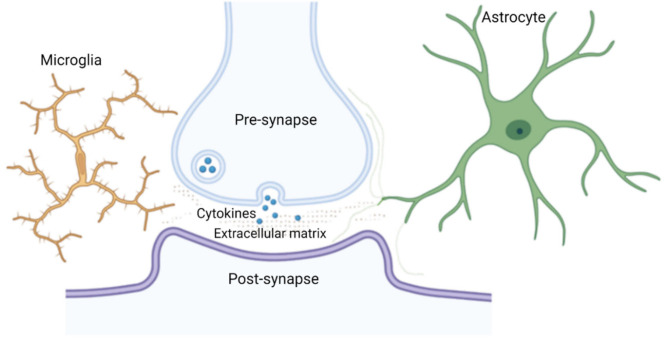
Microglial cell processes form part of a subset of synaptic contacts that have been dubbed microglial tetra-partite or quad-partite synapses. Since tetrapartite may also refer to the presence of extracellular matrix components, we propose the more precise term microglial penta-partite synapse for synapses that show a microglial cell process in close physical proximity to neuronal and astrocytic synaptic constituents. Microglial cells are now recognised as key players in central nervous system (CNS) synaptic changes. When synaptic plasticity involving microglial penta-partite synapses occurs, microglia may utilise their cytokine arsenal to facilitate the generation of new synapses, eliminate those that are not needed anymore, or modify the molecular and structural properties of the remaining synaptic contacts. In addition, microglia–synapse contacts may develop de novo under pathological conditions. Microglial penta-partite synapses have received comparatively little attention as unique sites in the CNS where microglial cells, cytokines and other factors they release have a direct influence on the connections between neurons and their function. It concerns our understanding of the penta-partite synapse where the confusion created by the term “neuroinflammation” is most counterproductive. The mere presence of activated microglia or the release of their cytokines may occur independent of inflammation, and penta-partite synapses are not usually active in a neuroimmunological sense. Clarification of these details is the main purpose of this review, specifically highlighting the relationship between microglia, synapses, and the cytokines that can be released by microglial cells in health and disease.
Overview
The claims and statistics of this paper haven’t been checked yet.
Free: it reads the open-access text and checks the first 5 claims that cite a source we can check. Create a free account to check every claim.
Integrity signals
Registry
Cites
Statistics
Figures
Verification
Claims the paper makes
The claims and statistics of this paper haven’t been checked yet.
Free: it reads the open-access text and checks the first 5 claims that cite a source we can check. Create a free account to check every claim.
Claims other papers make about this one
Each is checked against this paper’s own text: does it say what the citing paper says it does?
The cited source says what the claim attributes to it.
In the citing paper
“In addition to the tripartite synapse, the more recent concepts of the four-part extracellular matrix and the microglial five-part synapse 220 also support the idea that glial dysfunction plays key roles in the early pathological features common to psychiatric disorders. 221 , 222”
From Major depressive disorder: hypothesis, mechanism, prevention and treatment (2024) · cites this paper as [220]
Experimental — accuracy not yet measured
Self-check
Percentages, sums and reported differences re-computed from the paper’s own numbers.
The self-check needs the paper’s full text.
Citations
Cites
Polazzi, E., Mengoni, I., Caprini, M., Peña-Altamira, E., Kurtys, E., & Monti, B. (2013) · Neurosignals · doi:10.1159/000337115 · Cited by 8,994
Zhang, Y., Chen, K., Sloan, S. A., Bennett, M. L., Scholze, A. R., O'Keeffe, S., Phatnani, H. P., Guarnieri, P., Caneda, C., Ruderisch, N., et al. (2014) · The Journal of Neuroscience · doi:10.1523/jneurosci.1860-14.2014 · Cited by 4,875 · cited 2×
“Murine brain microglia express all genes required for glycolytic and oxidative energy metabolism, including the expression of transporters for all energy substrates [13,88,89].”
BackgroundSynaptic Pruning by Microglia Is Necessary for Normal Brain Development
Paolicelli, R. C., Bolasco, G., Pagani, F., Maggi, L., Scianni, M., Panzanelli, P., Giustetto, M., Ferreira, T. A., Guiducci, E., Dumas, L., et al. (2011) · Science · doi:10.1126/science.1202529 · Cited by 4,244
Microglia Sculpt Postnatal Neural Circuits in an Activity and Complement-Dependent Manner
Schafer, D. P., Lehrman, E. K., Kautzman, A. G., Koyama, R., Mardinly, A. R., Yamasaki, R., Ransohoff, R. M., Greenberg, M. E., Barres, B. A., & Stevens, B. (2012) · Neuron · doi:10.1016/j.neuron.2012.03.026 · Cited by 4,089 · cited 1×
“Microglia are also known to be stimulated by neuronal activity-dependent mechanisms to eliminate excessive synapses during neurodevelopment [108].”
BackgroundATP mediates rapid microglial response to local brain injury in vivo
Davalos, D., Grutzendler, J., Yang, G., Kim, J. V., Zuo, Y., Jung, S., Littman, D. R., Dustin, M. L., & Gan, W.-B. (2005) · Nature Neuroscience · doi:10.1038/nn1472 · Cited by 3,913 · cited 3×
“Furthermore, the absence of P2Y12 has been shown to lead to impaired microglia process motility following injury [48].”
BackgroundThe Classical Complement Cascade Mediates CNS Synapse Elimination
Stevens, B., Allen, N. J., Vazquez, L. E., Howell, G. R., Christopherson, K. S., Nouri, N., Micheva, K. D., Mehalow, A. K., Huberman, A. D., Stafford, B., et al. (2007) · Cell · doi:10.1016/j.cell.2007.10.036 · Cited by 3,313
Microglia promote learning-dependent synapse formation through brain-derived neurotrophic factor
Parkhurst, C. N., Yang, G., Ninan, I., Savas, J. N., Yates, J. R., Lafaille, J. J., Hempstead, B. L., Littman, D. R., & Gan, W.-B. (2013) · Cell · doi:10.1016/j.cell.2013.11.030 · Cited by 2,599
Tripartite synapses: glia, the unacknowledged partner
Araque, A., Parpura, V., Sanzgiri, R. P., & Haydon, P. G. (1999) · Trends in Neurosciences · doi:10.1016/s0166-2236(98)01349-6 · Cited by 2,529 · cited 1×
“The concept of the synapse has evolved over the last two decades from involving pre- and post- synaptic neuronal elements to including a third element—astrocytes—resulting in a ‘tripartite’ synapse [3].”
BackgroundHammond, T. R., Dufort, C., Dissing-Olesen, L., Giera, S., Young, A., Wysoker, A., Walker, A. J., Segel, M., Nemesh, J., Saunders, A., et al. (2018) · doi:10.1101/406140 · Cited by 2,225 · cited 1×
“Other studies have demonstrated the expression of several cytokines in different CNS cell types in both humans and animal models under physiological conditions, including retina Muller glial cells [62], cerebellar neurons and glia [63], as well as microglia obtained from human brain tissues [64,65].”
Synaptic scaling mediated by glial TNF-α
Stellwagen, D., & Malenka, R. C. (2006) · Nature · doi:10.1038/nature04671 · Cited by 1,715
Cited by
Major depressive disorder: hypothesis, mechanism, prevention and treatment
Cui, L., Li, S., Wang, S., Wu, X., Liu, Y., Yu, W., Wang, Y., Tang, Y., Xia, M., & Li, B. (2024) · Signal Transduction and Targeted Therapy · doi:10.1038/s41392-024-01738-y · Cited by 1,244
“219 In addition to the tripartite synapse, the more recent concepts of the four-part extracellular matrix and the microglial fi ve-part synapse 220 also support the idea that glial dysfunction plays key roles in the early pathological features common to psychiatric disorders.”
BackgroundMicroglia morphophysiological diversity and its implications for the CNS
Vidal-Itriago, A., Radford, R. A. W., Aramideh, J. A., Maurel, C., Scherer, N. M., Don, E. K., Lee, A., Chung, R. S., Graeber, M. B., & Morsch, M. (2022) · Frontiers in Immunology · doi:10.3389/fimmu.2022.997786 · Cited by 407
Self-citationMicroglial Activation and Priming in Alzheimer’s Disease: State of the Art and Future Perspectives
Bivona, G., Iemmolo, M., Agnello, L., Sasso, B. L., Gambino, C. M., Giglio, R. V., Scazzone, C., Ghersi, G., & Ciaccio, M. (2023) · International Journal of Molecular Sciences · doi:10.3390/ijms24010884 · Cited by 80
Bioelectronic Medicine: a multidisciplinary roadmap from biophysics to precision therapies
González‐González, M. A., Conde, S. V., Latorre, R., Thébault, S. C., Pratelli, M., Spitzer, N. C., Verkhratsky, A., Tremblay, M., Akçora, C. G., Hernandez-Reynoso, A. G., et al. (2024) · Frontiers in Integrative Neuroscience · doi:10.3389/fnint.2024.1321872 · Cited by 50
The Role of Glial Cells in the Pathophysiology of Epilepsy
Onat, F., Andersson, M., & Çarçak, N. (2025) · Cells · doi:10.3390/cells14020094 · Cited by 38
Verkhratsky, A., & Butt, A. M. (2023) · Elsevier eBooks · doi:10.1016/b978-0-12-821565-4.00008-0 · Cited by 32
New Insights into Microglial Mechanisms of Memory Impairment in Alzheimer’s Disease
Li, N., Deng, M., Hu, G., Li, N., Yuan, H., & Zhou, Y. (2022) · Biomolecules · doi:10.3390/biom12111722 · Cited by 35
VanderZwaag, J., Halvorson, T., Dolhan, K., Šimončičová, E., Ben‐Azu, B., & Tremblay, M. (2022) · Neurochemical Research · doi:10.1007/s11064-022-03772-0 · Cited by 30
You, Y., Chen, Z., & Hu, W. (2024) · Pharmacology & Therapeutics · doi:10.1016/j.pharmthera.2024.108606 · Cited by 27
What Is the Role of Cytokines in Synaptic Transmission?
Benarroch, E. E. (2024) · Neurology · doi:10.1212/wnl.0000000000209928 · Cited by 24
Tolédano, A., Rodríguez‐Casado, A., Álvarez, M., & Toledano‐Díaz, A. (2024) · Brain Sciences · doi:10.3390/brainsci14111101 · Cited by 21
Astrocyte Ezrin defines resilience to stress-induced depressive behaviours in mice
Lin, S.-S., Zhou, B., Liu, S.-L., Ren, X.-Y., Guo, J., Tong, J.-L., Chen, B., Jiang, R., Semyanov, A. V., Yi, C., et al. (2025) · National Science Review · doi:10.1093/nsr/nwaf480 · Cited by 21
Molecular Landscape of Tourette’s Disorder
Widomska, J., Witte, W. D., Buitelaar, J. K., Glennon, J. C., & Poelmans, G. (2023) · International Journal of Molecular Sciences · doi:10.3390/ijms24021428 · Cited by 16
Guidolin, D., Tortorella, C., Marcoli, M., Cervetto, C., Maura, G., & Agnati, L. F. (2023) · Neuropharmacology · doi:10.1016/j.neuropharm.2023.109509 · Cited by 13
When the Stars Misfire: Astrocytic Dysfunctions in Major Depressive Disorder
González-Arias, C., & Perea, G. (2025) · Neurochemical Research · doi:10.1007/s11064-025-04483-y · Cited by 16
General Pathophysiology of Microglia
Tremblay, M., & Verkhratsky, A. (2024) · Advances in neurobiology · doi:10.1007/978-3-031-55529-9_1 · Cited by 14
More Attention on Segments Remote from the Primary Spinal Cord Lesion Site
Chelyshev, Y. A. (2022) · Frontiers in Bioscience-Landmark · doi:10.31083/j.fbl2708235 · Cited by 12
Nicotine is an Immunosuppressant: Implications for Women's Health and Disease
White, A. M., Craig, A. J., Richie, D. L., Corley, C. L., Sadek, S. M., Barton, H. N., & Gipson, C. D. (2024) · Journal of Neuroimmunology · doi:10.1016/j.jneuroim.2024.578468 · Cited by 11
Bibliometric and visual analysis of microglia-related neuropathic pain from 2000 to 2021
Zhang, S.-B., Zhao, G., Lv, T.-R., Gong, C.-Y., Shi, Y., Nan, W., & Zhang, H. (2023) · Frontiers in Molecular Neuroscience · doi:10.3389/fnmol.2023.1142852 · Cited by 7
Marcoli, M., Agnati, L. F., Franco, R., Cortelli, P., Anderlini, D., Guidolin, D., Cervetto, C., & Maura, G. (2023) · Frontiers in Endocrinology · doi:10.3389/fendo.2022.1038874 · Cited by 7
Mitra, S., Gera, R., Sundheimer, J. K., Lemee, M., Wahlberg, L. U., Linderoth, B., Eriksdotter, M., & Behbahani, H. (2022) · International Journal of Molecular Sciences · doi:10.3390/ijms23169011 · Cited by 6
Curing the brain: in search for new astrocyte-specific therapies
Verkhratsky, A., Lee, C. J., Chun, H., Göritz, C., Harkany, T., Lee, J., Lee, S., Lindskog, M., Koh, W., Mulder, J., et al. (2026) · Experimental & Molecular Medicine · doi:10.1038/s12276-026-01712-4 · Cited by 9
McDaid, G., Vanek, J., Cromer, B. A., & Sümer, H. (2025) · Biomedicines · doi:10.3390/biomedicines13112783 · Cited by 2
Organoid–microglia system for modeling the immune microenvironment of the brain and retina
Yu, J., Tang, B., Gu, Z., Wang, G., & Liu, A. (2026) · Frontiers in Immunology · doi:10.3389/fimmu.2026.1747589 · Cited by 4
Evolution of Oligodendroglia and Myelin
Verkhratsky, A., Yi, C., Niu, J., & Butt, A. M. (2025) · Advances in neurobiology · doi:10.1007/978-3-031-87919-7_2 · Cited by 3
Neuroglia in the healthy brain
Verkhratsky, A., Hol, E. M., de Witte, L. D., & Aronica, E. (2025) · Handbook of clinical neurology · doi:10.1016/b978-0-443-19104-6.00008-5 · Cited by 2
Harry, G. J. (2022) · Advances in neurotoxicology · doi:10.1016/bs.ant.2022.06.001 · Cited by 2
The brain as a “hyper-network”: impact on neurophysiology and neuropharmacology
Guidolin, D., Tortorella, C., Anderlini, D., Marcoli, M., & Agnati, L. F. (2024) · Italian Journal of Anatomy and Embryology · doi:10.36253/ijae-15710 · Cited by 1
White, A. M., Craig, A. J., Richie, D. L., Corley, C. L., Bondy, E. O., Kendrick, P. T., McManus, H., Sadek, S. M., Scofield, M. D., & Gipson, C. D. (2025) · bioRxiv (Cold Spring Harbor Laboratory) · doi:10.1101/2025.03.18.643780 · Cited by 1
Verkhratsky, A., & Butt, A. M. (2023) · Elsevier eBooks · doi:10.1016/b978-0-12-821565-4.00005-5
Górecki, D. C., Patel, A. M., Pomeroy, J., & Verkhratsky, A. (2025) · Neurochemical Research · doi:10.1007/s11064-025-04464-1
Pain in 4D: How Do Early Life Events Create Susceptibilities to Pain
Johnston, C. H., Evans, S. G., Marini, D., Barratt, D. T., Mustafa, S., Agne, G. F., & Hutchinson, M. R. (2026) · Springer eBooks · doi:10.1007/978-3-032-11407-5_9
The neuroimmune-glutamate hypothesis of addiction
Gipson, C. D., White, A. M., Richie, D. L., McNealy, K. R., Stoops, W. W., & Ornelas, L. C. (2026) · Neuroscience & Biobehavioral Reviews · doi:10.1016/j.neubiorev.2026.106859
Utility of the Recombinase Driver CX3CR1-ERT2 Rat Strain in Nicotine Self-Administration
White, A. M., Craig, A. J., Richie, D. L., Corley, C. L., Bondy, E. O., Kendrick, P. T., McManus, H., Sadek, S. M., Scofield, M. D., & Gipson, C. D. (2026) · Cells · doi:10.3390/cells15161445 · Cited by 1
Saha, P. K., Rowe, R. K., Boison, D., & Shandra, O. O. (2026) · Experimental Neurology · doi:10.1016/j.expneurol.2026.115981 · Cited by 2
Metadata
- Authors
- Aramideh, J. A., Vidal-Itriago, A., Morsch, M., & Graeber, M. B.
- Affiliations
- The University of Sydney (AU)
- Faculty of Medicine, Health & Human Sciences, Macquarie Medical School, Macquarie University, Sydney, NSW 2109, Australia
- Macquarie University (AU)
- Corresponding author
- Graeber, Manuel B.
- Venue
- International Journal of Molecular Sciences
- Publisher
- MDPI AG
- Published
- 2021-12-07
- Volume
- 22
- Issue
- 24
- Pages
- 13186
- ISSN
- 1422-0067 (ISSN-L)
- PMC
- PMC8708012
- OpenAlex
- W4200551967
- Cited by
- 35
- References
- 190
- Citations by year
- 2026: 6 · 2025: 8 · 2024: 8 · 2023: 7 · 2022: 6
- FWCI
- 0.61
- Type
- journal article
- Language
- en
- Open access
- gold
- doi.org
- Licence
- Locations
- International Journal of Molecular Sciences (publishedVersion, cc-by)
- PubMed Central (publishedVersion, cc-by)
- PubMed (publishedVersion)
- DOAJ (DOAJ: Directory of Open Access Journals) (submittedVersion, cc-by-sa)
- Funders
- Australian Research Council (DP150104472, DP210103469)
- Topics
- Life Sciences › Neuroscience › Neurology › Neuroinflammation and Neurodegeneration Mechanisms
- Life Sciences › Neuroscience › Cellular and Molecular Neuroscience › Neuroscience and Neuropharmacology Research
- Life Sciences › Neuroscience › Biological Psychiatry › Tryptophan and brain disorders
- Keywords
- microglia, cytokine signaling, synaptic plasticity, neuroinflammation, microglial activation, astrocytes, synaptogenesis, neuroimmunology
- MeSH terms
- Animals, Gene Expression Regulation, Humans, Neuronal Plasticity, Synapses, Signal Transduction, Cytokines, Microglia
About these checks
Registry, retraction, Cites and statistics results are computed, not judged, with one exception: a printed reference that no index lists is read once by a model before it counts as a citation error. Claims are extracted by a model and kept only when their quote appears verbatim in the text; each cited source is then checked, with a model’s help, for whether it says what the claim relies on. Those verdicts can be wrong — read the claim’s quote and the cited source before relying on one.
Statistics and arithmetic are recomputed, not judged.
Confidence bands are shown only for fields calibrated on our annotated test set. None is calibrated yet, so no band is shown.
What counts as a claim ›How we measure confidence ›How we check this ›
Are you an author, or do you see a problem with this page? Request a review
Data sources
Bibliographic data: Semantic Scholar, OpenAlex, Crossref.
Contains information from the Semantic Scholar Academic Graph Datasets, made available under the ODC Attribution License (ODC-BY 1.0).
Semantic Scholar’s data is described in: Kinney, R., et al. (2023). The Semantic Scholar Open Data Platform. arXiv:2301.10140.
