

A Pan-RNase Inhibitor Enabling CRISPR-mRNA Platforms for Engineering of Primary Human Monocytes
Open accessThe DOI matches its Crossref record; 76 of the 77 references it cites were found in a registry or an index.
Abstract
Monocytes and their downstream effectors are critical components of the innate immune system. Monocytes are equipped with chemokine receptors, allowing them to migrate to various tissues, where they can differentiate into macrophage and dendritic cell subsets and participate in tissue homeostasis, infection, autoimmune disease, and cancer. Enabling genome engineering in monocytes and their effector cells will facilitate a myriad of applications for basic and translational research. Here, we demonstrate that CRISPR-Cas9 RNPs can be used for efficient gene knockout in primary human monocytes. In addition, we demonstrate that intracellular RNases are likely responsible for poor and heterogenous mRNA expression as incorporation of pan-RNase inhibitor allows efficient genome engineering following mRNA-based delivery of Cas9 and base editor enzymes. Moreover, we demonstrate that CRISPR-Cas9 combined with an rAAV vector DNA donor template mediates site-specific insertion and expression of a transgene in primary human monocytes. Finally, we demonstrate that SIRPa knock-out monocyte-derived macrophages have enhanced activity against cancer cells, highlighting the potential for application in cellular immunotherapies.
Overview
The claims and statistics of this paper haven’t been checked yet.
Free: it reads the open-access text and checks the first 5 claims that cite a source we can check. Create a free account to check every claim.
Integrity signals
Registry
Cites
Statistics
Figures
Verification
Claims the paper makes
The claims and statistics of this paper haven’t been checked yet.
Free: it reads the open-access text and checks the first 5 claims that cite a source we can check. Create a free account to check every claim.
Claims other papers make about this one
Each is checked against this paper’s own text: does it say what the citing paper says it does?
The source backs part of the claim, not all of it — or backs it for a different population, condition or comparison.
In the citing paper
“Some cell types, such as primary human natural killer (NK) cells and monocytes, may benefit from addition of RNase inhibitor (Millipore Sigma, Cat #3335399001) to reduce degradation of the mRNA and gRNA by endogenous RNases.27,54”
From Adenine base editor for knockout of proteins: A practical guide from design to analysis with updated MultiEditRbatch (2026) · cites this paper as [54]
Experimental — accuracy not yet measured
Self-check
Percentages, sums and reported differences re-computed from the paper’s own numbers.
The self-check needs the paper’s full text.
Citations
Cites
Programmable editing of a target base in genomic DNA without double-stranded DNA cleavage
Komor, A. C., Kim, Y. B., Packer, M. S., Zuris, J. A., & Liu, D. R. (2016) · Nature · doi:10.1038/nature17946 · Cited by 5,437 · cited 2×
“However, alternative genome editing methods that do not create DSBs, such as DNA base editors, can largely circumvent these issues [27,51].”
BackgroundSearch-and-replace genome editing without double-strand breaks or donor DNA
Anzalone, A. V., Randolph, P. B., Davis, J. R., Sousa, A. A., Koblan, L. W., Levy, J. M., Chen, P. J., Wilson, C., Newby, G. A., Raguram, A., et al. (2019) · Nature · doi:10.1038/s41586-019-1711-4 · Cited by 4,767 · cited 1×
“Delivery of CRISPR-Cas9-based systems using an mRNA format instead of RNP would allow for more flexibility and broader applications, particularly when specific editing enzyme proteins are not readily producible; for example, as noted with base editors and the prime editing systems [40,41].”
BackgroundMacrophage biology in development, homeostasis and disease
Wynn, T. A., Chawla, A., & Pollard, J. W. (2013) · Nature · doi:10.1038/nature12034 · Cited by 4,684
Programmable base editing of A•T to G•C in genomic DNA without DNA cleavage
Gaudelli, N. M., Komor, A. C., Rees, H. A., Packer, M. S., Badran, A. H., Bryson, D. I., & Liu, D. R. (2017) · Nature · doi:10.1038/nature24644 · Cited by 4,184 · cited 3×
“However, alternative genome editing methods that do not create DSBs, such as DNA base editors, can largely circumvent these issues [28,52].”
BackgroundFate Mapping Reveals Origins and Dynamics of Monocytes and Tissue Macrophages under Homeostasis
Yona, S., Kim, K.-W., Wolf, Y., Mildner, A., Varol, D., Breker, M., Strauss-Ayali, D., Viukov, S., Guilliams, M., Misharin, A., et al. (2013) · Immunity · doi:10.1016/j.immuni.2012.12.001 · Cited by 3,245
Development of Monocytes, Macrophages, and Dendritic Cells
Geissmann, F., Manz, M. G., Jung, S., Sieweke, M. H., Merad, M., & Ley, K. (2010) · Science · doi:10.1126/science.1178331 · Cited by 3,049
Dendritic cells in cancer immunology and immunotherapy
Wculek, S. K., Cueto, F. J., Mujal, A. M., Melero, I., Krummel, M. F., & Sancho, D. (2020) · Nature Reviews Immunology · doi:10.1038/s41577-019-0210-z · Cited by 2,574
mRNA-based therapeutics--developing a new class of drugs
Sahin, U., Karikó, K., & Türeci, Ö. (2014) · Nature Reviews Drug Discovery · doi:10.1038/nrd4278 · Cited by 2,474 · cited 1×
“Monocytes are a critical component of the innate immune response and are thus equipped with various intracellular response mechanisms to detect foreign genetic material [42,43].”
BackgroundEasy quantitative assessment of genome editing by sequence trace decomposition
Brinkman, E. K., Chen, T., Amendola, M., & van Steensel, B. (2014) · Nucleic Acids Research · doi:10.1093/nar/gku936 · Cited by 2,390 · cited 1×
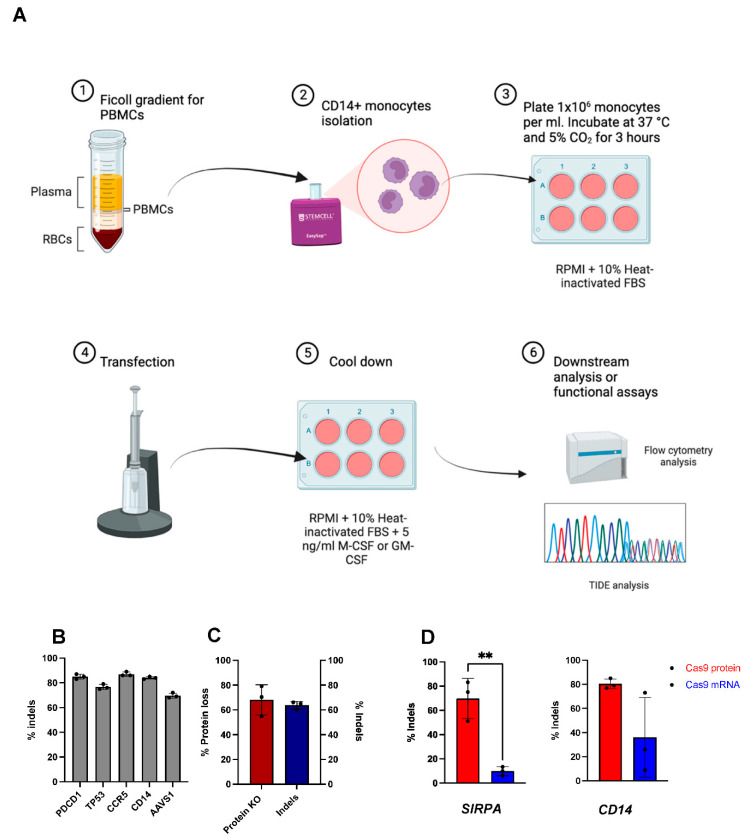
“CRISPR-Cas9 ribonucleoproteins (RNPs) complexes with these chemically modified sgRNAs were then individually electroporated into monocytes and the cells were cultured for 5 days before Sanger sequencing and analysis for non-homologous end joining derived insertions/deletions (indels), using the TIDE algorithm [35].”
MethodFrom Monocytes to M1/M2 Macrophages: Phenotypical vs. Functional Differentiation
Italiani, P., & Boraschi, D. (2014) · Frontiers in Immunology · doi:10.3389/fimmu.2014.00514 · Cited by 2,067
Cited by
Skeate, J. G., Pomeroy, E. J., Slipek, N. J., Jones, B. J., Wick, B. J., Chang, J., Lahr, W. S., Stelljes, E. M., Patrinostro, X., Barnes, B., et al. (2024) · Molecular Therapy · doi:10.1016/j.ymthe.2024.04.024 · Cited by 34
“61 However, there are very limited data available on the expression of ribonucleases in NK cells in resting or activated states.”
Muneekaew, S., Sasithong, P., Chupradit, K., Saiprayong, K., Nuchphongsai, T., & Wattanapanitch, M. (2025) · FEBS Journal · doi:10.1111/febs.70192 · Cited by 12
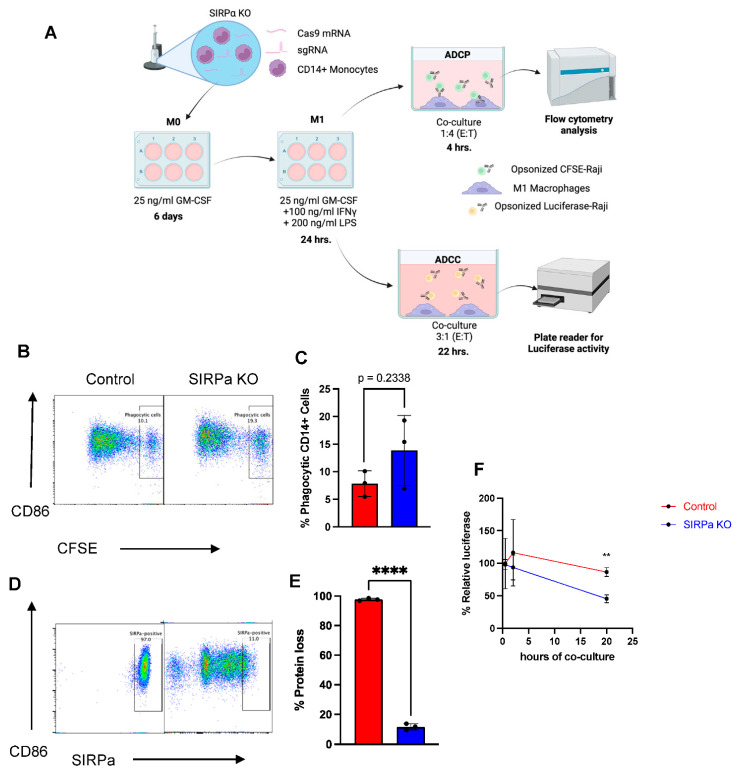
“[20] demonstrated that human macrophages derived from the SIRP a KO monocytes had enhanced phagocytic activity against rituximab-opsonized Raji cells.”
Eaton, E. J., Wick, B. J., Chacón, J. S., Wang, A. J., Kluesner, M., Barnes, J. T., Kar, B., Wang, M., Johnson, M. J., Skeate, J. G., et al. (2026) · Molecular Therapy Nucleic Acids · doi:10.1016/j.omtn.2026.102908 · Cited by 2
Molecular Targets for Cancer Immunotherapy: Focusing on (Immune and Tumor) Cell-Derived Metabolites
Quintans, R. D. T., de Freitas, Â. A., de Souza, M. M., Dias-Lopes, G., & Silva, R. C. M. C. (2026) · Applied Sciences · doi:10.3390/app16052461 · Cited by 1
Editing of ADA2 Point Mutation in Human Hematopoietic Stem CellsPreprint
Kopcil, P., Ervik, C. W., Reint, G., Mamia, K., Szymańska, M., Dahal‐Koirala, S., Conradi, J., Skjelbostad, S. F., Dønåsen, O. A., Jiang, X., et al. (2025) · bioRxiv (Cold Spring Harbor Laboratory) · doi:10.1101/2025.08.14.670303
Robbins, G. M., Chang, J., Krueger, J. B., Vue, Y. Y., Gilkey, A. K., Folsom, T. D., Jubenville, T. A., Skeate, J. G., Langworthy, B., Fitzgerald, K. M., et al. (2025) · Molecular Therapy Oncology · doi:10.1016/j.omton.2025.201119 · Cited by 2
Tackling anti-tumor macrophage function through genome engineering
Kaushal, R., Skeate, J. G., & Crane, A. T. (2026) · Molecular Therapy Oncology · doi:10.1016/j.omton.2026.201304
Metadata
- Authors
- Laoharawee, K., Johnson, M. J., Lahr, W. S., Sipe, C. J., Kleinboehl, E., Peterson, J. J., Lonetree, C.-L., Bell, J. B., Slipek, N. J., Crane, A. T., Webber, B. R., & Moriarity, B. S.
- Affiliations
- University of Minnesota (US)
- Corresponding author
- Moriarity, Branden S.
- ORCID
- Venue
- International Journal of Molecular Sciences
- Publisher
- MDPI AG
- Published
- 2022-08-28
- Volume
- 23
- Issue
- 17
- Pages
- 9749
- ISSN
- 1422-0067 (ISSN-L)
- PMC
- PMC9456164
- OpenAlex
- W4293426408
- Cited by
- 7
- References
- 77
- Citations by year
- 2026: 3 · 2025: 3 · 2024: 1
- FWCI
- 0.33
- Type
- journal article
- Language
- en
- Open access
- gold
- doi.org
- Licence
- Locations
- International Journal of Molecular Sciences (publishedVersion, cc-by)
- PubMed Central (publishedVersion, cc-by)
- PubMed (publishedVersion)
- DOAJ (DOAJ: Directory of Open Access Journals) (submittedVersion, cc-by-sa)
- Funders
- European Commission (282510, 2007–2013, FP7 2007-2013, FP7/2007)
- National Institute of Allergy and Infectious Diseases (R21AI163731)
- Topics
- Life Sciences › Biochemistry, Genetics and Molecular Biology › Molecular Biology › CRISPR and Genetic Engineering
- Life Sciences › Biochemistry, Genetics and Molecular Biology › Molecular Biology › RNA Interference and Gene Delivery
- Life Sciences › Biochemistry, Genetics and Molecular Biology › Molecular Biology › RNA regulation and disease
- Keywords
- CRISPR/Cas9, RNase inhibitor, genome editing, base editors, rAAV vectors, transgene integration, monocyte-derived macrophages, tumor cell killing, cellular immunotherapy, innate immunity
- MeSH terms
- Gene Editing, Endoribonucleases, Genetic Engineering, Humans, Monocytes, Ribonucleases, RNA, Messenger, Gene Knockout Techniques, CRISPR-Cas Systems
About these checks
Registry, retraction, Cites and statistics results are computed, not judged, with one exception: a printed reference that no index lists is read once by a model before it counts as a citation error. Claims are extracted by a model and kept only when their quote appears verbatim in the text; each cited source is then checked, with a model’s help, for whether it says what the claim relies on. Those verdicts can be wrong — read the claim’s quote and the cited source before relying on one.
Statistics and arithmetic are recomputed, not judged.
Confidence bands are shown only for fields calibrated on our annotated test set. None is calibrated yet, so no band is shown.
What counts as a claim ›How we measure confidence ›How we check this ›
Are you an author, or do you see a problem with this page? Request a review
Data sources
Bibliographic data: Semantic Scholar, OpenAlex, Crossref.
Contains information from the Semantic Scholar Academic Graph Datasets, made available under the ODC Attribution License (ODC-BY 1.0).
Semantic Scholar’s data is described in: Kinney, R., et al. (2023). The Semantic Scholar Open Data Platform. arXiv:2301.10140.
