

The DOI matches its Crossref record.
Relationship between IgE Levels Specific for Ragweed Pollen Extract, Amb a 1 and Cross-Reactive Allergen Molecules
Abstract
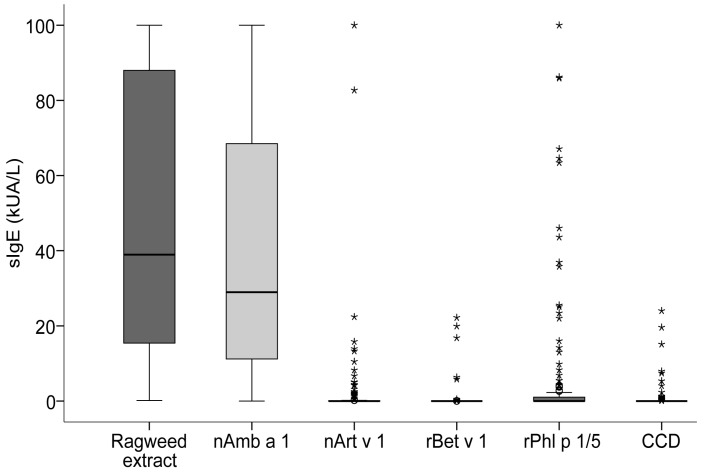
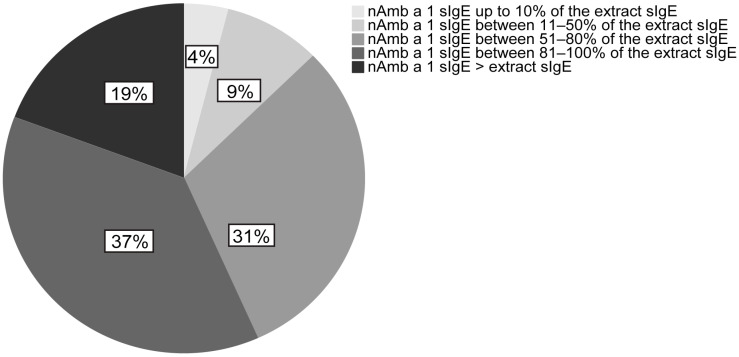
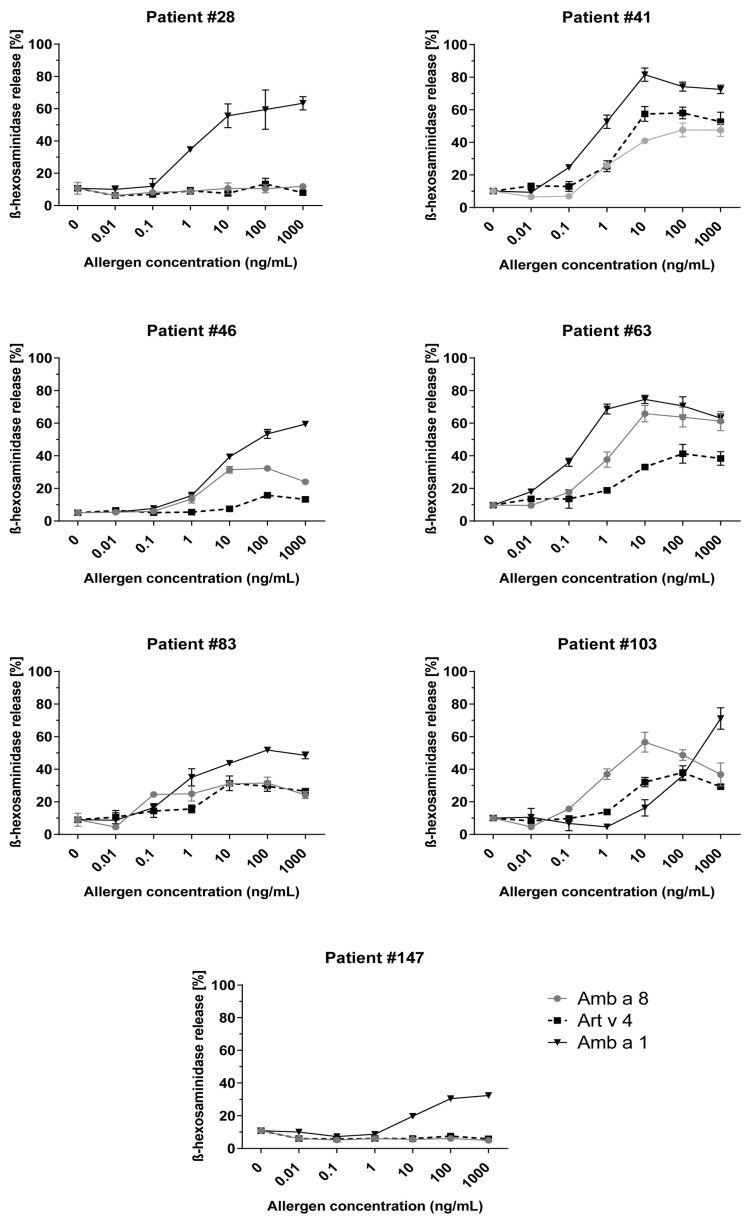
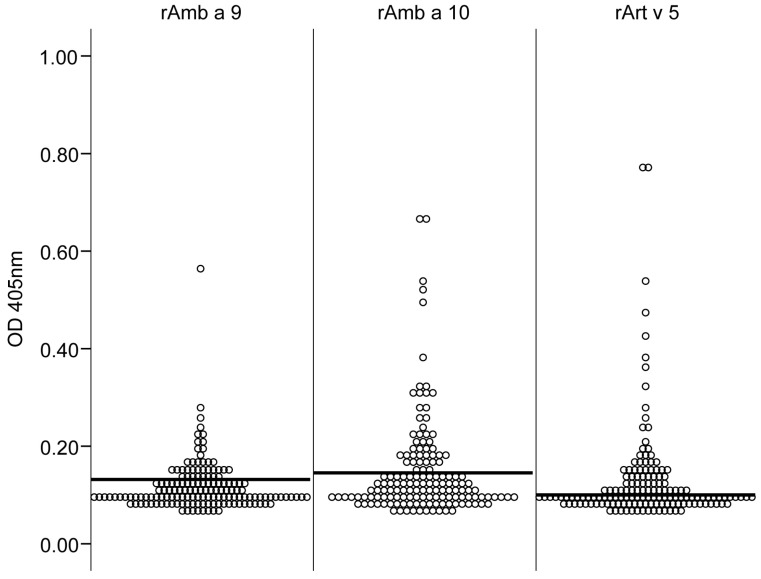
Ragweed (Ambrosia artemisiifolia) pollen is a major endemic allergen source responsible for severe allergic manifestations in IgE-sensitized allergic patients. It contains the major allergen Amb a 1 and cross-reactive allergen molecules, such as the cytoskeletal protein profilin, Amb a 8 and calcium-binding allergens Amb a 9 and Amb a 10. To assess the importance of Amb a 1, profilin and calcium-binding allergen, the IgE reactivity profiles of clinically well-characterized 150 ragweed pollen-allergic patients were analysed regarding specific IgE levels for Amb a 1 and cross-reactive allergen molecules by quantitative ImmunoCAP measurements, IgE ELISA and by basophil activation experiments. By quantifying allergen-specific IgE levels we found that Amb a 1-specific IgE levels accounted for more than 50% of ragweed pollen-specific IgE in the majority of ragweed pollen-allergic patients. However, approximately 20% of patients were sensitized to profilin and the calcium-binding allergens, Amb a 9 and Amb a 10, respectively. As shown by IgE inhibition experiments, Amb a 8 showed extensive cross-reactivity with profilins from birch (Bet v 2), timothy grass (Phl p 12) and mugwort pollen (Art v 4) and was identified as a highly allergenic molecule by basophil activation testing. Our study indicates that molecular diagnosis performed by the quantification of specific IgE to Amb a 1, Amb a 8, Amb a 9 and Amb a 10 is useful to diagnose genuine sensitization to ragweed pollen and to identify patients who are sensitized to highly cross-reactive allergen molecules present in pollen from unrelated plants, in order to enable precision medicine-based approaches for the treatment and prevention of pollen allergy in areas with complex pollen sensitization.
Overview
The claims and statistics of this paper haven’t been checked yet.
Run the check — free, no account needed. It reads the open-access text and checks the sources it cites.
Integrity signals
Registry
Cites
Statistics
Figures
Verification
Claims the paper makes
The claims and statistics of this paper haven’t been checked yet.
Run the check — free, no account needed. It reads the open-access text and checks the sources it cites.
Claims other papers make about this one
Each is checked against this paper’s own text: does it say what the citing paper says it does?
In the citing paper
“Profilins from pollens such as Bet v 2 from birch, Phl p 12 from grass pollen, and Amb a 8 from ragweed pollen play a crucial role as primary sensitizers in individuals who develop PFAS [136].”
From Pollen–Food Allergy Syndrome: Allergens, Clinical Insights, Diagnostic and Therapeutic Challenges (2024) · cites this paper as [136]
Self-check
Percentages, sums and reported differences re-computed from the paper’s own numbers.
The self-check needs the paper’s full text.
Citations
Cites
No references could be resolved yet.
Research works printed but not linked: 46
- Valenta, 2018, Molecular Aspects of Allergens and Allergy, Adv. Immunol., 138, 195, 10.1016/bs.ai.2018.03.002 · DOI
- Payne, 1964, A Re-Evaluation of the Genus Ambrosia (Compositae), J. Arnold Arbor., 45, 401, 10.5962/p.30872 · DOI
- Kiss, 2006, Anthropogenic Factors behind the Recent Population Expansion of Common Ragweed (Ambrosia Artemisiifolia L.) in Eastern Europe: Is There a Correlation with Political Transitions?, J. Biogeogr., 33, 2156, 10.1111/j.1365-2699.2006.01633.x · DOI
- Xu, 2006, The Status and Causes of Alien Species Invasion in China, Biodivers. Conserv., 15, 2893, 10.1007/s10531-005-2575-5 · DOI
- McFadyen, 1984, Annual Ragweed in Queensland, Proceedings of the Seventh Australian Weeds Conference, Volume 1, 205
- Essl, 2015, Biological Flora of the British Isles: Ambrosia Artemisiifolia, J. Ecol., 103, 1069, 10.1111/1365-2745.12424 · DOI
- Bassett, 1975, The biology of Canadian weeds: 11. Ambrosia Artemisiifolia L. and A. Psilostachya DC, Can. J. Plant Sci., 55, 463, 10.4141/cjps75-072 · DOI
- Siroux, 2017, Specific IgE and IgG Measured by the MeDALL Allergen-Chip Depend on Allergen and Route of Exposure: The EGEA Study, J. Allergy Clin. Immunol., 139, 643, 10.1016/j.jaci.2016.05.023 · DOI
- Smith, 2010, A Method for Producing Airborne Pollen Source Inventories: An Example of Ambrosia (Ragweed) on the Pannonian Plain, Agric. For. Meteorol., 150, 1203, 10.1016/j.agrformet.2010.05.002 · DOI
- Rasmussen, 2017, Climate-Change-Induced Range Shifts of Three Allergenic Ragweeds (Ambrosia L.) in Europe and Their Potential Impact on Human Health, PeerJ, 5, e3104, 10.7717/peerj.3104 · DOI
- Lu, 2022, Genetic Patterns Reveal Differences between the Invasion Processes of Common Ragweed in Urban and Non-Urban Ecosystems, Glob. Ecol. Conserv., 38, e02214, 10.1016/j.gecco.2022.e02214 · DOI
- Dahl, 1999, Ragweed–an Allergy Risk in Sweden?, Aerobiologia, 15, 293, 10.1023/A:1007678107552 · DOI
- Heinzerling, 2005, Standard Skin Prick Testing and Sensitization to Inhalant Allergens across Europe–a Survey from the GA2LEN Network, Allergy, 60, 1287, 10.1111/j.1398-9995.2005.00895.x · DOI
- Valenta, 2018, Allergen Extracts for In Vivo Diagnosis and Treatment of Allergy: Is There a Future?, J. Allergy Clin. Immunol. Pract., 6, 1845, 10.1016/j.jaip.2018.08.032 · DOI
- Santos, 2017, Making the Most of in Vitro Tests to Diagnose Food Allergy, J. Allergy Clin. Immunol. Pract., 5, 237, 10.1016/j.jaip.2016.12.003 · DOI
- Ansotegui, 2020, IgE Allergy Diagnostics and Other Relevant Tests in Allergy, a World Allergy Organization Position Paper, World Allergy Organ. J., 13, 100080, 10.1016/j.waojou.2019.100080 · DOI · Paper page
- Focke, 2009, Molecular Composition and Biological Activity of Commercial Birch Pollen Allergen Extracts, Eur. J. Clin. Investig., 39, 429, 10.1111/j.1365-2362.2009.02109.x · DOI
- Matricardi, 2016, EAACI Molecular Allergology User’s Guide, Pediatr. Allergy Immunol., 27, 1, 10.1111/pai.12563 · DOI · Paper page
- Valenta, 1999, The Recombinant Allergen-Based Concept of Component-Resolved Diagnostics and Immunotherapy (CRD and CRIT), Clin. Exp. Allergy, 29, 896, 10.1046/j.1365-2222.1999.00653.x · DOI · Paper page
- Pablos, 2017, Distinct Epitope Structures of Defensin-like Proteins Linked to Proline-rich Regions Give Rise to Differences in Their Allergenic Activity, Allergy, 73, 431, 10.1111/all.13298 · DOI
- Hamsten, 2017, ImmunoCAP Assays: Pros and Cons in Allergology, J. Allergy Clin. Immunol., 140, 974, 10.1016/j.jaci.2017.05.008 · DOI · Paper page
- Skevaki, 2017, Performance Evaluation of ImmunoCAP® ISAC 112: A Multi-Site Study, Clin. Chem. Lab. Med., 55, 571
- Buzzulini, 2019, Evaluation of a New Multiplex Assay for Allergy Diagnosis, Clin. Chim. Acta, 493, 73, 10.1016/j.cca.2019.02.025 · DOI
- Wopfner, 2008, Molecular and Immunological Characterization of Novel Weed Pollen Pan-allergens, Allergy, 63, 872, 10.1111/j.1398-9995.2008.01635.x · DOI
- Valenta, 1992, Profilins Constitute a Novel Family of Functional Plant Pan-Allergens, J. Exp. Med., 175, 377, 10.1084/jem.175.2.377 · DOI
- Niederberger, 2002, Recombinant Marker Allergens: Diagnostic Gatekeepers for the Treatment of Allergy, Int. Arch. Allergy Immunol., 127, 259, 10.1159/000057742 · DOI
- Ebo, 2004, Sensitization to Cross-reactive Carbohydrate Determinants and the Ubiquitous Protein Profilin: Mimickers of Allergy, Clin. Exp. Allergy, 34, 137, 10.1111/j.1365-2222.2004.01837.x · DOI
- Hemmer, 2001, Antibody Binding to Venom Carbohydrates Is a Frequent Cause for Double Positivity to Honeybee and Yellow Jacket Venom in Patients with Stinging-Insect Allergy, J. Allergy Clin. Immunol., 108, 1045, 10.1067/mai.2001.120013 · DOI
- Ianovici, 2013, Analysis of Airborne Allergenic Pollen Spectrum for 2009 in Timişoara, Romania, Aerobiologia, 29, 95, 10.1007/s10453-012-9266-y · DOI
- Chen, 2018, Ragweed Pollen Allergy: Burden, Characteristics, and Management of an Imported Allergen Source in Europe, Int. Arch. Allergy Immunol., 176, 163, 10.1159/000487997 · DOI
- Laaidi, 2003, Ragweed in France: An Invasive Plant and Its Allergenic Pollen, Ann. Allergy, Asthma Immunol., 91, 195, 10.1016/S1081-1206(10)62177-1 · DOI
- Ianovici, 2009, Comparative Analysis of Some Vernal Pollen Concentrations in Timisoara (Romania), Szeged (Hungary), Novi Sad (Serbia) and Ljubljana (Slovenia), Not. Bot. Horti Agrobot. Cluj-Napoca, 37, 49
- Norman, 1968, Immunotherapy of Hay Fever with Ragweed Antigen E: Comparisons with Whole Pollen Extract and Placebos, J. Allergy, 42, 93, 10.1016/0021-8707(68)90139-1 · DOI
- Buzan, 2022, Complex IgE Sensitization Patterns in Ragweed Allergic Patients: Implications for Diagnosis and Specific Immunotherapy, Clin. Transl. Allergy, 12, e12179, 10.1002/clt2.12179 · DOI
- Haidar, 2021, Symptom Patterns and Comparison of Diagnostic Methods in Ragweed Pollen Allergy, Exp. Ther. Med., 21, 525, 10.3892/etm.2021.9957 · DOI
- Jappe, 2017, Molecular Allergy Diagnostic Tests: Development and Relevance in Clinical Practice, Allergol. Sel., 1, 169, 10.5414/ALX01617E · DOI
- McKenna, 2016, How Relevant Is Panallergen Sensitization in the Development of Allergies?, Pediatr. Allergy Immunol., 27, 560, 10.1111/pai.12589 · DOI
- Curin, 2014, Microarrayed Dog, Cat, and Horse Allergens Show Weak Correlation between Allergen-Specific IgE and IgG Responses⋆, J. Allergy Clin. Immunol., 133, 918, 10.1016/j.jaci.2013.10.058 · DOI
- Gattinger, 2019, Recombinant Glycoproteins Resembling Carbohydrate-Specific IgE Epitopes from Plants, Venoms and Mites, EBioMedicine, 39, 33, 10.1016/j.ebiom.2018.12.002 · DOI
- Berings, 2020, Molecular Profiling of Allergen-Specific Antibody Responses May Enhance Success of Specific Immunotherapy, J. Allergy Clin. Immunol., 146, 1097, 10.1016/j.jaci.2020.03.029 · DOI
- Chen, 2019, Selection of House Dust Mite–Allergic Patients by Molecular Diagnosis May Enhance Success of Specific Immunotherapy, J. Allergy Clin. Immunol., 143, 1248, 10.1016/j.jaci.2018.10.048 · DOI
- Chen, 2008, Reduction of the in Vivo Allergenicity of Der p 2, the Major House-Dust Mite Allergen, by Genetic Engineering, Mol. Immunol., 45, 2486, 10.1016/j.molimm.2008.01.006 · DOI
- Weghofer, 2008, Characterization of Der p 21, a New Important Allergen Derived from the Gut of House Dust Mites, Allergy, 63, 758, 10.1111/j.1398-9995.2008.01647.x · DOI
- Nakamura, 2010, A Convenient and Sensitive Allergy Test: IgE Crosslinking-Induced Luciferase Expression in Cultured Mast Cells, Allergy Eur. J. Allergy Clin. Immunol., 65, 1266, 10.1111/j.1398-9995.2010.02363.x · DOI
- Takagi, 2003, Application of Human FcεRI α-Chain-Transfected RBL-2H3 Cells for Estimation of Active Serum IgE, Biol. Pharm. Bull., 26, 252, 10.1248/bpb.26.252 · DOI
- Wolf, 2017, Amb a 1 Isoforms: Unequal Siblings with Distinct Immunological Features, Allergy, 72, 1874, 10.1111/all.13196 · DOI
Cited by
Sorted by citations
Pollen–Food Allergy Syndrome: Allergens, Clinical Insights, Diagnostic and Therapeutic Challenges
Haidar, L., Bănărescu, C. F., Uța, C., Moldovan, S. I., Zimbru, E.-L., Zimbru, R.-I., Ciurariu, E., Georgescu, M., & Panaitescu, C. (2024) · Applied Sciences · doi:10.3390/app15010066 · Cited by 21
Self-citation
Metadata
- Authors
- Zbîrcea, L.-E., Buzan, M.-R., Grijincu, M., Babaev, E., Stolz, F., Valenta, R., Păunescu, V., Panaitescu, C., & Chen, K.-W.
- Venue
- International Journal of Molecular Sciences
- Publisher
- MDPI AG
- Published
- 2023-02-17
- Volume
- 24
- Issue
- 4
- Pages
- 4040
- ISSN
- 1422-0067
- PMC
- PMC9962666
- Cited by
- 22
- References
- 0
- Language
- en
- Funders
- National Authority for Scientific Research and Innovation (ANCSI), under the Operational Program Competitiveness 2014-2020, project INSPIRED (Innovative Strategies for Prevention, Diagnosis and Therapy of Ragweed Pollen Induced Respiratory Diseases). (COP 2014-2020 92/09.09.2016, MySMIS 103663, -)
- Danube Allergy Research Cluster program funded by the Country of Lower Austria (COP 2014-2020 92/09.09.2016, MySMIS 103663, -)
About these checks
Registry, retraction, Cites and statistics results are computed, not judged, with one exception: a printed reference that no index lists is read once by a model before it counts as a citation error. Claims are extracted by a model and kept only when their quote appears verbatim in the text; each cited source is then checked, with a model’s help, for whether it says what the claim relies on. Those verdicts can be wrong — read the claim’s quote and the cited source before relying on one.
Statistics and arithmetic are recomputed, not judged.
Confidence bands are shown only for fields calibrated on our annotated test set. None is calibrated yet, so no band is shown.
What counts as a claim ›How we measure confidence ›How we check this ›
Are you an author, or do you see a problem with this page? Request a review
