

The DOI matches its Crossref record; 355 of the 356 references it cites were found in a registry or an index.
The Dual Role of Mesenchymal Stem Cells in Cancer Pathophysiology: Pro-Tumorigenic Effects versus Therapeutic Potential
Open accessAbstract
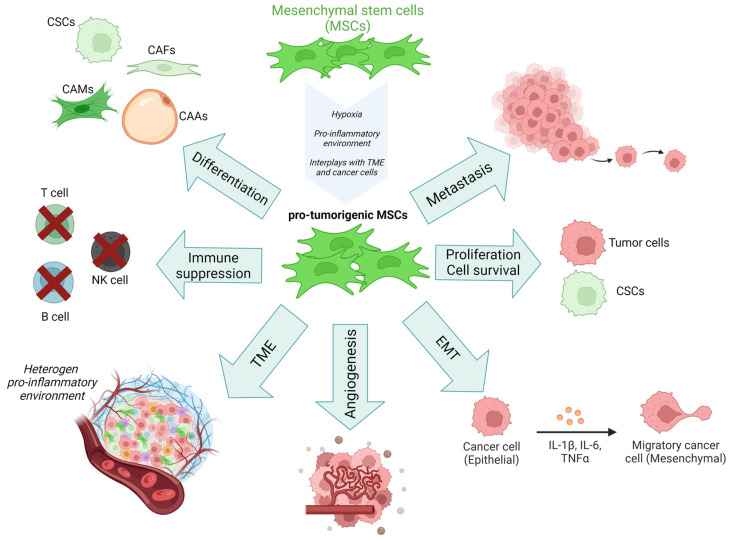
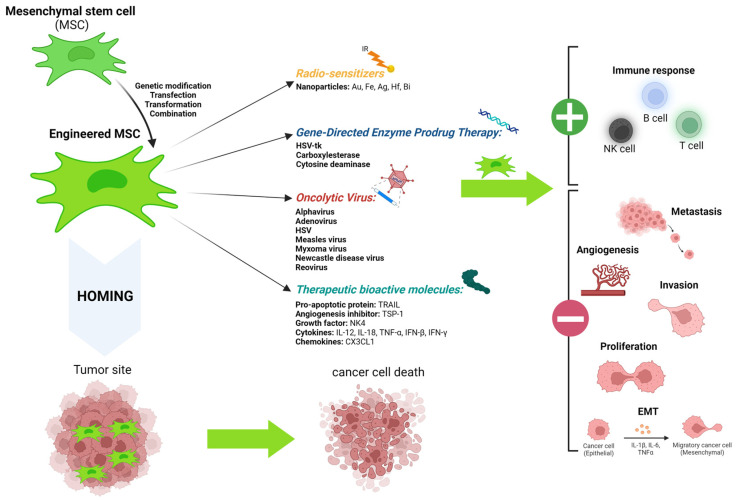
Mesenchymal stem/stromal cells (MSCs) are multipotent cells involved in numerous physiological events, including organogenesis, the maintenance of tissue homeostasis, regeneration, or tissue repair. MSCs are increasingly recognized as playing a major, dual, and complex role in cancer pathophysiology through their ability to limit or promote tumor progression. Indeed, these cells are known to interact with the tumor microenvironment, modulate the behavior of tumor cells, influence their functions, and promote distant metastasis formation through the secretion of mediators, the regulation of cell–cell interactions, and the modulation of the immune response. This dynamic network can lead to the establishment of immunoprivileged tissue niches or the formation of new tumors through the proliferation/differentiation of MSCs into cancer-associated fibroblasts as well as cancer stem cells. However, MSCs exhibit also therapeutic effects including anti-tumor, anti-proliferative, anti-inflammatory, or anti-oxidative effects. The therapeutic interest in MSCs is currently growing, mainly due to their ability to selectively migrate and penetrate tumor sites, which would make them relevant as vectors for advanced therapies. Therefore, this review aims to provide an overview of the double-edged sword implications of MSCs in tumor processes. The therapeutic potential of MSCs will be reviewed in melanoma and lung cancers.
Overview
The claims and statistics of this paper haven’t been checked yet.
Run the check — free, no account needed. It reads the open-access text and checks the sources it cites.
Integrity signals
Registry
Cites
Statistics
Figures
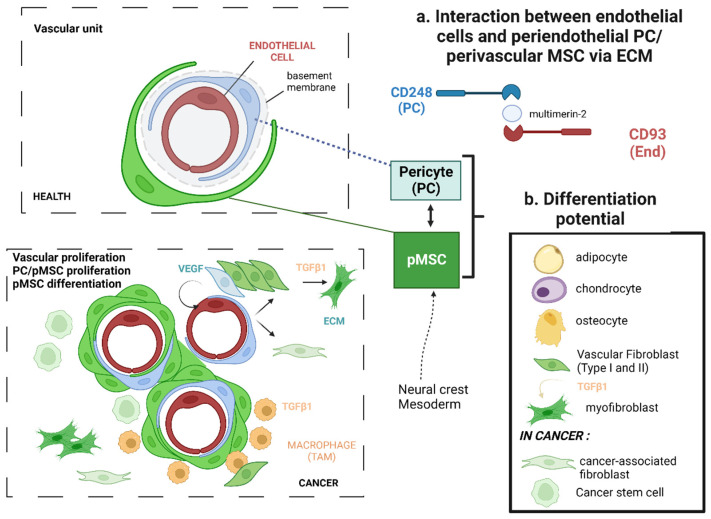
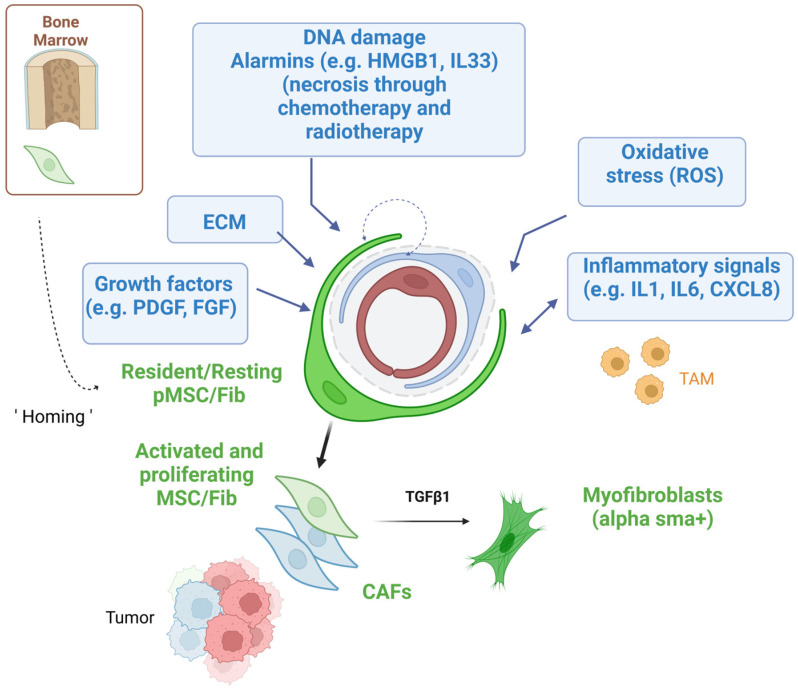
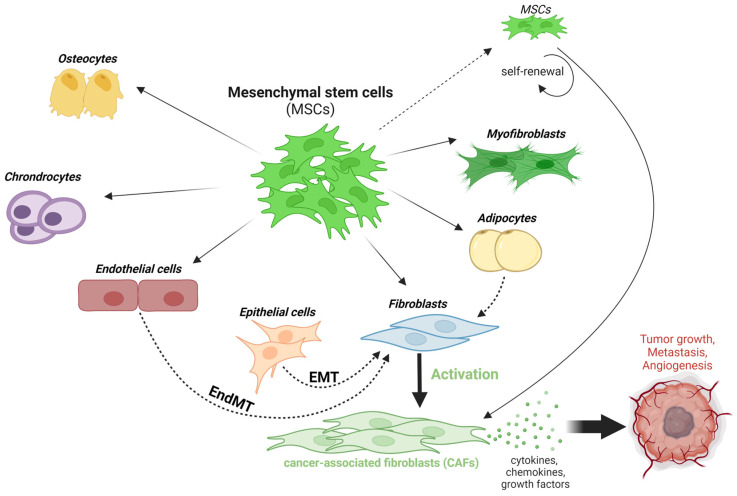
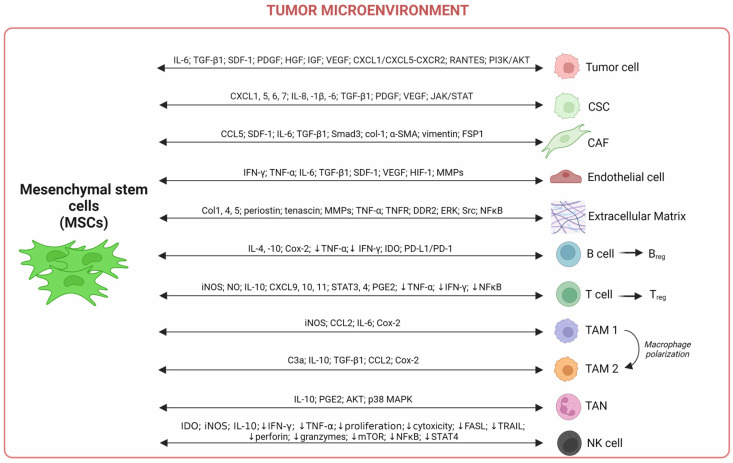
Verification
Claims the paper makes
The claims and statistics of this paper haven’t been checked yet.
Run the check — free, no account needed. It reads the open-access text and checks the sources it cites.
Claims other papers make about this one
Each is checked against this paper’s own text: does it say what the citing paper says it does?
The cited source says what the claim attributes to it.
In the citing paper
“The migration of MSC to the TME is regulated by numerous factors, including adhesion molecules (VCAM), chemokines (CCL2, CCL5, CCL22, CXCL8, and SDF-1/CXCL12), cytokines (IL-1, IL-6, TGF-β, and TNF-α), insulin GF (IGF-1), PDGF, hypoxia-inducible factor (HIF-1), reactive oxygen species (ROS), and many more [77].”
From Mesenchymal stromal cells in bone marrow niche of patients with multiple myeloma: a double-edged sword (2025) · cites this paper as [77]
Self-check
Percentages, sums and reported differences re-computed from the paper’s own numbers.
The self-check needs the paper’s full text.
Citations
Cites
1 retracted
RETRACTED: The Oncolytic Virus in Cancer Diagnosis and Treatment
Cao, G., He, X., Sun, Q., Chen, S., Wan, K. M., Xu, X., Feng, X., Li, P., Chen, B., & Xiong, M. (2020) · Frontiers in Oncology · doi:10.3389/fonc.2020.01786 · Cited by 109
RetractedSung, H., Ferlay, J., Siegel, R. L., Laversanne, M., Soerjomataram, I., Jemal, A., & Bray, F. (2021) · CA: A Cancer Journal for Clinicians · doi:10.3322/caac.21660 · Cited by 108,699
Hallmarks of Cancer: The Next Generation
Hanahan, D., & Weinberg, R. A. (2011) · Cell · doi:10.1016/j.cell.2011.02.013 · Cited by 66,590
Dominici, M., Le Blanc, K., Mueller, I., Slaper-Cortenbach, I., Marini, F. C., Krause, D. S., Deans, R. J., Keating, A., Prockop, D. J., & Horwitz, E. M. (2006) · Cytotherapy · doi:10.1080/14653240600855905 · Cited by 17,766
Siegel, R. L., Miller, K. D., Fuchs, H. E., & Jemal, A. (2022) · CA: A Cancer Journal for Clinicians · doi:10.3322/caac.21708 · Cited by 17,196
The Epithelial-Mesenchymal Transition Generates Cells with Properties of Stem Cells
Mani, S. A., Guo, W., Liao, M.-J., Eaton, E. N., Ayyanan, A., Zhou, A. Y., Brooks, M. W., Reinhard, F., Zhang, C. C., Shipitsin, M. V., et al. (2008) · Cell · doi:10.1016/j.cell.2008.03.027 · Cited by 8,839
Molecular mechanisms of epithelial–mesenchymal transition
Lamouille, S., Xu, J., & Derynck, R. (2014) · Nature Reviews Molecular Cell Biology · doi:10.1038/nrm3758 · Cited by 8,091
Multilineage Cells from Human Adipose Tissue: Implications for Cell-Based Therapies
Zuk, P. A., Zhu, M., Mizuno, H., Huang, J., Futrell, J. W., Katz, A. J., Benhaim, P., Lorenz, H. P., & Hedrick, M. H. (2001) · Tissue Engineering · doi:10.1089/107632701300062859 · Cited by 7,956
Human Adipose Tissue Is a Source of Multipotent Stem Cells
Zuk, P. A., Zhu, M., Ashjian, P. H., Ugarte, D. A. D., Huang, J. I., Mizuno, H., Alfonso, Z. C., Fraser, J. K., Benhaim, P., & Hedrick, M. H. (2002) · Molecular Biology of the Cell · doi:10.1091/mbc.e02-02-0105 · Cited by 6,762
Caplan, A. I. (1991) · Journal of Orthopaedic Research® · doi:10.1002/jor.1100090504 · Cited by 6,559
Research works printed but not linked: 1
- Birbrair, A. (2020). Tumor Microenvironment: Non-Hematopoietic Cells, Springer International Publishing. Advances in Experimental Medicine and Biology. · DOI
Cited by
Sorted by citations
Minev, T., Balbuena, S., Gill, J. M., Marincola, F. M., Kesari, S., & Lin, F. (2024) · Oncotarget · doi:10.18632/oncotarget.28672 · Cited by 34
Hoseinzadeh, A., Esmaeili, S., Sahebi, R., Melak, A. M., Mahmoudi, M., Hasannia, M., & Baharlou, R. (2025) · Stem Cell Research & Therapy · doi:10.1186/s13287-025-04158-z · Cited by 36
The Tumor Stroma of Squamous Cell Carcinoma: A Complex Environment That Fuels Cancer Progression
Buruiană, A., Gheban, B., Gheban-Roşca, I. A., Georgiu, C., Crișan, D., & Crişan, M. (2024) · Cancers · doi:10.3390/cancers16091727 · Cited by 32
Kamrani, S., Naseramini, R., Khani, P., Razavi, Z. S., Afkhami, H., Atashzar, M. R., Nasri, F., Alavimanesh, S., Saeidi, F., & Ronaghi, H. (2025) · Cancer Cell International · doi:10.1186/s12935-025-03741-x · Cited by 27
“…of MSC to the TME is regulated by numerous factors, including adhesion molecules (VCAM), chemokines (CCL2, CCL5, CCL22, CXCL8, and SDF-1/CXCL12), cytokines (IL-1, IL-6, TGF-β, and TNF-α), insulin GF (IGF-1), PDGF, hypoxia-inducible factor (HIF-1), reactive oxygen species (ROS), and many more [77].”
Radandish, M., Mashhadi, N., Aghayan, A. H., Taghizadeh, M., Salehianfard, S., Yahyazadeh, S., Vakili, O., & Igder, S. (2025) · Experimental Hematology and Oncology · doi:10.1186/s40164-025-00695-8 · Cited by 27
Metadata
- Authors
- Slama, Y., Ah-Pine, F., Khettab, M., Arcambal, A., Begue, M., Dutheil, F., & Gasque, P.
- Affiliations
- University of Reunion Island (RE)
- Laboratoire Interdisciplinaire de Recherche en Santé (LIRS), RunResearch, Clinique Sainte-Clotilde, 127 Route de Bois de Nèfles, 97400 Saint-Denis, La Réunion, France
- Clinifutur (RE)
- Corresponding author
- Slama, Youssef
- Venue
- International Journal of Molecular Sciences
- Publisher
- MDPI AG
- Published
- 2023-08-31
- Volume
- 24
- Issue
- 17
- Pages
- 13511
- ISSN
- 1422-0067 (ISSN-L)
- PMC
- PMC10488262
- OpenAlex
- W4386331467
- Cited by
- 57
- References
- 356
- Citations by year
- 2026: 13 · 2025: 22 · 2024: 21 · 2023: 1
- FWCI
- 2.67
- Type
- journal article
- Language
- en
- Open access
- gold
- doi.org
- Licence
- Locations
- International Journal of Molecular Sciences (publishedVersion, cc-by)
- PubMed Central (publishedVersion, cc-by)
- PubMed (publishedVersion)
- Funders
- EPIGEN project research (CPER FEDER 2019221-0022768)
- Topics
- Life Sciences › Biochemistry, Genetics and Molecular Biology › Cell Biology › Mesenchymal stem cell research
- Health Sciences › Medicine › Oncology › Cancer Cells and Metastasis
- Life Sciences › Immunology and Microbiology › Immunology › Immune cells in cancer
- Keywords
- mesenchymal stem cells, tumor microenvironment, tumor progression, metastasis, cancer-associated fibroblasts, cancer stem cells, tumor immunomodulation, melanoma, lung cancer, cell-cell interactions
- MeSH terms
- Humans, Lung Neoplasms, Melanoma, Multipotent Stem Cells, Tumor Microenvironment, Mesenchymal Stem Cells, Carcinogenesis
About these checks
Registry, retraction, Cites and statistics results are computed, not judged, with one exception: a printed reference that no index lists is read once by a model before it counts as a citation error. Claims are extracted by a model and kept only when their quote appears verbatim in the text; each cited source is then checked, with a model’s help, for whether it says what the claim relies on. Those verdicts can be wrong — read the claim’s quote and the cited source before relying on one.
Statistics and arithmetic are recomputed, not judged.
Confidence bands are shown only for fields calibrated on our annotated test set. None is calibrated yet, so no band is shown.
What counts as a claim ›How we measure confidence ›How we check this ›
Are you an author, or do you see a problem with this page? Request a review
