

Beyond NMDA Receptors: A Narrative Review of Ketamine’s Rapid and Multifaceted Mechanisms in Depression Treatment
Open accessThe DOI matches its Crossref record; 224 of the 225 references it cites were found in a registry or an index, and 1 are not checked yet.
Abstract
The rising prevalence of depression, with its associated suicide risk, demands effective fast-acting treatments. Ketamine has emerged as promising, demonstrating rapid antidepressant effects. While early studies show swift mood improvements, its precise mechanisms remain unclear. This article aims to compile and synthesize the literature on ketamine’s molecular actions. Ketamine primarily works by antagonizing NMDA receptors, reducing GABAergic inhibition, and increasing glutamate release. This enhanced glutamate activates AMPA receptors, triggering crucial downstream cascades, including BDNF-TrkB and mTOR pathways, promoting synaptic proliferation and regeneration. Moreover, neuroimaging studies have demonstrated alterations in brain networks involved in emotional regulation, including the Default Mode Network (DMN), Central Executive Network (CEN), and Salience Network (SN), which are frequently disrupted in depression. Despite the promising findings, the literature reveals significant inaccuracies and gaps in understanding the full scope of ketamine’s therapeutic potential. For instance, ketamine engages with opioid receptors, insinuating a permissive role of the opioid system in amplifying ketamine’s antidepressant effects, albeit ketamine does not operate as a direct opioid agonist. Further exploration is requisite to comprehensively ascertain its safety profile, long-term efficacy, and the impact of genetic determinants, such as BDNF polymorphisms, on treatment responsiveness.
Overview
The claims and statistics of this paper haven’t been checked yet.
Free: it reads the open-access text and checks the first 5 claims that cite a source we can check. Create a free account to check every claim.
Integrity signals
Registry
Cites
Statistics
Figures
Verification
Claims the paper makes
The claims and statistics of this paper haven’t been checked yet.
Free: it reads the open-access text and checks the first 5 claims that cite a source we can check. Create a free account to check every claim.
Claims other papers make about this one
Each is checked against this paper’s own text: does it say what the citing paper says it does?
The source backs part of the claim, not all of it — or backs it for a different population, condition or comparison.
In the citing paper
“TrkB activation triggers ERK and mTORC1 cascades, extends protein synthesis windows, and supports dendritic spine maturation”
From Synaptic Plasticity—Intrinsic Excitability and Antidepressant Discovery (2026) · cites this paper as [56]
Experimental — accuracy not yet measuredThe source backs part of the claim, not all of it — or backs it for a different population, condition or comparison.
In the citing paper
“Esketamine provides a more NMDAR-centered entry into the induction pathway described above, producing rapid clinical effects but also transient dissociation and sympathomimetic effects [45,46,47,49,52,55,56].”
From Synaptic Plasticity—Intrinsic Excitability and Antidepressant Discovery (2026) · cites this paper as [56]
Experimental — accuracy not yet measured
Self-check
Percentages, sums and reported differences re-computed from the paper’s own numbers.
The self-check needs the paper’s full text.
Citations
Cites
1 retracted
Zolghadriha, A., Anjomshoaa, A., Jamshidi, M. R., & Taherkhani, F. (2024) · BMC Psychiatry · doi:10.1186/s12888-024-05716-0 · Cited by 35
RetractedMalhi, G. S., & Mann, J. J. (2018) · The Lancet · doi:10.1016/s0140-6736(18)31948-2 · Cited by 4,099 · cited 1×
“It is characterized by a recurrent and chronic course and is associated with a high risk of suicidal thoughts and attempts [2–4].”
THE CATECHOLAMINE HYPOTHESIS OF AFFECTIVE DISORDERS: A REVIEW OF SUPPORTING EVIDENCE
SCHILDKRAUT, J. J. (1965) · American Journal of Psychiatry · doi:10.1176/ajp.122.5.509 · Cited by 3,492
A Neurotrophic Model for Stress-Related Mood Disorders
Duman, R. S., & Monteggia, L. M. (2006) · Biological Psychiatry · doi:10.1016/j.biopsych.2006.02.013 · Cited by 3,375 · cited 1×
“A growing number of clinical studies support the neurotrophic hypothesis of depression, which emphasizes the role of the PFC and hippocampus, including the disruption of neurotrophic factors and synaptic connections [213–215].”
mTOR-Dependent Synapse Formation Underlies the Rapid Antidepressant Effects of NMDA Antagonists
Li, N., Lee, B., Liu, R.-J., Banasr, M., Dwyer, J. M., Iwata, M., Li, X.-Y., Aghajanian, G., & Duman, R. S. (2010) · Science · doi:10.1126/science.1190287 · Cited by 2,881 · cited 1×
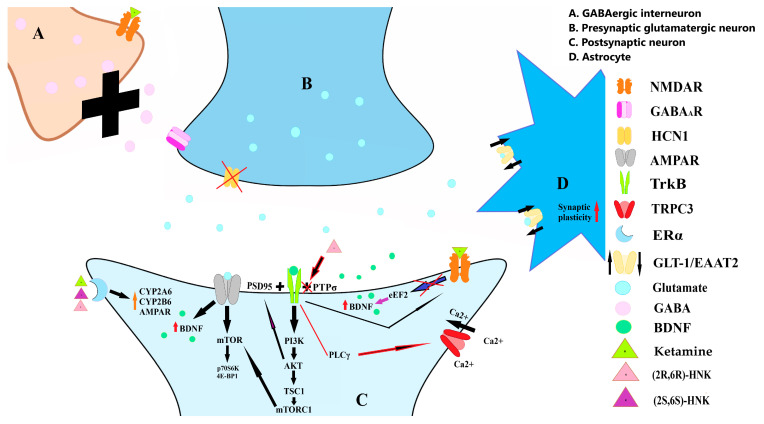
“This inhibitory action subsequently liberates mTOR Complex 1 (mTORC1) from its regulatory constraints. mTORC1 then phosphorylates downstream targets including p70S6K and 4E-BP1 (see Figure 3) [105,143].”
Subgenual prefrontal cortex abnormalities in mood disorders
Drevets, W. C., Price, J. L., Simpson, J. R., Todd, R. D., Reich, T., Vannier, M., & Raichle, M. E. (1997) · Nature · doi:10.1038/386824a0 · Cited by 2,693 · cited 1×
“A series of magnetic resonance imaging (MRI) studies have shown a reduction in the volume of both the PFC and hippocampus by up to about 19% in patients with MDD [78,154,155], and positron emission tomography (PET) reduced metabolism in PFC [78,156].”
Estimating the true global burden of mental illness
Vigo, D., Thornicroft, G., & Atun, R. (2016) · The Lancet Psychiatry · doi:10.1016/s2215-0366(15)00505-2 · Cited by 2,494
Cross-national epidemiology of DSM-IV major depressive episode
Bromet, E., Andrade, L. H., Hwang, I., Sampson, N. A., Alonso, J., de Girolamo, G., de Graaf, R., Demyttenaere, K., Hu, C., Iwata, N., et al. (2011) · BMC Medicine · doi:10.1186/1741-7015-9-90 · Cited by 2,221
A molecular and cellular theory of depression
Duman, R. S. (1997) · Archives of General Psychiatry · doi:10.1001/archpsyc.1997.01830190015002 · Cited by 2,129
Risks of all-cause and suicide mortality in mental disorders: a meta-review
Chesney, E., Goodwin, G. M., & Fazel, S. (2014) · World Psychiatry · doi:10.1002/wps.20128 · Cited by 2,115 · cited 1×
“It is characterized by a recurrent and chronic course and is associated with a high risk of suicidal thoughts and attempts [2–4].”
Research works printed but not linked: 1
- Delgado P.L. Depression: The case for a monoamine deficiency J. Clin. Psychiatry 2000 61 (Suppl. S6) 7 11 10775018
Cited by
Nagpurkar, K., Ghive, P., Kale, M. B., Nistane, N. T., Taksande, B. G., Umekar, M. J., & Trivedi, R. (2025) · Neuroscience · doi:10.1016/j.neuroscience.2025.05.022 · Cited by 12
Molecular Mechanisms of Depression: The Interplay Between Genes and Receptors
Oatu, A., Trifu, S. C., & Coman, E. (2025) · International Journal of Molecular Sciences · doi:10.3390/ijms262311325 · Cited by 10
Azadbakht, A. A., Mashayekhi‐Sardoo, H., & Baghcheghi, Y. (2025) · Neurochemical Research · doi:10.1007/s11064-025-04619-0 · Cited by 6
Yao, Z., Godje, I. S. G., Jiao, B., Shen, L., & Luo, S. (2026) · Ageing Research Reviews · doi:10.1016/j.arr.2026.103153 · Cited by 6
Is the antidepressant efficacy of ketamine and esketamine mediated via opioid mechanisms?
Lu, A., Xu, H., Le, G. H., Dri, C. E., Wong, S., Ho, R., Cao, B., Lo, H. K. Y., Rhee, T. G., Yin, L., et al. (2026) · European Psychiatry · doi:10.1192/j.eurpsy.2026.10157 · Cited by 6
Kheirkhah, M., Mcdonald, N., Aepfelbacher, J., Rengasamy, M. L., Shivanekar, S. P., Spotts, C., Cooper, I., Baumeister, A., Bell, E., Do-Nguyen, K., et al. (2025) · Frontiers in Psychiatry · doi:10.3389/fpsyt.2025.1642025 · Cited by 5
Esketamine treatment: advances in personalized clinical monitoring
Tonhajzerová, I., Višňovcová, Z., Ferencová, N., Kovacova, V., Farský, I., & Ondrejka, I. (2025) · Bratislavské lekárske listy/Bratislava medical journal · doi:10.1007/s44411-025-00181-x · Cited by 2
Frycz, B. A., Dutsch-Wicherek, M., Płaza, O., Szulc, A., Bijata, M., Włodarczyk, J., & Dzwonek, J. (2026) · Pharmacological Reports · doi:10.1007/s43440-026-00827-9 · Cited by 2
Biological Risk Factors for Suicidal Behavior in Children and Adolescents: A Narrative Review
Vatrál, M., Jurík, J., Katrenčíková, B., Muchová, J., Ďuračková, Z., & Trebatická, J. (2026) · Children · doi:10.3390/children13030356 · Cited by 1
Synaptic Plasticity—Intrinsic Excitability and Antidepressant Discovery
Tanaka, M. (2026) · Biomedicines · doi:10.3390/biomedicines14061265
Turtulli, S., & Papadaki, E. (2026) · Journal of Clinical Medicine · doi:10.3390/jcm15155922
Farooqui, M. R., Fatima, M., Khan, S., Singh, S., Choudhary, F., Farooq, T., Khan, A. M. A., Sarwat, M., & Farooqi, H. (2026) · ACS Chemical Neuroscience · doi:10.1021/acschemneuro.6c00406
Depression Unveiled: Current Understanding and Pathways to Recovery
Singh, G., Imanshu, Ashraf, R., Malik, S., & Haq, S. I. U. (2026) · Pan-African Journal of Health and Psychological Sciences · doi:10.64261/vjtak127
查, 冰. (2026) · Advances in Clinical Medicine · doi:10.12677/acm.2026.162575
Siu, S., Hsin, P., Simon, S., Lall, T., Lin, A., Lee, D., Berkun, R., & Junquera, P. (2026) · Cureus · doi:10.7759/cureus.107180
A hierarchical framework for nociplastic pain mechanisms
Zanos, P., Michael, A., Faidonos, N., & Papacharalambous, C. (2026) · Neuroscience & Biobehavioral Reviews · doi:10.1016/j.neubiorev.2026.106947
Hussain, M., Abbasi, S. K., Joyia, F. A., Sajjad, M., Eman, N. U., Shafique, K., Kanwal, N., & Iqbal, K. (2025) · Futuristic Biotechnology · doi:10.54393/fbt.v5i4.220
Lipke, K., & Piwowar, A. (2026) · Cells · doi:10.3390/cells15181689
Blasi, C. (2026) · Journal of Clinical Medicine · doi:10.3390/jcm15207914
Neurobiological correlates of treatment-resistant depression: implications for pharmacotherapy
Kot, J., Priadka, M., Ferensztajn‐Rochowiak, E., Kaliuzhna, O., Bienert, A., & Rybakowski, F. (2026) · Neuropsychiatria i Neuropsychologia · doi:10.5114/nan.2026.162406
Xiao, C., Xu, X., Yao, W., Pan, Y., Wan, S., Wei, J., & Xu, L. (2026) · Journal of Psychiatric Research · doi:10.1016/j.jpsychires.2026.10.038
Li, Q., Liu, S., Chen, H., Liang, G., Song, Z., Liu, Y., Liu, X., & Qin, B. (2026) · Frontiers in Pharmacology · doi:10.3389/fphar.2026.1873924
Beyond the High: A Narrative Review of the Chronic Complications of Recreational Ketamine Use
Erskine, K. L., Dargan, P. I., & Wood, D. M. (2026) · British Journal of Hospital Medicine · doi:10.31083/bjhm53976
Murimbechi, Z. (2026) · World Journal of Advanced Research and Reviews · doi:10.30574/wjarr.2026.31.2.2070
L-tetrahydropalmatine attenuates ketamine reward effect via modulating the miR-27a-3p/MAP2K4 axis
Du, Y., Gao, X., Ma, Q., Li, B., Chen, Y., Su, H.-L., Du, L., & Liang, T.-G. (2026) · Frontiers in Genetics · doi:10.3389/fgene.2026.1701742
Psychiatric Pharmacotherapy and the Problem of Mechanistic Validation: A Critical Review
Husain, W. (2026) · Clinical Pharmacy Connect · doi:10.69709/cpc.2026.100116
Cell-type specific modulation of dorsal raphe serotonergic neurons by ketamine
Hmaied, C., Oubraim, S., Koulchitsky, S., Gladwyn-Ng, I. E., Haj‐Dahmane, S., & Seutin, V. (2026) · iScience · doi:10.1016/j.isci.2026.118121
Ketamine for Treatment-Resistant Depression in Adolescents: Hope or Risk?
Kamosińska, A., Pająk, J., Sławatyniec, O., Sobieraj, W., Łuniewska, W., Modrzyk, M., & Majda, A. (2026) · Journal of Education Health and Sport · doi:10.12775/jehs.2026.95.73956
Ketamine for Treatment-Resistant Depression in Adolescents: Hope or Risk?
Pająk, J., Kamosińska, A., Sławatyniec, O., Sobieraj, W., Łuniewska, W., Modrzyk, M., & Majda, A. (2026) · Journal of Education Health and Sport · doi:10.12775/jehs.2026.95.74058
Kaur, N., Rani, S., & SAINI, V. (2026) · International Journal of Drug Delivery Technology · doi:10.25258/ijddt.16.81s.169
Ketamine for Treatment-Resistant Depression
Simmons, D., Raynor, P., DuBose, D., Baliko, B., & Vick, L. (2026) · Journal of the American Psychiatric Nurses Association · doi:10.1177/10783903261499294
FREITAS, G. C., & BARBOSA, M. F. D. (2026) · JNT - Facit Business and Technology Journal
Rodrigues, S. S., Bosco, G. B. D., Martins, C. R. G., Dias, A. J. E. A., & Neves, R. A. (2025) · DELOS Desarrollo Local Sostenible · doi:10.55905/rdelosv18.n72espec-017
Metadata
- Authors
- Antos, Z., Żukow, X., Bursztynowicz, L., & Jakubów, P.
- Affiliations
- Medical University of Białystok (PL)
- Corresponding author
- Jakubów, Piotr
- Venue
- International Journal of Molecular Sciences
- Publisher
- MDPI AG
- Published
- 2024-12-20
- Volume
- 25
- Issue
- 24
- Pages
- 13658
- ISSN
- 1422-0067 (ISSN-L)
- PMC
- PMC11728282
- OpenAlex
- W4405695206
- Cited by
- 21
- References
- 225
- Citations by year
- 2026: 15 · 2025: 6
- FWCI
- 1.31
- Type
- journal article
- Language
- en
- Open access
- gold
- doi.org
- Licence
- Locations
- International Journal of Molecular Sciences (publishedVersion, cc-by)
- PubMed Central (publishedVersion, cc-by)
- PubMed (publishedVersion)
- Topics
- Health Sciences › Medicine › Pharmacology (medical) › Treatment of Major Depression
- Life Sciences › Neuroscience › Cellular and Molecular Neuroscience › Neuroscience and Neuropharmacology Research
- Life Sciences › Neuroscience › Biological Psychiatry › Tryptophan and brain disorders
- Keywords
- ketamine, depression, rapid-acting antidepressants, NMDA receptor antagonism, glutamate, AMPA receptors, BDNF/TrkB signaling, mTOR signaling, synaptic plasticity, default mode network, frontoparietal network, salience network, opioid receptors, BDNF polymorphism, treatment response
- MeSH terms
- Animals, Antidepressive Agents, Brain, Depression, Humans, Ketamine, Receptors, N-Methyl-D-Aspartate, Brain-Derived Neurotrophic Factor
About these checks
Registry, retraction, Cites and statistics results are computed, not judged, with one exception: a printed reference that no index lists is read once by a model before it counts as a citation error. Claims are extracted by a model and kept only when their quote appears verbatim in the text; each cited source is then checked, with a model’s help, for whether it says what the claim relies on. Those verdicts can be wrong — read the claim’s quote and the cited source before relying on one.
Statistics and arithmetic are recomputed, not judged.
Confidence bands are shown only for fields calibrated on our annotated test set. None is calibrated yet, so no band is shown.
What counts as a claim ›How we measure confidence ›How we check this ›
Are you an author, or do you see a problem with this page? Request a review
Data sources
Bibliographic data: Semantic Scholar, OpenAlex, Crossref.
Contains information from the Semantic Scholar Academic Graph Datasets, made available under the ODC Attribution License (ODC-BY 1.0).
Semantic Scholar’s data is described in: Kinney, R., et al. (2023). The Semantic Scholar Open Data Platform. arXiv:2301.10140.
