

The DOI matches its Crossref record; 35 of the 35 references it cites were found in a registry or an index.
Assessment of Long-Read Sequencing-Based Congenital Adrenal Hyperplasia Genotyping Assay for Newborns in Fujian, China
Open accessAbstract
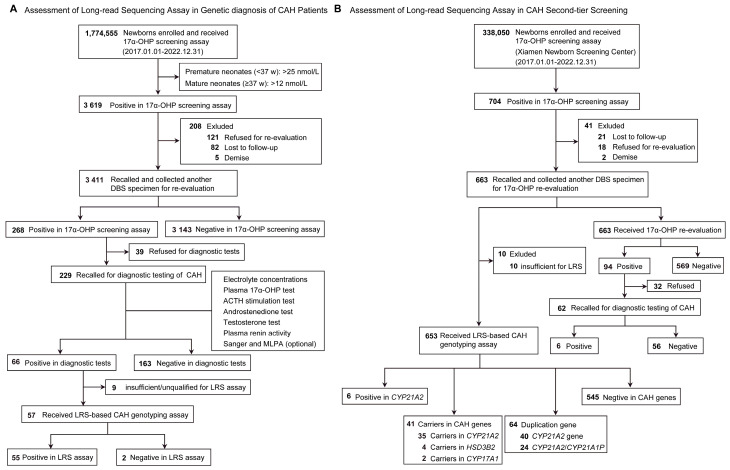
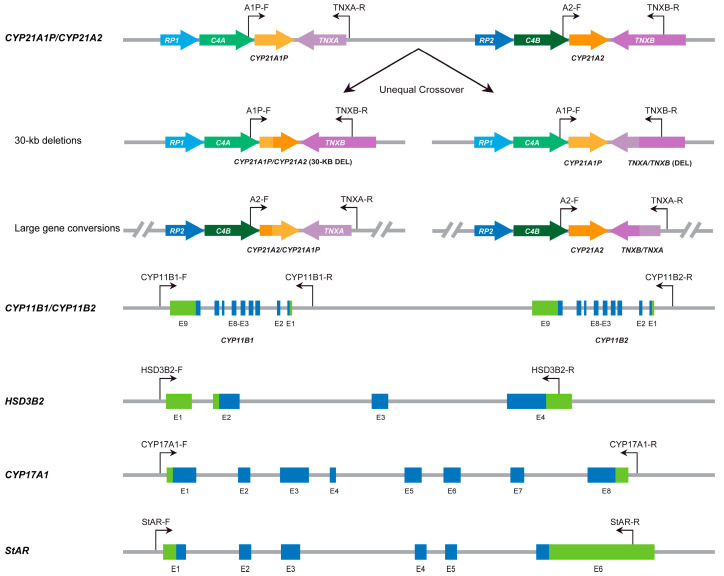
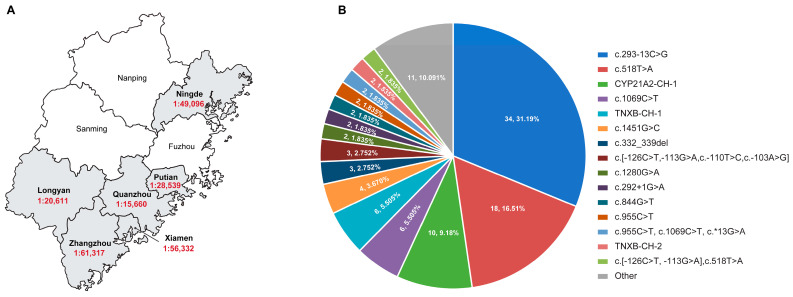
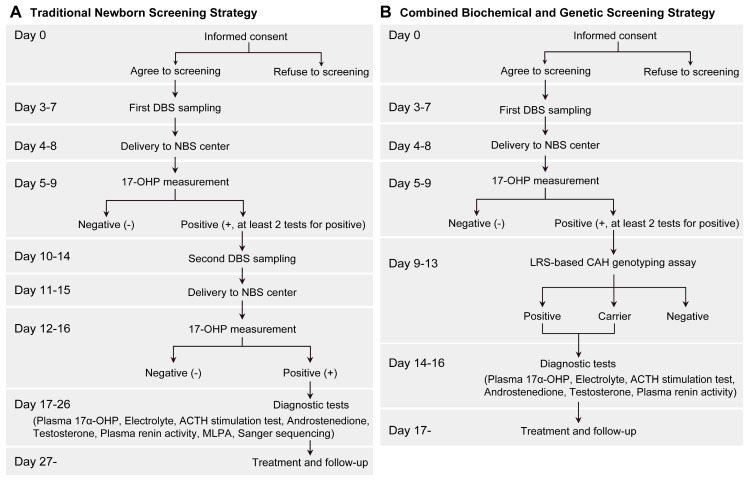
Long-read sequencing (LRS) provides comprehensive genetic information, but research of LRS applied to congenital adrenal hyperplasia (CAH) newborn screening is limited. This study aimed to evaluate the clinical utility of LRS in genetic diagnosis and second-tier newborn screening. Neonates born between January 2017 and December 2022 in Fujian, China, were recruited for biochemical and LRS-based genetic screening assay. The LRS covers the entire gene regions and exon–intron boundary regions for CYP21A2, CYP11B1, CYP17A1, HSD3B2, and StAR. In this retrospective study, 1,774,555 newborns received 17α-OHP screening, yielding a screening positive rate of 0.20%. Of these high-risk neonates, 3411 were successfully recalled for re-evaluation. Finally, 66 neonates were diagnosed with CAH, with a positive predictive value of 28.82%. Based on this data, the overall prevalence of CAH in Fujian was estimated to be 1:26,883. LRS was performed on 57 neonates with 21-hydroxylase deficiency (21-OHD) and 109 variant alleles were identified. The c.293-13C>G variant (31.19%) was the most prevalent in Fujian. Additionally, 647 neonates with suspected positive results were genotyped, and 41 were identified as carriers, with carrier frequencies of 1:18 for CYP21A2, 1:162 for HSD3B2, and 1:324 for CYP17A1 in Xiamen. Therefore, LRS can provide comprehensive genotypes in approximately 1.5 days at a cost of less than $20 USD per sample, and effectively improve screening efficiency, reduce anxiety of parents during newborn screening (NBS), and shorten the time to referral of CAH patients (approximately 10 days). Such a combined screening strategy is worthy to be recommended for NBS programs in the future.
Overview
The claims and statistics of this paper haven’t been checked yet.
Run the check — free, no account needed. It reads the open-access text and checks the sources it cites.
Integrity signals
Registry
Cites
Statistics
Figures
Verification
Claims the paper makes
The claims and statistics of this paper haven’t been checked yet.
Run the check — free, no account needed. It reads the open-access text and checks the sources it cites.
Claims other papers make about this one
Each is checked against this paper’s own text: does it say what the citing paper says it does?
The source backs part of the claim, not all of it — or backs it for a different population, condition or comparison.
In the citing paper
“The combination of long-range PCR and long-read sequencing approaches near-complete sensitivity and specificity, with significant reductions in false positives and turnaround time, while maintaining competitive costs (<USD 20/sample) (75, 99).”
From Evolution of molecular diagnostic strategies for 21-hydroxylase deficiency: from classical methods to advanced genomic techniques (2026) · cites this paper as [99]
Experimental — accuracy not yet measured
Self-check
Percentages, sums and reported differences re-computed from the paper’s own numbers.
The self-check needs the paper’s full text.
Citations
Cites
Richards, S., Aziz, N., Bale, S., Bick, D., Das, S., Gastier-Foster, J., Grody, W. W., Hegde, M., Lyon, E., Spector, E., et al. (2015) · Genetics in Medicine · doi:10.1038/gim.2015.30 · Cited by 32,594 · cited 1×
“It can shorten the time to referral of CAH patients (approximately 10 days)”
Speiser, P. W., Arlt, W., Auchus, R. J., Baskin, L. S., Conway, G. S., Merke, D. P., Meyer-Bahlburg, H. F. L., Miller, W. L., Murad, M. H., Oberfield, S. E., et al. (2018) · The Journal of Clinical Endocrinology & Metabolism · doi:10.1210/jc.2018-01865 · Cited by 1,234
The Third Revolution in Sequencing Technology
van Dijk, E. L., Jaszczyszyn, Y., Naquin, D., & Thermes, C. (2018) · Trends in Genetics · doi:10.1016/j.tig.2018.05.008 · Cited by 1,057
Next-generation sequencing technologies: An overview
Hu, T., Chitnis, N., Monos, D., & Dinh, A. (2021) · Human Immunology · doi:10.1016/j.humimm.2021.02.012 · Cited by 949
Congenital adrenal hyperplasia
El-Maouche, D., Arlt, W., & Merke, D. P. (2017) · The Lancet · doi:10.1016/s0140-6736(17)31431-9 · Cited by 669
Pang, S., Wallace, M. A., Hofman, L., Thuline, H. C., Dorche, C., Lyon, I. C. T., Dobbins, R. H., Kling, S., Fujieda, K., & Suwa, S. (1988) · Journal of Urology · doi:10.1016/s0022-5347(17)42164-1 · Cited by 392
Pang, S., Wallace, M. A., Hofman, L. F., Thuline, H. C., Dorche, C., Lyon, I. C. T., Dobbins, R. H., Kling, S., Fujieda, K., & Suwa, S. (1988) · PEDIATRICS · doi:10.1542/peds.81.6.866 · Cited by 302
Congenital adrenal hyperplasia
Auer, M. K., Nordenström, A., Lajić, S., & Reisch, N. (2022) · The Lancet · doi:10.1016/s0140-6736(22)01330-7 · Cited by 241
Congenital Adrenal Hyperplasia
Witchel, S. F. (2017) · Journal of Pediatric and Adolescent Gynecology · doi:10.1016/j.jpag.2017.04.001 · Cited by 198
Tusié-Luna, M. T., & White, P. C. (1995) · Proceedings of the National Academy of Sciences · doi:10.1073/pnas.92.23.10796 · Cited by 179
Cited by
Sorted by citations
Liang, D., Zhu, M., Liang, Q., Qiang, R., Yu, L., Xu, S., Li, M., Song, J., Zhou, Y., He, X., et al. (2025) · Genome Medicine · doi:10.1186/s13073-025-01594-7 · Cited by 11
Self-citationMiranda, M. C. D., Oliveira, A. C. M. D., Soares, G. J., Batatinha, J. A. P., Latronico, A. C., Mendonca, B. B., & Bachega, T. A. S. S. (2026) · Frontiers in Endocrinology · doi:10.3389/fendo.2026.1770274 · Cited by 2
High-Resolution Variant Profiling of CAH-Associated Genes Using a Long-Read Sequencing AssayPreprint
Gu, S., Chu, G., Cai, R., Sun, X., Lu, Q., Han, W., Deng, S., Wang, X., Xiang, J., & He, R. X. (2025) · medRxiv · doi:10.1101/2025.10.24.25338696
Self-citationChen, X., Cuiting, P., Chen, H., Yang, H., Zhao, X., Hu, T., Wang, H., Liu, S., & Ren, J. (2026) · Journal of Endocrinological Investigation · doi:10.1007/s40618-026-02912-5
Zhao, P., Qiu, X., Lin, Q., Huang, T., Zeng, Y., Zhou, J., & Xu, L. (2026) · Frontiers in Genetics · doi:10.3389/fgene.2026.1894466
Dai, Y., Zhu, L., Zeng, Y., Chen, Y., Qian, X., Li, X., & Wu, T. (2026) · Frontiers in Pediatrics · doi:10.3389/fped.2026.1869920
Metadata
- Authors
- Wang, X., Lu, X., Zheng, F., Lin, K., Liao, M., Dong, Y., Chen, T., He, Y., Lu, M., Chen, J., Li, Y., & Zhou, Y.
- Affiliations
- Xiamen University (CN)
- Quanzhou Women and Children's Hospital (CN)
- Putian University (CN)
- Fujian Medical University (CN)
- Screening Center of Neonatal Genetic Metabolic Disease, Ningde Maternity and Child Health Care Hospital, Ningde 352100, China
- Zhangzhou Newborn Screening Center, Zhangzhou Maternity and Child Care Hospital, Zhangzhou 363000, China
- Corresponding author
- Wang, Xudong
- Venue
- International Journal of Neonatal Screening
- Publisher
- MDPI AG
- Published
- 2025-03-13
- Volume
- 11
- Issue
- 1
- Pages
- 22
- ISSN
- 2409-515X (ISSN-L)
- PMC
- PMC11942758
- OpenAlex
- W4408409007
- Cited by
- 6
- References
- 35
- Citations by year
- 2026: 4 · 2025: 2
- FWCI
- 1.80
- Type
- journal article
- Language
- en
- Open access
- gold
- doi.org
- Licence
- Locations
- International Journal of Neonatal Screening (publishedVersion, cc-by)
- SSRN Electronic Journal (acceptedVersion)
- PubMed Central (publishedVersion, cc-by)
- PubMed (publishedVersion)
- DOAJ (DOAJ: Directory of Open Access Journals) (submittedVersion, cc-by-sa)
- Funders
- National Natural Science Foundation of China (82101824, 3502Z20227296, 3502Z20224014, 2021CXB025)
- Xiamen Natural Science Foundation (82101824, 3502Z20227296, 3502Z20224014, 2021CXB025)
- General Science and Technology Project of Xiamen, China (82101824, 3502Z20227296, 3502Z20224014, 2021CXB025)
- Fujian Provincial Health Technology Project (82101824, 3502Z20227296, 3502Z20224014, 2021CXB025)
- Topics
- Health Sciences › Medicine › Endocrinology, Diabetes and Metabolism › Sexual Differentiation and Disorders
- Life Sciences › Biochemistry, Genetics and Molecular Biology › Clinical Biochemistry › Metabolism and Genetic Disorders
- Health Sciences › Medicine › Endocrinology, Diabetes and Metabolism › Adrenal Hormones and Disorders
- Keywords
- congenital adrenal hyperplasia, long-read sequencing, newborn screening, 21-hydroxylase deficiency, CYP21A2, CYP11B1, CYP17A1, HSD3B2, stars, 17-hydroxyprogesterone, carrier frequency, variant allele frequency, Fujian
About these checks
Registry, retraction, Cites and statistics results are computed, not judged, with one exception: a printed reference that no index lists is read once by a model before it counts as a citation error. Claims are extracted by a model and kept only when their quote appears verbatim in the text; each cited source is then checked, with a model’s help, for whether it says what the claim relies on. Those verdicts can be wrong — read the claim’s quote and the cited source before relying on one.
Statistics and arithmetic are recomputed, not judged.
Confidence bands are shown only for fields calibrated on our annotated test set. None is calibrated yet, so no band is shown.
What counts as a claim ›How we measure confidence ›How we check this ›
Are you an author, or do you see a problem with this page? Request a review
