

The DOI matches its Crossref record; 29 of the 29 references it cites were found in a registry or an index.
Efficient Edge-AI Application Deployment for FPGAs
Open accessAbstract
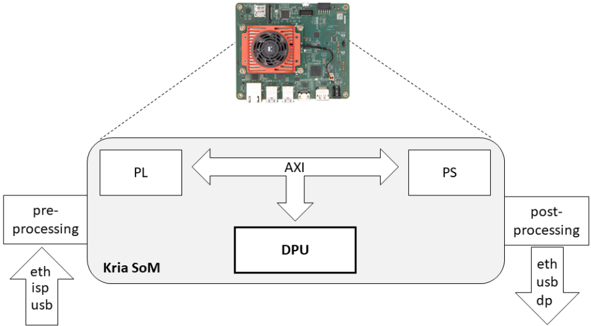
Field Programmable Gate Array (FPGA) accelerators have been widely adopted for artificial intelligence (AI) applications on edge devices (Edge-AI) utilizing Deep Neural Networks (DNN) architectures. FPGAs have gained their reputation due to the greater energy efficiency and high parallelism than microcontrollers (MCU) and graphical processing units (GPU), while they are easier to develop and more reconfigurable than the Application Specific Integrated Circuit (ASIC). The development and building of AI applications on resource constraint devices such as FPGAs remains a challenge, however, due to the co-design approach, which requires a valuable expertise in low-level hardware design and in software development. This paper explores the efficacy and the dynamic deployment of hardware accelerated applications on the Kria KV260 development platform based on the Xilinx Kria K26 system-on-module (SoM), which includes a Zynq multiprocessor system-on-chip (MPSoC). The platform supports the Python-based PYNQ framework and maintains a high level of versatility with the support of custom bitstreams (overlays). The demonstration proved the reconfigurabibilty and the overall ease of implementation with low-footprint machine learning (ML) algorithms.
Overview
The claims and statistics of this paper haven’t been checked yet.
Free: it reads the open-access text and checks the first 5 claims that cite a source we can check. Create a free account to check every claim.
Integrity signals
Registry
Cites
Statistics
Figures

Verification
Claims the paper makes
The claims and statistics of this paper haven’t been checked yet.
Free: it reads the open-access text and checks the first 5 claims that cite a source we can check. Create a free account to check every claim.
Claims other papers make about this one
Each is checked against this paper’s own text: does it say what the citing paper says it does?
The source backs part of the claim, not all of it — or backs it for a different population, condition or comparison.
In the citing paper
“Nearly every single industry today has tasks that might be better served by using edge AI [22].”
From Edge AI: A survey (2023) · cites this paper as [22]
Experimental — accuracy not yet measuredThe source backs part of the claim, not all of it — or backs it for a different population, condition or comparison.
In the citing paper
“Neural network architectures: Neural network architectures, such as convolutional neural networks (CNNs) and recurrent neural networks (RNNs), are used to train and run deep learning models on edge devices [22].”
From Edge AI: A survey (2023) · cites this paper as [22]
Experimental — accuracy not yet measured
Self-check
Percentages, sums and reported differences re-computed from the paper’s own numbers.
The self-check needs the paper’s full text.
Citations
Cites
Deep Residual Learning for Image Recognition
He, K., Zhang, X., Ren, S., & Sun, J. (2016) · 2016 IEEE Conference on Computer Vision and Pattern Recognition (CVPR) · doi:10.1109/cvpr.2016.90 · Cited by 235,474
Very Deep Convolutional Networks for Large-Scale Image Recognition
Simonyan, K., & Zisserman, A. (2014) · arXiv · doi:10.48550/arxiv.1409.1556 · Cited by 114,148
Going deeper with convolutions
Szegedy, C., Liu, W., Jia, Y., Sermanet, P., Reed, S., Anguelov, D., Erhan, D., Vanhoucke, V., & Rabinovich, A. (2015) · 2015 IEEE Conference on Computer Vision and Pattern Recognition (CVPR) · doi:10.1109/cvpr.2015.7298594 · Cited by 48,562
ImageNet Large Scale Visual Recognition Challenge
Russakovsky, O., Deng, J., Su, H., Krause, J., Satheesh, S., Ma, S., Huang, Z., Karpathy, A., Khosla, A., Bernstein, M., et al. (2015) · International Journal of Computer Vision · doi:10.1007/s11263-015-0816-y · Cited by 39,380
PyTorch: An Imperative Style, High-Performance Deep Learning Library
Paszke, A., Gross, S., Massa, F., Lerer, A., Bradbury, J., Chanan, G., Killeen, T., Lin, Z., Gimelshein, N., Antiga, L., et al. (2019) · arXiv · doi:10.48550/arxiv.1912.01703 · Cited by 31,473
Harris, C. R., Millman, K. J., van der Walt, S. J., Gommers, R., Virtanen, P., Cournapeau, D., Wieser, E., Taylor, J., Berg, S., Smith, N. J., et al. (2020) · Nature · doi:10.1038/s41586-020-2649-2 · Cited by 23,826
Harris, C., Millman, K., van der Walt, S., Gommers, R., Virtanen, P., Cournapeau, D., Wieser, E., Taylor, J., Berg, S., Smith, N., et al. (2020) · RePEc: Research Papers in Economics · Cited by 17,844
YOLOv3: An Incremental Improvement
Redmon, J., & Farhadi, A. (2018) · arXiv · doi:10.48550/arxiv.1804.02767 · Cited by 17,141
Caffe: Convolutional Architecture for Fast Feature Embedding
Jia, Y., Shelhamer, E., Donahue, J., Karayev, S., Long, J., Girshick, R., Guadarrama, S., & Darrell, T. (2014) · Proceedings of the 22nd ACM international conference on Multimedia · doi:10.1145/2647868.2654889 · Cited by 11,077
The MNIST Database of Handwritten Digit Images for Machine Learning Research [Best of the Web]
Deng, L. (2012) · IEEE Signal Processing Magazine · doi:10.1109/msp.2012.2211477 · Cited by 4,836
Research works printed but not linked: 2
- Loizides, F., and Schmidt, B. (2016). Jupyter Notebooks—A Publishing Format for Reproducible Computational Workflows, IOS Press. Positioning and Power in Academic Publishing: Players, Agents and Agendas.
- Maas, 2013, Rectifier nonlinearities improve neural network acoustic models, Proceedings ICML, Volume 30, 3
Cited by
Singh, R., & Gill, S. S. (2023) · Internet of Things and Cyber-Physical Systems · doi:10.1016/j.iotcps.2023.02.004 · Cited by 572
Edge AI: A Taxonomy, Systematic Review and Future Directions
Gill, S. S., Golec, M., Hu, J., Xu, M., Du, J., Wu, H., Walia, G. K., Murugesan, S. S., Ali, B., Kumar, M., et al. (2025) · Cluster Computing · doi:10.1007/s10586-024-04686-y · Cited by 211
Efficient Hardware Architectures for Accelerating Deep Neural Networks: Survey
Pudi, D., Boppu, S., Manikandan, M. S., & Cenkeramaddi, L. R. (2022) · IEEE Access · doi:10.1109/access.2022.3229767 · Cited by 180
FPGA-Based Real-Time Object Detection and Classification System Using YOLO for Edge Computing
Amin, R. A., Hasan, M., Wiese, V., & Obermaisser, R. (2024) · IEEE Access · doi:10.1109/access.2024.3404623 · Cited by 93
A Survey on RISC-V-Based Machine Learning Ecosystem
Kalapothas, S., Galetakis, M., Flamis, G., Plessas, F. C., & Kitsos, P. (2023) · Information · doi:10.3390/info14020064 · Cited by 74
Self-citation
Metadata
- Authors
- Kalapothas, S., Flamis, G., & Kitsos, P.
- Affiliations
- University of Peloponnese (GR)
- Corresponding author
- Kitsos, Paris
- Venue
- Information
- Publisher
- MDPI AG
- Published
- 2022-05-28
- Volume
- 13
- Issue
- 6
- Pages
- 279
- ISSN
- 2078-2489 (ISSN-L)
- OpenAlex
- W4281757109
- Cited by
- 53
- References
- 22
- Citations by year
- 2026: 10 · 2025: 17 · 2024: 13 · 2023: 11 · 2022: 2
- FWCI
- 8.23
- Type
- journal article
- Language
- en
- Open access
- gold
- doi.org
- Licence
- Locations
- Information (publishedVersion, cc-by)
- DOAJ (DOAJ: Directory of Open Access Journals) (submittedVersion)
- Topics
- Physical Sciences › Computer Science › Hardware and Architecture › Embedded Systems Design Techniques
- Physical Sciences › Engineering › Electrical and Electronic Engineering › Embedded Systems and FPGA Applications
- Physical Sciences › Engineering › Control and Systems Engineering › Embedded Systems and FPGA Design
- Keywords
- edge AI, FPGA accelerator, application deployment, deep neural network, system-on-module, hardware reconfigurability, resource-constrained devices
About these checks
Registry, retraction, Cites and statistics results are computed, not judged, with one exception: a printed reference that no index lists is read once by a model before it counts as a citation error. Claims are extracted by a model and kept only when their quote appears verbatim in the text; each cited source is then checked, with a model’s help, for whether it says what the claim relies on. Those verdicts can be wrong — read the claim’s quote and the cited source before relying on one.
Statistics and arithmetic are recomputed, not judged.
Confidence bands are shown only for fields calibrated on our annotated test set. None is calibrated yet, so no band is shown.
What counts as a claim ›How we measure confidence ›How we check this ›
Are you an author, or do you see a problem with this page? Request a review
How to cite
Cite CoChat for the checks on this page, and the paper for its own findings.
- This page
- CoChat. (2026). Citation check: Efficient Edge-AI Application Deployment for FPGAs. https://app.cochat.ai/papers/10.3390/info13060279
- The paper
- Kalapothas, S., Flamis, G., & Kitsos, P. (2022). Efficient Edge-AI Application Deployment for FPGAs. Information. https://doi.org/10.3390/info13060279
Data sources
Bibliographic data: Semantic Scholar, OpenAlex, Crossref.
Contains information from the Semantic Scholar Academic Graph Datasets, made available under the ODC Attribution License (ODC-BY 1.0).
Semantic Scholar’s data is described in: Kinney, R., et al. (2023). The Semantic Scholar Open Data Platform. arXiv:2301.10140.
