

Biomarkers of Post-COVID Depression
Open accessThe DOI matches its Crossref record; 235 of the 241 references it cites were found in a registry or an index.
Abstract
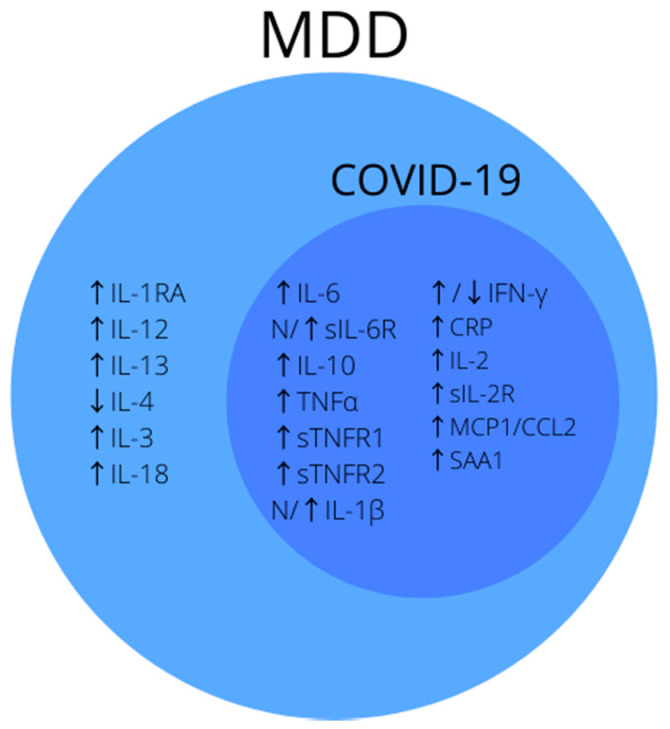
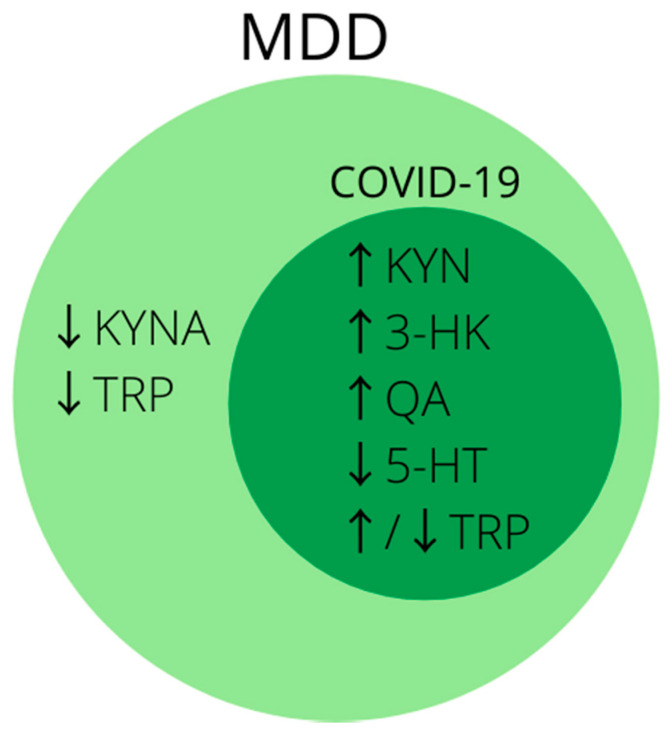
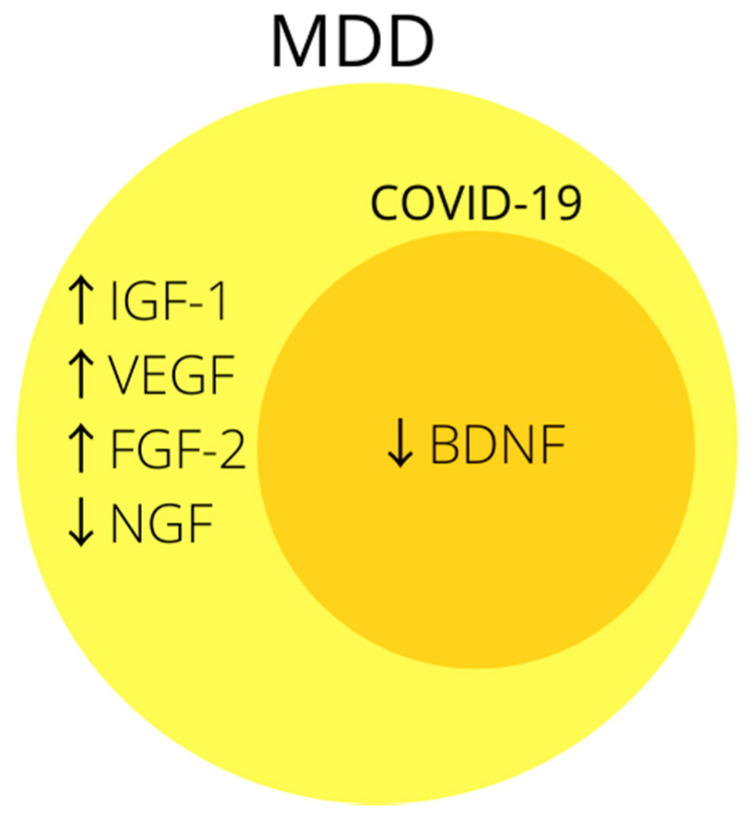
The COVID-19 pandemic is spreading around the world and 187 million people have already been affected. One of its after-effects is post-COVID depression, which, according to the latest data, affects up to 40% of people who have had SARS-CoV-2 infection. A very important issue for the mental health of the general population is to look for the causes of this complication and its biomarkers. This will help in faster diagnosis and effective treatment of the affected patients. In our work, we focused on the search for major depressive disorder (MDD) biomarkers, which are also present in COVID-19 patients and may influence the development of post-COVID depression. For this purpose, we searched PubMed, Scopus and Google Scholar scientific literature databases using keywords such as 'COVID-19', 'SARS-CoV-2', 'depression', 'post-COVID', 'biomarkers' and others. Among the biomarkers found, the most important that were frequently described are increased levels of interleukin 6 (IL-6), soluble interleukin 6 receptor (sIL-6R), interleukin 1 β (IL-1β), tumor necrosis factor α (TNF-α), interferon gamma (IFN-γ), interleukin 10 (IL-10), interleukin 2 (IL-2), soluble interleukin 2 receptor (sIL-2R), C-reactive protein (CRP), Monocyte Chemoattractant Protein-1 (MCP-1), serum amyloid a (SAA1) and metabolites of the kynurenine pathway, as well as decreased brain derived neurotrophic factor (BDNF) and tryptophan (TRP). The biomarkers identified by us indicate the etiopathogenesis of post-COVID depression analogous to the leading inflammatory hypothesis of MDD.
Overview
The claims and statistics of this paper haven’t been checked yet.
Free: it reads the open-access text and checks the first 5 claims that cite a source we can check. Create a free account to check every claim.
Integrity signals
Registry
Cites
Statistics
Figures
Verification
Claims the paper makes
The claims and statistics of this paper haven’t been checked yet.
Free: it reads the open-access text and checks the first 5 claims that cite a source we can check. Create a free account to check every claim.
Claims other papers make about this one
Each is checked against this paper’s own text: does it say what the citing paper says it does?
The cited source says what the claim attributes to it.
In the citing paper
“This investigation underlines the importance of identifying and prioritizing the distinctive demands and individual preferences of depression patients; this is in contrast to previous research with a focus on objective representation (76).”
From Anti-stigmatizing: a collaborative autoethnography on recovery from depression (2024) · cites this paper as [76]
Self-check
Percentages, sums and reported differences re-computed from the paper’s own numbers.
The self-check needs the paper’s full text.
Citations
Cites
Clinical features of patients infected with 2019 novel coronavirus in Wuhan, China
Huang, C., Wang, Y., Li, X., Ren, L., Zhao, J., Hu, Y., Zhang, L., Fan, G., Xu, J., Gu, X., et al. (2020) · The Lancet · doi:10.1016/s0140-6736(20)30183-5 · Cited by 48,884
James, S. L., Abate, D., Abate, K. H., Abay, S. M., Abbafati, C., Abbasi, N., Abbastabar, H., Abd-Allah, F., Abdela, J., Abdelalim, A., et al. (2018) · The Lancet · doi:10.1016/s0140-6736(18)32279-7 · Cited by 13,867
Vos, T., Abajobir, A. A., Abate, K. H., Abbafati, C., Abbas, K. M., Abd-Allah, F., Abdulkader, R. S., Abdulle, A. M., Abebo, T. A., Abera, S. F., et al. (2017) · The Lancet · doi:10.1016/s0140-6736(17)32154-2 · Cited by 13,220
COVID-19: consider cytokine storm syndromes and immunosuppression
Mehta, P., McAuley, D. F., Brown, M., Sanchez, E., Tattersall, R. S., & Manson, J. J. (2020) · The Lancet · doi:10.1016/s0140-6736(20)30628-0 · Cited by 9,664
Molecular Mechanisms of Depression: Perspectives on New Treatment Strategies
Lang, U. E., & Borgwardt, S. (2013) · Cellular Physiology and Biochemistry · doi:10.1159/000350094 · Cited by 8,475
Neurotoxic reactive astrocytes are induced by activated microglia
Liddelow, S. A., Guttenplan, K. A., Clarke, L. E., Bennett, F. C., Bohlen, C. J., Schirmer, L., Bennett, M. L., Münch, A. E., Chung, W.-S., Peterson, T. C., et al. (2017) · Nature · doi:10.1038/nature21029 · Cited by 7,971
Lai, C.-C., Shih, T.-P., Ko, W.-C., Tang, H.-J., & Hsueh, P.-R. (2020) · International Journal of Antimicrobial Agents · doi:10.1016/j.ijantimicag.2020.105924 · Cited by 6,068
IL‐6 in inflammation, immunity, and disease
Tanaka, T., Narazaki, M., & Kishimoto, T. (2014) · Cold Spring Harbor Perspectives in Biology · doi:10.1101/cshperspect.a016295 · Cited by 5,046
Nalbandian, A., Sehgal, K., Gupta, A., Madhavan, M. V., McGroder, C., Stevens, J. S., Cook, J. R., Nordvig, A. S., Shalev, D., Sehrawat, T. S., et al. (2021) · Nature Medicine · doi:10.1038/s41591-021-01283-z · Cited by 4,862
Dysregulation of Immune Response in Patients With Coronavirus 2019 (COVID-19) in Wuhan, China
Qin, C., Zhou, L., Hu, Z., Zhang, S., Yang, S., Tao, Y., Xie, C., Ma, K., Shang, K., Wang, W., et al. (2020) · Clinical Infectious Diseases · doi:10.1093/cid/ciaa248 · Cited by 4,775
Cited by
Items 101–108 of 108
Alvarenga, F. D. S., Zetum, A. S. S., Casotti, M. C., Barbosa, K. R. M., Guaitolini, Y. M., Louro, I. D., & Meira, D. D. (2025) · Brazilian Journal of Health Review · doi:10.34119/bjhrv8n1-131
Long COVID’s Chronic Toll: A Case Report on Unresolved Neuromuscular and Psychological Symptoms
Rezaei, A. R., & Lenzen, D. (2025) · Neurology Letters · doi:10.61186/nl.4.1.37
You, Y., Zhang, D., Jin, Y., Cai, L., & Wu, Y. (2025) · Journal of Community & Applied Social Psychology · doi:10.1002/casp.70170
Mandal, S., Acharya, R., & Mandal, M. (2026) · Journal of Public Health Research and Community Health Development · doi:10.20473/jphrecode.v9i2.71677
“Increased severity of COVID-19 illness was associated with higher levels of inflammatory markers and thereby increased risk of depression (Lorkiewicz et al ., 2021), which is reflected as significant association (p .05) between COVID-19 severity and severity of depression amongst the study…”
Lessons from irritable bowel syndrome: potential for understanding and managing post-COVID
Stallmach, A., Layer, P., Katzer, K., & Reuken, P. A. (2026) · Frontiers in Immunology · doi:10.3389/fimmu.2026.1717324
Abdullah, M., Naz, A., Reznikov, L. R., Qureshi, J. A., Hasnain, A., Obaid, A., & Ali, A. (2026) · Frontiers in Cellular Neuroscience · doi:10.3389/fncel.2026.1763029
Janssen‐Aguilar, R., Lin, Q., Meshkat, S., Al-Shamali, H. F., Lou, W., Méndez‐Domínguez, N., & Bhat, V. (2026) · BJPsych International · doi:10.1192/bji.2026.10116
The Impact of Long COVID on Mental Health
Podkalicka, M. (2026) · Digital Commons - PCOM (Philadelphia College of Osteopathic Medicine)
Metadata
- Authors
- Lorkiewicz, P., & Waszkiewicz, N.
- Affiliations
- Medical University of Białystok (PL)
- Corresponding author
- Lorkiewicz, Piotr
- Venue
- Journal of Clinical Medicine
- Publisher
- MDPI AG
- Published
- 2021-09-14
- Volume
- 10
- Issue
- 18
- Pages
- 4142
- ISSN
- 2077-0383 (ISSN-L)
- PMC
- PMC8470902
- OpenAlex
- W3200359909
- Cited by
- 102
- References
- 241
- Citations by year
- 2026: 5 · 2025: 16 · 2024: 24 · 2023: 27 · 2022: 28 · 2021: 2
- FWCI
- 1.91
- Type
- journal article
- Language
- en
- Open access
- gold
- doi.org
- Licence
- Locations
- Journal of Clinical Medicine (publishedVersion, cc-by)
- Europe PMC (PubMed Central) (publishedVersion, other-oa)
- PubMed Central (publishedVersion, cc-by)
- PubMed (publishedVersion)
- DOAJ (DOAJ: Directory of Open Access Journals) (submittedVersion, cc-by-sa)
- Funders
- the Medical University of Bialystok (SUB/1/DN/21/001/1147)
- Topics
- Life Sciences › Neuroscience › Biological Psychiatry › Tryptophan and brain disorders
- Health Sciences › Medicine › Clinical Neurology › Long-Term Effects of COVID-19
- Social Sciences › Psychology › Clinical Psychology › COVID-19 and Mental Health
- Keywords
- post-COVID depression, major depressive disorder, biomarkers, SARS-CoV-2, COVID-19 pandemic, cytokines, interleukin-6, C-reactive protein, brain-derived neurotrophic factor, tryptophan, kynurenine pathway, serum amyloid A, MCP-1, neuroinflammation
About these checks
Registry, retraction, Cites and statistics results are computed, not judged, with one exception: a printed reference that no index lists is read once by a model before it counts as a citation error. Claims are extracted by a model and kept only when their quote appears verbatim in the text; each cited source is then checked, with a model’s help, for whether it says what the claim relies on. Those verdicts can be wrong — read the claim’s quote and the cited source before relying on one.
Statistics and arithmetic are recomputed, not judged.
Confidence bands are shown only for fields calibrated on our annotated test set. None is calibrated yet, so no band is shown.
What counts as a claim ›How we measure confidence ›How we check this ›
Are you an author, or do you see a problem with this page? Request a review
Data sources
Bibliographic data: Semantic Scholar, OpenAlex, Crossref.
Contains information from the Semantic Scholar Academic Graph Datasets, made available under the ODC Attribution License (ODC-BY 1.0).
Semantic Scholar’s data is described in: Kinney, R., et al. (2023). The Semantic Scholar Open Data Platform. arXiv:2301.10140.
