

Effect of Exercise on Liver Function and Insulin Resistance Markers in Patients with Non-Alcoholic Fatty Liver Disease: A Systematic Review and Meta-Analysis of Randomized Controlled Trials
Open accessThe DOI matches its Crossref record; 71 of the 71 references it cites were found in a registry or an index.
Abstract
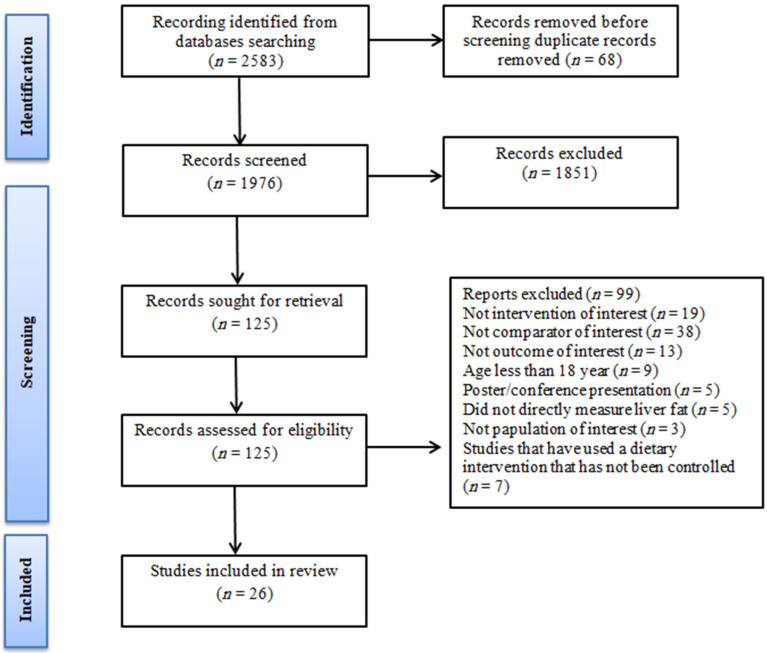
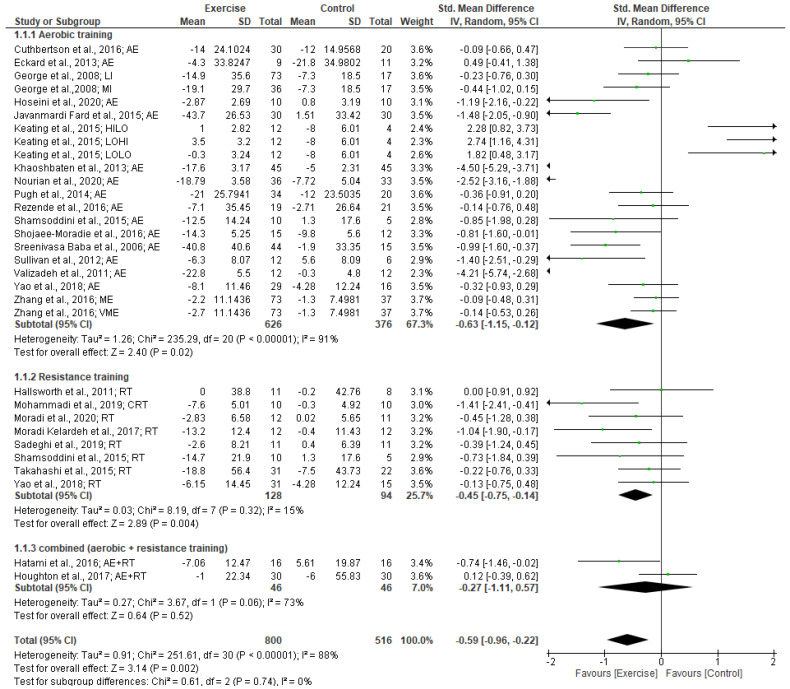
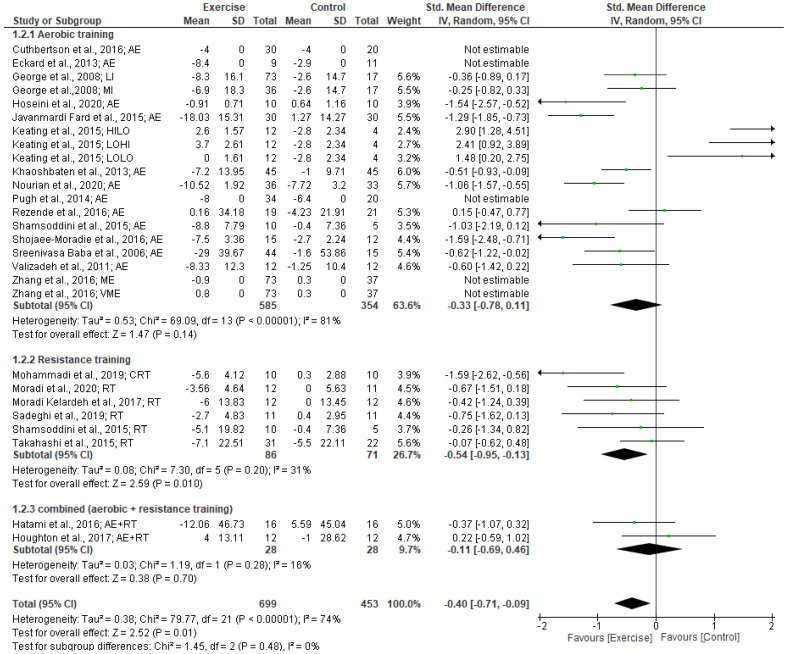
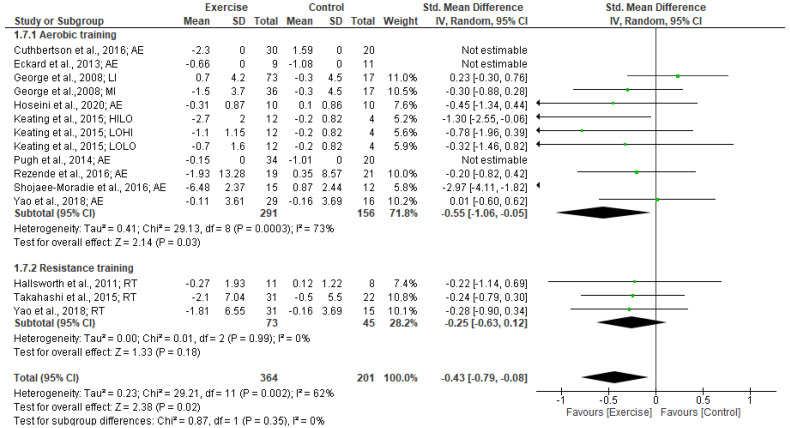
Background: Structured exercise as part of lifestyle modification plays an important role in the improvement of non-alcoholic fatty liver disease (NAFLD); however, its effectiveness has been shown to vary. This systematic review with meta-analysis investigated the effects of exercise on liver function and insulin resistance markers in patients with NAFLD. Methods: Six electronic databases were searched using terms related to exercise and NAFLD up to March 2022. Data were analyzed using a random-effects model to estimate the standardized mean difference (SMD) and 95% confidence interval. Results: The systematic search identified 2583 articles, of which a total of 26 studies met the inclusion criteria and were eligible. Exercise training had a moderate effect on reducing ALT (SMD: −0.59, p = 0.01) and small effects on reducing AST (SMD: −0.40, p = 0.01) and insulin (SMD: −0.43, p = 0.02). Significant reductions in ALT were found following aerobic training (SMD: −0.63, p < 0.01) and resistance training (SMD: −0.45, p < 0.001). Moreover, reductions in AST were found following resistance training (SMD: −0.54, p = 0.001), but not after aerobic training and combined training. However, reductions in insulin were found following aerobic training (SMD: −0.55, p = 0.03). Exercise interventions for <12 weeks compared to ≥12 weeks were more effective in reducing FBG and HOMA-IR, while interventions for ≥12 weeks compared to <12 weeks were more effective in reducing ALT and AST levels. Conclusions: Our findings support the effectiveness of exercise in improving liver function markers but not in blood glucose control in NAFLD patients. Additional studies are needed to determine the exercise prescription to maximize health in these patients.
Overview
The claims and statistics of this paper haven’t been checked yet.
Free: it reads the open-access text and checks the first 5 claims that cite a source we can check. Create a free account to check every claim.
Integrity signals
Registry
Cites
Statistics
Figures
Verification
Claims the paper makes
The claims and statistics of this paper haven’t been checked yet.
Free: it reads the open-access text and checks the first 5 claims that cite a source we can check. Create a free account to check every claim.
Claims other papers make about this one
Each is checked against this paper’s own text: does it say what the citing paper says it does?
The source backs part of the claim, not all of it — or backs it for a different population, condition or comparison.
In the citing paper
“The significant reduction in liver fat percentage observed with aerobic exercise may be attributed to enhanced fat oxidation and improved hepatic insulin sensitivity [100, 101].”
From Effects of Mediterranean diet, exercise, and their combination on body composition and liver outcomes in metabolic dysfunction-associated steatotic liver disease: a systematic review and meta-analysis of randomized controlled trials (2025) · cites this paper as [101]
Experimental — accuracy not yet measuredThe source backs part of the claim, not all of it — or backs it for a different population, condition or comparison.
In the citing paper
“This effect on ALT aligns with previous findings, suggesting that resistance training may improve hepatic enzyme levels through enhanced insulin sensitivity and reduced hepatic fat accumulation [101].”
From Effects of Mediterranean diet, exercise, and their combination on body composition and liver outcomes in metabolic dysfunction-associated steatotic liver disease: a systematic review and meta-analysis of randomized controlled trials (2025) · cites this paper as [101]
Experimental — accuracy not yet measured
Self-check
Percentages, sums and reported differences re-computed from the paper’s own numbers.
The self-check needs the paper’s full text.
Citations
Cites
Measuring inconsistency in meta-analyses
Higgins, J. P. T., Thompson, S. G., Deeks, J. J., & Altman, D. G. (2003) · BMJ · doi:10.1136/bmj.327.7414.557 · Cited by 63,139 · cited 2×
“If standard errors were reported, these values were converted to SD [21].”
MethodBias in meta-analysis detected by a simple, graphical test
Egger, M., Smith, G. D., Schneider, M., & Minder, C. (1997) · BMJ · doi:10.1136/bmj.315.7109.629 · Cited by 56,722
Statistical Power Analysis for the Behavioral Sciences
Cohen, J. (2013) · doi:10.4324/9780203771587 · Cited by 25,373
The PRISMA 2020 statement: an updated guideline for reporting systematic reviews
Page, M. J., McKenzie, J. E., Bossuyt, P. M., Boutron, I., Hoffmann, T. C., Mulrow, C. D., Shamseer, L., Tetzlaff, J. M., Akl, E. A., Brennan, S. E., et al. (2021) · Systematic Reviews · doi:10.1186/s13643-021-01626-4 · Cited by 13,874 · cited 2×
“2023, 12, 3011 16 of 19 Supplementary Materials: The following supporting information can be downloaded at: https://www.mdpi.com/article/10.3390/jcm12083011/s1, Figure S1: Funnel plot for ALT levels; Figure S2: Funnel plot for AST levels; Figure S3: Funnel plot for FBG levels; Figure S4: Funnel plot for insulin; Figur…”
MethodInfluentialBorenstein, M., Hedges, L. V., Higgins, J. P. T., & Rothstein, H. R. (2021) · doi:10.1002/9781119558378 · Cited by 9,799
Global burden of NAFLD and NASH: trends, predictions, risk factors and prevention
Younossi, Z., Anstee, Q. M., Marietti, M., Hardy, T., Henry, L., Eslam, M., George, J., & Bugianesi, E. (2018) · Nature Reviews Gastroenterology & Hepatology · doi:10.1038/nrgastro.2017.109 · Cited by 5,249 · cited 1×
“The disease affects almost 25% of the world population [7] and 23% of European citizens [8].”
BackgroundEASL–EASD–EASO Clinical Practice Guidelines for the management of non-alcoholic fatty liver disease
(2016) · Journal of Hepatology · doi:10.1016/j.jhep.2015.11.004 · Cited by 4,836
Boulé, N. G., Haddad, E., Kenny, G. P., Wells, G. A., & Sigal, R. J. (2001) · JAMA · doi:10.1001/jama.286.10.1218 · Cited by 1,889
KANALEY, J. A., COLBERG, S. R., CORCORAN, M. H., MALIN, S. K., RODRIGUEZ, N. R., CRESPO, C. J., KIRWAN, J. P., & ZIERATH, J. R. (2022) · Medicine & Science in Sports & Exercise · doi:10.1249/mss.0000000000002800 · Cited by 931 · cited 1×
“Physical activity is consistently reported to be as effective as weight loss, if not more so, for T2D prevention [61].”
BackgroundMelsen, W. G., Bootsma, M. C. J., Rovers, M. M., & Bonten, M. J. M. (2014) · Clinical Microbiology and Infection · doi:10.1111/1469-0691.12494 · Cited by 776 · cited 1×
“However, even with the strictest selection criteria for study inclusion, it is challenging to avoid some heterogeneity [67].”
Background
Research works printed but not linked: 1
- Yao J. Meng M. Yang S. Li F. Anderson R.M. Liu C. Liu L. Yuan X. Fang Z. Lou Q. Effect of aerobic and resistance exercise on liver enzyme and blood lipids in Chinese patients with nonalcoholic fatty liver disease: A randomized controlled trial Int. J. Clin. Exp. Med. 2018 11 4867 4874
Cited by
Keating, S. E., Sabag, A., Hallsworth, K., Hickman, I. J., Macdonald, G. A., Stine, J. G., George, J., & Johnson, N. A. (2023) · Sports Medicine · doi:10.1007/s40279-023-01918-w · Cited by 119
“…within-group benefits for exercise on hepatic insulin sensitivity [69], the efficacy for improving glycaemic control [54, 65, 73, 75, 79, 80] and the Homeostatic Model Assessment for Insulin Resistance (HOMA-IR) [25, 50, 54, 59, 60, 66, 67, 70, 76, 123] in people with MAFLD is…”
Arita, V. A., Cabezas, M. C., Hernández Vargas, J. A., Trujillo-Cáceres, S. J., Mendez Pernicone, N., Bridge, L. A., Raeisi-Dehkordi, H., Dietvorst, C. A. W., Dekker, R., Uriza-Pinzón, J. P., et al. (2025) · BMC Medicine · doi:10.1186/s12916-025-04320-7 · Cited by 43
Grinshpan, L. S., Haim, Y. E., Wajcman, D. I., Isakov, N. F., Nov, Y., Webb, M., Shibolet, O., Kariv, R., & Zelber‐Sagi, S. (2024) · Hepatology Communications · doi:10.1097/hc9.0000000000000583 · Cited by 29
“[3] Many studies have tested the role of different lifestyle factors in the prevention and treatment of MASLD, suggesting moderate physical activity, [4] nonsmoking, [5] maintenance of normal body weight, and adherence to a healthy diet [6,7] as key protective factors.”
BackgroundPhysical exercise in liver diseases
Zhang, Y., Cao, C., Li, C., Witt, R. G., Huang, H., Tsung, A., & Zhang, H. (2024) · Hepatology · doi:10.1097/hep.0000000000000941 · Cited by 26
“[107] Interestingly, an RCT indicated that combining moderate-intensity aerobic exercise (60 min per day, 5 times per week for 12 wks) with alternate-day fasting has been shown to reduce insulin resistance in adults with MASLD.”
Huang, M., Yang, J., Wang, Y., & Wu, J. (2024) · Frontiers in Physiology · doi:10.3389/fphys.2024.1428723 · Cited by 14
Shahiddoust, F., & Monazzami, A. (2025) · BMC Sports Science Medicine and Rehabilitation · doi:10.1186/s13102-025-01123-4 · Cited by 10
“Studies indicate that both AT and RT can reduce AST and ALT levels by decreasing liver fat content, visceral fat content, and IR [64–66].”
Liu, X., Zhong, Y., Guo, Y., Xu, J., Wang, S., Liu, Y., Lv, Y., & Zheng, X. (2025) · International Journal of Molecular Sciences · doi:10.3390/ijms26125810 · Cited by 5
“Aerobic exercise has been shown to enhance liver function by reducing hepatic fat deposition, improving insulin sensitivity, and lowering liver enzyme levels, even without significant weight loss [6–8].”
Pinto, A. P., Muñoz, V. R., Tavares, M. E. A., Neto, I. V. D. S., dos Santos, J. R., Rodrigues, G. S., Carolino, R. O. G., Alberici, L. C., Simabuco, F. M., Teixeira, G. R., et al. (2024) · Clinical and Experimental Pharmacology and Physiology · doi:10.1111/1440-1681.70001 · Cited by 4
“47 However, the effects of short-and long-term combined exercise protocols on healthy livers remain largely unknown.”
Cho, S. H., Kim, G., Lee, K., Oh, R., Kim, J. Y., Jang, M., Lee, Y., Jin, S., Hur, K. Y., Han, K., et al. (2025) · Scientific Reports · doi:10.1038/s41598-025-16750-7 · Cited by 3
“Recent research has emphasized that the mechanisms underlying MASLD involve lipotoxicity; therefore, the interaction between exercise and smoking could play a significant role in managing the condition 31–34 .”
Khaleghi, M. M., Zar, A., & Sadeghipour, H. R. (2025) · Journal of the International Society of Sports Nutrition · doi:10.1080/15502783.2025.2532686 · Cited by 2
“Medical studies highlight numerous benefits of physical activity, including reduced mortality, improved quality of life, enhanced bone and brain health, reduced anxiety, prevention of metabolic disorders, and improved liver function [1,3–5].”
Uçar, M. A., Yılmaz, C., Soylu, H. H., Sarıakçalı, B., BUDAK, C., Kavuran, K., DURMUŞOĞLU, M. V., & Ceylan, L. (2025) · Frontiers in Public Health · doi:10.3389/fpubh.2025.1630525 · Cited by 4
Vlahović, D., Trifunović, S., Borković-Mitić, S., Pavlović, S. Z., Gizdović, I., Lütjohann, D., Filipović, B. R., Marina, L., & Šošić‐Jurjević, B. (2025) · Antioxidants · doi:10.3390/antiox14121492 · Cited by 2
“Exercise remains a cornerstone of metabolic health, as it independently improves glucose regulation, cardiovascular performance, and hepatic integrity [13,14].”
Guo, Y., Xin, X., & Liu, P. (2026) · Frontiers in Nutrition · doi:10.3389/fnut.2026.1731510 · Cited by 2
“Long-term exercise not only improves liver fat metabolism but also enhances liver function recovery by activating more complex metabolic pathways (25).”
Mihaila, D. F., Domnariu, H. P., Moga, D. F. C., & Domnariu, C. D. (2026) · Metabolites · doi:10.3390/metabo16040224 · Cited by 2
Kim, Y., Lee, T., & Oh, C. (2025) · BMC Gastroenterology · doi:10.1186/s12876-025-03687-4 · Cited by 2
“Recent meta-analysis reported that exercise training showed significant improvement in liver function markers in MASLD patients [46].”
Pamungkas, B. T., Rejeki, P. S., & Susanto, J. (2023) · International Journal of Research Publications · doi:10.47119/ijrp10013911220235792 · Cited by 2
Xu, S., Xiao, Y., Xu, C., Zeng, X., Zhao, L., Li, T., Jiang, D., Na, R., & Chen, H. (2025) · BMJ Open Sport & Exercise Medicine · doi:10.1136/bmjsem-2025-002702 · Cited by 1
“23 24 Another limitation of previous research is the reliance on self-reported physical activity data collected through questionnaires, which are prone to recall bias and insensitive to light-intensity physical activity (LPA), thus restricting the classification of physical activity into broad…”
Niu, Y., Radzimiński, Ł., Qian, G., Szwarc, A., & Ossowski, Z. M. (2025) · Scientific Reports · doi:10.1038/s41598-025-25909-1 · Cited by 2
“The Alinity c system demonstrated metrological traceability to IFCC reference procedures and exhibited acceptable measurement uncertainty for AST and ALT 40 .”
InfluentialExercise as a Metabolic Therapy for MASLD: Beyond Weight Loss Toward Sustainable Exercise Strategies
Roh, H., & Bae, J. Y. (2026) · Medicina · doi:10.3390/medicina62040784 · Cited by 1
“This integrated metabolic adaptation may be particularly effective in attenuating hepatic steatosis and improving insulin sensitivity [82].”
Du, X., Gao, F., Wang, X., Lei, S., Cheng, S., & Le, S. (2025) · Science & Sports · doi:10.1016/j.scispo.2023.10.006 · Cited by 1
Paydar, Y., Sheikhani Shahin, H., & Rahimi, E. (2024) · مجله دانشگاه علوم پزشکی تربت حیدریه · doi:10.61186/jmsthums.12.3.65
Wang, J., Yang, Y., Yang, C., Shi, Y., & Cao, B. (2025) · International Journal of Clinical Practice · doi:10.1155/ijcp/2802391
Xia, N., Cheng, Y., Liu, J., Li, D., Li, J., Li, H., Meng, F., Zhu, Y., & Qin, J. (2025) · BMJ Open · doi:10.1136/bmjopen-2024-095151
“33 34 For instance, research conducted by Charatcharoenwitthaya et al 35 and Guo et al 36 used uniform exercise prescriptions for all participants, while Mascaró et al 37 employed individualised prescriptions.”
Fuad, N. A., Alifianti, A., Harum, N. A., & Cheng, W. (2025) · Jurnal Gastrohepatologi Anak Indonesia/Archives of Pediatric Gastroenterology, Hepatology, and Nutrition · doi:10.58427/apghn.4.4.2025.174-188
“32 The results from the studies demonstrate the positive impact of aerobic exercise interventions on hepatic steatosis and fibrosis in pediatric patients with MASLD, as assessed through various radiological methods including USG, FibroScan, and MRI.”
Meena, A., Chahar, P. S., & Singh, J. (2025) · Lecture notes in bioengineering · doi:10.1007/978-981-96-8757-2_4
Drogy, M. S., Minto, S. T., & Frishman, W. H. (2026) · Cardiology in Review · doi:10.1097/crd.0000000000001259 · Cited by 3
Ali, M. (2026) · Journal of Clinical and Experimental Hepatology · doi:10.1016/j.jceh.2026.103614
Hong, D., Xi, B., Lv, Z., Li, N., He, X., Zhu, X., Zhang, J., Wang, C., Cai, Z., Wu, H., et al. (2026) · European Journal of Gastroenterology & Hepatology · doi:10.1097/meg.0000000000003290
Metadata
- Authors
- Hejazi, K., & Hackett, D.
- Affiliations
- Hakim Sabzevari University (IR)
- The University of Sydney (AU)
- Corresponding author
- Hejazi, Keyvan
- Venue
- Journal of Clinical Medicine
- Publisher
- MDPI AG
- Published
- 2023-04-20
- Volume
- 12
- Issue
- 8
- Pages
- 3011
- ISSN
- 2077-0383 (ISSN-L)
- PMC
- PMC10143548
- OpenAlex
- W4366772864
- Semantic Scholar
- 3a65867ab7112337b1c88f6c1010312de666185d
- Cited by
- 29
- References
- 71
- Citations by year
- 2026: 6 · 2025: 16 · 2024: 5 · 2023: 2
- FWCI
- 1.13
- Type
- journal article
- Language
- en
- Open access
- gold
- doi.org
- Licence
- Locations
- Journal of Clinical Medicine (publishedVersion, cc-by)
- PubMed Central (publishedVersion, cc-by)
- PubMed (publishedVersion)
- Topics
- Health Sciences › Medicine › Hepatology › Liver Disease Diagnosis and Treatment
- Health Sciences › Medicine › Public Health, Environmental and Occupational Health › Physical Activity and Health
- Health Sciences › Medicine › Endocrinology, Diabetes and Metabolism › Diabetes, Cardiovascular Risks, and Lipoproteins
- Keywords
- non-alcoholic fatty liver disease, exercise training, aerobic exercise, resistance training, liver function markers, alanine aminotransferase, aspartate aminotransferase, insulin resistance, HOMA-IR, fasting blood glucose, lifestyle modification
About these checks
Registry, retraction, Cites and statistics results are computed, not judged, with one exception: a printed reference that no index lists is read once by a model before it counts as a citation error. Claims are extracted by a model and kept only when their quote appears verbatim in the text; each cited source is then checked, with a model’s help, for whether it says what the claim relies on. Those verdicts can be wrong — read the claim’s quote and the cited source before relying on one.
Statistics and arithmetic are recomputed, not judged.
Confidence bands are shown only for fields calibrated on our annotated test set. None is calibrated yet, so no band is shown.
What counts as a claim ›How we measure confidence ›How we check this ›
Are you an author, or do you see a problem with this page? Request a review
Data sources
Bibliographic data: Semantic Scholar, OpenAlex, Crossref.
Contains information from the Semantic Scholar Academic Graph Datasets, made available under the ODC Attribution License (ODC-BY 1.0).
Semantic Scholar’s data is described in: Kinney, R., et al. (2023). The Semantic Scholar Open Data Platform. arXiv:2301.10140.
