

The DOI matches its Crossref record; 51 of the 52 references it cites were found in a registry or an index, and 1 are not checked yet.
Immunology of Stress: A Review Article
Open accessAbstract
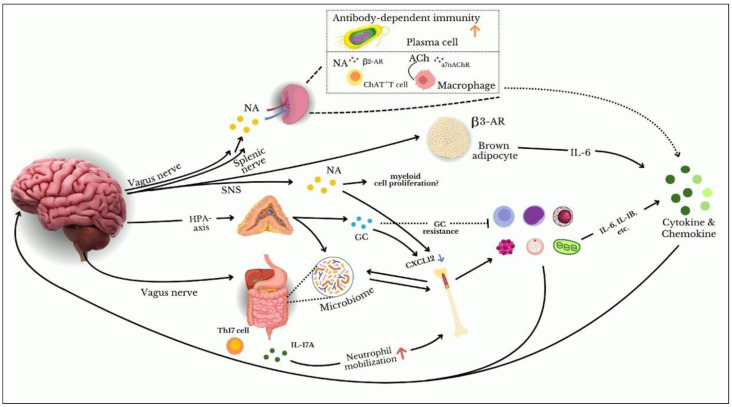
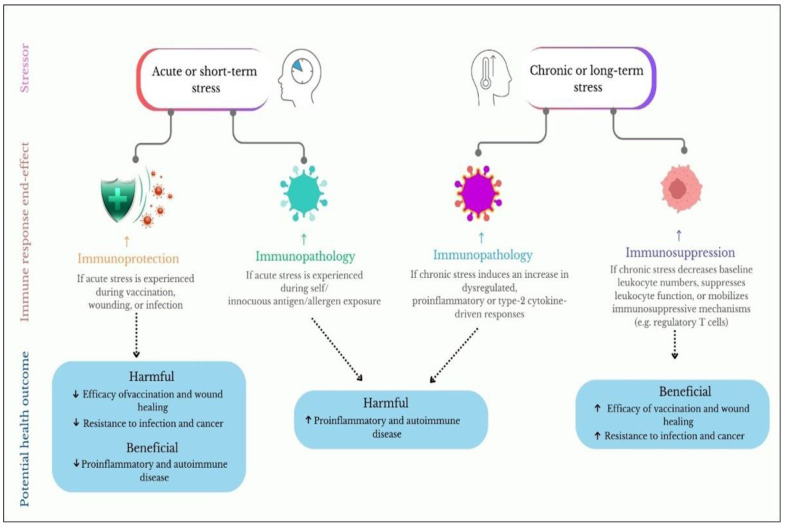
Stress significantly impacts the immune system, affecting susceptibility to illness and overall health. This review examines the intricate relationship between stress and the immune system, offering insights having practical implications for health and disease prevention. Stress can significantly trigger molecular and immune modulation, affecting the distribution and trafficking of immune cells in various organs and altering their composition in the blood. The review delves into two key pathways connecting stress and immunity: the hypothalamic–pituitary–adrenal (HPA) axis and the sympathetic nervous system. Stress activates the neuroendocrine system and triggers microglia in the brain, releasing stress hormones and neurotransmitters that modulate the function and movement of immune cells. Acute stress can temporarily strengthen immunity and promote protection during infection; in contrast, chronic stress dysregulates or inhibits immune functions. Chronic stress causes an increase in cortisol levels through the HPA axis, ultimately suppressing the immune response. Recognizing stress triggers and implementing effective stress management techniques can significantly impact individuals’ well-being. This review indicates that immune cells express genes differentially in response to stress, suggesting individual variabilities in the immune response against stress. This underscores the need for a personalized approach to stress management. This review also highlights the potential link between chronic stress and autoimmune disorders and warrants further investigation.
Overview
The claims and statistics of this paper haven’t been checked yet.
Run the check — free, no account needed. It reads the open-access text and checks the sources it cites.
Integrity signals
Registry
Cites
Statistics
Figures
Verification
Claims the paper makes
The claims and statistics of this paper haven’t been checked yet.
Run the check — free, no account needed. It reads the open-access text and checks the sources it cites.
Claims other papers make about this one
Each is checked against this paper’s own text: does it say what the citing paper says it does?
The source backs part of the claim, not all of it — or backs it for a different population, condition or comparison.
In the citing paper
“Recent studies indicate that chronic psychological or physiological stress can exacerbate RA through neuro–immune–bone axis pathways [76]”
From Interorgan Communications in Skeletal Pathophysiology: From Molecular Pathways to Multidisciplinary Therapies (2026) · cites this paper as [76]
Experimental — accuracy not yet measured
Self-check
Percentages, sums and reported differences re-computed from the paper’s own numbers.
The self-check needs the paper’s full text.
Citations
Cites
Neutrophil Extracellular Traps Kill Bacteria
Brinkmann, V., Reichard, U., Goosmann, C., Fauler, B., Uhlemann, Y., Weiss, D. S., Weinrauch, Y., & Zychlinsky, A. (2004) · Science · doi:10.1126/science.1092385 · Cited by 10,268
Macrophage activation and polarization: nomenclature and experimental guidelines
Murray, P. J., Allen, J. E., Biswas, S. K., Fisher, E. A., Gilroy, D. W., Goerdt, S., Gordon, S., Hamilton, J. A., Ivashkiv, L. B., Lawrence, T., et al. (2014) · Immunity · doi:10.1016/j.immuni.2014.06.008 · Cited by 6,337
Psychological stress and the human immune system: a meta-analytic study of 30 Years of inquiry
Segerstrom, S. C., & Miller, G. E. (2004) · Psychological Bulletin · doi:10.1037/0033-2909.130.4.601 · Cited by 3,334
Psychological Stress and Disease
Cohen, S., Janicki-Deverts, D., & Miller, G. E. (2007) · JAMA · doi:10.1001/jama.298.14.1685 · Cited by 3,168
MURPHY, K. M. M., & Weaver, C. T. (2016) · W.W. Norton eBooks · doi:10.1201/9781315533247 · Cited by 2,262
Slavich, G. M., & Irwin, M. R. (2014) · Psychological Bulletin · doi:10.1037/a0035302 · Cited by 2,206
Regulation of the Hypothalamic‐Pituitary‐Adrenocortical Stress Response
Herman, J. P., McKlveen, J. M., Ghosal, S., Kopp, B., Wulsin, A., Makinson, R., Scheimann, J., & Myers, B. (2016) · Comprehensive Physiology · doi:10.1002/cphy.c150015 · Cited by 1,819
Effects of stress on immune function: The good, the bad, and the beautiful
Dhabhar, F. S. (2014) · Immunologic Research · doi:10.1007/s12026-014-8517-0 · Cited by 1,343
Decisions About Dendritic Cells: Past, Present, and Future
Steinman, R. M. (2012) · Annual Review of Immunology · doi:10.1146/annurev-immunol-100311-102839 · Cited by 1,319
Mast cells in the development of adaptive immune responses
Galli, S. J., Nakae, S., & Tsai, M. M. (2005) · Nature Immunology · doi:10.1038/ni1158 · Cited by 1,280
Research works printed but not linked: 1
- Figueiredo, 2018, Stress and the Immune System: The Role of the HPA Axis, Curr. Neuropharmacol., 16, 1
Cited by
Sorted by citations
Neuro-immune cross-talk in cancer
Amit, M., Eichwald, T., Roger, A., Anderson, J. L., Chang, A., Vermeer, P. D., Dixon, K. O., Scheff, N. N., & Talbot, S. (2025) · Nature reviews. Cancer · doi:10.1038/s41568-025-00831-w · Cited by 120
Balakin, E. I., Yurku, K. A., Ivanov, M., Izotov, A., Игоревна, Н. В., & Pustovoit, V. I. (2025) · Biology · doi:10.3390/biology14010076 · Cited by 61
Xu, J., Wang, Q., Anikeeva, O., Zhu, P., Bi, P., & Huang, C. (2025) · BMJ · doi:10.1136/bmj-2025-084675 · Cited by 50
Carollo, C., Sorce, A., Cirafici, E., Ciuppa, M. E., Mulè, G., & Caimi, G. (2025) · International Journal of Molecular Sciences · doi:10.3390/ijms26178256 · Cited by 37
The gut–brain connection: microbes’ influence on mental health and psychological disorders
Ataei, P., Kalantari, H., Bodnar, T. S., & Turner, R. J. (2026) · Frontiers in Microbiomes · doi:10.3389/frmbi.2025.1701608 · Cited by 33
“…proin fl ammatory cytokines (e.g., IL-6 and TNF-a ) and dampens T-cell activity in the short term, chronic cortisol elevation may impair immune cell responsiveness and promote a shift toward Th2 dominance, reducing cellular immunity and increasing susceptibility to infections (Alotiby, 2024).”
Metadata
- Authors
- Alotiby, A.
- Affiliations
- Umm al-Qura University (SA)
- Corresponding author
- Alotiby, Amna
- ORCID
- Alotiby, Amna
- Venue
- Journal of Clinical Medicine
- Publisher
- MDPI AG
- Published
- 2024-10-25
- Volume
- 13
- Issue
- 21
- Pages
- 6394
- ISSN
- 2077-0383 (ISSN-L)
- PMC
- PMC11546738
- OpenAlex
- W4403749058
- Cited by
- 253
- References
- 51
- Citations by year
- 2026: 145 · 2025: 108
- FWCI
- 9.71
- Type
- journal article
- Language
- en
- Open access
- gold
- doi.org
- Licence
- Locations
- Journal of Clinical Medicine (publishedVersion, cc-by)
- PubMed Central (publishedVersion, cc-by)
- PubMed (publishedVersion)
- Topics
- Life Sciences › Neuroscience › Behavioral Neuroscience › Stress Responses and Cortisol
- Life Sciences › Biochemistry, Genetics and Molecular Biology › Cancer Research › Cancer, Stress, Anesthesia, and Immune Response
- Life Sciences › Neuroscience › Neurology › Vagus Nerve Stimulation Research
- Keywords
- stress, immune system, hypothalamic-pituitary-adrenal axis, sympathetic nervous system, cortisol, chronic stress, acute stress, immune cell trafficking, neuroendocrine-immune interaction, microglia, stress hormones, stress management, autoimmune disease, immune gene expression
About these checks
Registry, retraction, Cites and statistics results are computed, not judged, with one exception: a printed reference that no index lists is read once by a model before it counts as a citation error. Claims are extracted by a model and kept only when their quote appears verbatim in the text; each cited source is then checked, with a model’s help, for whether it says what the claim relies on. Those verdicts can be wrong — read the claim’s quote and the cited source before relying on one.
Statistics and arithmetic are recomputed, not judged.
Confidence bands are shown only for fields calibrated on our annotated test set. None is calibrated yet, so no band is shown.
What counts as a claim ›How we measure confidence ›How we check this ›
Are you an author, or do you see a problem with this page? Request a review
