

Potential Health Consequences of Regular Blood Donation: Current Evidence and Remaining Uncertainties
Open accessThe DOI matches its Crossref record; 52 of the 52 references it cites were found in a registry or an index; none of the 83 sources its claims cite is checked for support yet.
Abstract
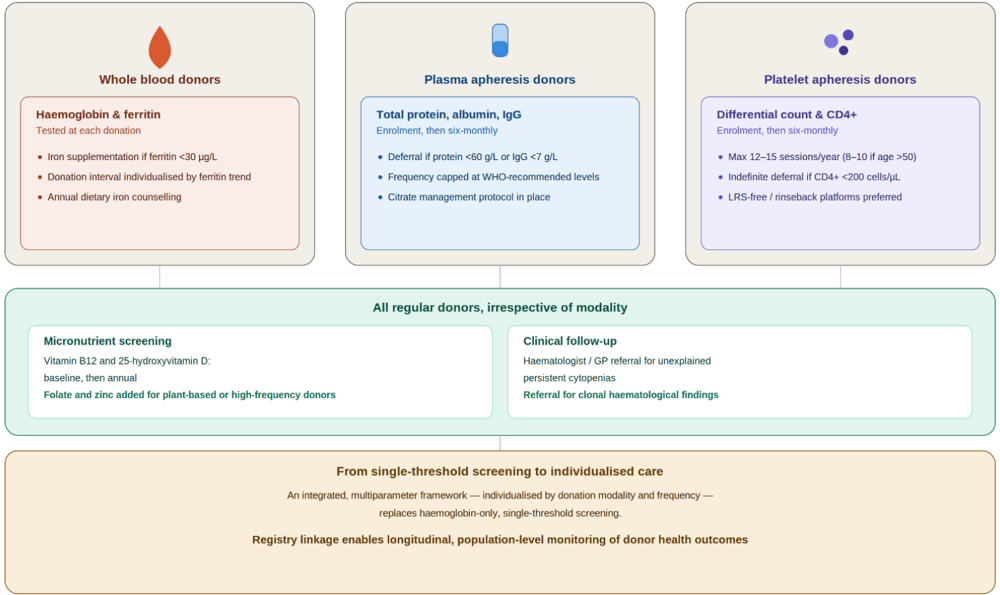
Blood donation sustains an estimated 118 million annual donations worldwide, and while advances in infectious disease screening have greatly reduced recipient risk, the long-term health of repeat donors has received comparatively less attention. This cumulative review synthesises current evidence on the principal acquired complications of regular blood donation across all modalities—whole blood, plasmapheresis, and plateletpheresis—addressing iron deficiency, plasma protein depletion, apheresis-related lymphopenia, clonal haematopoiesis of indeterminate potential (CHIP), and micronutrient deficiency. Iron deficiency affects 15–36% of frequent whole blood donors and is systematically underdetected by haemoglobin-based screening alone; ferritin-guided interval adjustment and oral supplementation are effective countermeasures. Regular plasmapheresis depletes immunoglobulins (IgG below normal in 5–15% of high-frequency donors), albumin, and coagulation factors, compounded by cumulative citrate-mediated hypocalcaemia. Plateletpheresis causes measurable subset-selective T-cell and NK-cell depletion, with CD4+ counts below clinically significant thresholds in a minority of the most frequent donors, an observation of unknown significance. Emerging molecular data indicate that repeated haematopoietic stress selectively enriches low-risk, EPO-responsive DNMT3A clonal variants without increasing malignant risk. Regular blood donation if properly applied is a safe process. Across all domains, current eligibility criteria based on haemoglobin alone turn out to be inadequate; a shift to multiparameter, individualised and targeted donor monitoring—integrating ferritin, serum proteins, differential leucocyte counts, and micronutrient profiling—is both evidence-suggested and ethically worth considering to sustain the long-term health of voluntary donor populations.
Overview
CoChat Summary
TL;DR
This narrative review synthesizes evidence on acquired health consequences of regular whole blood, plasma, and platelet donation, concluding that donation is generally safe when properly applied but that hemoglobin-only eligibility screening is inadequate. It recommends multiparameter, individualized donor monitoring—including ferritin, serum proteins, differential leucocyte counts, and micronutrient profiling—to protect repeat donors.
Key findings
- Iron deficiency affects 15–36% of frequent whole blood donors; in REDS-II RISE, 36% of frequent female and 23% of frequent male donors had ferritin below 12 µg/L despite acceptable hemoglobin. The INTERVAL trial randomized 45,000 donors, and the FIND’EM trial in 412,888 Dutch donors found ferritin-guided intervals reduced iron deficiency prevalence.
- Regular plasmapheresis depletes immunoglobulins, albumin, and coagulation factors: IgG below 700 mg/dL occurs in 5–15% of donors completing more than 40 sessions annually, and the SIPLA study of 3,783 donors reported a 12.5% deferral rate attributable to low IgG. Citrate-mediated hypocalcemia is clinically actionable in an estimated 1–5% of sessions.
- Plateletpheresis causes subset-selective lymphopenia: absolute lymphocyte count below 1.0 × 10⁹/L in 8–28% of donors completing more than 12 sessions/year versus 1–3% in non-donors. CD4+ counts below 200 cells/µL occurred in 30% of highest-frequency Trima Accel LRS donors; the BEST collaborative found 9.9% in frequent Trima donors versus 4.4% in Amicus donors and 0% in whole blood controls. SCANDAT3-S (74,408 apheresis donors) showed dose-dependent increased risk of immunosuppression-related infections.
- In a Swedish cohort of more than one million donors and nearly 20 million person-years, regular donation was not associated with increased overall hematological malignancy; AML SIR was 0.85 (95% CI 0.77–0.83) and CLL SIR 1.07 (95% CI 1.01–1.15). Karpova et al. found frequent donors (>100 lifetime donations) enriched for low-risk, EPO-responsive DNMT3A W305* variants but not high-risk DNMT3A R882 mutations.
Methods
- Narrative review synthesizing evidence across whole blood donation, plasmapheresis, plateletpheresis, CHIP, micronutrient deficiency, and psychological aspects.
- PubMed/MEDLINE, Web of Science, and Scopus were searched for studies published from 2000 to current using terms related to blood donation, blood donors, iron status, haematological parameters, and physiological effects; reference lists were also screened. Original research, systematic reviews, meta-analyses, clinical guidelines, and other relevant publications were considered.
- The authors state the search was intended to identify and synthesize relevant evidence rather than provide an exhaustive systematic review.
Limitations
- Stated: as a narrative review, it is not an exhaustive systematic review; long-term prospective observations are lacking, evidence on the clinical significance of plateletpheresis-associated lymphopenia is contradictory, CHIP cardiovascular impact in donors has not been systematically evaluated, and vitamin D causality is not established. Some platelet donor data are preliminary unpublished observations from the authors’ service (personal communication).
- Stated: no data are available on the expected rate of return to donation for deferred lymphopenic donors.
- Evident from the text: there is no formal systematic review methodology, meta-analysis, risk-of-bias assessment, or quality appraisal; conclusions rely on heterogeneous observational studies, cohort data, and selected trials, with several evidence gaps identified by the authors.
Model-written summary. Check it against the paper before relying on it.
Integrity signals
Registry
Cites
Statistics
Figures
Verification
Claims the paper makes
0 Valid · 4 Not valid · 65 Not checked · 44 Own results and interpretations
In the paper
“A Swedish nationwide cohort study including more than one million donors and nearly 20 million person-years of follow-up found no increase in the risk of any haematological malignancy in regular donors”
§ Potential Health Consequences of Regular Blood Donation: Current Evidence and Remaining Uncertainties > 5. Clonal Haematopoiesis of Indeterminate Potential in Regular Blood Donors > 5.2. Evidence in Blood Donors
What the sources say
- Not checked yetcites [32] Zhao J. Dahlén T. Brynolf A. Edgren G. Risk of hematological malignancy in blood donors: A nationwide cohort study Transfusion 2020 60 2591 2596 10.1111/trf.16020 32818321 PMC7754460 source
plain- Asserted: passes — The authors put it forward as true.
- Checkable: passes — It can be checked against evidence.
- Load-bearing: passes — The paper’s conclusions depend on it.
- Based: passes — The paper gives a reason why it holds.
A result the paper states — it cites no source for it, so there is none to check. The quote shows it is in the paper.
In the paper
“Restless legs syndrome has been specifically linked to low ferritin in blood donor studies, with evidence of a threshold effect below ferritin 50 µg/L.”
§ Potential Health Consequences of Regular Blood Donation: Current Evidence and Remaining Uncertainties > 2. Iron Deficiency as an Acquired Complication of Regular Blood Donation > 2.3. Clinical Presentation
plainstates an association- Asserted: passes — The authors put it forward as true.
- Checkable: passes — It can be checked against evidence.
- Load-bearing: unclear — It is unclear whether the paper’s conclusions depend on it.
- Based: passes — The paper gives a reason why it holds.
In the paper
“In the landmark REDS-II RISE study—a large prospective cohort of 2425 American donors—36% of frequent female donors and 23% of frequent male donors had ferritin below 12 µg/L, despite acceptable haemoglobin at donation”
§ Potential Health Consequences of Regular Blood Donation: Current Evidence and Remaining Uncertainties > 2. Iron Deficiency as an Acquired Complication of Regular Blood Donation > 2.2. Incidence and Epidemiology
What the sources say
- Not checked yetcites [3] Cable R.G. Glynn S.A. Kiss J.E. Mast A.E. Steele W.R. Murphy E.L. Wright D.J. Sacher R.A. Gottschall J.L. Tobler L.H. Iron deficiency in blood donors: The REDS-II Donor Iron Status Evaluation (RISE) study Transfusion 2012 52 702 711 10.1111/j.1537-2995.2011.03401.x 22023513 PMC3618489 source
plainn = 2,425- Asserted: passes — The authors put it forward as true.
- Checkable: passes — It can be checked against evidence.
- Load-bearing: passes — The paper’s conclusions depend on it.
- Based: passes — The paper gives a reason why it holds.
A result the paper states — it cites no source for it, so there is none to check. The quote shows it is in the paper.
In the paper
“studies report ferritin below 15 µg/L in 25–40% of this subgroup”
§ Potential Health Consequences of Regular Blood Donation: Current Evidence and Remaining Uncertainties > 2. Iron Deficiency as an Acquired Complication of Regular Blood Donation > 2.2. Incidence and Epidemiology
plain- Asserted: passes — The authors put it forward as true.
- Checkable: passes — It can be checked against evidence.
- Load-bearing: unclear — It is unclear whether the paper’s conclusions depend on it.
- Based: passes — The paper gives a reason why it holds.
A result the paper states — it cites no source for it, so there is none to check. The quote shows it is in the paper.
In the paper
“In blood donors, the cardiovascular impact of CHIP has not yet been systematically evaluated in dedicated longitudinal studies—a significant evidence gap.”
§ Potential Health Consequences of Regular Blood Donation: Current Evidence and Remaining Uncertainties > 5. Clonal Haematopoiesis of Indeterminate Potential in Regular Blood Donors > 5.2. Evidence in Blood Donors
plain- Asserted: passes — The authors put it forward as true.
- Checkable: passes — It can be checked against evidence.
- Load-bearing: passes — The paper’s conclusions depend on it.
- Based: passes — The paper gives a reason why it holds.
56 more claims
Create a free account to see all 113 claims and to verify the 82 references still open.
- It may state two separate claims as one. 40
- Probably not a substantial claim. 20
Self-check
Percentages, sums and reported differences re-computed from the paper’s own numbers.
Each contradiction between two passages listed here was confirmed by an independent check.
Rated major: it would touch a result — a value a result rests on, reported and recomputed p-values on opposite sides of the significance level, two passages that conflict with no sign which is right, or a cited work retracted before this paper was published.
In the paper
§ Potential Health Consequences of Regular Blood Donation: Current Evidence and Remaining Uncertainties > 5. Clonal Haematopoiesis of Indeterminate Potential in Regular Blood Donors > 5.2. Evidence in Blood Donors
“found no increase in the risk of any haematological malignancy in regular donors”
§ Potential Health Consequences of Regular Blood Donation: Current Evidence and Remaining Uncertainties > 5. Clonal Haematopoiesis of Indeterminate Potential in Regular Blood Donors > 5.2. Evidence in Blood Donors
“a modest excess of chronic lymphocytic leukaemia (CLL; SIR 1.07, 95% CI 1.01–1.15)”
Rated minor: it would not touch a result — a value no result rests on, a p-value that stays on the same side of the significance level, or a conflict that is clerical, resolved elsewhere in the paper, or outside its own findings.
In the paper
§ Potential Health Consequences of Regular Blood Donation: Current Evidence and Remaining Uncertainties > 7. Psychological Aspects of Chronic Blood Donation
“The most systematic prospective study, which followed regular whole blood donors over eight weeks”
§ Potential Health Consequences of Regular Blood Donation: Current Evidence and Remaining Uncertainties > References
“52. Esefeld M. Sümnig A. Alpen U. Grabe H.J. Greinacher A. A Cross-Sectional Study of Blood Donors’ Psychological Characteristics over 8 Weeks”
Rated minor: it would not touch a result — a value no result rests on, a p-value that stays on the same side of the significance level, or a conflict that is clerical, resolved elsewhere in the paper, or outside its own findings.
In the paper
§ Potential Health Consequences of Regular Blood Donation: Current Evidence and Remaining Uncertainties > 8. Integrated Discussion: The Case for Multiparameter Donor Health Monitoring
“The six complication domains reviewed in this article”
§ Potential Health Consequences of Regular Blood Donation: Current Evidence and Remaining Uncertainties > 8. Integrated Discussion: The Case for Multiparameter Donor Health Monitoring > Towards a Comprehensive Donor Health Monitoring Framework
“Drawing on the evidence reviewed across all five complication domains”
Rated minor: it would not touch a result — a value no result rests on, a p-value that stays on the same side of the significance level, or a conflict that is clerical, resolved elsewhere in the paper, or outside its own findings.
In the paper
§ Potential Health Consequences of Regular Blood Donation: Current Evidence and Remaining Uncertainties > 3. Acquired Complications of Regular Plasma Donation by Apheresis > 3.2. Pathogenesis of Protein Depletion
“Immunoglobulin G (IgG), the predominant antibody class in human plasma (normal range 800–1700 mg/dL)”
§ Potential Health Consequences of Regular Blood Donation: Current Evidence and Remaining Uncertainties > 3. Acquired Complications of Regular Plasma Donation by Apheresis > 3.2. Pathogenesis of Protein Depletion
“IgG below 700 mg/dL—the lower limit of the normal reference range”
Rated minor: it would not touch a result — a value no result rests on, a p-value that stays on the same side of the significance level, or a conflict that is clerical, resolved elsewhere in the paper, or outside its own findings.
In the paper
§ Potential Health Consequences of Regular Blood Donation: Current Evidence and Remaining Uncertainties > 3. Acquired Complications of Regular Plasma Donation by Apheresis > 3.3. Citrate-Mediated Metabolic Disturbance
“repeated citrate metabolism to bicarbonate may produce cumulative metabolic alkalosis and suppress parathyroid hormone secretion”
§ Potential Health Consequences of Regular Blood Donation: Current Evidence and Remaining Uncertainties > 6. Vitamin and Micronutrient Deficiencies in Regular Blood Donors > 6.3. Vitamin D
“citrate-mediated hypocalcaemia stimulates secondary hyperparathyroidism”
1 more finding
Create a free account to see every finding of this check.
Citations
Cites
Clonal hematopoiesis and risk of atherosclerotic cardiovascular disease
Jaiswal, S., Natarajan, P., Silver, A. J., Gibson, C. J., Bick, A. G., Shvartz, E., McConkey, M., Gupta, N., Gabriel, S., Ardissino, D., et al. (2017) · New England Journal of Medicine · doi:10.1056/nejmoa1701719 · Cited by 2,683 · cited 1×
“CHIP has been consistently linked to elevated cardiovascular risk in the general population through the pro-inflammatory activity of DNMT3A-and TET2-mutant myeloid cells, which promote vascular inflammation and accelerate atherosclerosis [33,34].”
Ganz, T., & Nemeth, E. (2012) · Biochimica et Biophysica Acta (BBA) - Molecular Cell Research · doi:10.1016/j.bbamcr.2012.01.014 · Cited by 1,282 · cited 1×
“The principal homeostatic regulator of systemic iron balance, hepcidin—a hepatic peptide hormone that suppresses the iron exporter ferroportin on enterocytes and macrophages—falls sharply following donation, upregulating intestinal absorption as a compensatory response [4].”
Clonal hematopoiesis in human aging and disease
Jaiswal, S., & Ebert, B. L. (2019) · Science · doi:10.1126/science.aan4673 · Cited by 1,156 · cited 1×
“Age is the dominant determinant of prevalence: CHIP is rare below age 40, rises steeply with age, and affects more than 10–20% of individuals over 70 years [30].”
Cui, A., Zhang, T., Xiao, P., Fan, Z., Wang, H., & Zhuang, Y. (2023) · Frontiers in Nutrition · doi:10.3389/fnut.2023.1070808 · Cited by 449 · cited 1×
“It should be acknowledged here that causality is difficult to establish because prevalence of Vit D deficiency is already high by 20–50% in otherwise healthy subjects in the general population [48].”
Di Angelantonio, E., Thompson, S. G., Kaptoge, S., Moore, C., Walker, M., Armitage, J., Ouwehand, W. H., Roberts, D. J., Danesh, J., Di Angelantonio, E., et al. (2017) · The Lancet · doi:10.1016/s0140-6736(17)31928-1 · Cited by 265 · cited 2×
“…fatigue, reduced physical endurance, and cognitive impairment—including poor concentration and impaired short-term memory—reflecting iron’s role in dopaminergic neurotransmission and cerebral myelination, effects that may be present at ferritin levels well above the anaemia threshold [2,5,9].”
InfluentialIron deficiency in blood donors: the REDS‐II Donor Iron Status Evaluation (RISE) study
Cable, R. G., Glynn, S. A., Kiss, J. E., Mast, A. E., Steele, W. R., Murphy, E. L., Wright, D. J., Sacher, R. A., Gottschall, J. L., Tobler, L. H., et al. (2012) · Transfusion · doi:10.1111/j.1537-2995.2011.03401.x · Cited by 230 · cited 2×
“…blood donation, arising from the straightforward biophysical fact that each whole blood donation of 450–500 mL removes approximately 200–250 mg of elemental iron— predominantly as haemoglobin within donated erythrocytes, with additional contributions from plasma transferrin and ferritin [1–3].”
Oral Iron Supplementation After Blood Donation: A Randomized Clinical Trial
Kiss, J. E., Brambilla, D., Glynn, S. A., Mast, A. E., Spencer, B. R., Stone, M., Kleinman, S. H., & Cable, R. G. (2015) · JAMA · doi:10.1001/jama.2015.119 · Cited by 171 · cited 1×
“Short-course oral iron supplementation following donation—ferrous sulphate 325 mg (65 mg elemental iron) daily for 60 days—has been demonstrated in the HEIRS study and RISE trial to significantly attenuate ferritin decline, reduce subsequent deferral rates, and improve quality of life [12].”
Donor Clonal Hematopoiesis and Recipient Outcomes After Transplantation
Gibson, C. J., Kim, H. T., Zhao, L., Murdock, H. M., Hambley, B., Ogata, A., Madero-Marroquin, R., Wang, S., Green, L., Fleharty, M., et al. (2022) · Journal of Clinical Oncology · doi:10.1200/jco.21.02286 · Cited by 168 · cited 1×
“The question of transfusion transmission of CHIP-associated clones, while not documented for blood transfusion, warrants vigilance given case reports of clonal engraftment in haematopoietic stem cell transplantation under permissive conditions [38].”
Frequency of immediate adverse effects associated with apheresis donation
McLeod, B. C., Price, T. H., Owen, H., Ciavarella, D., Sniecinski, I., Randels, M. J., & Smith, J. W. (1998) · Transfusion · doi:10.1046/j.1537-2995.1998.381098440858.x · Cited by 136 · cited 2×
“Citrate-related adverse events collectively represent the most frequently reported class of donation-related event in hemovigilance data from plasmapheresis programmes globally [18].”
MTHFR gene polymorphism, homocysteine and cardiovascular disease
Cortese, C., & Motti, C. (2001) · Public Health Nutrition · doi:10.1079/phn2001159 · Cited by 100 · cited 1×
“…overt deficiency from donation alone is uncommon; however, donors following unfortified plant-based diets are at risk of both folate and B12 depletion, the latter because B12 is present almost exclusively in animal-source foods and its absorption is dependent upon intrinsic factor [41,42].”
Comprehensive analysis of citrate effects during plateletpheresis in normal donors
Bolan, C. D., Greer, S. E., Cecco, S. A., Oblitas, J. M., Rehak, N. N., & Leitman, S. F. (2001) · Transfusion · doi:10.1046/j.1537-2995.2001.41091165.x · Cited by 98 · cited 3×
“…return rates during symptomatic hypocalcaemia, and low-citrate apheresis platform settings; nutritional guidance should specify a protein intake of at least 1.0–1.2 g/kg body weight per day, with attention to calcium and vitamin D adequacy in donors with evidence of chronic citrate exposure [19].”
InfluentialClonality in context: hematopoietic clones in their marrow environment
Cooper, J. N., & Young, N. S. (2017) · Blood · doi:10.1182/blood-2017-07-794362 · Cited by 87 · cited 1×
“Current evidence does not support routine CHIP screening in blood donors, given uncertain clinical actionability and the predominance of low-risk variants in this population [36].”
Cobo, I., Tanaka, T., Glass, C. K., & Yeang, C. (2022) · Current Opinion in Hematology · doi:10.1097/moh.0000000000000688 · Cited by 87
Schulzki, T., Seidel, K., Storch, H., Karges, H., Kiessig, S., Schneider, S., Taborski, U., Wolter, K., Steppat, D., Behm, E., et al. (2006) · Vox Sanguinis · doi:10.1111/j.1423-0410.2006.00794.x · Cited by 76 · cited 1×
“The landmark SIPLA multicentre study of 3783 donors showed that IgG concentrations fell significantly with increasing donation frequency, with a 12.5% de-ferral rate attributable to low IgG values [16].”
InfluentialClonal hematopoiesis and hematological malignancy
Dunn, W. G., McLoughlin, M. A., & Vassiliou, G. S. (2024) · Journal of Clinical Investigation · doi:10.1172/jci180065 · Cited by 61 · cited 1×
“Most CHIP-associated mutations occur in genes involved in epigenetic regulation—particularly DNMT3A, TET2, and ASXL1, which together account for approximately 70% of cases—with additional mutations in signal transduction, RNA splicing, and DNA damage response genes occurring less frequently [28].”
Tran‐Mi, B., Storch, H., Seidel, K., Schulzki, T., Haubelt, H., Anders, C., Nagel, D., Siegler, K. E., Vogt, A., Seiler, D., et al. (2004) · Vox Sanguinis · doi:10.1111/j.0042-9007.2004.00408.x · Cited by 42 · cited 2×
“…German multicentre study found that donors completing more than 40 annual sessions showed significantly greater decrements in total protein and albumin than less frequent donors, with statistically meaningful declines emerging at 20 sessions per year in those with lower dietary protein intake [17].”
Meulenbeld, A., Ramondt, S., Sweegers, M. G., Quee, F. A., Prinsze, F. J., Hoogendijk, E. O., Swinkels, D. W., & van den Hurk, K. (2024) · The Lancet · doi:10.1016/s0140-6736(24)01085-7 · Cited by 36 · cited 3×
“The recently published FIND’EM trial, a stepped-wedge cluster-randomised study of 412,888 Dutch donors, demonstrated that nationwide implementation of ferritin-guided donation intervals significantly reduced the prevalence of iron deficiency compared to interval-fixed management [8].”
Development of a riboflavin and ultraviolet light-based device to treat whole blood
Reddy, H. L., Doane, S. K., Keil, S. D., Marschner, S., & Goodrich, R. P. (2013) · Transfusion · doi:10.1111/trf.12047 · Cited by 33 · cited 1×
“Riboflavin (vitamin B2) merits specific mention in the context of apheresis donation in blood services employing riboflavin-based pathogen reduction technology (Mirasol, Terumo BCT) [49,50].”
Folate, vitamin B12 and homocysteine status in an Italian blood donor population
Zappacosta, B., Persichilli, S., Iacoviello, L., Di Castelnuovo, A., Graziano, M., Gervasoni, J., Leoncini, E., Cimino, G., & Mastroiacovo, P. (2013) · Nutrition, Metabolism and Cardiovascular Diseases · doi:10.1016/j.numecd.2011.10.001 · Cited by 31 · cited 2×
“…overt deficiency from donation alone is uncommon; however, donors following unfortified plant-based diets are at risk of both folate and B12 depletion, the latter because B12 is present almost exclusively in animal-source foods and its absorption is dependent upon intrinsic factor [41,42].”
Blood donor iron status: Are we bleeding them dry?
Spencer, B. (2013) · Current Opinion in Hematology · doi:10.1097/moh.0b013e32836589f2 · Cited by 26 · cited 2×
“…blood donation, arising from the straightforward biophysical fact that each whole blood donation of 450–500 mL removes approximately 200–250 mg of elemental iron— predominantly as haemoglobin within donated erythrocytes, with additional contributions from plasma transferrin and ferritin [1–3].”
Plateletpheresis-associated lymphopenia in frequent platelet donors
Gansner, J. M., Rahmani, M., Jonsson, A. H., Fortin, B. M., Brimah, I., Ellis, M., Smeland-Wagman, R., Li, Z. J., Schenkel, J. M., Brenner, M. B., et al. (2019) · Blood · doi:10.1182/blood-2018-09-873125 · Cited by 26 · cited 5×
“…the buffy coat generated during centrifugal separation: lymphocytes, monocytes, and platelets co-localise by virtue of their similar densities within the separation gradient, and their physical proximity to the platelet collection interface results in significant lymphocyte co-collection [21].”
InfluentialCafolla, A., Dragoni, F., Girelli, G., Tosti, M. E., Costante, A., De Luca, A. M., Funaro, D., & Scott, C. S. (2002) · Atherosclerosis · doi:10.1016/s0021-9150(01)00745-6 · Cited by 23 · cited 1×
“Elevated homocysteine—a sensitive marker of combined folate, B12, and B6 insufficiency—has been documented in some cohorts of regular blood donors, with potential implications for vascular risk [42,43].”
Zhao, J., Gabriel, E., Norda, R., Höglund, P., Baden, L., Diedrich, B. A., Marits, P., Enoksson, S. L., Gansner, J. M., Kaufman, R., et al. (2021) · Transfusion · doi:10.1111/trf.16175 · Cited by 23 · cited 3×
“Although in some studies recurrent viral infections were associated with the severity of lymphopenia [25], in others no differences in seroresponsiveness after vaccinations were noticed [24,27].”
Kaptoge, S., Di Angelantonio, E., Moore, C., Walker, M., Armitage, J., Ouwehand, W. H., Roberts, D. J., Danesh, J., Thompson, S. G., Kaptoge, S., et al. (2019) · The Lancet Haematology · doi:10.1016/s2352-3026(19)30106-1 · Cited by 22 · cited 1×
“…that male donors at 8-week intervals had ferritin decrements approximately 2.5-fold greater than those donating at 12-week intervals, without a proportionate increase in haemoglobin deferral, confirming the dissociation between haemoglobin and iron store status in this population [5,6].”
InfluentialSpencer, B. R., & Mast, A. E. (2022) · Current Opinion in Hematology · doi:10.1097/moh.0000000000000733 · Cited by 20 · cited 2×
“…fatigue, reduced physical endurance, and cognitive impairment—including poor concentration and impaired short-term memory—reflecting iron’s role in dopaminergic neurotransmission and cerebral myelination, effects that may be present at ferritin levels well above the anaemia threshold [2,5,9].”
Risk of hematological malignancy in blood donors: A nationwide cohort study
Zhao, J., Dahlén, T., Brynolf, A., & Edgren, G. (2020) · Transfusion · doi:10.1111/trf.16020 · Cited by 18 · cited 1×
“…leukaemia (AML; standardised incidence ratio (SIR) 0.85, 95% CI 0.77–0.83) was observed alongside a modest excess of chronic lymphocytic leukaemia (CLL; SIR 1.07, 95% CI 1.01–1.15), with the latter showing no association with donation intensity in complementary nested case–control analysis [32].”
InfluentialLymphocytopenia in donors undergoing regular platelet apheresis with cell separators
Bsc, G. R., BS, C. V. P. M., & Phd, B. B. (1985) · Clinical & Laboratory Haematology · doi:10.1111/j.1365-2257.1985.tb00029.x · Cited by 18 · cited 3×
“…Boston, documented CD4 + T-cell counts below 200 cells/ µ L—a threshold of clinical significance in established secondary immunodeficiency—in 30% of the highest-frequency Trima Accel (LRS-equipped) platform donors, while no such depletion was found in Fenwal Amicus (non-LRS) donors [22,23].”
InfluentialA donor safety evidence literature review of the short- and long-term effects of plasmapheresis
Hoad, V. C., Castrén, J., Norda, R., & Pink, J. (2024) · Vox Sanguinis · doi:10.1111/vox.13512 · Cited by 14 · cited 4×
“A retrospective analysis of a large US apheresis programme found that donors donating for more than five consecutive years at high frequency had serum protein concentrations approximately 8–12% below age-and sex-matched controls [14].”
InfluentialClonal hematopoiesis landscape in frequent blood donors
Karpova, D., Huerga Encabo, H., Donato, E., Calderazzo, S., Scherer, M., Llorian-Sopena, M., Leppä, A.-M., Würth, R., Stelmach, P., Papazoglou, D., et al. (2025) · Blood · doi:10.1182/blood.2024027999 · Cited by 14 · cited 4×
“…DNMT3A W305* variants, which preferentially expand under EPO stimulation and preserve normal erythroid differentiation, while high-risk premalignant DNMT3A R882 mutations—which expand under interferon-γ -mediated inflammatory conditions and exhibit impaired differentiation—were not enriched [31].”
InfluentialPhysiological and psychological stress response of blood donors during the blood donation process
Kaur, A., Kaur, R., Sood, T., Malhotra, A., Arun, P., Mittal, K., Kaur, P., Kaur, G., & Prakash, K. (2023) · Vox Sanguinis · doi:10.1111/vox.13541 · Cited by 11 · cited 1×
“…with repeated exposure, can become sensitised in vulnerable donors: each episode strengthens an aversive association between the donation setting and the physical symptoms experienced, producing escalating anticipatory anxiety, needle phobia, and a generalised fear of medical procedures [51].”
Moog, R., Laitinen, T., & Taborski, U. (2022) · Transfusion Medicine and Hemotherapy · doi:10.1159/000522528 · Cited by 11 · cited 2×
“A prospective Austrian cohort study found that donors with IgG below 700 mg/dL had a significantly higher rate of upper respiratory tract infections over 12 months compared to those with normal IgG [15].”
Baart, A. M., Fontana, S., Tschaggelar, A., Heymans, M. W., & de Kort, W. L. A. M. (2016) · Transfusion Medicine and Hemotherapy · doi:10.1159/000446817 · Cited by 11 · cited 1×
“Extending minimum inter-donation intervals—to 12 weeks for men and 16 weeks for women in some jurisdictions—provides additional time for iron store recovery; dynamic, ferritin-guided intervals represent the most precise refinement of this approach [8,10,11].”
Rahmani, M., Fortin, B. M., Berliner, N., Issa, N., Neuberg, D., Kaufman, R. M., & Gansner, J. M. (2019) · Transfusion · doi:10.1111/trf.15192 · Cited by 11 · cited 1×
“Importantly, a follow-up study demonstrated that CD4 + lymphopenia persists in former frequent donors more than 12 months after cessation of plateletpheresis, demonstrating that recovery is slow and incomplete [26].”
Risk factors for T‐cell lymphopenia in frequent platelet donors: The BEST collaborative study
Kaufman, R. M., Marks, D. C., Flamand, Y., Acker, J. P., Brown, B. L., Olafson, C., Marschner, S., Pandey, S., Papari, M., Petraszko, T., et al. (2023) · Transfusion · doi:10.1111/trf.17567 · Cited by 9 · cited 4×
“Although in some studies recurrent viral infections were associated with the severity of lymphopenia [25], in others no differences in seroresponsiveness after vaccinations were noticed [24,27].”
InfluentialD'aes, T., van den Hurk, K., Schroyens, N., Mikkelsen, S., Severijns, P., De Buck, E., O'Leary, P., Tiberghien, P., Compernolle, V., Erikstrup, C., et al. (2024) · Transfusion Medicine Reviews · doi:10.1016/j.tmrv.2024.150851 · Cited by 9
CHIP ahoy: charting a decade of discovery in clonal hematopoiesis
Wong, C. K., McDonald, A. R., Buttigieg, M. M., & Rauh, M. J. (2025) · Haematologica · doi:10.3324/haematol.2023.283896 · Cited by 9 · cited 1×
“…technologies become affordable and widely deployed, incidental CHIP detection is expected to increase; blood services should develop evidence-based frameworks for counselling donors with incidentally identified CHIP, particularly older individuals or those with extended donation histories [37].”
Gansner, J. M., Papari, M., Goldstein, J., Gaufberg, R. A., Neuberg, D., Makar, R. S., & Kaufman, R. M. (2019) · Transfusion · doi:10.1111/trf.15441 · Cited by 9 · cited 3×
“…Boston, documented CD4 + T-cell counts below 200 cells/ µ L—a threshold of clinical significance in established secondary immunodeficiency—in 30% of the highest-frequency Trima Accel (LRS-equipped) platform donors, while no such depletion was found in Fenwal Amicus (non-LRS) donors [22,23].”
Effects of donation frequency on U.S. source plasma donor health
Fransen, M., Becker, M., Hershman, J., Lenart, J., Simon, T., McCausland, K., Parfitt, A., & Weissfeld, L. (2023) · Transfusion · doi:10.1111/trf.17523 · Cited by 8
Vitamin status in patients undergoing single or multiple plasmapheresis
Reddi, A., Frank, O., DeAngelis, B., Jain, R., Bashiruddin, I., Lasker, N., & Baker, H. (1987) · Journal of the American College of Nutrition · doi:10.1080/07315724.1987.10720207 · Cited by 7
Haugen, M., Nissen‐Meyer, L. S. H., Strand, T. A., & Magnussen, K. (2025) · Vox Sanguinis · doi:10.1111/vox.70105 · Cited by 6 · cited 2×
“…impairs DNA synthesis in rapidly dividing erythroid progenitors, potentially limiting the rate of haemoglobin recovery be-tween donations and contributing to macrocytic anaemia superimposed on iron deficiency in nutritionally vulnerable donors [20,39,40,44,45]. https://doi.org/10.3390/jcm15176847”
InfluentialLaumaea, A. E., Lewin, A., Chatterjee, D., Marchitto, L., Ding, S., Gendron‐Lepage, G., Goyette, G., Allard, M., Simard, C., Tremblay, T., et al. (2022) · Transfusion · doi:10.1111/trf.17037 · Cited by 6 · cited 2×
“Although in some studies recurrent viral infections were associated with the severity of lymphopenia [25], in others no differences in seroresponsiveness after vaccinations were noticed [24,27].”
Hod, E. A., Habeck, C. G., Zhuang, H., Dimov, A., Spincemaille, P., Kessler, D. A., Bitan, Z. C., Feit, Y., Fliginger, D., Stone, E. F., et al. (2025) · JCI Insight · doi:10.1172/jci.insight.194442 · Cited by 6 · cited 1×
“…fatigue, reduced physical endurance, and cognitive impairment—including poor concentration and impaired short-term memory—reflecting iron’s role in dopaminergic neurotransmission and cerebral myelination, effects that may be present at ferritin levels well above the anaemia threshold [2,5,9].”
Clonal hematopoiesis in frequent whole blood donors
Karpova, D. (2023) · Hematology · doi:10.1182/hematology.2023000483 · Cited by 5 · cited 1×
“The selective pressures imposed by the bone marrow microenvironment—EPO-driven regenerative stress versus inflammatory cytokine-mediated stress—determine which clonal populations expand preferentially [35].”
Krommendijk, F., Meulenbeld, A., Karregat, J. H. M., Spencer, B. R., Toss, F., Namba, N., Tsuno, N. H., Greffin, K., Aurich, K., Merz, E., et al. (2025) · Transfusion Medicine Reviews · doi:10.1016/j.tmrv.2025.150950 · Cited by 5 · cited 1×
“Transparent communication of ferritin results to donors—framed within clear educational messaging about iron physiology—is both an ethical obligation and a practical behaviour-change intervention [13].”
Regulators of clonal hematopoiesis and physiological consequences of this condition
Park, E., Evans, M. A., & Walsh, K. (2024) · The Journal of Cardiovascular Aging · doi:10.20517/jca.2023.39 · Cited by 4 · cited 1×
“CHIP is conventionally defined by a variant allele fraction (VAF) of at least 2%, with larger VAFs indicating greater clonal dominance and conferring higher risk of haematological malignancy and cardiovascular disease [29].”
A Cross-Sectional Study of Blood Donors’ Psychological Characteristics over 8 Weeks
Esefeld, M., Sümnig, A., Alpen, U., Grabe, H. J., & Greinacher, A. (2022) · Transfusion Medicine and Hemotherapy · doi:10.1159/000517566 · Cited by 4
Considerations on the number of plasma donations per donor per year: Pro
Moog, R. (2025) · Transfusion and Apheresis Science · doi:10.1016/j.transci.2025.104143 · Cited by 4
Karregat, J. H. M., Ekroos, S., Castrén, J., Arvas, M., & van den Hurk, K. (2024) · Vox Sanguinis · doi:10.1111/vox.13639 · Cited by 4 · cited 1×
“Cross-sectional surveys across Europe, North America, and Australia consistently document ferritin below 15 µ g/L in 14–30% of regular female donors and 8–12% of regular male donors, compared with 5–8% and 2–3%, respectively, in age-matched non-donors [2,7].”
Considerations on the number of plasma donations per donor per year: Con
Vrielink, H. (2025) · Transfusion and Apheresis Science · doi:10.1016/j.transci.2025.104142 · Cited by 2
Li, W., Liu, J., Li, C., Yang, H., Yang, Y., Li, Z., Yang, S., He, Y., Xiao, G., Wang, Y., et al. (2024) · PeerJ · doi:10.7717/peerj.18589 · Cited by 1 · cited 1×
“Observational studies report a higher prevalence of vitamin D insufficiency (25-hydroxyvitamin D below 50 nmol/L) in regular platelet and plasma apheresis donors compared to non-donors in some cohorts, though causality has not been formally established [44,46,47].”
A ferritin prediction model to determine individual blood donation frequencies
Pothast, M., Paalvast, Y., van den Hurk, K., & Janssen, M. P. (2026) · Transfusion · doi:10.1111/trf.70303 · Cited by 1 · cited 1×
“Extending minimum inter-donation intervals—to 12 weeks for men and 16 weeks for women in some jurisdictions—provides additional time for iron store recovery; dynamic, ferritin-guided intervals represent the most precise refinement of this approach [8,10,11].”
(2017) · doi:10.2450/2017.0320-16 · cited 1×
“Riboflavin (vitamin B2) merits specific mention in the context of apheresis donation in blood services employing riboflavin-based pathogen reduction technology (Mirasol, Terumo BCT) [49,50].”
Metadata
- Authors
- Berli, S., Kaiser, M. S., Schindler, E., & Tsakiris, D. A.
- Affiliations
- Swiss Red Cross (CH)
- Corresponding author
- Tsakiris, Dimitrios A.
- Venue
- Journal of Clinical Medicine
- Publisher
- MDPI AG
- Published
- 2026-09-04
- Volume
- 15
- Issue
- 17
- Pages
- 6847
- ISSN
- 2077-0383 (ISSN-L)
- PMC
- PMC13566232
- OpenAlex
- W7208761128
- Semantic Scholar
- a56e40602d371d2ff4323594f718f1a2ebe2dc55
- Cited by
- 0
- References
- 52
- FWCI
- 0.00
- Type
- journal article
- Language
- en
- Open access
- gold
- doi.org
- Licence
- Locations
- Journal of Clinical Medicine (publishedVersion, cc-by)
- Preprints.org (submittedVersion, cc-by)
- PubMed Central (publishedVersion, cc-by)
- PubMed (publishedVersion)
- Topics
- Health Sciences › Medicine › Hematology › Blood donation and transfusion practices
- Health Sciences › Medicine › Hematology › Blood transfusion and management
- Health Sciences › Medicine › Hematology › Iron Metabolism and Disorders
- Keywords
- repeat donors, iron deficiency, plasma protein depletion, clonal hematopoiesis of indeterminate potential, micronutrient deficiency, plasmapheresis, plateletpheresis, whole blood donation, immunoglobulin depletion, donor eligibility criteria, erythropoietin response
About these checks
Registry, retraction, Cites and statistics results are computed, not judged, with one exception: a printed reference that no index lists is read once by a model before it counts as a citation error. Claims are extracted by a model and kept only when their quote appears verbatim in the text; each cited source is then checked, with a model’s help, for whether it says what the claim relies on. Those verdicts can be wrong — read the claim’s quote and the cited source before relying on one.
A language model drew the claims from the paper on 2026-11-28, under version 3 of the claim definition (model deepseek-v4.1-flash, prompt extract-v3).
A second model labelled each claim on 2026-11-28 (model jev-1.13-20260917, definition revision gold-guideline-v0.2).
Statistics and arithmetic are recomputed, not judged.
Confidence bands are shown only for fields calibrated on our annotated test set. None is calibrated yet, so no band is shown.
What counts as a claim ›How we measure confidence ›How we check this ›
Are you an author, or do you see a problem with this page? Request a review
Data sources
Bibliographic data: Semantic Scholar, OpenAlex, Crossref.
Contains information from the Semantic Scholar Academic Graph Datasets, made available under the ODC Attribution License (ODC-BY 1.0).
Semantic Scholar’s data is described in: Kinney, R., et al. (2023). The Semantic Scholar Open Data Platform. arXiv:2301.10140.
