

The DOI matches its Crossref record; 54 of the 54 references it cites were found in a registry or an index.
Effects of Mind–Body Exercises (Tai Chi/Yoga) on Heart Rate Variability Parameters and Perceived Stress: A Systematic Review with Meta-Analysis of Randomized Controlled Trials
Open accessAbstract
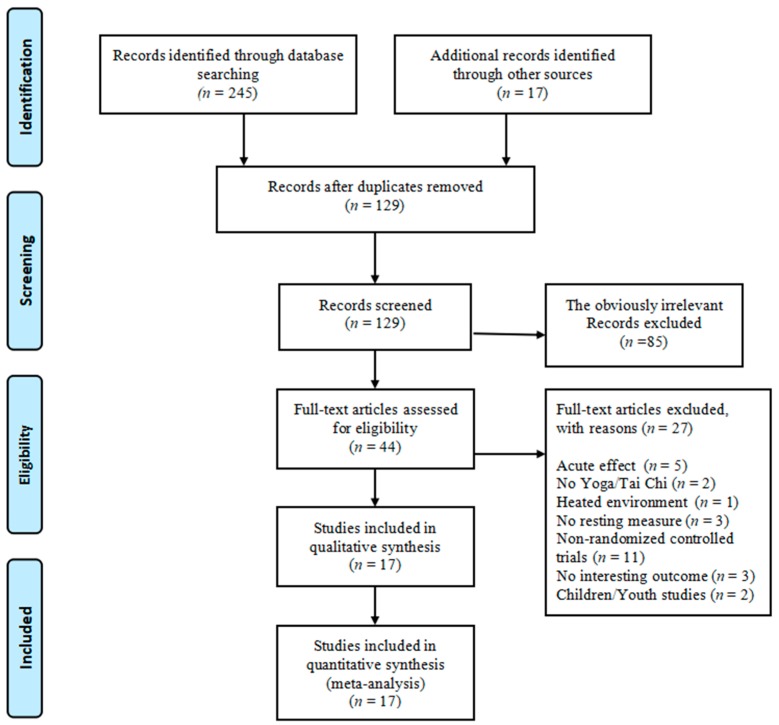
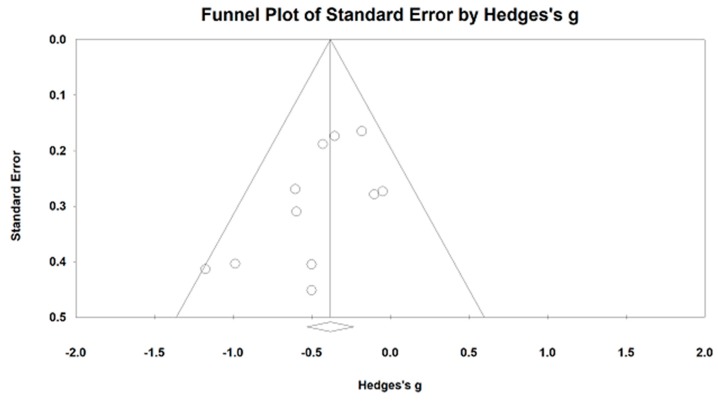
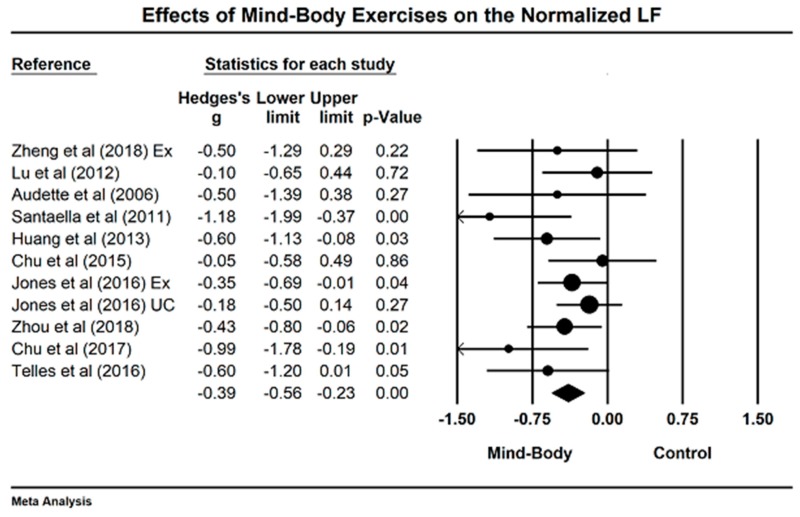
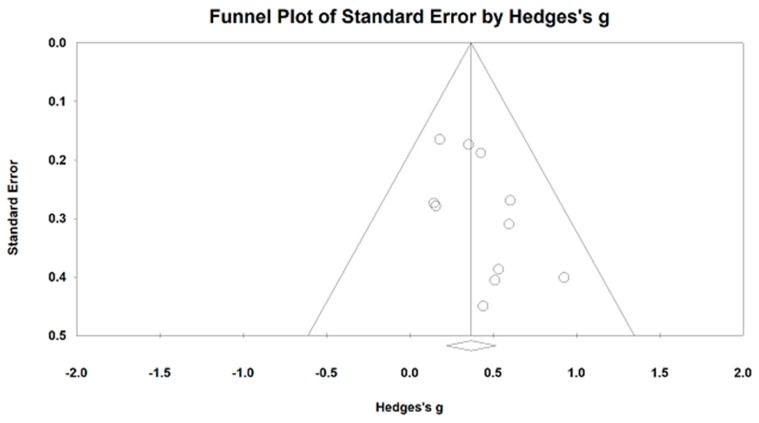
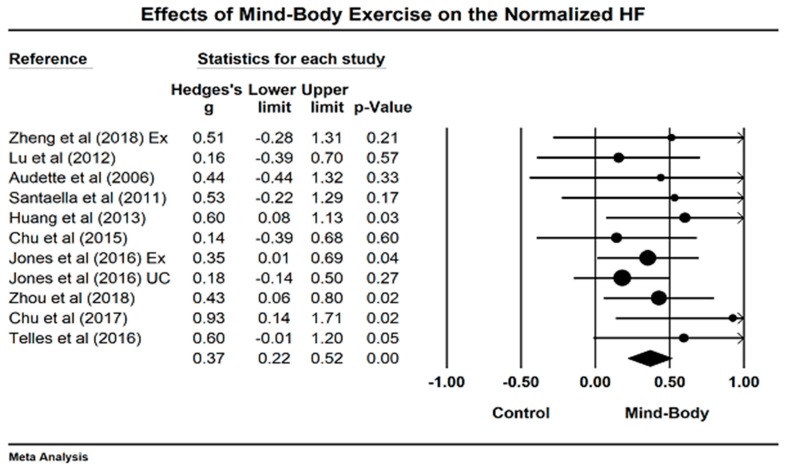
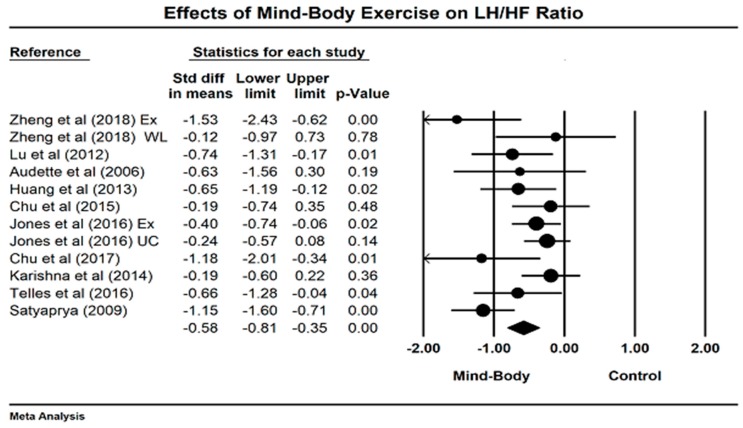
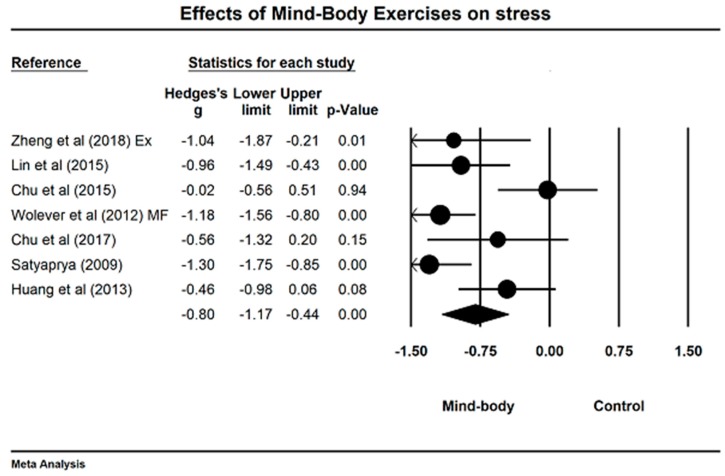
Background: Heart rate variability (HRV) as an accurate, noninvasive measure of the Autonomous Nervous System (ANS) can reflect mental health (e.g., stress, depression, or anxiety). Tai Chi and Yoga (Tai Chi/Yoga), as the most widely practiced mind–body exercises, have shown positive outcomes of mental health. To date, no systematic review regarding the long-lasting effects of Tai Chi/Yoga on HRV parameters and perceived stress has been conducted. Objective: To critically evaluate the existing literature on this topic. Methods: Five electronic databases (Web of Science, PubMed, Scopus, SportDiscus and Cochrane Library) were searched from the start of the research project to July 2018. Study selection, data extraction, and study quality assessment were independently carried out by two reviewers. The potentially identified randomized controlled trials (RCT) reported the useful quantitative data that were included only for meta-analysis. Results: meta-analysis of 17 medium-to-high quality RCTs showed significantly beneficial effects on HRV parameters (normalized low-frequency, Hedge’s g = −0.39, 95% CI −0.39 to −0.56, p < 0.001, I2 = 11.62%; normalized high-frequency, Hedge’s g = 0.37, 95% CI 0.22 to −0.52, p < 0.001, I2 = 0%; low-frequency to high-frequency ratio, Hedge’s g = −0.58, 95% CI −0.81 to −0.35, p < 0.001, I2 = 53.78%) and stress level (Hedge’s g = −0.80, 95% CI −1.17 to −0.44, p < 0.001, I2 = 68.54%). Conclusions: Stress reduction may be attributed to sympathetic-vagal balance modulated by mind–body exercises. Tai Chi/Yoga could be an alternative method for stress reduction for people who live under high stress or negative emotions.
Overview
The claims and statistics of this paper haven’t been checked yet.
Run the check — free, no account needed. It reads the open-access text and checks the sources it cites.
Integrity signals
Registry
Cites
Statistics
Figures
Verification
Claims the paper makes
The claims and statistics of this paper haven’t been checked yet.
Run the check — free, no account needed. It reads the open-access text and checks the sources it cites.
Claims other papers make about this one
Each is checked against this paper’s own text: does it say what the citing paper says it does?
The cited source says what the claim attributes to it.
In the citing paper
“Critically, heart rate variability (or HRV) reflects an index of the functioning of the vagus nerve (Paso et al., 2013), and can be used as a target for tracking the impact of wellbeing-related interventions including for example, a healthy lifestyle (Jandackova et al., 2019), HRV biofeedback (Lehrer et al., 2020), mind-body techniques (Zou et al., 2018), compassion focused therapy (Bello et al.,”
From The Complex Construct of Wellbeing and the Role of Vagal Function (2022) · cites this paper as Zou et al., 2018
Self-check
Percentages, sums and reported differences re-computed from the paper’s own numbers.
The self-check needs the paper’s full text.
Citations
Cites
Stress and Heart Rate Variability: A Meta-Analysis and Review of the Literature
Kim, H.-G., Cheon, E.-J., Bai, D.-S., Lee, Y. H., & Koo, B.-H. (2018) · Psychiatry Investigation · doi:10.30773/pi.2017.08.17 · Cited by 2,308
The LF/HF ratio does not accurately measure cardiac sympatho-vagal balance
Billman, G. E. (2013) · Frontiers in Physiology · doi:10.3389/fphys.2013.00026 · Cited by 1,401
Anxiety Disorders are Associated with Reduced Heart Rate Variability: A Meta-Analysis
Chalmers, J. A., Quintana, D. S., Abbott, M. J.-A., & Kemp, A. H. (2014) · Frontiers in Psychiatry · doi:10.3389/fpsyt.2014.00080 · Cited by 1,067
Effective and viable mind-body stress reduction in the workplace: A randomized controlled trial.
Wolever, R. Q., Bobinet, K. J., McCabe, K., Mackenzie, E. R., Fekete, E., Kusnick, C. A., & Baime, M. (2012) · Journal of Occupational Health Psychology · doi:10.1037/a0027278 · Cited by 539
Heart rate variability as predictive factor for sudden cardiac death
Sessa, F., Valenzano, A. A., Messina, G., Cibelli, G., Monda, V., Marsala, G., Ruberto, M., Biondi, A., Cascio, O., Bertozzi, G., et al. (2018) · Aging · doi:10.18632/aging.101386 · Cited by 320
Stauss, H. M. (2003) · American Journal of Physiology-Regulatory, Integrative and Comparative Physiology · doi:10.1152/ajpregu.00452.2003 · Cited by 318
Cheema, B. S., Houridis, A., Busch, L., Raschke-Cheema, V., Melville, G. W., Marshall, P. W., Chang, D., Machliss, B., Lonsdale, C., Bowman, J., et al. (2013) · BMC Complementary and Alternative Medicine · doi:10.1186/1472-6882-13-82 · Cited by 281
Yoga and heart rate variability: a comprehensive review of the literature
Cohen, M., & Tyagi, A. (2016) · International Journal of Yoga · doi:10.4103/0973-6131.183712 · Cited by 269
Effect of integrated yoga on stress and heart rate variability in pregnant women
Maharana, S., Nagendra, H. R., Nagarathna, R., & Padmalatha, V. (2008) · International Journal of Gynecology & Obstetrics · doi:10.1016/j.ijgo.2008.11.013 · Cited by 260
Autonomic nervous system activity and workplace stressors—A systematic review
Jarczok, M. N., Jarczok, M., Mauss, D., Koenig, J., Li, J., Herr, R. M., & Thayer, J. F. (2013) · Neuroscience & Biobehavioral Reviews · doi:10.1016/j.neubiorev.2013.07.004 · Cited by 247
Research works printed but not linked: 2
- Zou, 2017, Effect of traditional Chinese mind-body exercise on disease activity, spinal mobility, and quality of life in patients with ankylosing spondylitis, Trav. Hum., 80, 1585
- Michael, B., Larry, V.H., Julian, H., and Hannah, R.W. (2009). Introduction to Meta-Analysis, A John Wiley and Sons Ltd.
Cited by
Sorted by citations
Pinna, T., & Edwards, D. J. (2020) · Frontiers in Psychology · doi:10.3389/fpsyg.2020.01792 · Cited by 224
Li, Z., Liu, S., Wang, L., & Smith, L. (2019) · International Journal of Environmental Research and Public Health · doi:10.3390/ijerph17010022 · Cited by 189
Effects of Diaphragmatic Breathing on Health: A Narrative Review
Hamasaki, H. (2020) · Medicines · doi:10.3390/medicines7100065 · Cited by 173
Non‐pharmacological management of hypertension
Verma, N., Rastogi, S., Chia, Y. C., Siddique, S., Turana, Y., Cheng, H., Sogunuru, G. P., Tay, J. C., Teo, B. W., Wang, T., et al. (2021) · Journal of Clinical Hypertension · doi:10.1111/jch.14236 · Cited by 207
Yoga-Based Cardiac Rehabilitation After Acute Myocardial Infarction
Prabhakaran, D., Chandrasekaran, A. M., Singh, K., Mohan, B., Chattopadhyay, K., Chadha, D. S., Negi, P. C., Bhat, P., Sadananda, K. S., Ajay, V. S., et al. (2020) · Journal of the American College of Cardiology · doi:10.1016/j.jacc.2020.01.050 · Cited by 115
Metadata
- Authors
- Zou, L., Sasaki, J. E., Wei, G.-X., Huang, T., Yeung, A. S., Neto, O. B., Chen, K. W., & Hui, S. S.-C.
- Affiliations
- Chinese University of Hong Kong (HK)
- Universidade Federal do Triângulo Mineiro (BR)
- Chinese Academy of Sciences (CN)
- Shanghai Jiao Tong University (CN)
- Harvard University (US)
- University of Maryland, Baltimore (US)
- Corresponding author
- Hui, Stanley Sai-chuen
- ORCID
- Venue
- Journal of Clinical Medicine
- Publisher
- MDPI AG
- Published
- 2018-10-31
- Volume
- 7
- Issue
- 11
- Pages
- 404
- ISSN
- 2077-0383 (ISSN-L)
- PMC
- PMC6262541
- OpenAlex
- W2898943828
- Cited by
- 267
- References
- 54
- Citations by year
- 2026: 43 · 2025: 39 · 2024: 41 · 2023: 40 · 2022: 35 · 2021: 26 · 2020: 17 · 2019: 22 · 2018: 3
- FWCI
- 3.17
- Type
- journal article
- Language
- en
- Open access
- gold
- doi.org
- Licence
- Locations
- Journal of Clinical Medicine (publishedVersion, cc-by)
- Europe PMC (PubMed Central) (publishedVersion, other-oa)
- PubMed Central (publishedVersion, cc-by)
- PubMed (publishedVersion)
- Institutional Repository of Institute of Psychology, Chinese Academy of Sciences (Institute of Psychology, Chinese Academy of Sciences) (submittedVersion)
- Topics
- Health Sciences › Medicine › Cardiology and Cardiovascular Medicine › Heart Rate Variability and Autonomic Control
- Social Sciences › Psychology › Clinical Psychology › Mindfulness and Compassion Interventions
- Health Sciences › Medicine › Complementary and alternative medicine › Biofield Effects and Biophysics
- Keywords
- mind-body exercise, Tai Chi, yoga, heart rate variability, perceived stress, stress reduction, autonomic nervous system, sympathovagal balance, mental health, LF/HF ratio
About these checks
Registry, retraction, Cites and statistics results are computed, not judged, with one exception: a printed reference that no index lists is read once by a model before it counts as a citation error. Claims are extracted by a model and kept only when their quote appears verbatim in the text; each cited source is then checked, with a model’s help, for whether it says what the claim relies on. Those verdicts can be wrong — read the claim’s quote and the cited source before relying on one.
Statistics and arithmetic are recomputed, not judged.
Confidence bands are shown only for fields calibrated on our annotated test set. None is calibrated yet, so no band is shown.
What counts as a claim ›How we measure confidence ›How we check this ›
Are you an author, or do you see a problem with this page? Request a review
