

Bevacizumab-Based Chemotherapy Triggers Immunological Effects in Responding Multi-Treated Recurrent Ovarian Cancer Patients by Favoring the Recruitment of Effector T Cell Subsets
Open accessThe DOI matches its Crossref record; 34 of the 34 references it cites were found in a registry or an index.
Abstract
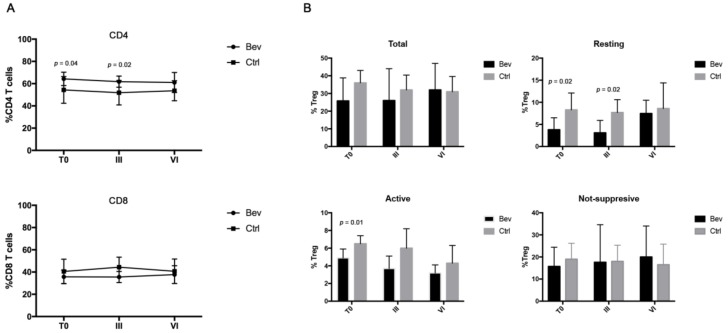
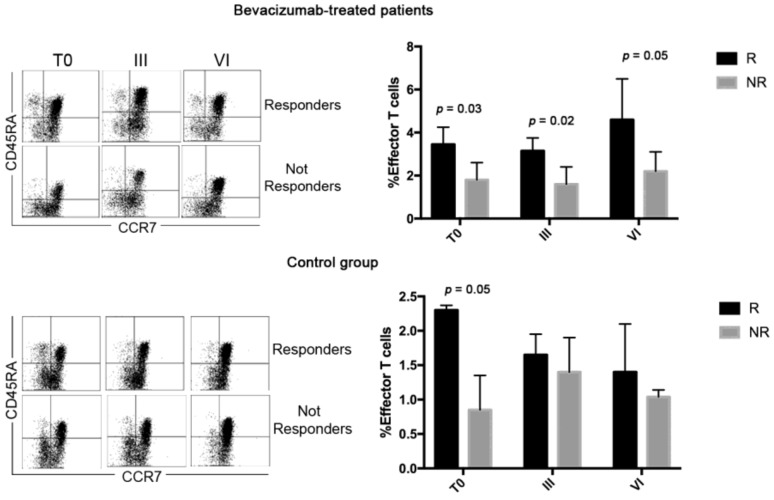
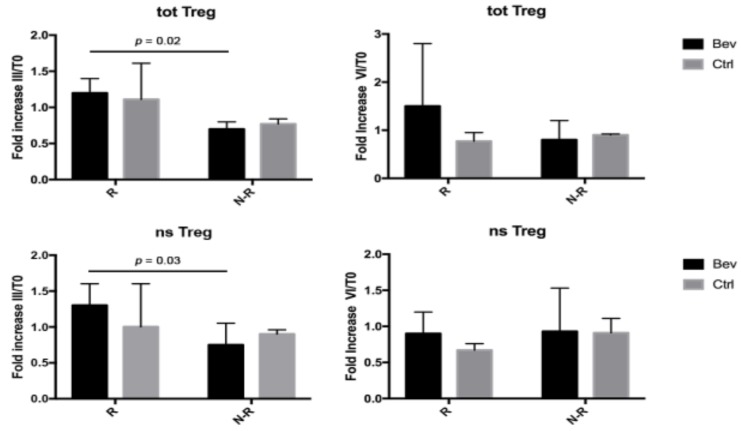
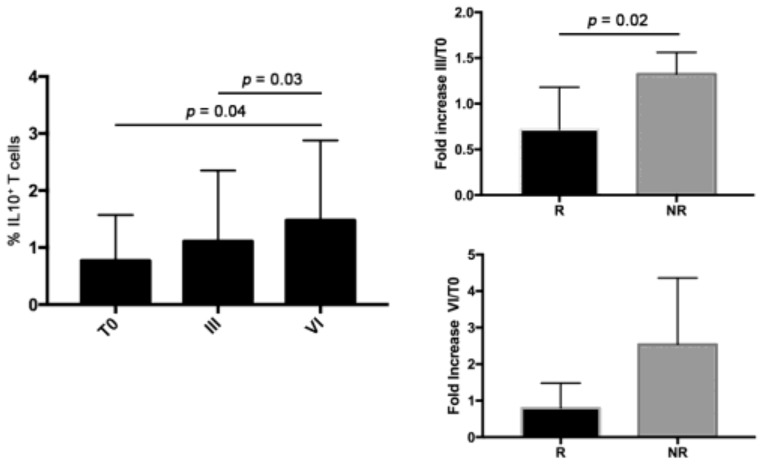
Increasing evidence strongly suggests that bevacizumab compound impacts the immunological signature of cancer patients and normalizes tumor vasculature. This study aims to investigate the correlation between the clinical response to bevacizumab-based chemotherapy and the improvement of immune fitness of multi-treated ovarian cancer patients. Peripheral blood mononuclear cells (PBMCs) of 20 consecutive recurrent ovarian cancer patients retrospectively selected to have received bevacizumab or non-bevacizumab-based chemotherapy (Bev group and Ctrl group, respectively) were analyzed. CD4, CD8, and regulatory T cell (Treg) subsets were monitored at the beginning (T0) and after three and six cycles of treatment, together with IL10 production. A lower activated and resting Treg subset was found in the Bev group compared with the Ctrl group until the third therapy cycle, suggesting a reduced immunosuppressive signature. Indeed, clinically responding patients in the Bev group showed a high percentage of non-suppressive Treg and a significant lower IL10 production compared with non-responding patients in the Bev group after three cycles. Furthermore, clinically responding patients showed a discrete population of effector T cell at T0 independent of the therapeutic regimen. This subset was maintained throughout the therapy in only the Bev group. This study evidences that bevacizumab could affect the clinical response of cancer patients, reducing the percentage of Treg and sustaining the circulation of the effector T cells. Results also provide a first rationale regarding the positive immunologic synergism of combining bevacizumab with immunotherapy in multi-treated ovarian cancer patients.
Overview
The claims and statistics of this paper haven’t been checked yet.
Free: it reads the open-access text and checks the first 5 claims that cite a source we can check. Create a free account to check every claim.
Integrity signals
Registry
Cites
Statistics
Figures
Verification
Claims the paper makes
The claims and statistics of this paper haven’t been checked yet.
Free: it reads the open-access text and checks the first 5 claims that cite a source we can check. Create a free account to check every claim.
Claims other papers make about this one
Each is checked against this paper’s own text: does it say what the citing paper says it does?
In the citing paper
“increased tumor infiltration by activated TEFF cells coupled to TREG (and TAM) depletion”
From Immunomodulation by targeted anticancer agents (2021) · cites this paper as Napoletano et al., 2019
Self-check
Percentages, sums and reported differences re-computed from the paper’s own numbers.
The self-check needs the paper’s full text.
Citations
Cites
Bray, F., Ferlay, J., Soerjomataram, I., Siegel, R. L., Torre, L. A., & Jemal, A. (2018) · CA: A Cancer Journal for Clinicians · doi:10.3322/caac.21492 · Cited by 84,109 · cited 1×
“Ovarian cancer still accounts for the highest mortality rate among all gynecological malignancies, with 295,414 estimated new cases and 184,799 estimated new deaths in 2018 worldwide [1].”
BackgroundNew response evaluation criteria in solid tumours: revised RECIST guideline (version 1.1)
Eisenhauer, E. A., Therasse, P., Bogaerts, J., Schwartz, L. H., Sargent, D., Ford, R., Dancey, J., Arbuck, S., Gwyther, S., Mooney, M., et al. (2009) · European Journal of Cancer · doi:10.1016/j.ejca.2008.10.026 · Cited by 29,534
Miyara, M., Yoshioka, Y., Kitoh, A., Shima, T., Wing, K., Niwa, A., Parizot, C., Taflin, C., Heike, T., Valeyre, D., et al. (2009) · Immunity · doi:10.1016/j.immuni.2009.03.019 · Cited by 2,291 · cited 3×
“aTreg have been described as terminally differentiated cells that rapidly die after exerting their suppressive activity, whereas rTreg proliferate and convert into aTreg both in vitro and in vivo [10].”
BackgroundInfluentialGabrilovich, D. I., Chen, H. L., Girgis, K. R., Cunningham, H. T., Meny, G. M., Nadaf, S., Kavanaugh, D., & Carbone, D. P. (1996) · Nature Medicine · doi:10.1038/nm1096-1096 · Cited by 1,977
Immunological aspects of cancer chemotherapy
Zitvogel, L., Apetoh, L., Ghiringhelli, F., & Kroemer, G. (2008) · Nature Reviews Immunology · doi:10.1038/nri2216 · Cited by 1,712 · cited 1×
“) that differently impact the immunological system [29], together with the capacity of the immunological signature of each patient to differently respond to the same environmental factor, such as chemotherapy and surgery.”
BackgroundNormalization of the Vasculature for Treatment of Cancer and Other Diseases
Goel, S., Duda, D. G., Xu, L., Munn, L. L., Boucher, Y., Fukumura, D., & Jain, R. K. (2011) · Physiological Reviews · doi:10.1152/physrev.00038.2010 · Cited by 1,605 · cited 2×
“Indeed, it is reasonable to suggest that the circulating effector T cells recruited and sustained by bevacizumab treatment, thanks to its ability to restore tumor microvascular normalization [13], could be expanded by the administration of checkpoint inhibitor agents, thus giving a strong biological rationale for the…”
BackgroundTumour hypoxia promotes tolerance and angiogenesis via CCL28 and Treg cells
Facciabene, A., Peng, X., Hagemann, I. S., Balint, K., Barchetti, A., Wang, L.-P., Gimotty, P. A., Gilks, C. B., Lal, P., Zhang, L., et al. (2011) · Nature · doi:10.1038/nature10169 · Cited by 1,376
Gabrilovich, D., Ishida, T., Oyama, T., Ran, S., Kravtsov, V., Nadaf, S., & Carbone, D. P. (1998) · Blood · doi:10.1182/blood.v92.11.4150 · Cited by 1,048
Dynamics of T Lymphocyte Responses: Intermediates, Effectors, and Memory Cells
Lanzavecchia, A., & Sallusto, F. (2000) · Science · doi:10.1126/science.290.5489.92 · Cited by 796 · cited 1×
“CD8 lymphocytes exerted their cytotoxic activity by eliminating tumor cells, while CD4 T lymphocytes sustained and maintained a CD8 T cell response by cytokine production [9].”
BackgroundRay-Coquard, I., Cropet, C., Van Glabbeke, M., Sebban, C., Le Cesne, A., Judson, I., Tredan, O., Verweij, J., Biron, P., Labidi, I., et al. (2009) · Cancer Research · doi:10.1158/0008-5472.can-08-3845 · Cited by 784 · cited 1×
“Another important point is the occurrence of leukopenia in multi-treated patients, which represents an important prognostic factor in patients with advance malignances [30].”
Background
Cited by
Immunomodulation by targeted anticancer agents
Petroni, G., Buqué, A., Zitvogel, L., Kroemer, G., & Galluzzi, L. (2021) · Cancer Cell · doi:10.1016/j.ccell.2020.11.009 · Cited by 212
Regulatory cells and the effect of cancer immunotherapy
Iglesias-Escudero, M., Arias-González, N., & Martínez-Cáceres, E. (2023) · Molecular Cancer · doi:10.1186/s12943-023-01714-0 · Cited by 191
“Other approaches, such as blockade of TIM-3 [44], V-domain Ig suppressor of T cell activation (VISTA) [45, 46], treatment with glucocorticoid-induced TNFR-related (GITR) protein agonistic antibody [47, 48], anti-OX40 antibodies [49–51], IDO-1 inhibitors [52, 53], TGF-β inhibitors [54]VEGF-targeting therapy receptor 2…”
BackgroundTargeting oncogene and non-oncogene addiction to inflame the tumour microenvironment
Petroni, G., Buqué, A., Coussens, L. M., & Galluzzi, L. (2022) · Nature Reviews Drug Discovery · doi:10.1038/s41573-022-00415-5 · Cited by 160
Resveratrol induces immunogenic cell death of human and murine ovarian carcinoma cells
Zhang, Y., Yang, S., Yang, Y., & Liu, T. (2019) · Infectious Agents and Cancer · doi:10.1186/s13027-019-0247-4 · Cited by 70
Nanodrug Delivery Systems for the Treatment of Ovarian Cancer
Pantshwa, J. M., Kondiah, P. P. D., Choonara, Y. E., Marimuthu, T., & Pillay, V. (2020) · Cancers · doi:10.3390/cancers12010213 · Cited by 53
Immunogenic Cell Death and Immunomodulatory Effects of Cabozantinib
Scirocchi, F., Napoletano, C., Pace, A., Koshkaki, H. R., Filippo, A. D., Zizzari, I. G., Nuti, M., & Rughetti, A. (2021) · Frontiers in Oncology · doi:10.3389/fonc.2021.755433 · Cited by 48
Self-citationAnti-vascular nano agents: a promising approach for cancer treatment
Chen, D., Qu, X., Shao, J., Wang, W., & Dong, X. (2020) · Journal of Materials Chemistry B · doi:10.1039/c9tb02957e · Cited by 47
Láníčková, T., Hensler, M., Kašíková, L., Vosahlikova, S., Angelidou, A., Pasulka, J., Griebler, H., Drozenová, J., Mojžíšová, K., Vankerckhoven, A., et al. (2024) · Clinical Cancer Research · doi:10.1158/1078-0432.ccr-24-1594 · Cited by 43
Zhang, M., Zhu, J., Bao, Y., Ao, Q., Mao, X., Qiu, Z., Zhang, Y., Chen, Y., Zhu, H., & Gao, J. (2025) · Frontiers in Bioengineering and Biotechnology · doi:10.3389/fbioe.2025.1589841 · Cited by 42
Mohaghegh, S., Tarighatnia, A., Omidi, Y., Barar, J., Aghanejad, A., & Adibkia, K. (2022) · Journal of Microencapsulation · doi:10.1080/02652048.2022.2094487 · Cited by 40
“Consequently, adverse reactions such as hair loss, excessive nausea, deterioration in plasma cell counts and multidrug resistance occur in most of the patients (Madariaga et al. 2019, Moffitt et al. 2019, Napoletano et al. 2019).”
BackgroundImmunological control of ovarian carcinoma by chemotherapy and targeted anticancer agents
Fucikova, J. P., Palová-Jelínková, L., Klapp, V., Holíček, P., Láníčková, T., Kašíková, L., Drozenová, J., Cibula, D., Álvarez-Abril, B., García-Martínez, E., et al. (2022) · Trends in cancer · doi:10.1016/j.trecan.2022.01.010 · Cited by 32
Exploratory Pilot Study of Circulating Biomarkers in Metastatic Renal Cell Carcinoma
Zizzari, I. G., Napoletano, C., Filippo, A. D., Botticelli, A., Gelibter, A. J., Calabrò, F., Rossi, E., Schinzari, G., Urbano, F., Pomati, G., et al. (2020) · Cancers · doi:10.3390/cancers12092620 · Cited by 31
“Indeed bevacizumab and sorafenib reverse the immunosuppressive effects of VEGF and restore the maturation of dendritic cells (DCs) [8,9].”
BackgroundSelf-citationSaman, S., Srivastava, N., Yasir, M., & Chauhan, I. (2023) · Current Cancer Drug Targets · doi:10.2174/1568009623666230811093139 · Cited by 31
Divano, S., Camera, A., Biggi, S., Tornago, S., Formica, M., & Felli, L. (2018) · Archives of Orthopaedic and Trauma Surgery · doi:10.1007/s00402-018-2888-y · Cited by 31
Liu, Z.-L., Liu, J., Staiculescu, D., & Chen, J. (2021) · Therapeutic Advances in Medical Oncology · doi:10.1177/17588359211018026 · Cited by 27
Wei, Q., & Taskén, K. (2022) · Biochemical Journal · doi:10.1042/bcj20210233 · Cited by 19
Lee, J., Miller, A., Rose, P. G., AlHilli, M. M., Washington, C. R., John, V. S., Shah, C. A., Matsuo, K., Siedel, J., Miller, D. S., et al. (2025) · Clinical Cancer Research · doi:10.1158/1078-0432.ccr-24-3877 · Cited by 18
Tavira, B., Iscar, T., Manso, L., Santaballa, A., Gil-Martín, M., García, Y. G., Romeo, M., Iglesias, M., Ferré, A. D. J., Barretina-Ginesta, M.-P., et al. (2023) · Clinical Cancer Research · doi:10.1158/1078-0432.ccr-23-0771 · Cited by 15
Hsieh, C., Chuang, P.-C., & Liu, Y. (2025) · Cancers · doi:10.3390/cancers17071250 · Cited by 14
“Combining an anti-angiogenic with a trained immunity stimulus might yield better immune infiltration than either alone, e.g., bevacizumab could improve access of trained myeloid cells to the tumor [67].”
Gelibter, A. J., Tuosto, L., Asquino, A., Siringo, M., Sabatini, A., Zizzari, I. G., Pace, A., Scirocchi, F., Valentino, F., Bianchini, S., et al. (2024) · Frontiers in Immunology · doi:10.3389/fimmu.2024.1483182 · Cited by 13
Self-citationRegulatory T cells and vaccine effectiveness in older adults. Challenges and prospects
Batista-Duharte, A., Pera, A., Aliño, S. F., & Solana, R. (2021) · International Immunopharmacology · doi:10.1016/j.intimp.2021.107761 · Cited by 13
Gnagni, L., Ruscito, I., Zizzari, I. G., Nuti, M., Napoletano, C., & Rughetti, A. (2024) · Critical Reviews in Oncology/Hematology · doi:10.1016/j.critrevonc.2024.104464 · Cited by 12
Self-citationImmunotherapy for Pediatric Brain and Spine Tumors: Current State and Future Directions
Estévez-Ordoñez, D., Gary, S. E., Atchley, T. J., Maleknia, P. D., George, J. A., Laskay, N. M. B., Gross, E. G., Devulapalli, R. K., & Johnston, J. M. (2022) · Pediatric Neurosurgery · doi:10.1159/000528792 · Cited by 12
“Bevacizumab, a monoclonal antibody against vascular endothelial growth factor (VEGF) with antiangiogenic properties, has been implicated as an antitumor immune modulator in patients with ovarian cancer, colorectal cancer, and other malignant effusions [71–73].”
BackgroundExploring the Clinical Impact of Predictive Biomarkers in Serous Ovarian Carcinomas
Page, C. L., Chung, J. W., Rahimi, K., Köbel, M., Provencher, D. M., & Mes‐Masson, A. (2019) · Current Drug Targets · doi:10.2174/1389450120666191016143836 · Cited by 12
Liu, L., & Xiong, W. (2021) · Medicine · doi:10.1097/md.0000000000026849 · Cited by 10
“So far, a number of prospective trials have been conducted to extensively investigate the efficacy of several novel targeted agents, including aromatase inhibitors([38,39]) and poly(ADP)-ribose polymerase inhibitors([40]) for treating ROC in this setting.”
BackgroundAdvanced drug delivery systems in the treatment of ovarian cancer
Padhi, S., & Behera, A. (2021) · Elsevier eBooks · doi:10.1016/b978-0-323-85503-7.00020-1 · Cited by 9
Coward, J. I. G., Barve, M. A., Kichenadasse, G., Moore, K. N., Harnett, P. R., Berg, D., Garner, J. S., & Dizon, D. S. (2021) · Cancers · doi:10.3390/cancers13133196 · Cited by 8
“In Pt-R patients who had received IP bevacizumab plus IV cisplatin for the treatment of malignant ascites, clinical response correlated with IP immune activation [40], and compared to non-responders the responding patients had higher levels of circulating effector CD4 T cells and lower IL-10 cytokine levels [41].”
Liu, Y., Huang, Y., Li, J., Wan, S., Jiang, N., Yang, J., Chiampanichayakul, S., Tima, S., Anuchapreeda, S., & Wu, J. (2022) · Frontiers in Pharmacology · doi:10.3389/fphar.2022.1010626 · Cited by 7
“By depleting regulatory T cells, bevacizumab also exerted multipronged immunostimulatory functions for various tumors (Napoletano et al., 2019).”
BackgroundChou, M.-Y., & Yang, M. (2025) · Translational Oncology · doi:10.1016/j.tranon.2025.102353 · Cited by 6
“…in combination with chemotherapy or radiation, has been associated with increased tumor infiltration by activated effective T cells coupled to Treg and TAM depletion [109], improved DC maturation [110], and downregulation of PD-L1 on malignant and myeloid cells in preclinical cancer models [111].”
Methodical Manipulation of the TME in Ovarian Cancer
Pina, P. S., & Oza, A. M. (2023) · Clinical Cancer Research · doi:10.1158/1078-0432.ccr-23-2365 · Cited by 6
Jia, H., Nowocin, A. K., Burns, C. J., & Wadhwa, M. (2025) · International Journal of Molecular Sciences · doi:10.3390/ijms26136280 · Cited by 5
“…improved the cytotoxic T lymphocytes response in patients with metastatic non-small-cell lung cancer [20], expanded the extent of CD3+ and CD8+ T cell infiltration in glioblastoma tissues of patients [21] and sustained the circulation of the effector T cells in patients with ovarian cancer [22].”
Salvador, R. M., Correia, B., Grosa, D. S. C. P., Martins, T., Baal, S. C. S., Saraiva, D. P., Cristóvão‐Ferreira, S., Pereira, I., de Almeida, C. R., Fior, R., et al. (2025) · Frontiers in Immunology · doi:10.3389/fimmu.2025.1653970 · Cited by 6
The Binary Classification of Protein Kinases
Elkoshi, Z. (2021) · Journal of Inflammation Research · doi:10.2147/jir.s303750 · Cited by 5
Neoantigens from the bench to the bedside: new prospective for ovarian cancer immunotherapy
Napoletano, C., & Bellati, F. (2019) · Annals of Translational Medicine · doi:10.21037/atm.2019.10.62 · Cited by 4
Self-citationNormalization of the tumor vasculature
Klein, D. (2021) · Elsevier eBooks · doi:10.1016/b978-0-12-816196-8.00015-1 · Cited by 3
Rajendra, P. K. M., Balan, A. P., Selvaraj, J., & Natarajan, J. (2022) · International Journal of Applied Pharmaceutics · doi:10.22159/ijap.2022v14i5.45464 · Cited by 3
Wang, Y., MaoYan, T., Peng, C., Yang, J., Liu, F., Ding, D., Guo, Y., Yu, Y., & Han, F. (2026) · International Immunopharmacology · doi:10.1016/j.intimp.2026.116821 · Cited by 2
Smith, L. A., Augustin, B., Jacob, V., Black, L. P., Bertrand, A. H., Hopson, C., Cagmat, E. B., Datta, S., Reddy, S. T., Guirgis, F. W., et al. (2026) · bioRxiv (Cold Spring Harbor Laboratory) · doi:10.64898/2026.03.28.714506 · Cited by 1
“…different definitions and inclusion criteria for sepsis in each included study, however we addressed this by reviewing inclusion criteria used for each study as well as study specific diagnoses, excluding samples with known parasitic infections or other unique cases of sepsis, such as melioidosis.”
Advances in the Treatment of Renal Cell Carcinoma
Reynolds, P., & Stewart, G. D. (2022) · MDPI eBooks · doi:10.3390/books978-3-0365-2934-9
Vaccine-induced effects on regulatory T cell function: autoimmune perspective
Batista-Duharte, A. (2024) · Elsevier eBooks · doi:10.1016/b978-0-443-13947-5.00038-5
Etude du microenvironnement tumoral des cancers de l’ovaire en fonction de l’instabilité génomique
Fumet, J.-D. (2022) · theses.fr (ABES) · doi:10.70675/ed5879b6z2c3az44f3z99cbz8466ad6dca12
Ergasti, R., Vertechy, L., Ruscito, I., Boccia, S. M., Congedo, L., Sassu, C. M., Capomacchia, F. M., Costantini, B., Distefano, M. G., Scambia, G., et al. (2025) · European Journal of Surgical Oncology · doi:10.1016/j.ejso.2025.110016
Self-citationXu, X., Zhang, C., & Han, L. (2026) · Archives of Medical Science · doi:10.5114/aoms/214432
The impact of BRCA status on the efficacy of paclitaxel monotherapy in recurrent ovarian cancer
Russo, G., Apostol, A. I., Ruscito, I., Sassu, C. M., Diella, C., Salvati, F., Capomacchia, F. M., Boccia, S. M., Vertechy, L., Marth, C., et al. (2026) · International Journal of Gynecological Cancer · doi:10.1016/j.ijgc.2026.104641
Self-citationVladimirova, L. Y., Sagakyants, A. B., Алькина, А. К., Dzhenkova, E. A., Teplyakova, M. A., Kalabanova, E. A., & Александровна, У. И. (2026) · Современные проблемы науки и образования · doi:10.17513/spno.34547
Supporting information 1 of Immunogenic Cell Death and Immunomodulatory Effects of Cabozantinib
Scirocchi, F., Napoletano, C., Pace, A., Koshkaki, H. R., Filippo, A. D., Zizzari, I. G., Nuti, M., & Rughetti, A. (2021) · doi:10.3389/fonc.2021.755433.s001
Self-citation
Metadata
- Authors
- Napoletano, C., Ruscito, I., Bellati, F., Zizzari, I. G., Rahimi, H., Gasparri, M. L., Antonilli, M., Panici, P. B., Rughetti, A., & Nuti, M.
- Affiliations
- Sapienza University of Rome (IT)
- Humboldt-Universität zu Berlin (DE)
- Azienda Ospedaliera Sant'Andrea (IT)
- Policlinico Umberto I (IT)
- Corresponding author
- Napoletano, Chiara
- ORCID
- Venue
- Journal of Clinical Medicine
- Publisher
- MDPI AG
- Published
- 2019-03-18
- Volume
- 8
- Issue
- 3
- Pages
- 380
- ISSN
- 2077-0383 (ISSN-L)
- PMC
- PMC6462947
- OpenAlex
- W2921909640
- Cited by
- 43
- References
- 34
- Citations by year
- 2026: 3 · 2025: 7 · 2024: 5 · 2023: 4 · 2022: 8 · 2021: 8 · 2020: 4 · 2019: 3
- FWCI
- 5.50
- Type
- journal article
- Language
- en
- Open access
- gold
- dx.doi.org
- Licence
- Locations
- Journal of Clinical Medicine (publishedVersion, cc-by)
- PubMed Central (publishedVersion, cc-by)
- PubMed (publishedVersion)
- IRIS Research product catalog (Sapienza University of Rome) (submittedVersion, cc-by)
- DOAJ (DOAJ: Directory of Open Access Journals) (submittedVersion, cc-by-sa)
- IRIS Research product catalog (Sapienza University of Rome) (submittedVersion)
- Funders
- Associazione Italiana per la Ricerca sul Cancro (17432)
- Topics
- Health Sciences › Medicine › Oncology › Ovarian cancer diagnosis and treatment
- Health Sciences › Medicine › Oncology › Cancer Immunotherapy and Biomarkers
- Life Sciences › Immunology and Microbiology › Immunology › T-cell and B-cell Immunology
- Keywords
- bevacizumab, recurrent ovarian cancer, regulatory T cells, effector T cells, CD4+ T cells, CD8+ T cells, IL-10, tumor immune microenvironment, anti-angiogenic therapy, chemotherapy response, peripheral blood mononuclear cells, combination immunotherapy
About these checks
Registry, retraction, Cites and statistics results are computed, not judged, with one exception: a printed reference that no index lists is read once by a model before it counts as a citation error. Claims are extracted by a model and kept only when their quote appears verbatim in the text; each cited source is then checked, with a model’s help, for whether it says what the claim relies on. Those verdicts can be wrong — read the claim’s quote and the cited source before relying on one.
Statistics and arithmetic are recomputed, not judged.
Confidence bands are shown only for fields calibrated on our annotated test set. None is calibrated yet, so no band is shown.
What counts as a claim ›How we measure confidence ›How we check this ›
Are you an author, or do you see a problem with this page? Request a review
Data sources
Bibliographic data: Semantic Scholar, OpenAlex, Crossref.
Contains information from the Semantic Scholar Academic Graph Datasets, made available under the ODC Attribution License (ODC-BY 1.0).
Semantic Scholar’s data is described in: Kinney, R., et al. (2023). The Semantic Scholar Open Data Platform. arXiv:2301.10140.
