

Immune Response of Galleria mellonella against Human Fungal Pathogens
Open accessThe DOI matches its Crossref record; 114 of the 114 references it cites were found in a registry or an index.
Abstract
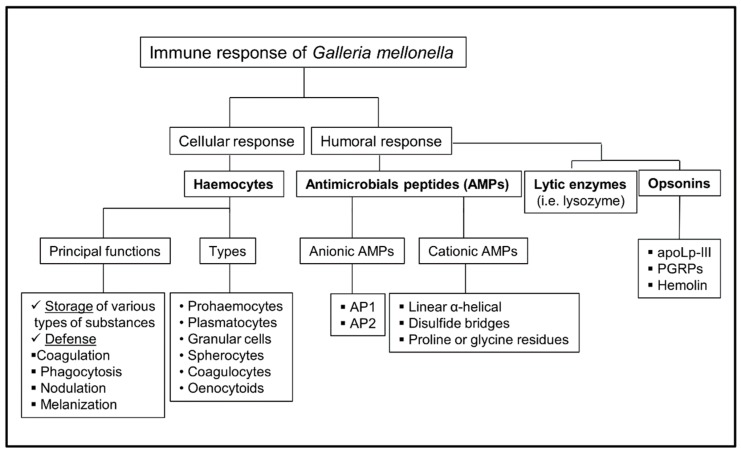
In many aspects, the immune response against pathogens in insects is similar to the innate immunity in mammals. This has caused a strong interest in the scientific community for the use of this model in research of host–pathogen interactions. In recent years, the use of Galleria mellonella larvae, an insect belonging to the Lepidoptera order, has emerged as an excellent model to study the virulence of human pathogens. It is a model that offers many advantages; for example, it is easy to handle and establish in every laboratory, the larvae have a low cost, and they tolerate a wide range of temperatures, including human temperature 37 °C. The immune response of G. mellonella is innate and is divided into a cellular component (hemocytes) and humoral component (antimicrobial peptides, lytic enzymes, and peptides and melanin) that work together against different intruders. It has been shown that the immune response of this insect has a great specificity and has the ability to distinguish between different classes of microorganisms. In this review, we delve into the different components of the innate immune response of Galleria mellonella, and how these components manifest in the infection of fungal pathogens including Candida albicans, Aspergillus fumigatus, Cryptococcus neoformans, and Histoplasma capsulatum.
Overview
The claims and statistics of this paper haven’t been checked yet.
Free: it reads the open-access text and checks the first 5 claims that cite a source we can check. Create a free account to check every claim.
Integrity signals
Registry
Cites
Statistics
Figures
Verification
Claims the paper makes
The claims and statistics of this paper haven’t been checked yet.
Free: it reads the open-access text and checks the first 5 claims that cite a source we can check. Create a free account to check every claim.
Claims other papers make about this one
Each is checked against this paper’s own text: does it say what the citing paper says it does?
The source backs part of the claim, not all of it — or backs it for a different population, condition or comparison.
In the citing paper
“G. mellonella has a single innate immune system that is highly similar to the mammalian innate immune system [40,41]”
From The F 1 F o -ATP synthase α subunit of Candida albicans induces inflammatory responses by controlling amino acid catabolism (2023) · cites this paper as [41]
Experimental — accuracy not yet measuredThe source backs part of the claim, not all of it — or backs it for a different population, condition or comparison.
In the citing paper
“Apart from the mouse models of IPA, alternative minihost models of IPA in Drosophila, Galleria, and zebrafish have been used successfully to screen the virulence of mutants (180–184).”
From Aspergillus fumigatus and Aspergillosis in 2019 (2019) · cites this paper as [184]
Experimental — accuracy not yet measuredThe cited source says what the claim attributes to it.
In the citing paper
“G. mellonella is a well-established model to study host immune responses induced by C. albicans [40,41].”
From The F 1 F o -ATP synthase α subunit of Candida albicans induces inflammatory responses by controlling amino acid catabolism (2023) · cites this paper as [41]
Self-check
Percentages, sums and reported differences re-computed from the paper’s own numbers.
The self-check needs the paper’s full text.
Citations
Cites
Antimicrobial peptides of multicellular organisms
Zasloff, M. (2002) · Nature · doi:10.1038/415389a · Cited by 8,457 · cited 1×
“These molecules play a fundamental role in host defense and are produced mainly in the fat body, in both the digestive and reproductive tract, and subsequently are released into the hemolymph [26].”
BackgroundWisplinghoff, H., Bischoff, T., Tallent, S. M., Seifert, H., Wenzel, R. P., & Edmond, M. B. (2004) · Clinical Infectious Diseases · doi:10.1086/421946 · Cited by 4,496
The immune response of Drosophila
Hoffmann, J. A. (2003) · Nature · doi:10.1038/nature02021 · Cited by 1,553 · cited 1×
“Recent studies have revealed that the innate immune response has great specificity, in addition to having the ability to distinguish between different classes of microorganisms [55].”
BackgroundBIOLOGICAL MEDIATORS OF INSECT IMMUNITY
Gillespie and, J. P., Kanost, M. R., & Trenczek, T. (1997) · Annual Review of Entomology · doi:10.1146/annurev.ento.42.1.611 · Cited by 1,347
Antimicrobial peptides in insects; structure and function
Bulet, P., Hetru, C., Dimarcq, J.-L., & Hoffmann, D. (1999) · Developmental & Comparative Immunology · doi:10.1016/s0145-305x(99)00015-4 · Cited by 1,041
Tsai, C. J.-Y., Loh, J. M. S., & Proft, T. (2016) · Virulence · doi:10.1080/21505594.2015.1135289 · Cited by 778 · cited 5×
“Although many studies mention that only plasmatocytes are involved in phagocytosis, it has been shown that both plasmatocytes and granular cells participate in this process as well as in encapsulation [5,19,22].”
BackgroundMethodInfluentialBoman, H. G., & Hultmark, D. (1987) · Annual Review of Microbiology · doi:10.1146/annurev.mi.41.100187.000535 · Cited by 740
Casadevall, A., & Perfect, J. R. (1998) · ASM Press eBooks · doi:10.1128/9781555818241 · Cited by 661
Invertebrate Immunity: Basic Concepts and Recent Advances
Ratcliffe, N. A., Rowley, A. F., Fitzgerald, S. W., & Rhodes, C. P. (1985) · International Review of Cytology · doi:10.1016/s0074-7696(08)62351-7 · Cited by 603 · cited 1×
“Melanin produces the accumulation of nodules, which can be visible in histological sections whose main function is to contain the replication of microorganisms [42,43].”
BackgroundSteenbergen, J. N., Shuman, H. A., & Casadevall, A. (2001) · Proceedings of the National Academy of Sciences · doi:10.1073/pnas.261418798 · Cited by 511
Research works printed but not linked: 1
- Soderhall K.S. Smith V.J. The prophenoloxidase activating system. The biochemistry of its activation and role in arthropod cellular immunity, with special reference to crustacenad Immunity Arthropods 1986 251 285 · DOI
Cited by
Items 101–138 of 138
A microinjection protocol for the greater waxworm moth, Galleria mellonellaPreprint
Pearce, J., Housden, A., Senior, N. J., Champion, O. L., Prior, J. L., Titball, R. W., & Wakefield, J. G. (2024) · bioRxiv (Cold Spring Harbor Laboratory) · doi:10.1101/2024.09.17.613528 · Cited by 2
Repositioning of moxidectin: a promising approach in cutaneous leishmaniasis therapy
Samra, L. A., Nahas, M. E., Mneimneh, I., Tokajian, S. T., Nemer, G. M., Sinno, A., Rahy, K., Thoumi, S., Zibara, Z., Khatib, A. E., et al. (2025) · Parasite · doi:10.1051/parasite/2025035 · Cited by 1
“Also, G. mellonella lacks a fully developed adaptive immune system, relying exclusively on innate immune responses [73].”
Sousa, I. S., Giovanini, L., Lorentino, C. M. A., Barcellos, I. C., McCann, M., Devereux, M. M., dos Santos, A. L. S., & Kneipp, L. F. (2025) · Pharmaceuticals · doi:10.3390/ph18121819 · Cited by 1
“Although G. mellonella lacks anatomical similarity to human skin, its innate immune system shares several functional characteristics with that of humans [40].”
GENÇ, T. T., Kaya, S., & Günay, M. (2026) · Bulletin of Entomological Research · doi:10.1017/s000748532510076x · Cited by 2
Holt, C. J. D., Williams, C. C., & Usher, J. (2026) · Journal of Medical Microbiology · doi:10.1099/jmm.0.002127 · Cited by 1
“These haemocytes perform phagocytosis, generate reactive oxygen species (ROS) and release antimicrobial peptides (AMPs) in response to fungal infections, providing a useful platform for studying host–pathogen interactions [36–38].”
Maslova, E., Staber, C., & McCarthy, R. R. (2026) · Essays in Biochemistry · doi:10.1042/ebc20250030 · Cited by 1
“It has become established as a robust in vivo research model in multiple research fields, from infectious diseases to ecotoxicology [1,2].”
Do farnesol and tyrosol production in Candidozyma auris biofilms reflect virulence potential?
dos Santos, M. M., Moure, H. S., Ferreira, M. J. P., & Ishida, K. (2025) · Virulence · doi:10.1080/21505594.2025.2561832 · Cited by 2
“The G. mellonella larval is widely recognized by the literature as a valuable model for studying microbial virulence and pathogenicity, aligning with the 3 R principles (refinement, reduction, and replacement), in addition to strong correlation with mice model [36].”
Ação imunomoduladora de vesículas extracelulares produzidas por Aspergillus flavus
Brauer, V. S. (2020) · Digital Library of Theses and Dissertations (Universidade de São Paulo) · doi:10.11606/t.17.2020.tde-07092020-102302 · Cited by 1
Liaw, J. (2020) · LSHTM Research Online (London School of Hygiene and Tropical Medicine) · doi:10.17037/pubs.04657129
Galleria mellonella’nın Bağışıklığı ile İlgili Proteinler ve Peptitler
Erdem, M., & Kaplan, A. (2020) · Biyoloji Bilimleri Araştırma Dergisi
Lack of relationship between genotype and virulence in Candida species
Díaz-García, J., Arendrup, M. C., Cantón, R., García‐Rodríguez, J., de la Pedrosa, E. G. G., Parisi, G., Pemán, J., Posteraro, B., Sanguinetti, M., da Matta, D. A., et al. (2021) · Revista Iberoamericana de Micología · doi:10.1016/j.riam.2020.10.002
Avaliação da produção e composição de vesículas extracelulares de Aspergillus fumigatus
Pessoni, A. M. (2021) · Digital Library of Theses and Dissertations (Universidade de São Paulo) · doi:10.11606/d.17.2021.tde-08092021-112744
Barreto, T. L. (2020) · Digital Library of Theses and Dissertations (Universidade de São Paulo) · doi:10.11606/d.42.2020.tde-13012022-165803
Caspofungina no tratamento de infecção mista por Candida albicans e Staphylococcus aureus.
Scheunemann, G. S. (2020) · Digital Library of Theses and Dissertations (Universidade de São Paulo) · doi:10.11606/d.42.2020.tde-13012022-173246
Felizardo, G. (2021) · Digital Library of Theses and Dissertations (Universidade de São Paulo) · doi:10.11606/d.87.2021.tde-28112022-114824
Mechanizmy odpornościowe owadów i ich przełamywanie przez grzyby entomopatogenne
Kaczmarek, A., Wrońska, A. K., Sobich, J., Drozdowski, M., & Boguś, M. I. (2022) · Kosmos · doi:10.36921/kos.2022_2872
Galleria Mellonella as a model for drug screening of topical steroids against Malassezia Furfur
Subhash, A., & Farrar, C. (2022) · Journal of Student Research · doi:10.47611/jsrhs.v11i3.2962
Eiamthaworn, K., Holthaus, D., Suriyaprom, S., Rickerts, V., & Tragoolpua, Y. (2024) · Insects · doi:10.3390/insects15110882
“Live C. albicans triggers immune activation that mitigates significant hemocyte loss and stimulates an increased production of hemocytes, leading to stable or even elevated hemocyte counts in response to the infection [49].”
Infection Models for Human Pathogenic Fungi
Jacobsen, I. D. (2024) · The mycota · doi:10.1007/978-3-031-64853-3_9
Simmons, T. S., Nadal‐Jimenez, P., & Hurst, G. D. D. (2025) · Environmental Microbiology · doi:10.1111/1462-2920.70088
Takács, T. (2024) · SZTE Repository of Dissertations (University of Szeged) · doi:10.14232/phd.12257
Tewari, A., Pollumahanti, N., Gowtham, M., Barbuddhe, S. B., & Rawool, D. B. (2025) · The Microbe · doi:10.1016/j.microb.2025.100546
The transcription factor CgHaa1 plays a role in virulence of the pathogenic yeast Candida glabrata
Salazar, S. B., Pedro, N. A., Silva, S., Mil‐Homens, D., Pimenta, A. I., Włodarczyk, M., Szwed, A., Sasamoto, K., Chibana, H., Michlewska, S., et al. (2025) · FEMS Yeast Research · doi:10.1093/femsyr/foaf054
“…offering the possibility of using a temperature of 37 ◦ C and the presence of an innate immune system comprised of a humoral and a cellular response (mediated by hemocytes capable of phagocytosis and that produce antimicrobial peptides) (Tojo et al. 2000 , Trevijano-Contador and Zaragoza 2018 ).”
Deep-sea discovery - mining marine environments for novel biologics.
Hesketh-Best, P. J. (2021) · PEARL (University of Plymouth) · doi:10.24382/1021
Differential Expression of Clostridium difficile and phage genes during a one-step growth curve
Al-Tayawi, T. S. (2020) · Figshare · doi:10.25392/leicester.data.11800164
Evaluation of the mode of action of novel metal-based antimicrobial compounds
Piatek, M. E. (2023) · Maynooth University ePrints and eTheses Archive (Maynooth University) · Cited by 1
Reis, N. F. (2024) · LA Referencia (Red Federada de Repositorios Institucionales de Publicaciones Científicas)
Zhang, L., Ji, M., Hasimu, H., & Abliz, P. (2026) · Mycopathologia · doi:10.1007/s11046-026-01072-7
“First, the G. mellonella model mainly reflects early innate immune responses and does not reproduce the adaptive immune system or organ-specific microenvironments of vertebrate hosts [54].”
Candra, A., Prasetyo, B. E., Fitri, F. I., Wiranasetio, D., Purba, P. K. A., `AiNi, N., & Darge, H. F. (2026) · Journal of Agriculture and Food Research · doi:10.1016/j.jafr.2026.103024 · Cited by 1
(2026) · Elsevier eBooks · doi:10.1016/b978-0-443-44367-1.00006-4
Onmaz, N. E., Bayram, L. Ç., Ekebaş, G., Yağlı, K., Sugeçti, S., Bayram, D., Çufaoğlu, G., & Özkaya, Y. (2026) · Developmental & Comparative Immunology · doi:10.1016/j.dci.2026.105667
Nguyen, T. T. H., Hassan, M., Teng, K.-W., Backert, S., Wang, S., Liu, C., Wu, D.-C., Kuo, C.-H., & Kao, M. (2026) · Frontiers in Microbiology · doi:10.3389/fmicb.2026.1909795
Khan, S. A., Kojour, M. A. M., Patnaik, H. H., & Han, Y. S. (2026) · Cell and Tissue Research · doi:10.1007/s00441-026-04099-w
BindingDB (2025) · UC San Diego · doi:10.7270/q27w6hvf
Metadata
- Authors
- Trevijano-Contador, N., & Zaragoza, O.
- Affiliations
- Albert Einstein College of Medicine, Bronx 10461, NY, USA
- Mycology Reference Laboratory, National Centre for Microbiology, Instituto de Salud Carlos III, Majadahonda, 28220 Madrid, Spain
- ORCID
- Zaragoza, Oscar
- Venue
- Journal of Fungi
- Publisher
- MDPI AG
- Published
- 2018-12-26
- Volume
- 5
- Issue
- 1
- Pages
- 3
- ISSN
- 2309-608X (ISSN-L)
- PMC
- PMC6463112
- OpenAlex
- W2905989696
- Cited by
- 134
- References
- 113
- Citations by year
- 2026: 12 · 2025: 22 · 2024: 18 · 2023: 18 · 2022: 13 · 2021: 19 · 2020: 22 · 2019: 9 · 2018: 1
- FWCI
- 1.30
- Type
- journal article
- Language
- en
- Open access
- gold
- dx.doi.org
- Licence
- Locations
- Journal of Fungi (publishedVersion, cc-by)
- Europe PMC (PubMed Central) (publishedVersion, cc-by)
- PubMed Central (publishedVersion, cc-by)
- PubMed (publishedVersion)
- LA Referencia (Red Federada de Repositorios Institucionales de Publicaciones Científicas) (submittedVersion, cc-by)
- DOAJ (DOAJ: Directory of Open Access Journals) (submittedVersion, cc-by-sa)
- Topics
- Life Sciences › Immunology and Microbiology › Immunology › Invertebrate Immune Response Mechanisms
- Health Sciences › Medicine › Infectious Diseases › Antifungal resistance and susceptibility
- Life Sciences › Immunology and Microbiology › Immunology › Immune Response and Inflammation
- Keywords
- Galleria mellonella, innate immunity, insect immunity, fungal pathogens, host-pathogen interaction, hemocytes, antimicrobial peptides, melanization, Candida albicans, Aspergillus fumigatus, Cryptococcus neoformans, Histoplasma capsulatum, virulence, infection model
About these checks
Registry, retraction, Cites and statistics results are computed, not judged, with one exception: a printed reference that no index lists is read once by a model before it counts as a citation error. Claims are extracted by a model and kept only when their quote appears verbatim in the text; each cited source is then checked, with a model’s help, for whether it says what the claim relies on. Those verdicts can be wrong — read the claim’s quote and the cited source before relying on one.
Statistics and arithmetic are recomputed, not judged.
Confidence bands are shown only for fields calibrated on our annotated test set. None is calibrated yet, so no band is shown.
What counts as a claim ›How we measure confidence ›How we check this ›
Are you an author, or do you see a problem with this page? Request a review
Data sources
Bibliographic data: Semantic Scholar, OpenAlex, Crossref.
Contains information from the Semantic Scholar Academic Graph Datasets, made available under the ODC Attribution License (ODC-BY 1.0).
Semantic Scholar’s data is described in: Kinney, R., et al. (2023). The Semantic Scholar Open Data Platform. arXiv:2301.10140.
