

N-Acetylglucosamine (GlcNAc) Sensing, Utilization, and Functions in Candida albicans
Open accessThe DOI matches its Crossref record; 94 of the 97 references it cites were found in a registry or an index.
Abstract
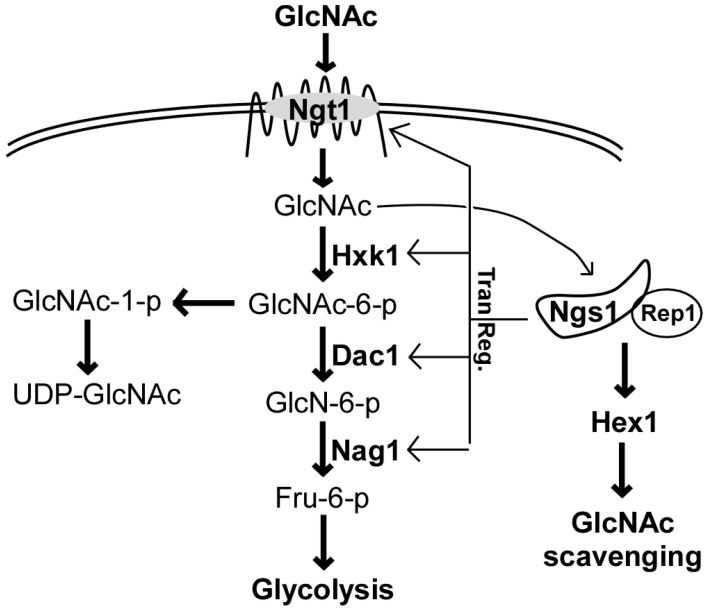
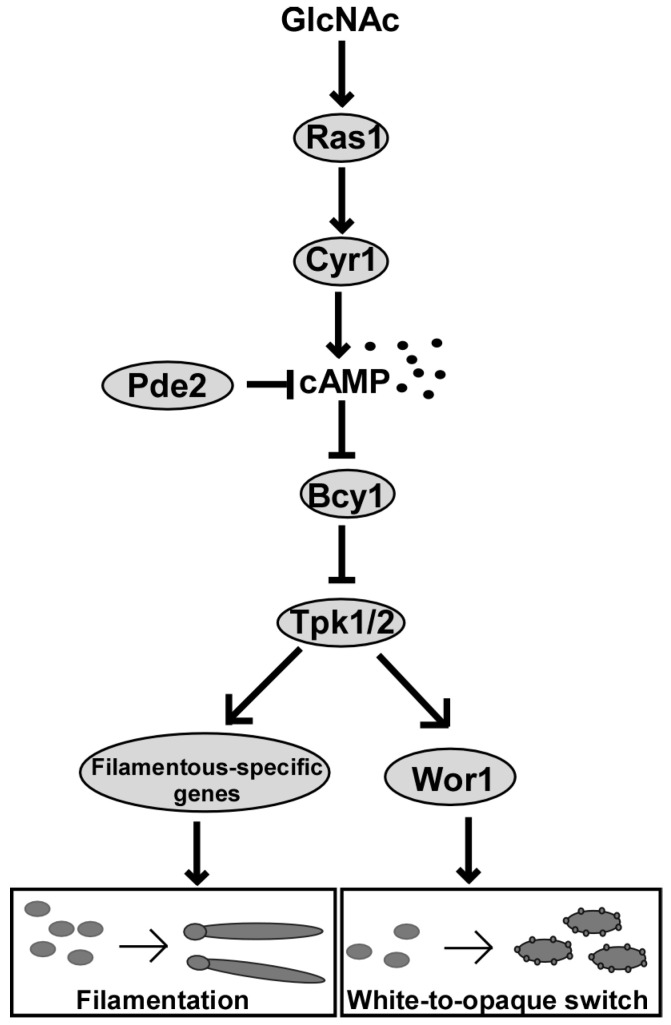
The sensing and efficient utilization of environmental nutrients are critical for the survival of microorganisms in environments where nutrients are limited, such as within mammalian hosts. Candida albicans is a common member of the human microbiota as well as an opportunistic fungal pathogen. The amide derivative sugar N-acetlyglucosamine (GlcNAc) is an important signaling molecule for C. albicans that could be a major nutrient source for this fungus in host settings. In this article, we review progress made over the past two decades on GlcNAc utilization, sensing, and functions in C. albicans and its related fungal species. GlcNAc sensing and catabolic pathways have been intensively studied in C. albicans. The C. albicans protein Ngt1 represents the first identified GlcNAc-specific transporter in eukaryotic organisms. In C. albicans, GlcNAc not only induces morphological transitions including the yeast to hyphal transition and the white to opaque phenotypic switch, but it also promotes fungal cell death. The Ras-cAMP/PKA signaling pathway plays critical roles in regulating these processes. Given the importance of GlcNAc sensing and utilization in C. albicans, targeting GlcNAc associated pathways and key pathway components could be promising in the development of new antifungal strategies.
Overview
The claims and statistics of this paper haven’t been checked yet.
Free: it reads the open-access text and checks the first 5 claims that cite a source we can check. Create a free account to check every claim.
Integrity signals
Registry
Cites
Statistics
Figures
Verification
Claims the paper makes
The claims and statistics of this paper haven’t been checked yet.
Free: it reads the open-access text and checks the first 5 claims that cite a source we can check. Create a free account to check every claim.
Self-check
Percentages, sums and reported differences re-computed from the paper’s own numbers.
The self-check needs the paper’s full text.
Citations
Cites
Role of the microbiota in immunity and inflammation.
Belkaid, Y., & Hand, T. W. (2014) · Cell · doi:10.1016/j.cell.2014.03.011 · Cited by 5,385 · cited 1×
“albicans, contains many commensal bacteria that contain peptidoglycans in their cell walls [85,86].”
BackgroundRecognition of peptidoglycan from the microbiota by Nod1 enhances systemic innate immunity
Clarke, T. B., Davis, K. M., Lysenko, E. S., Zhou, A. Y., Yu, Y., & Weiser, J. N. (2010) · Nature Medicine · doi:10.1038/nm.2087 · Cited by 1,154 · cited 1×
“albicans, contains many commensal bacteria that contain peptidoglycans in their cell walls [85,86].”
BackgroundPfaller, M. A., Diekema, D. J., Turnidge, J. D., Castanheira, M., & Jones, R. N. (2019) · Open Forum Infectious Diseases · doi:10.1093/ofid/ofy358 · Cited by 825
Transcriptional Response of Candida albicans upon Internalization by Macrophages
Lorenz, M. C., Bender, J. A., & Fink, G. R. (2004) · Eukaryotic Cell · doi:10.1128/ec.3.5.1076-1087.2004 · Cited by 712 · cited 1×
“Consistent with the latter finding, transcriptomic analysis showed that the expression of NGT1 and GlcNAc catabolism-associated genes were upregulated upon macrophage engulfment [18].”
ResultLysM, a widely distributed protein motif for binding to (peptido)glycans
Buist, G., Steen, A., Kok, J., & Kuipers, O. P. (2008) · Molecular Microbiology · doi:10.1111/j.1365-2958.2008.06211.x · Cited by 628 · cited 1×
“Fungal LysM domain-containing proteins often bind to chitin or GlcNAc and function as effectors to suppress plant and insect host immune responses [89,90].”
Background"White-opaque transition": a second high-frequency switching system in Candida albicans
Slutsky, B., Staebell, M., Anderson, J., Risen, L., Pfaller, M., & Soll, D. R. (1987) · Journal of Bacteriology · doi:10.1128/jb.169.1.189-197.1987 · Cited by 570 · cited 1×
“albicans, white and opaque cells differ in colony and cell morphologies, mating competencies, virulence, and transcriptomic profiles [38,40,42,43].”
BackgroundMiller, M. G., & Johnson, A. D. (2002) · Cell · doi:10.1016/s0092-8674(02)00837-1 · Cited by 568 · cited 6×
“The white–opaque switch in C. albicans is controlled by the mating type locus (MTL) [45].”
BackgroundInfluentialCandida albicans cell-type switching and functional plasticity in the mammalian host
Noble, S. M., Gianetti, B. A., & Witchley, J. N. (2017) · Nature Reviews Microbiology · doi:10.1038/nrmicro.2016.157 · Cited by 521 · cited 2×
“Morphological changes are often associated with virulence and adaptation to the continuously changing host environment [40].”
BackgroundBiswas, S., Van Dijck, P., & Datta, A. (2007) · Microbiology and Molecular Biology Reviews · doi:10.1128/mmbr.00009-06 · Cited by 516
Carbon nutrition of Escherichia coli in the mouse intestine
Chang, D.-E., Smalley, D. J., Tucker, D. L., Leatham, M. P., Norris, W. E., Stevenson, S. J., Anderson, A. B., Grissom, J. E., Laux, D. C., Cohen, P. S., et al. (2004) · Proceedings of the National Academy of Sciences · doi:10.1073/pnas.0307888101 · Cited by 512 · cited 2×
“A study by Chang et al. (2004) suggested that GlcNAc is a major nutrient carbon source for Escherichia coli in the mouse gastrointestinal tract [87].”
Background
Cited by
Amino Acid Sensing and Assimilation by the Fungal Pathogen Candida albicans in the Human Host
Silao, F. G. S., & Ljungdahl, P. O. (2021) · Pathogens · doi:10.3390/pathogens11010005 · Cited by 40
Padder, S. A., Ramzan, A., Tahir, I., Rehman, R. U., & Shah, A. H. (2022) · Critical Reviews in Microbiology · doi:10.1080/1040841x.2021.1935447 · Cited by 27
Rao, K. H., Paul, S., & Ghosh, S. (2021) · Journal of Fungi · doi:10.3390/jof7010065 · Cited by 25
Qiu, L., Song, J.-Z., Li, J., Zhang, T.-S., Li, Z., Hu, S.-J., Liu, J., Dong, J.-C., Cheng, W., & Wang, J.-J. (2022) · International Journal of Biological Macromolecules · doi:10.1016/j.ijbiomac.2022.03.037 · Cited by 16
N-acetylglucosamine-mediated morphological transition in Candida albicans and Candida tropicalis
Lew, S. Q., & Lin, C. (2021) · Current Genetics · doi:10.1007/s00294-020-01138-z · Cited by 11
Metadata
- Authors
- Du, H., Ennis, C. L., Hernday, A. D., Nobile, C. J., & Huang, G.
- Affiliations
- Fudan University (CN)
- University of California, Merced (US)
- Corresponding author
- Huang, Guanghua
- Venue
- Journal of Fungi
- Publisher
- MDPI AG
- Published
- 2020-08-07
- Volume
- 6
- Issue
- 3
- Pages
- 129
- ISSN
- 2309-608X (ISSN-L)
- PMC
- PMC7558947
- OpenAlex
- W3047010790
- Cited by
- 30
- References
- 97
- Citations by year
- 2026: 3 · 2025: 10 · 2024: 7 · 2022: 3 · 2021: 7
- FWCI
- 0.24
- Type
- journal article
- Language
- en
- Open access
- gold
- doi.org
- Licence
- Locations
- Journal of Fungi (publishedVersion, cc-by)
- PubMed Central (publishedVersion, cc-by)
- PubMed (publishedVersion)
- eScholarship (California Digital Library) (submittedVersion, cc-by)
- DOAJ (DOAJ: Directory of Open Access Journals) (submittedVersion, cc-by-sa)
- eScholarship (California Digital Library) (submittedVersion)
- Funders
- National Natural Science Foundation of China (31930005 and 31625002)
- Natural Science Foundation of Shanghai award (19ZR1405100)
- National Institutes of Health (R15AI37975)
- Kamangar family in the form of an endowed chair (na)
- NIH fellowship (F31DE028488)
- Topics
- Life Sciences › Biochemistry, Genetics and Molecular Biology › Molecular Biology › Fungal and yeast genetics research
- Health Sciences › Medicine › Infectious Diseases › Antifungal resistance and susceptibility
- Health Sciences › Medicine › Infectious Diseases › Fungal Infections and Studies
- Keywords
- N-acetylglucosamine, Candida albicans, nutrient sensing, yeast-to-hypha transition, white-opaque switching, fungal cell death, antifungal drug targets, opportunistic fungal pathogens
About these checks
Registry, retraction, Cites and statistics results are computed, not judged, with one exception: a printed reference that no index lists is read once by a model before it counts as a citation error. Claims are extracted by a model and kept only when their quote appears verbatim in the text; each cited source is then checked, with a model’s help, for whether it says what the claim relies on. Those verdicts can be wrong — read the claim’s quote and the cited source before relying on one.
Statistics and arithmetic are recomputed, not judged.
Confidence bands are shown only for fields calibrated on our annotated test set. None is calibrated yet, so no band is shown.
What counts as a claim ›How we measure confidence ›How we check this ›
Are you an author, or do you see a problem with this page? Request a review
How to cite
Cite CoChat for the checks on this page, and the paper for its own findings.
- This page
- CoChat. (2026). Citation check: N-Acetylglucosamine (GlcNAc) Sensing, Utilization, and Functions in Candida albicans. https://app.cochat.ai/papers/10.3390/jof6030129
- The paper
- Du, H., Ennis, C. L., Hernday, A. D., Nobile, C. J., & Huang, G. (2020). N-Acetylglucosamine (GlcNAc) Sensing, Utilization, and Functions in Candida albicans. Journal of Fungi. https://doi.org/10.3390/jof6030129
Data sources
Bibliographic data: Semantic Scholar, OpenAlex, Crossref.
Contains information from the Semantic Scholar Academic Graph Datasets, made available under the ODC Attribution License (ODC-BY 1.0).
Semantic Scholar’s data is described in: Kinney, R., et al. (2023). The Semantic Scholar Open Data Platform. arXiv:2301.10140.
