

Can Self-Presentation on Social Media Increase Individuals’ Conspicuous Consumption Tendency? A Mixed-Method Empirical Study on WeChat in China
Open accessThe DOI matches its Crossref record; 81 of the 81 references it cites were found in a registry or an index; none of the 38 sources its claims cite is checked for support yet.
Abstract
Previous studies have mainly focused on the impact of social media self-presentation on individuals’ happiness and mental health, whereas few have attended to its potential influence on consumer behavior. A mixed-method empirical study with an online survey (N = 408) and an experimental study (N = 160) investigated the effects of social media self-presentation on individuals’ conspicuous consumption in China. We found that consumers’ self-presentation behavior on social media promoted tendencies for social comparison, thereby enhancing their conspicuous consumption. However, compared with individuals using social media less often, self-presentation had a more significant impact on the social comparison tendencies of users who used social media more often. Our study explains why individuals’ self-presentation on social media increases their conspicuous consumption tendencies. The study results contribute to the existing knowledge of how consumers’ behavior on social media affects their product preferences.
Overview
CoChat Summary
TL;DR
Across an online survey (N = 408) and a WeChat experiment, self-presentation on social media increased conspicuous consumption tendency, mediated by social comparison, and this effect was stronger among heavier social media users. The authors argue this helps explain how online self-presentation can shape consumer preferences in China.
Key findings
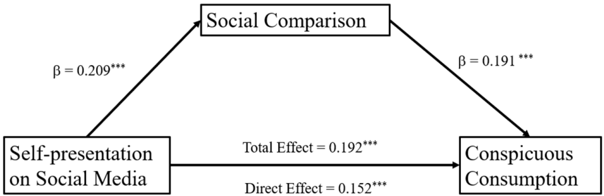
- In Study 1, self-presentation on social media positively predicted conspicuous consumption tendency (total effect β = 0.192, p < 0.001). Social comparison mediated this relationship (indirect effect β = 0.040, 95% CI = 0.015–0.099); self-presentation positively affected social comparison (β = 0.209, p < 0.001), and social comparison positively affected conspicuous consumption (β = 0.191, p < 0.001).
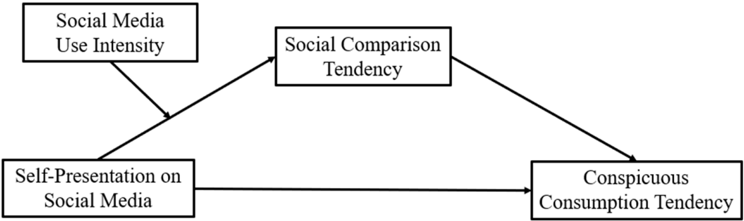
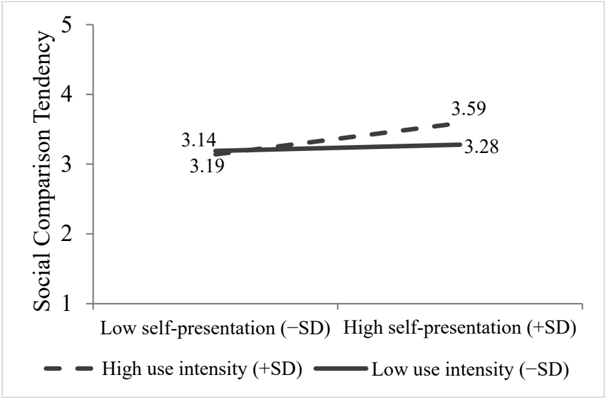
- Social media use intensity moderated the path from self-presentation to social comparison (β = 0.234, p < 0.001). At lower use intensity (−SD), the effect was not significant (B = 0.07, p = 0.231); at higher use intensity (+SD), it was significant (B = 0.36, p < 0.001). The conditional indirect effect was not significant at −SD (B = 0.02, 95% CI = −0.011–0.063) but was significant at +SD (B = 0.08, 95% CI = 0.032–0.142).
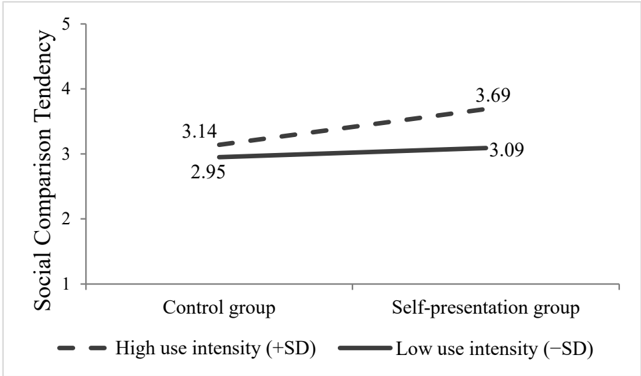
- In Study 2, more self-presentation-group participants chose the large-logo Nike hat than control-group participants (73.3% vs. 57.8%; χ² = 4.82, p = 0.028). Social comparison mediated the effect (β = 0.26, 95% CI = 0.035–0.564); self-presentation positively affected social comparison (β = 0.394, p < 0.000), and social comparison positively affected conspicuous consumption (β = 0.663, p = 0.021). Social media use intensity again moderated the path (β = 0.376, p = 0.010), with a non-significant effect at −SD (β = 0.144, p = 0.202) and a significant effect at +SD (β = 0.572, p < 0.001); the conditional indirect effect was non-significant at −SD (β = 0.10, 95% CI = −0.075–0.264) and significant at +SD (β = 0.379, 95% CI = 0.058–0.800).
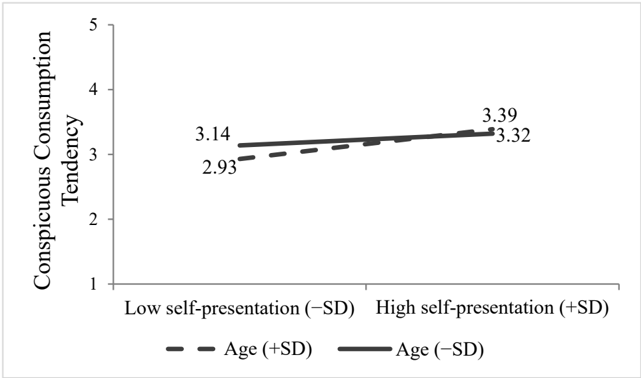
- Female participants scored higher than male participants on social media self-presentation (M = 3.77 vs. 3.34, p < 0.001), social media use intensity (M = 4.84 vs. 4.55, p = 0.001), and conspicuous consumption tendency (M = 3.38 vs. 2.93, p < 0.001), with no significant difference in social comparison tendency. Gender moderation of the self-presentation–conspicuous consumption link was not significant (CI = −0.12–0.36, p = 0.34); age moderation was marginally significant (CI = −0.002–0.03, p = 0.059), with a non-significant simple slope at lower age (p = 0.083) and a significant positive slope at higher age (p < 0.001).
Methods
- Study 1 was an online survey of 408 participants recruited on Credamo in China (59.8% female, 17–52 years old, M age = 28.85 ± 7.43). Measures included self-presentation on social media (17 items, α = 0.902), social media use intensity (8 items, α = 0.904), social comparison tendency (11 items, α = 0.805), and conspicuous consumption tendency (5 items, α = 0.744); analyses used Hayes’s PROCESS Model 4 and Model 7 in SPSS 25.0.
- Study 2 used a single-factor between-subjects design (self-presentation group vs. control group). The paper states 180 participants were recruited from a Chinese university (47.91% female, 16–23 years old, M age = 20.37 ± 1.85); the abstract reports N = 160 for the experimental study. Participants in the self-presentation group posted recent-state content with a photo on WeChat Moments, while control participants forwarded an article; 24 h later, conspicuous consumption tendency was measured by choosing between a Nike hat with a large logo vs. a small logo, and social comparison was measured with the Study 1 scale (α = 0.821).
- Study 2 used the same bootstrap/mediation approach as Study 1, with PROCESS Model 4 and Model 7; conspicuous consumption was coded as big logo = 1, small logo = 0, and self-presentation = 1, control = 0.
Limitations
- The paper states that reverse causality is possible: buying or using conspicuous products may make individuals more likely to present themselves on social media. It also states that only social media use intensity was examined as a moderator, while other personal characteristics such as materialistic values and self-esteem may also moderate the effect.
- The paper states that social media was limited to WeChat, that privacy differs across platforms (e.g., WeChat Moments vs. Weibo), that cross-cultural differences in online conspicuous behavior are worth studying, and that participants were geographically concentrated in China, limiting generalizability. It also notes that experimental groups mostly comprised young people and recommends future research on older adults.
- Evident from the text: Study 1 is correlational and cannot establish causality; Study 2’s sample size is inconsistent between the abstract (N = 160) and the Study 2 participant section (180 recruited); and the measures rely on self-report scales except for the hat-choice outcome in Study 2.
Model-written summary. Check it against the paper before relying on it.
Integrity signals
Registry
Cites
Statistics
Figures

Verification
Claims the paper makes
0 Valid · 0 Not valid · 23 Not checked · 42 Own results and interpretations
A result the paper reports from its own data — it cites no other source for it, so there is none to check. The quote shows it is in the paper.
In the paper
“conspicuous consumption tendency (M male = 2.93, SD = 0.72; M female = 3.38, SD = 0.77, p < 0.001)”
§ Can Self-Presentation on Social Media Increase Individuals' Conspicuous Consumption Tendency? A Mixed-Method Empirical Study on WeChat in China > 3.4.3. The Effect of Demographic Variables
plain- Asserted: passes — The authors put it forward as true.
- Checkable: passes — It can be checked against evidence.
- Load-bearing: unclear — It is unclear whether the paper’s conclusions depend on it.
- Based: passes — The paper gives a reason why it holds.
A result the paper reports from its own data — it cites no other source for it, so there is none to check. The quote shows it is in the paper.
In the paper
“more self-presentation group participants chose the hat with the big logo compared to the control group participants (73.3% vs. 57.8%;χ 2 = 4.82, p = 0.028)”
§ Can Self-Presentation on Social Media Increase Individuals' Conspicuous Consumption Tendency? A Mixed-Method Empirical Study on WeChat in China > 4.3.1. Main Effect and Mediation Effect
plain- Asserted: passes — The authors put it forward as true.
- Checkable: passes — It can be checked against evidence.
- Load-bearing: passes — The paper’s conclusions depend on it.
- Based: passes — The paper gives a reason why it holds.
- Rests on 2 assumptions not shown here.
A result the paper reports from its own data — it cites no other source for it, so there is none to check. The quote shows it is in the paper.
In the paper
“social comparison tendency positively affected conspicuous consumption tendency (β = 0.191, p < 0.001)”
§ Can Self-Presentation on Social Media Increase Individuals' Conspicuous Consumption Tendency? A Mixed-Method Empirical Study on WeChat in China > 3.4.1. Main Effect and Mediation Effect
plainstates a cause- Asserted: passes — The authors put it forward as true.
- Checkable: passes — It can be checked against evidence.
- Load-bearing: passes — The paper’s conclusions depend on it.
- Based: passes — The paper gives a reason why it holds.
A result the paper reports from its own data — it cites no other source for it, so there is none to check. The quote shows it is in the paper.
In the paper
“social media use intensity (M male = 4.55, SD = 0.92; M female = 4.84, SD = 0.75, p = 0.001)”
§ Can Self-Presentation on Social Media Increase Individuals' Conspicuous Consumption Tendency? A Mixed-Method Empirical Study on WeChat in China > 3.4.3. The Effect of Demographic Variables
plain- Asserted: passes — The authors put it forward as true.
- Checkable: passes — It can be checked against evidence.
- Load-bearing: unclear — It is unclear whether the paper’s conclusions depend on it.
- Based: passes — The paper gives a reason why it holds.
A result the paper reports from its own data — it cites no other source for it, so there is none to check. The quote shows it is in the paper.
In the paper
“self-presentation on social media positively affected social comparison tendency (β = 0.209, p < 0.001)”
§ Can Self-Presentation on Social Media Increase Individuals' Conspicuous Consumption Tendency? A Mixed-Method Empirical Study on WeChat in China > 3.4.1. Main Effect and Mediation Effect
plainstates a cause- Asserted: passes — The authors put it forward as true.
- Checkable: passes — It can be checked against evidence.
- Load-bearing: passes — The paper’s conclusions depend on it.
- Based: passes — The paper gives a reason why it holds.
41 more claims
Create a free account to see all 65 claims and to verify the 38 references still open.
- The quote only partly states this claim. 3
- It may state two separate claims as one. 10
- Probably not a substantial claim. 9
Self-check
Percentages, sums and reported differences re-computed from the paper’s own numbers.
Each contradiction between two passages listed here was confirmed by an independent check.
Rated minor: it would not touch a result — a value no result rests on, a p-value that stays on the same side of the significance level, or a conflict that is clerical, resolved elsewhere in the paper, or outside its own findings.
In the paper
§ Can Self-Presentation on Social Media Increase Individuals' Conspicuous Consumption Tendency? A Mixed-Method Empirical Study on WeChat in China > 3.2.1. Self-Presentation on Social Media
“We used the scale by Yang et al. [69] to measure participants' self-presentation on social media.”
§ Can Self-Presentation on Social Media Increase Individuals' Conspicuous Consumption Tendency? A Mixed-Method Empirical Study on WeChat in China > References
“69. Sun, Y.; Zhang, Y. A review of theories and models applied in studies of social media addiction and implications for future research.”
Citations
Cites
A theory of social comparison processes
Festinger, L. (1954) · Human Relations · doi:10.1177/001872675400700202 · Cited by 20,926
Addressing Moderated Mediation Hypotheses: Theory, Methods, and Prescriptions
Preacher, K. J., Rucker, D. D., & Hayes, A. F. (2007) · Multivariate Behavioral Research · doi:10.1080/00273170701341316 · Cited by 9,973
Ellison, N. B., Steinfield, C., & Lampe, C. (2007) · Journal of Computer-Mediated Communication · doi:10.1111/j.1083-6101.2007.00367.x · Cited by 9,939 · cited 2×
“The eight-item scale by Ellison et al. [26] was used to measure participants’ social media use intensity; “Facebook” from the original questionnaire was replaced with “WeChat.” intensity; “Facebook” from the original questionnaire was replaced with “WeChat.””
BackgroundMethodStatistical mediation analysis with a multicategorical independent variable
Hayes, A. F., & Preacher, K. J. (2014) · British Journal of Mathematical and Statistical Psychology · doi:10.1111/bmsp.12028 · Cited by 3,403 · cited 1×
“As shown in Table 3, the mediation e ff ect was not signi fi cant ( B 0.02, 95% CI = − 0.011–0.063) when social media use intensity was lower ( − SD ), but it became signi fi cant ( B = 0.08, 95% The results of the simple slope analysis in Figure 3 also show that when participants’ social media use…”
ResultInfluentialGibbons, F. X., & Buunk, B. P. (1999) · Journal of Personality and Social Psychology · doi:10.1037/0022-3514.76.1.129 · Cited by 1,813
Schouten, A. P., Janssen, L., & Verspaget, M. (2020) · International Journal of Advertising · doi:10.1080/02650487.2019.1634898 · Cited by 1,422
Chou, H.-T. G., & Edge, N. (2012) · Cyberpsychology, Behavior, and Social Networking · doi:10.1089/cyber.2011.0324 · Cited by 1,166
Social media addiction: Its impact, mediation, and intervention
Hou, Y., Xiong, D., Jiang, T., Song, L., & Wang, Q. (2019) · Cyberpsychology: Journal of Psychosocial Research on Cyberspace · doi:10.5817/cp2019-1-4 · Cited by 815 · cited 1×
“For individuals, due to its popularity, people are used to presenting themselves on social media.”
BackgroundThe Demand for Unobservable and Other Nonpositional Goods
Frank, R. H. (2016) · American Economic Review · Cited by 800
Griskevicius, V., Tybur, J. M., Sundie, J. M., Cialdini, R. B., Miller, G. F., & Kenrick, D. T. (2007) · Journal of Personality and Social Psychology · doi:10.1037/0022-3514.93.1.85 · Cited by 726
Research works printed but not linked: 4
- Niu, G.; Bao, N.; Zhou, Z.; Fan, C.; Kong, F.; Sun, X. The impact of self-presentation in online social network sites on life satisfaction: The effect of positive affect and social support. Psychol. Dev. Educ. 2015, 31, 563-570. [CrossRef]
- Zheng, X.Y.; Peng, S.Q.; Dai, S.S. Impact of social comparison on conspicuous consumption: A psychological compensation perspective. J. Mark. Sci. 2014, 10, 19-31.
- Chadee, D., Ed.; John Wiley & Sons: Edison, NJ, USA, 2011.
- Hayes, A.F. Introduction to Mediation, Moderation, and Conditional Process Analysis: A Regression-Based Approach, 3rd ed.; The Guilford Press: New York, NY, USA, 2022.
Cited by
Pang, H., Ruan, Y., & Wang, L. (2024) · Journal of theoretical and applied electronic commerce research · doi:10.3390/jtaer19040134 · Cited by 16
Liu, Y., & Lei, K. (2025) · Frontiers in Psychology · doi:10.3389/fpsyg.2025.1494083 · Cited by 14
Tuna, M. F., Bayır, T., & Çam, S. (2025) · Discover Psychology · doi:10.1007/s44202-025-00533-2 · Cited by 10
Kristina, A., Tsaniyah, A. E., & Kamsin, K. B. (2026) · The Journal of Society & Media · doi:10.26740/jsm.v10n1.p58-77 · Cited by 5
Siddiqui, H. M. A., Syed, M., & Behzad, T. (2025) · Market Forces · doi:10.51153/mf.nxh48.077 · Cited by 4
Chen, Y., Yang, W., Zhang, X., & Wu, Y. (2025) · Health Communication · doi:10.1080/10410236.2025.2567514 · Cited by 3
Hua, Z., Li, Q., & Zhang, Q. (2025) · Asia Pacific Journal of Marketing and Logistics · doi:10.1108/apjml-06-2025-1255 · Cited by 2
The Role of Fear of Missing Out on Purchase Intention Through The Use of Paylater Services
Sudrajad, I., & Edastama, P. (2025) · Quantitative Economics and Management Studies · doi:10.35877/454ri.qems4155 · Cited by 2
YILDIRIM, Y. O. (2025) · Anadolu Üniversitesi İktisadi ve İdari Bilimler Fakültesi Dergisi · doi:10.53443/anadoluibfd.1642648 · Cited by 1
The Effect of Perceived Affordance on AIGC Platform User Loyalty
Zhou, T., & Jiang, Y. (2025) · International Journal of Human-Computer Interaction · doi:10.1080/10447318.2025.2580552 · Cited by 1
Zhao, X., Yang, B., Ding, J., & Xia, F. (2026) · Current Psychology · doi:10.1007/s12144-025-09007-z · Cited by 1
Wang, S., Jing, Y., Yu, Q., Yan, F., & Huang, B. (2026) · BMC Psychology · doi:10.1186/s40359-026-04358-z · Cited by 1
Rintia, R., Siti Nurbayani, K., Wilodati, W., & Sukimi, M. F. (2026) · Jurnal Pendidikan Progresif · doi:10.23960/jpp.v16i1.pp554-576 · Cited by 1
You, J., & Jeong, K.-H. (2026) · Behavioral Sciences · doi:10.3390/bs16060939 · Cited by 1
Demand, law of demand, Giffen and Veblen effects. Part 2. Non-functional demand and demand puzzles
Tsurikov, V. (2024) · Theoretical economics · doi:10.52957/2221-3260-2024-11-12-33
Digital Transformation and Socio-Cultural Influences on Consumer Decision Making in China
Yu, K. (2025) · Advances in Economics Management and Political Sciences · doi:10.54254/2754-1169/2025.bl25925
YILMAZ, N., & Ekinci, S. Ç. (2025) · Advances in computational intelligence and robotics book series · doi:10.4018/979-8-3373-6970-9.ch008
The Effect of Consumers’ Lifestyle on Priority Points on Their Product Selection
Zihan, M. A. O., HAMADA, Y., Maru, C., & SHOJI, H. (2026) · International Journal of Affective Engineering · doi:10.5057/ijae.ijae-d-25-00024
(2025) · Wroclaw University of Economics and Business eBooks · doi:10.15611/2025.09.8
Konsumpcja demonstracyjna i efekt snobizmu a decyzje finansowe studentów kierunków ekonomicznych
Ploch, O. (2025) · Wroclaw University of Economics and Business eBooks · doi:10.15611/2025.09.8.06
Aydin, G., Başoğlu, Ö. E., Karababa, B., Ünver, O., Yavuz, G., & Aydin, G. (2026) · Frontiers in Psychology · doi:10.3389/fpsyg.2026.1773459
EROĞLU, O., Bas, M., & Karadağ, A. (2026) · International journal of Sport Studies for Health · doi:10.61838/kman.intjssh.5134
Budaya Konsumtif dan Identitas Sosial: Studi Budaya terhadap Perilaku Konsumen Fashion Lokal
Diana, A. N., & Oktaria, N. (2025) · Education Jurnal Sosial Humaniora dan Pendidikan · doi:10.51903/7sp8tg45
Chen, P., & Xi, W. (2026) · Frontiers in Environmental Science · doi:10.3389/fenvs.2026.1870340
Ismail, S., & Siddiqui, D. A. (2026) · International Journal of Emerging Multidisciplinaries Social Science · doi:10.54938/ijemdss.2026.05.4.810
จำปาเงิน, ภ. (2026) · Siam University Journal of Business Administration · doi:10.14456/sujba.2026.13
Conspicuous consumption on Instagram: Representations of wealth and popular culture on social media
Altıntaş, M. (2026) · Business And Management Studies An International Journal · doi:10.15295/bmij.v14i3.2796
Sosyal Medyada Benlik Sunumu ile Gösteriş Tüketimi Eğilimi Arasındaki İlişkide FoMO’nun Aracı Rolü
Çöllü, E. F. (2026) · İnsan ve Toplum Bilimleri Araştırmaları Dergisi · doi:10.15869/itobiad.1962588
Budaya Flexing di Media Sosial dalam Perspektif Teori Behaviour
Mahananie, E. T. (2024) · KAPATA Jurnal Teologi dan Pendidikan Kristen · doi:10.55798/kapata.v5i1.160
Hubungan Paparan Konten Viral dengan Perilaku Sosial Konsumtif Pengguna Media Sosial
Alfaruq, M. Z., Wangsakerta, S. K., & Lembayung, G. N. (2026) · Journal of Modern Social and Humanities · doi:10.71094/jmsh.v2i5.496
Agustiawan, R. (2026) · NUSANTARA Jurnal Ilmu Pengetahuan Sosial · doi:10.31604/jips.v13i9.2026.2434-2449
Wu, M.-H., & Liao, Y.-Q. (2026) · Heliyon · doi:10.1016/j.heliyon.2026.e45587
Dijital Temas Noktalarında Sosyal Karşılaştırma: Tüketici Psikolojisi ve Davranışsal Tepkiler
YILDIZ, S. Y., & Ibrahim, B. (2026) · Özgür Yayınları eBooks · doi:10.58830/ozgur.pub1504.c6025
Tüketici Davranışlarında Güncel Konular II
(2026) · Özgür Yayınları eBooks · doi:10.58830/ozgur.pub1504
Fatkhurrohman, F., Fatwanti, D., & Mulyadi, R. (2026) · ROIN Journal of Islamic Education Management · doi:10.67961/rjiem.v1i2.631
anamagh, B. E., Atadokht, A., Basharpoor, S., & Mikaeili, N. (2025) · Rooyesh Psychological Journal · doi:10.66224/rooyesh.14.5.5
Household Smartphone Use and Consumption: Evidence from the China Household Finance Survey
Zou, H., Peng, Y., Wang, S., & Wang, X. (2026) · Economic society and humanities. · doi:10.62381/e264705
Metadata
- Authors
- Lu, Y., Zhao, T., Song, S., & Song, W.
- Affiliations
- School of Philosophy and Sociology, Jilin University, Changchun 130012, China
- Jilin University (CN)
- Yatai School of Business Management, Jilin University of Finance and Economics, Changchun 130012, China
- Corresponding author
- Zhao, Taiyang
- Venue
- Journal of Theoretical and Applied Electronic Commerce Research
- Publisher
- MDPI AG
- Published
- 2024-05-25
- Volume
- 19
- Issue
- 2
- Pages
- 1206-1221
- ISSN
- 0718-1876 (ISSN-L)
- OpenAlex
- W4399042458
- Semantic Scholar
- dca699ae49ac9c72f33e12720786e3e256be4aa9
- Cited by
- 39
- References
- 81
- Citations by year
- 2026: 20 · 2025: 15 · 2024: 4
- FWCI
- 7.45
- Type
- journal article
- Language
- en
- Open access
- gold
- doi.org
- Licence
- Locations
- Journal of theoretical and applied electronic commerce research (publishedVersion, cc-by)
- DOAJ (DOAJ: Directory of Open Access Journals) (submittedVersion, cc-by-sa)
- Funders
- National Natural Science Foundation of China (71902069, 72202084, 72372053, 72272060, 23YJC630250, 2023CX001)
- Humanities and Social Sciences Fund Project of the Chinese Ministry of Education (71902069, 72202084, 72372053, 72272060, 23YJC630250, 2023CX001)
- Graduate Innovation Fund of Jilin University (71902069, 72202084, 72372053, 72272060, 23YJC630250, 2023CX001)
- Topics
- Social Sciences › Business, Management and Accounting › Marketing › Consumer Behavior in Brand Consumption and Identification
- Social Sciences › Sociology and Political Science › Impact of Technology on Adolescents
- Social Sciences › Business, Management and Accounting › Marketing › Digital Marketing and Social Media
- Keywords
- self-presentation, social media, conspicuous consumption, social comparison, WeChat, consumer behavior, social media use frequency, product preference
About these checks
Registry, retraction, Cites and statistics results are computed, not judged, with one exception: a printed reference that no index lists is read once by a model before it counts as a citation error. Claims are extracted by a model and kept only when their quote appears verbatim in the text; each cited source is then checked, with a model’s help, for whether it says what the claim relies on. Those verdicts can be wrong — read the claim’s quote and the cited source before relying on one.
A language model drew the claims from the paper on 2026-11-17, under version 3 of the claim definition (model deepseek-v4.1-flash, prompt extract-v3).
A second model labelled each claim on 2026-11-17 (model jev-1.13-20260917, definition revision gold-guideline-v0.2).
Statistics and arithmetic are recomputed, not judged.
Confidence bands are shown only for fields calibrated on our annotated test set. None is calibrated yet, so no band is shown.
What counts as a claim ›How we measure confidence ›How we check this ›
Are you an author, or do you see a problem with this page? Request a review
Data sources
Bibliographic data: Semantic Scholar, OpenAlex, Crossref.
Contains information from the Semantic Scholar Academic Graph Datasets, made available under the ODC Attribution License (ODC-BY 1.0).
Semantic Scholar’s data is described in: Kinney, R., et al. (2023). The Semantic Scholar Open Data Platform. arXiv:2301.10140.
