

Can Self-Presentation on Social Media Increase Individuals’ Conspicuous Consumption Tendency? A Mixed-Method Empirical Study on WeChat in China
Open accessThe DOI matches its Crossref record; 81 of the 81 references it cites were found in a registry or an index; none of the 38 sources its claims cite is checked for support yet.
Abstract
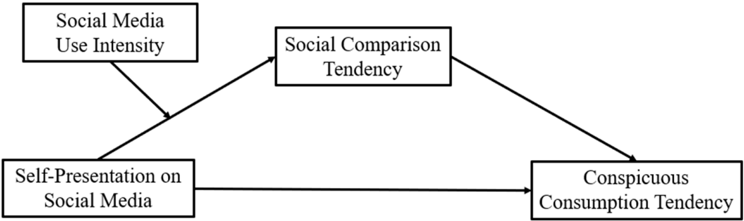
Previous studies have mainly focused on the impact of social media self-presentation on individuals’ happiness and mental health, whereas few have attended to its potential influence on consumer behavior. A mixed-method empirical study with an online survey (N = 408) and an experimental study (N = 160) investigated the effects of social media self-presentation on individuals’ conspicuous consumption in China. We found that consumers’ self-presentation behavior on social media promoted tendencies for social comparison, thereby enhancing their conspicuous consumption. However, compared with individuals using social media less often, self-presentation had a more significant impact on the social comparison tendencies of users who used social media more often. Our study explains why individuals’ self-presentation on social media increases their conspicuous consumption tendencies. The study results contribute to the existing knowledge of how consumers’ behavior on social media affects their product preferences.
Overview
CoChat Summary
TL;DR
Across an online survey (N = 408) and a WeChat experiment, self-presentation on social media increased conspicuous consumption tendency, mediated by social comparison, and this effect was stronger among heavier social media users. The authors argue this helps explain how online self-presentation can shape consumer preferences in China.
Key findings
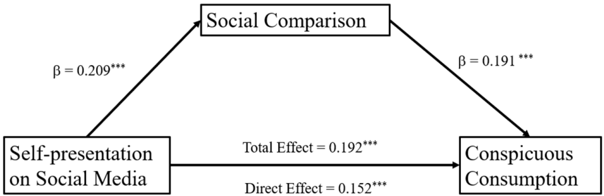
- In Study 1, self-presentation on social media positively predicted conspicuous consumption tendency (total effect β = 0.192, p < 0.001). Social comparison mediated this relationship (indirect effect β = 0.040, 95% CI = 0.015–0.099); self-presentation positively affected social comparison (β = 0.209, p < 0.001), and social comparison positively affected conspicuous consumption (β = 0.191, p < 0.001).
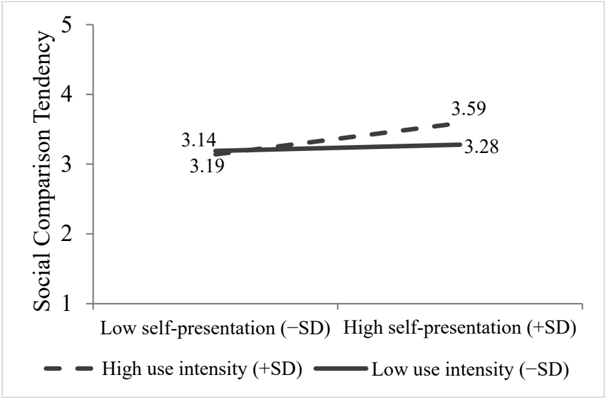
- Social media use intensity moderated the path from self-presentation to social comparison (β = 0.234, p < 0.001). At lower use intensity (−SD), the effect was not significant (B = 0.07, p = 0.231); at higher use intensity (+SD), it was significant (B = 0.36, p < 0.001). The conditional indirect effect was not significant at −SD (B = 0.02, 95% CI = −0.011–0.063) but was significant at +SD (B = 0.08, 95% CI = 0.032–0.142).
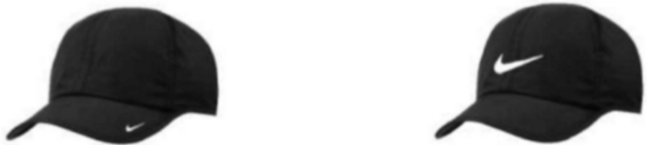
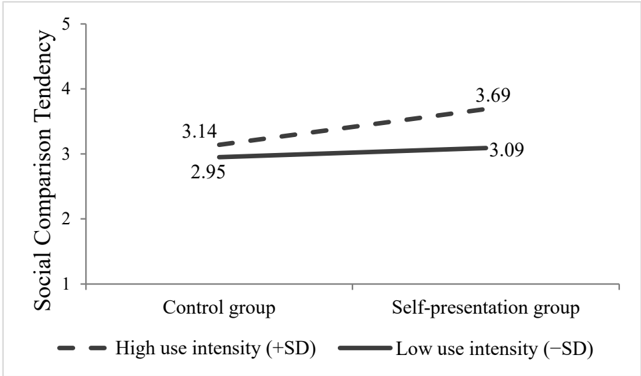
- In Study 2, more self-presentation-group participants chose the large-logo Nike hat than control-group participants (73.3% vs. 57.8%; χ² = 4.82, p = 0.028). Social comparison mediated the effect (β = 0.26, 95% CI = 0.035–0.564); self-presentation positively affected social comparison (β = 0.394, p < 0.000), and social comparison positively affected conspicuous consumption (β = 0.663, p = 0.021). Social media use intensity again moderated the path (β = 0.376, p = 0.010), with a non-significant effect at −SD (β = 0.144, p = 0.202) and a significant effect at +SD (β = 0.572, p < 0.001); the conditional indirect effect was non-significant at −SD (β = 0.10, 95% CI = −0.075–0.264) and significant at +SD (β = 0.379, 95% CI = 0.058–0.800).
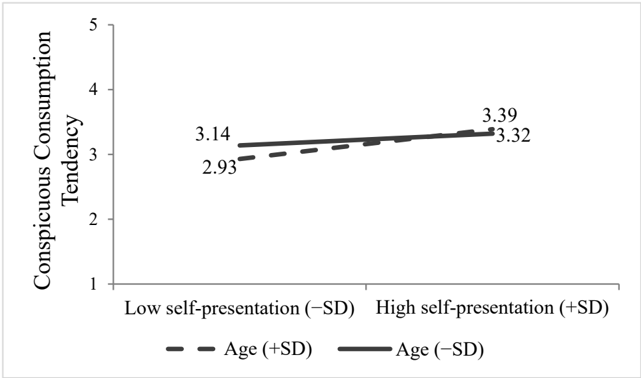
- Female participants scored higher than male participants on social media self-presentation (M = 3.77 vs. 3.34, p < 0.001), social media use intensity (M = 4.84 vs. 4.55, p = 0.001), and conspicuous consumption tendency (M = 3.38 vs. 2.93, p < 0.001), with no significant difference in social comparison tendency. Gender moderation of the self-presentation–conspicuous consumption link was not significant (CI = −0.12–0.36, p = 0.34); age moderation was marginally significant (CI = −0.002–0.03, p = 0.059), with a non-significant simple slope at lower age (p = 0.083) and a significant positive slope at higher age (p < 0.001).
Methods
- Study 1 was an online survey of 408 participants recruited on Credamo in China (59.8% female, 17–52 years old, M age = 28.85 ± 7.43). Measures included self-presentation on social media (17 items, α = 0.902), social media use intensity (8 items, α = 0.904), social comparison tendency (11 items, α = 0.805), and conspicuous consumption tendency (5 items, α = 0.744); analyses used Hayes’s PROCESS Model 4 and Model 7 in SPSS 25.0.
- Study 2 used a single-factor between-subjects design (self-presentation group vs. control group). The paper states 180 participants were recruited from a Chinese university (47.91% female, 16–23 years old, M age = 20.37 ± 1.85); the abstract reports N = 160 for the experimental study. Participants in the self-presentation group posted recent-state content with a photo on WeChat Moments, while control participants forwarded an article; 24 h later, conspicuous consumption tendency was measured by choosing between a Nike hat with a large logo vs. a small logo, and social comparison was measured with the Study 1 scale (α = 0.821).
- Study 2 used the same bootstrap/mediation approach as Study 1, with PROCESS Model 4 and Model 7; conspicuous consumption was coded as big logo = 1, small logo = 0, and self-presentation = 1, control = 0.
Limitations
- The paper states that reverse causality is possible: buying or using conspicuous products may make individuals more likely to present themselves on social media. It also states that only social media use intensity was examined as a moderator, while other personal characteristics such as materialistic values and self-esteem may also moderate the effect.
- The paper states that social media was limited to WeChat, that privacy differs across platforms (e.g., WeChat Moments vs. Weibo), that cross-cultural differences in online conspicuous behavior are worth studying, and that participants were geographically concentrated in China, limiting generalizability. It also notes that experimental groups mostly comprised young people and recommends future research on older adults.
- Evident from the text: Study 1 is correlational and cannot establish causality; Study 2’s sample size is inconsistent between the abstract (N = 160) and the Study 2 participant section (180 recruited); and the measures rely on self-report scales except for the hat-choice outcome in Study 2.
Model-written summary. Check it against the paper before relying on it.
Integrity signals
Registry
Cites
Statistics
Figures
Verification
Claims the paper makes
0 Valid · 0 Not valid · 23 Not checked · 42 Own results and interpretations
A result the paper reports from its own data — it cites no other source for it, so there is none to check. The quote shows it is in the paper.
In the paper
“conspicuous consumption tendency (M male = 2.93, SD = 0.72; M female = 3.38, SD = 0.77, p < 0.001)”
§ Can Self-Presentation on Social Media Increase Individuals' Conspicuous Consumption Tendency? A Mixed-Method Empirical Study on WeChat in China > 3.4.3. The Effect of Demographic Variables
plain- Asserted: passes — The authors put it forward as true.
- Checkable: passes — It can be checked against evidence.
- Load-bearing: unclear — It is unclear whether the paper’s conclusions depend on it.
- Based: passes — The paper gives a reason why it holds.
A result the paper reports from its own data — it cites no other source for it, so there is none to check. The quote shows it is in the paper.
In the paper
“more self-presentation group participants chose the hat with the big logo compared to the control group participants (73.3% vs. 57.8%;χ 2 = 4.82, p = 0.028)”
§ Can Self-Presentation on Social Media Increase Individuals' Conspicuous Consumption Tendency? A Mixed-Method Empirical Study on WeChat in China > 4.3.1. Main Effect and Mediation Effect
plain- Asserted: passes — The authors put it forward as true.
- Checkable: passes — It can be checked against evidence.
- Load-bearing: passes — The paper’s conclusions depend on it.
- Based: passes — The paper gives a reason why it holds.
- Rests on 2 assumptions not shown here.
A result the paper reports from its own data — it cites no other source for it, so there is none to check. The quote shows it is in the paper.
In the paper
“social comparison tendency positively affected conspicuous consumption tendency (β = 0.191, p < 0.001)”
§ Can Self-Presentation on Social Media Increase Individuals' Conspicuous Consumption Tendency? A Mixed-Method Empirical Study on WeChat in China > 3.4.1. Main Effect and Mediation Effect
plainstates a cause- Asserted: passes — The authors put it forward as true.
- Checkable: passes — It can be checked against evidence.
- Load-bearing: passes — The paper’s conclusions depend on it.
- Based: passes — The paper gives a reason why it holds.
A result the paper reports from its own data — it cites no other source for it, so there is none to check. The quote shows it is in the paper.
In the paper
“social media use intensity (M male = 4.55, SD = 0.92; M female = 4.84, SD = 0.75, p = 0.001)”
§ Can Self-Presentation on Social Media Increase Individuals' Conspicuous Consumption Tendency? A Mixed-Method Empirical Study on WeChat in China > 3.4.3. The Effect of Demographic Variables
plain- Asserted: passes — The authors put it forward as true.
- Checkable: passes — It can be checked against evidence.
- Load-bearing: unclear — It is unclear whether the paper’s conclusions depend on it.
- Based: passes — The paper gives a reason why it holds.
A result the paper reports from its own data — it cites no other source for it, so there is none to check. The quote shows it is in the paper.
In the paper
“self-presentation on social media positively affected social comparison tendency (β = 0.209, p < 0.001)”
§ Can Self-Presentation on Social Media Increase Individuals' Conspicuous Consumption Tendency? A Mixed-Method Empirical Study on WeChat in China > 3.4.1. Main Effect and Mediation Effect
plainstates a cause- Asserted: passes — The authors put it forward as true.
- Checkable: passes — It can be checked against evidence.
- Load-bearing: passes — The paper’s conclusions depend on it.
- Based: passes — The paper gives a reason why it holds.
41 more claims
Create a free account to see all 65 claims and to verify the 37 references still open.
- The quote only partly states this claim. 3
- It may state two separate claims as one. 10
- Probably not a substantial claim. 9
Self-check
Percentages, sums and reported differences re-computed from the paper’s own numbers.
Each contradiction between two passages listed here was confirmed by an independent check.
Rated minor: it would not touch a result — a value no result rests on, a p-value that stays on the same side of the significance level, or a conflict that is clerical, resolved elsewhere in the paper, or outside its own findings.
In the paper
§ Can Self-Presentation on Social Media Increase Individuals' Conspicuous Consumption Tendency? A Mixed-Method Empirical Study on WeChat in China > 3.2.1. Self-Presentation on Social Media
“We used the scale by Yang et al. [69] to measure participants' self-presentation on social media.”
§ Can Self-Presentation on Social Media Increase Individuals' Conspicuous Consumption Tendency? A Mixed-Method Empirical Study on WeChat in China > References
“69. Sun, Y.; Zhang, Y. A review of theories and models applied in studies of social media addiction and implications for future research.”
Citations
Cites
A theory of social comparison processes
Festinger, L. (1954) · Human Relations · doi:10.1177/001872675400700202 · Cited by 20,926
Addressing Moderated Mediation Hypotheses: Theory, Methods, and Prescriptions
Preacher, K. J., Rucker, D. D., & Hayes, A. F. (2007) · Multivariate Behavioral Research · doi:10.1080/00273170701341316 · Cited by 9,973
Ellison, N. B., Steinfield, C., & Lampe, C. (2007) · Journal of Computer-Mediated Communication · doi:10.1111/j.1083-6101.2007.00367.x · Cited by 9,939 · cited 2×
“The eight-item scale by Ellison et al. [26] was used to measure participants’ social media use intensity; “Facebook” from the original questionnaire was replaced with “WeChat.” intensity; “Facebook” from the original questionnaire was replaced with “WeChat.””
BackgroundMethodStatistical mediation analysis with a multicategorical independent variable
Hayes, A. F., & Preacher, K. J. (2014) · British Journal of Mathematical and Statistical Psychology · doi:10.1111/bmsp.12028 · Cited by 3,403 · cited 1×
“As shown in Table 3, the mediation e ff ect was not signi fi cant ( B 0.02, 95% CI = − 0.011–0.063) when social media use intensity was lower ( − SD ), but it became signi fi cant ( B = 0.08, 95% The results of the simple slope analysis in Figure 3 also show that when participants’ social media use…”
ResultInfluentialGibbons, F. X., & Buunk, B. P. (1999) · Journal of Personality and Social Psychology · doi:10.1037/0022-3514.76.1.129 · Cited by 1,813
Schouten, A. P., Janssen, L., & Verspaget, M. (2020) · International Journal of Advertising · doi:10.1080/02650487.2019.1634898 · Cited by 1,422
Chou, H.-T. G., & Edge, N. (2012) · Cyberpsychology, Behavior, and Social Networking · doi:10.1089/cyber.2011.0324 · Cited by 1,166
Social media addiction: Its impact, mediation, and intervention
Hou, Y., Xiong, D., Jiang, T., Song, L., & Wang, Q. (2019) · Cyberpsychology: Journal of Psychosocial Research on Cyberspace · doi:10.5817/cp2019-1-4 · Cited by 815 · cited 1×
“For individuals, due to its popularity, people are used to presenting themselves on social media.”
BackgroundThe Demand for Unobservable and Other Nonpositional Goods
Frank, R. H. (2016) · American Economic Review · Cited by 800
Griskevicius, V., Tybur, J. M., Sundie, J. M., Cialdini, R. B., Miller, G. F., & Kenrick, D. T. (2007) · Journal of Personality and Social Psychology · doi:10.1037/0022-3514.93.1.85 · Cited by 726
Chua, T. H. H., & Chang, L. (2016) · Computers in Human Behavior · doi:10.1016/j.chb.2015.09.011 · Cited by 704 · cited 2×
“Considering the inevitable social comparison in the process of both self-presentation and conspicuous consumption [6,23–25], this study explores the mediating role of social comparison in the relationship between social media self-presentation and conspicuous consumption.”
BackgroundMasuda, H., Han, S. H., & Lee, J. (2022) · Technological Forecasting and Social Change · doi:10.1016/j.techfore.2021.121246 · Cited by 576
Sun, Y., & Zhang, Y. (2021) · Addictive Behaviors · doi:10.1016/j.addbeh.2020.106699 · Cited by 509
Protecting the self through consumption: Status goods as affirmational commodities
Sivanathan, N., & Pettit, N. C. (2010) · Journal of Experimental Social Psychology · doi:10.1016/j.jesp.2010.01.006 · Cited by 449 · cited 1×
“To compensate for this threat, lighten their unpleasant psychological state, and present a positive self-image, consumers choose to purchase goods, including through conspicuous consumption, that symbolize their higher social status [24,54,57,58].”
BackgroundHow do people compare themselves with others on social network sites?: The case of Facebook
Lee, S. Y. (2014) · Computers in Human Behavior · doi:10.1016/j.chb.2013.12.009 · Cited by 437 · cited 1×
“People have reported that they use social networking sites to make social comparisons, specifically while viewing others’ posts and photos [39].”
BackgroundDinh, T. C. T., & Lee, Y. (2022) · Journal of Research in Interactive Marketing · doi:10.1108/jrim-04-2021-0127 · Cited by 429
Lee, J., & Shrum, L. J. (2012) · Journal of Consumer Research · doi:10.1086/664039 · Cited by 424
Explaining variation in conspicuous luxury consumption: An individual differences' perspective
Kastanakis, M. N., & Balabanis, G. (2014) · Journal of Business Research · doi:10.1016/j.jbusres.2014.04.024 · Cited by 354
How Face Influences Consumption - A Comparative Study of American and Chinese Consumers
Juan Li, J., & Su, C. (2007) · International Journal of Market Research · doi:10.1177/147078530704900207 · Cited by 331
Classic and current social comparison research: Expanding the perspective.
Kruglanski, A. W., & Mayseless, O. (1990) · Psychological Bulletin · doi:10.1037//0033-2909.108.2.195 · Cited by 326
Selective Self-Presentation and Social Comparison Through Photographs on Social Networking Sites
Fox, J., & Vendemia, M. A. (2016) · Cyberpsychology, Behavior, and Social Networking · doi:10.1089/cyber.2016.0248 · Cited by 310
Mapping the luxury research landscape: A bibliometric citation analysis
Gurzki, H., & Woisetschläger, D. M. (2017) · Journal of Business Research · doi:10.1016/j.jbusres.2016.11.009 · Cited by 302
Ethics of the Attention Economy: The Problem of Social Media Addiction
Bhargava, V. R., & Velasquez, M. (2021) · Business Ethics Quarterly · doi:10.1017/beq.2020.32 · Cited by 292 · cited 1×
“Heavy social media users often obtain information through social media and pay more attention to the content posted by others, which serves as an essential source for their social comparison [66–68].”
BackgroundEnvy on Facebook: a hidden threat to users' life satisfaction?
Krasnova, H., Wenninger, H., Widjaja, T., & Buxmann, P. (2013) · University of Bern · doi:10.7892/boris.47080 · Cited by 290
Online Self-Presentation on Facebook and Self Development During the College Transition
Yang, C.-C., & Bradford Brown, B. (2016) · Journal of Youth and Adolescence · doi:10.1007/s10964-015-0385-y · Cited by 262
Keeping Up With the Joneses: Analyzing the Effect of Income Inequality on Consumer Borrowing
Christen, M., & Morgan, R. M. (2005) · Quantitative Marketing and Economics · doi:10.1007/s11129-005-0351-1 · Cited by 225
Steinsbekk, S., Wichstrøm, L., Stenseng, F., Nesi, J., Hygen, B. W., & Skalická, V. (2021) · Computers in Human Behavior · doi:10.1016/j.chb.2020.106528 · Cited by 221
The Envy Premium in Product Evaluation
Van de Ven, N., Zeelenberg, M., & Pieters, R. (2011) · Journal of Consumer Research · doi:10.1086/657239 · Cited by 216
Bazarova, N. N., Taft, J. G., Choi, Y. H., & Cosley, D. (2013) · Journal of Language and Social Psychology · doi:10.1177/0261927x12456384 · Cited by 204
Insight into the motivation of selfie postings: impression management and self-esteem
Pounders, K., Kowalczyk, C. M., & Stowers, K. (2016) · European Journal of Marketing · doi:10.1108/ejm-07-2015-0502 · Cited by 189
Editorial – What is an interactive marketing perspective and what are emerging research areas?
Wang, C. L. (2024) · Journal of Research in Interactive Marketing · doi:10.1108/jrim-03-2024-371 · Cited by 187
Consumer-based approach to customer engagement – The case of luxury brands
Prentice, C., & Loureiro, S. M. C. (2018) · Journal of Retailing and Consumer Services · doi:10.1016/j.jretconser.2018.05.003 · Cited by 170
Bi, N. C., & Zhang, R. (2023) · Journal of Research in Interactive Marketing · doi:10.1108/jrim-08-2021-0214 · Cited by 170
Samarah, T., Bayram, P., Aljuhmani, H. Y., & Elrehail, H. (2022) · Journal of Research in Interactive Marketing · doi:10.1108/jrim-03-2021-0072 · Cited by 158
Conspicuous consumption and “race”: Evidence from South Africa
Kaus, W. (2012) · Journal of Development Economics · doi:10.1016/j.jdeveco.2012.07.004 · Cited by 156
When people want what others have: The impulsive side of envious desire.
Crusius, J., & Mussweiler, T. (2012) · Emotion · doi:10.1037/a0023523 · Cited by 147
Zheng, X., Baskin, E., & Peng, S. (2018) · Journal of Business Research · doi:10.1016/j.jbusres.2018.04.041 · Cited by 139 · cited 2×
“Some studies have confirmed that even though the fields of comparison are non-material (such as ability and popularity), consumers increase their conspicuous consumption tendencies because conspicuous material goods can help an individual gain a relative comparative advantage [24].”
BackgroundHong, S., Jahng, M. R., Lee, N., & Wise, K. R. (2020) · Computers in Human Behavior · doi:10.1016/j.chb.2019.106159 · Cited by 139
How the intention to share can undermine enjoyment: photo-taking goals and evaluation of experiences
Barasch, A., Zauberman, G., & Diehl, K. (2018) · Journal of Consumer Research · doi:10.1093/jcr/ucx112 · Cited by 128 · cited 1×
“Online selfie posting is one method of self-presentation in social media [42]; relative to taking photos for oneself, taking photos for sharing with others (posting on social media) increases self-presentational concerns [43].”
MethodZhang, L., & Zhao, H. (2019) · Journal of Retailing and Consumer Services · doi:10.1016/j.jretconser.2019.05.027 · Cited by 121
Strategic orientation towards digitization to improve supermarket loyalty in an omnichannel context
Valiño, P. C., Rodríguez, P. G., Núñez‐Barriopedro, E., & Henche, B. G. (2022) · Journal of Business Research · doi:10.1016/j.jbusres.2022.113475 · Cited by 118
How do people use Facebook features to manage social capital?
Lee, E., Kim, Y. J., & Ahn, J. (2014) · Computers in Human Behavior · doi:10.1016/j.chb.2014.04.007 · Cited by 110
Valiño, P. C., Rodríguez, P. G., Henche, B. G., & Núñez‐Barriopedro, E. (2023) · Psychology and Marketing · doi:10.1002/mar.21940 · Cited by 103
Ji, C., Mieiro, S., & Huang, G.-H. (2021) · Journal of Research in Interactive Marketing · doi:10.1108/jrim-04-2020-0067 · Cited by 102
Like me (please?): Connecting online self-presentation to pre- and early adolescents’ self-esteem
Meeus, A., Beullens, K., & Eggermont, S. (2019) · New Media & Society · doi:10.1177/1461444819847447 · Cited by 98
Twomey, C., & O'Reilly, G. (2017) · Cyberpsychology, Behavior, and Social Networking · doi:10.1089/cyber.2017.0247 · Cited by 96
Zheng, X., Baskin, E., & Peng, S. (2018) · European Journal of Marketing · doi:10.1108/ejm-04-2016-0208 · Cited by 91
Yang, C.-C., Holden, S. M., & Carter, M. D. K. (2017) · Journal of Applied Developmental Psychology · doi:10.1016/j.appdev.2017.08.006 · Cited by 90
Lee, D. K. L., & Borah, P. (2020) · Computers in Human Behavior · doi:10.1016/j.chb.2019.09.017 · Cited by 83
Li, J., Zhang, X.-A., & Sun, G. (2015) · Psychological Reports · doi:10.2466/17.07.pr0.116k11w3 · Cited by 82
Social comparisons: A potential mechanism linking problematic social media use with depression
Samra, A., Warburton, W. A., & Collins, A. M. (2022) · Journal of Behavioral Addictions · doi:10.1556/2006.2022.00023 · Cited by 82
Leite, F. P., & Baptista, P. D. P. (2022) · Journal of Research in Interactive Marketing · doi:10.1108/jrim-05-2020-0111 · Cited by 79
Frison, E., & Eggermont, S. (2016) · Cyberpsychology, Behavior, and Social Networking · doi:10.1089/cyber.2015.0296 · Cited by 77
Digitalization in B2B marketing: omnichannel management from a PLS-SEM approach
Alonso, J., Pablo-Martí, F., Núñez‐Barriopedro, E., & Valiño, P. C. (2022) · Journal of Business and Industrial Marketing · doi:10.1108/jbim-09-2021-0421 · Cited by 72
The Plastic Trap: Self-Threat Drives Credit Usage and Status Consumption
Pettit, N. C., & Sivanathan, N. (2010) · Social Psychological and Personality Science · doi:10.1177/1948550610385138 · Cited by 71
Wallace, E., Buil, I., & de Chernatony, L. (2017) · European Journal of Marketing · doi:10.1108/ejm-03-2017-0210 · Cited by 68
Mun, I. B., & Kim, H. (2021) · Frontiers in Psychology · doi:10.3389/fpsyg.2021.660484 · Cited by 68
Li, P., Chang, L., Chua, T. H. H., & Loh, R. S. M. (2018) · Telematics and Informatics · doi:10.1016/j.tele.2018.07.003 · Cited by 57
How online self-presentation affects well-being and body image: A systematic review
Bij de Vaate, N. A. J. D., Veldhuis, J., & Konijn, E. A. (2020) · Telematics and Informatics · doi:10.1016/j.tele.2019.101316 · Cited by 57
The Impact of Social Media Use on Job Burnout: The Role of Social Comparison
Han, R., Xu, J., Ge, Y., & Qin, Y. (2020) · Frontiers in Public Health · doi:10.3389/fpubh.2020.588097 · Cited by 53 · cited 1×
“Previous studies have found that it is easy for individuals to compare the statuses and perspectives with their own when using social media because the content posted by other users easily becomes reference information [36,37].”
BackgroundNIU, G., SUN, X., ZHOU, Z., KONG, F., & TIAN, Y. (2016) · Acta Psychologica Sinica · doi:10.3724/sp.j.1041.2016.01282 · Cited by 52
Choi, S., Williams, D., & Kim, H. (2026) · New Media & Society · doi:10.1177/1461444820977199 · Cited by 52
Wang, E. S.-T., & Hu, F.-T. (2022) · Journal of Research in Interactive Marketing · doi:10.1108/jrim-09-2020-0194 · Cited by 52
Chen, M., Zhang, J., Xie, Z., & Niu, J. (2020) · Journal of Consumer Behaviour · doi:10.1002/cb.1863 · Cited by 44
Vlachvei, A., Νόττα, Ο., & Koronaki, E. (2021) · Journal of Research in Interactive Marketing · doi:10.1108/jrim-12-2020-0275 · Cited by 43
Ultra-high-net-worth individuals: Self-presentation and luxury consumption on Instagram
Michaelidou, N., Christodoulides, G., & Presi, C. (2022) · European Journal of Marketing · doi:10.1108/ejm-11-2020-0853 · Cited by 42
Choi, J., & Seo, S. (2017) · International Journal of Hospitality Management · doi:10.1016/j.ijhm.2016.09.014 · Cited by 41
Núñez‐Barriopedro, E., Valiño, P. C., & Mansori-Amar, S. (2022) · Corporate Communications An International Journal · doi:10.1108/ccij-03-2022-0033 · Cited by 41
Adler, A. (1927) · The Journal of Abnormal and Social Psychology · doi:10.1037/h0072190 · Cited by 38
Izogo, E. E., & Mpinganjira, M. (2021) · Journal of Research in Interactive Marketing · doi:10.1108/jrim-05-2021-0146 · Cited by 37
What type of purchase do you prefer to share on social networking sites: Experiential or material?
Zhang, M., Li, Y., Gu, R., & Luo, C. (2020) · Journal of Retailing and Consumer Services · doi:10.1016/j.jretconser.2020.102342 · Cited by 32
Ghouse, S. M., Duffett, R. G., & Chaudhary, M. (2022) · International Journal of Internet Marketing and Advertising · doi:10.1504/ijima.2022.120973 · Cited by 28
Keutler, M., & McHugh, L. (2021) · Journal of Contextual Behavioral Science · doi:10.1016/j.jcbs.2021.11.006 · Cited by 26
Chen, J., Gao, J., Liu, Z., Luo, Y., Chen, M., & Bu, L. (2022) · Sustainability · doi:10.3390/su14042096 · Cited by 22
Development and initial validation of the conspicuous behaviour orientation scale
Shaikh, S., & Gummerum, M. (2021) · Journal of Consumer Behaviour · doi:10.1002/cb.2001 · Cited by 20
Listen as Much as You Want: The Antecedents of the Engagement of Podcast Consumers
Netto, C. F. S., TASSINARI, G., & Rohden, S. F. (2022) · International Journal of Internet Marketing and Advertising · doi:10.1504/ijima.2023.128152 · Cited by 18
The psychological motivations of online conspicuous consumption: A qualitative study
Qattan, J., & Al Khasawneh, M. (2020) · International Journal of E-Business Research · doi:10.4018/ijebr.2020040101 · Cited by 16
Customers' perspectives on marketing mix elements in social media-based purchases
Nghiêm-Phú, B. (2022) · International Journal of Internet Marketing and Advertising · doi:10.1504/ijima.2022.120967 · Cited by 9
Veblen Online: Information and the Risk of Commandeering the Conspicuous Self.
Miller, H. E. (2018) · Information Research · Cited by 8
(2011)
(1959)
Research works printed but not linked: 4
- Niu, G.; Bao, N.; Zhou, Z.; Fan, C.; Kong, F.; Sun, X. The impact of self-presentation in online social network sites on life satisfaction: The effect of positive affect and social support. Psychol. Dev. Educ. 2015, 31, 563-570. [CrossRef]
- Zheng, X.Y.; Peng, S.Q.; Dai, S.S. Impact of social comparison on conspicuous consumption: A psychological compensation perspective. J. Mark. Sci. 2014, 10, 19-31.
- Chadee, D., Ed.; John Wiley & Sons: Edison, NJ, USA, 2011.
- Hayes, A.F. Introduction to Mediation, Moderation, and Conditional Process Analysis: A Regression-Based Approach, 3rd ed.; The Guilford Press: New York, NY, USA, 2022.
Cited by
Pang, H., Ruan, Y., & Wang, L. (2024) · Journal of theoretical and applied electronic commerce research · doi:10.3390/jtaer19040134 · Cited by 16
Liu, Y., & Lei, K. (2025) · Frontiers in Psychology · doi:10.3389/fpsyg.2025.1494083 · Cited by 14
Tuna, M. F., Bayır, T., & Çam, S. (2025) · Discover Psychology · doi:10.1007/s44202-025-00533-2 · Cited by 10
Kristina, A., Tsaniyah, A. E., & Kamsin, K. B. (2026) · The Journal of Society & Media · doi:10.26740/jsm.v10n1.p58-77 · Cited by 5
Siddiqui, H. M. A., Syed, M., & Behzad, T. (2025) · Market Forces · doi:10.51153/mf.nxh48.077 · Cited by 4
Metadata
- Authors
- Lu, Y., Zhao, T., Song, S., & Song, W.
- Affiliations
- School of Philosophy and Sociology, Jilin University, Changchun 130012, China
- Jilin University (CN)
- Yatai School of Business Management, Jilin University of Finance and Economics, Changchun 130012, China
- Corresponding author
- Zhao, Taiyang
- Venue
- Journal of Theoretical and Applied Electronic Commerce Research
- Publisher
- MDPI AG
- Published
- 2024-05-25
- Volume
- 19
- Issue
- 2
- Pages
- 1206-1221
- ISSN
- 0718-1876 (ISSN-L)
- OpenAlex
- W4399042458
- Semantic Scholar
- dca699ae49ac9c72f33e12720786e3e256be4aa9
- Cited by
- 39
- References
- 81
- Citations by year
- 2026: 20 · 2025: 15 · 2024: 4
- FWCI
- 7.45
- Type
- journal article
- Language
- en
- Open access
- gold
- doi.org
- Licence
- Locations
- Journal of theoretical and applied electronic commerce research (publishedVersion, cc-by)
- DOAJ (DOAJ: Directory of Open Access Journals) (submittedVersion, cc-by-sa)
- Funders
- National Natural Science Foundation of China (71902069, 72202084, 72372053, 72272060, 23YJC630250, 2023CX001)
- Humanities and Social Sciences Fund Project of the Chinese Ministry of Education (71902069, 72202084, 72372053, 72272060, 23YJC630250, 2023CX001)
- Graduate Innovation Fund of Jilin University (71902069, 72202084, 72372053, 72272060, 23YJC630250, 2023CX001)
- Topics
- Social Sciences › Business, Management and Accounting › Marketing › Consumer Behavior in Brand Consumption and Identification
- Social Sciences › Sociology and Political Science › Impact of Technology on Adolescents
- Social Sciences › Business, Management and Accounting › Marketing › Digital Marketing and Social Media
- Keywords
- self-presentation, social media, conspicuous consumption, social comparison, WeChat, consumer behavior, social media use frequency, product preference
About these checks
Registry, retraction, Cites and statistics results are computed, not judged, with one exception: a printed reference that no index lists is read once by a model before it counts as a citation error. Claims are extracted by a model and kept only when their quote appears verbatim in the text; each cited source is then checked, with a model’s help, for whether it says what the claim relies on. Those verdicts can be wrong — read the claim’s quote and the cited source before relying on one.
A language model drew the claims from the paper on 2026-11-17, under version 3 of the claim definition (model deepseek-v4.1-flash, prompt extract-v3).
A second model labelled each claim on 2026-11-17 (model jev-1.13-20260917, definition revision gold-guideline-v0.2).
Statistics and arithmetic are recomputed, not judged.
Confidence bands are shown only for fields calibrated on our annotated test set. None is calibrated yet, so no band is shown.
What counts as a claim ›How we measure confidence ›How we check this ›
Are you an author, or do you see a problem with this page? Request a review
Data sources
Bibliographic data: Semantic Scholar, OpenAlex, Crossref.
Contains information from the Semantic Scholar Academic Graph Datasets, made available under the ODC Attribution License (ODC-BY 1.0).
Semantic Scholar’s data is described in: Kinney, R., et al. (2023). The Semantic Scholar Open Data Platform. arXiv:2301.10140.
